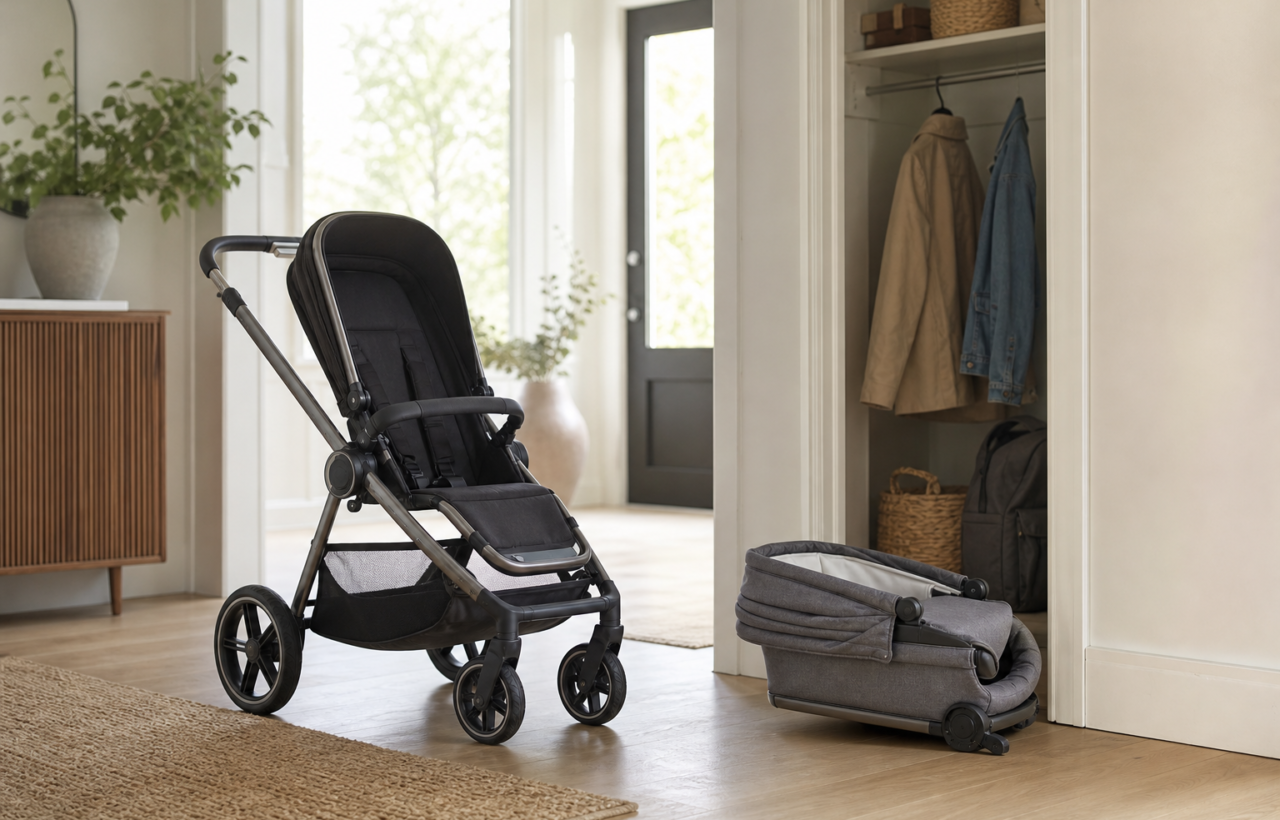
If the Balios S Lux is already on your shortlist, the cot may be the part that decides whether the system works in real life. A conventional carrycot can take up much of a car boot or hall cupboard even after the stroller chassis has been folded. The CYBEX Fold Cot is a new addition to the award-winning Balios S Lux travel system, with folding as its practical point of difference.
But the word “fold” is not a complete specification. Before buying, you still need to establish how small the cot becomes, what has to be removed, whether it fits your exact Balios S Lux chassis, and whether its permitted uses match your plans. Those details determine whether it solves a daily problem or simply adds another mechanism to manage.
Key takeaways
- A folding cot can reduce storage volume, but it does not reduce the cot’s weight or the size of the stroller while the cot is in use.
- Confirm compatibility with your exact Balios S Lux version and check what is included in the box. A matching product name or photograph is not enough.
- Get the folded dimensions, weight, folding sequence, and list of removable parts before deciding whether it will fit your car or home.
- A stroller cot is not automatically approved as an overnight bassinet, household travel cot, or vehicle restraint. Use it only for purposes expressly permitted by its manual.
- Try the complete fold, pack, lift, unpack, and reassembly sequence yourself. The useful test is the whole routine, not a quick shop-floor demonstration.
Start with the space you actually need to reclaim
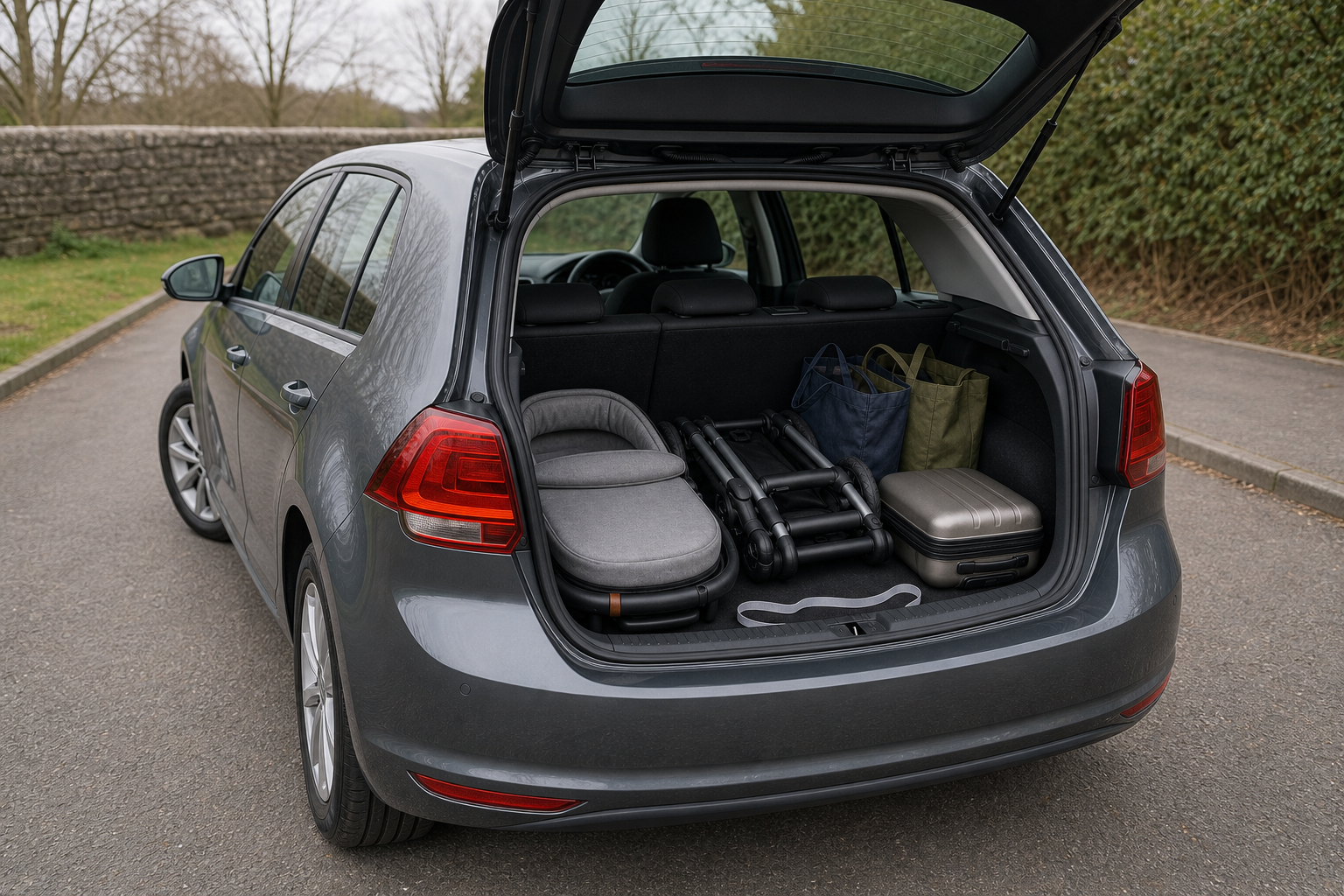
A foldable cot is most valuable when storage volume is your constraint. It may make a bulky component easier to place in a boot, cupboard, apartment entryway, or luggage area. It will not necessarily help if your main problem is lifting weight, navigating a narrow corridor, reaching the stroller basket, or fitting through a doorway while the cot is attached.
Name the pinch point before looking at product measurements. Then check the complete packed arrangement against it:
- For a car boot: Measure the narrowest part of the opening as well as the usable width, depth, and height inside. Wheel arches, a sloped hatch, and items you routinely carry can make the headline boot capacity irrelevant.
- For home storage: Measure the shelf or cupboard opening, not just its interior. Allow enough clearance to rotate the folded cot into place and remove it without emptying everything around it.
- For stairs or public transport: Ask for the cot’s actual weight and try lifting it separately from the chassis. Folding changes shape; it does not remove mass.
- For family travel: Count every piece you will need to transport. The chassis, folded cot, approved mattress or liner, attachment parts, changing bag, and other luggage still have to fit together.
Obtain the Fold Cot’s official folded dimensions before ordering and compare each dimension with your measurements. Do not rely on words such as “compact” or on a photograph taken without scale. A cot can look flat yet remain too long or wide for the space you have.
Also compare the complete system rather than the cot in isolation. Ask whether the cot must be removed before the chassis folds, whether any approved insert or textile has to come out, and where those loose pieces go. Saving space on the cot is less useful if the folding sequence creates several awkward parts that still need their own storage.
Confirm the exact configuration before paying
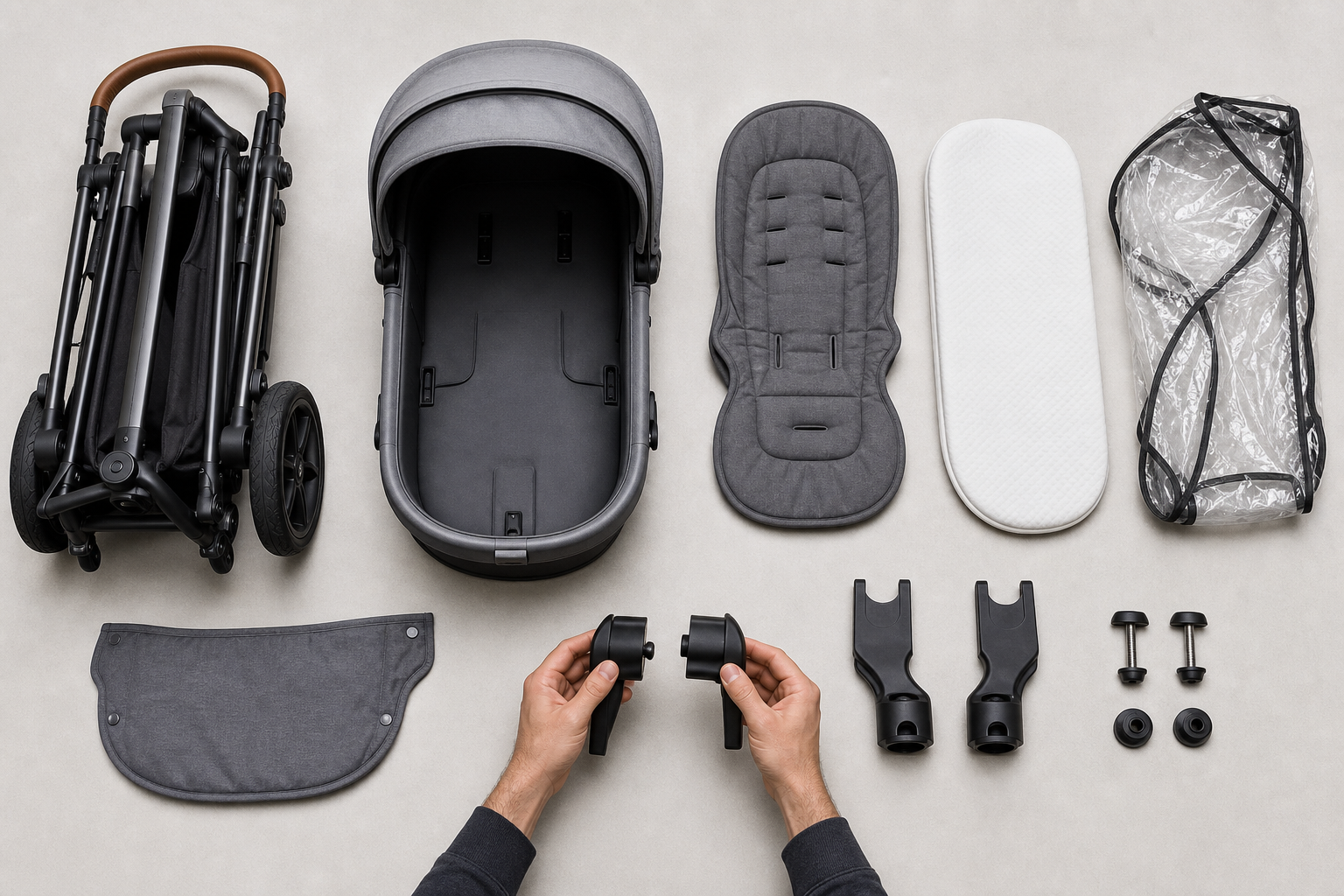
Travel-system listings often place the chassis, seat, cot, accessories, and bundles on closely related pages. Make the retailer identify exactly what you are buying. Keep the answer in writing until the order arrives and you have checked the labels and contents.
- What is the Fold Cot’s full product name and stock or product code?
- Which Balios S Lux chassis versions is that code compatible with?
- Is the listing for the Fold Cot alone, or is it part of a stroller bundle?
- Which mattress, liner, attachment pieces, or adapters are included?
- Are any additional parts required to attach it to the chassis?
- Can it be folded while attached, or must it be detached first?
- Must the mattress, base, or textiles be removed before folding?
- What are its folded and unfolded dimensions and its weight?
- How do you verify that it is fully open and locked before placing a baby inside?
- What return conditions apply if the cot is incompatible or does not fit your measured space?
Compatibility deserves particular care if you already own the stroller. “Balios S Lux” in a listing title does not, by itself, establish compatibility across every production version or regional package. Match the product code and chassis identification using the manufacturer’s documentation or a written confirmation from an authorised retailer.
If you are considering a used Fold Cot, ask for a clear photograph of its identification label and a video showing it being opened, locked, released, and folded. Check that all original structural and attachment parts are present. Faded fabric is a cosmetic issue; damage, looseness, deformation, or uncertain locking at a hinge or attachment point is a reason not to use the cot.
Keep stroller use, sleep use, and car travel separate
The word “cot” can hide an important distinction. A stroller carrycot, an overnight bassinet, a household travel cot, and a vehicle restraint are different product uses. Permission for one does not automatically establish permission for the others.
Before the first outing, read the manual supplied for the exact Fold Cot and confirm:
- The permitted age, weight, and developmental limits, including the condition that requires you to stop using the cot first.
- Whether the product is approved for overnight or otherwise unsupervised sleep. If the manual does not expressly permit that use, do not treat it as a replacement for an approved sleep space.
- Which mattress, liner, cover, and other parts are approved for use inside it.
- Whether every approved internal component stays in place when the cot is folded.
- The exact visual or mechanical signs that show the cot is completely unfolded, attached, and locked.
- Any restrictions on carrying the cot by hand when a baby is inside.
Do not add a pillow, wedge, topper, sleep positioner, or improvised padding to change the baby’s position or make the cot feel softer. Added soft items can create hazards and can interfere with the fit intended by the manufacturer. If your baby has a medical positioning or breathing concern, ask the appropriate health professional rather than modifying the cot.
Do not use a stroller cot as a restraint in a moving vehicle unless that exact product is explicitly certified for that purpose and installed exactly as directed. A folding mechanism, carry handle, or travel-system label is not vehicle approval. Use a child restraint that is approved for your child’s stage and for use in your jurisdiction.
Make the lock check part of every setup. Open the cot on a stable surface, follow the prescribed sequence, confirm each locking point, and inspect the base before placing your baby inside. Never attempt to fold or partially collapse it with a child in it.
Test the whole routine, not just the folding feature

A polished demonstration can make any mechanism look effortless. The better test is whether you can complete the routine correctly, identify every locking point, and pack the resulting pieces into your own space without staff prompting you.
- Start with the exact cot folded and the exact compatible Balios S Lux chassis in the state in which you would take them out of your car or cupboard.
- Lay out every component needed for assembly and identify which parts are included with the cot, the stroller, or an additional purchase.
- Unfold the cot using the manual’s sequence. Find each lock or readiness indicator and verify it as directed.
- Attach the cot to the chassis, then remove it again. Check whether you can reach both release points comfortably and whether removal requires a second person.
- Fold the cot yourself. Note what must be removed, where each loose part will be stored, and whether the folded cot remains securely closed while being carried.
- Fold the chassis and arrange all the pieces within your measured car or home space. If possible, test your own boot rather than estimating from a showroom floor.
- Repeat the full setup without coaching. If a step is easy to miss, decide how you will check it every time before your baby goes into the cot.
If you cannot test the product in person, ask the retailer to confirm the same points in writing and request the official manual before purchase. Use the stated dimensions to recreate the required space with a tape measure. Remember that a rectangular measurement describes size, not ease of lifting, gripping, or turning the item into position.
The Fold Cot is ready for your shortlist when its compatibility is documented, the complete packed system fits your measured space, the setup is manageable, and the manual permits every use you have planned. If any of those points remains unknown, pause the purchase and ask: “Please confirm the Fold Cot product code, compatible Balios S Lux versions, folded dimensions, weight, required removable parts, included attachment parts, and whether it is approved for overnight sleep.” The answer should give you something concrete to check when the order arrives.