
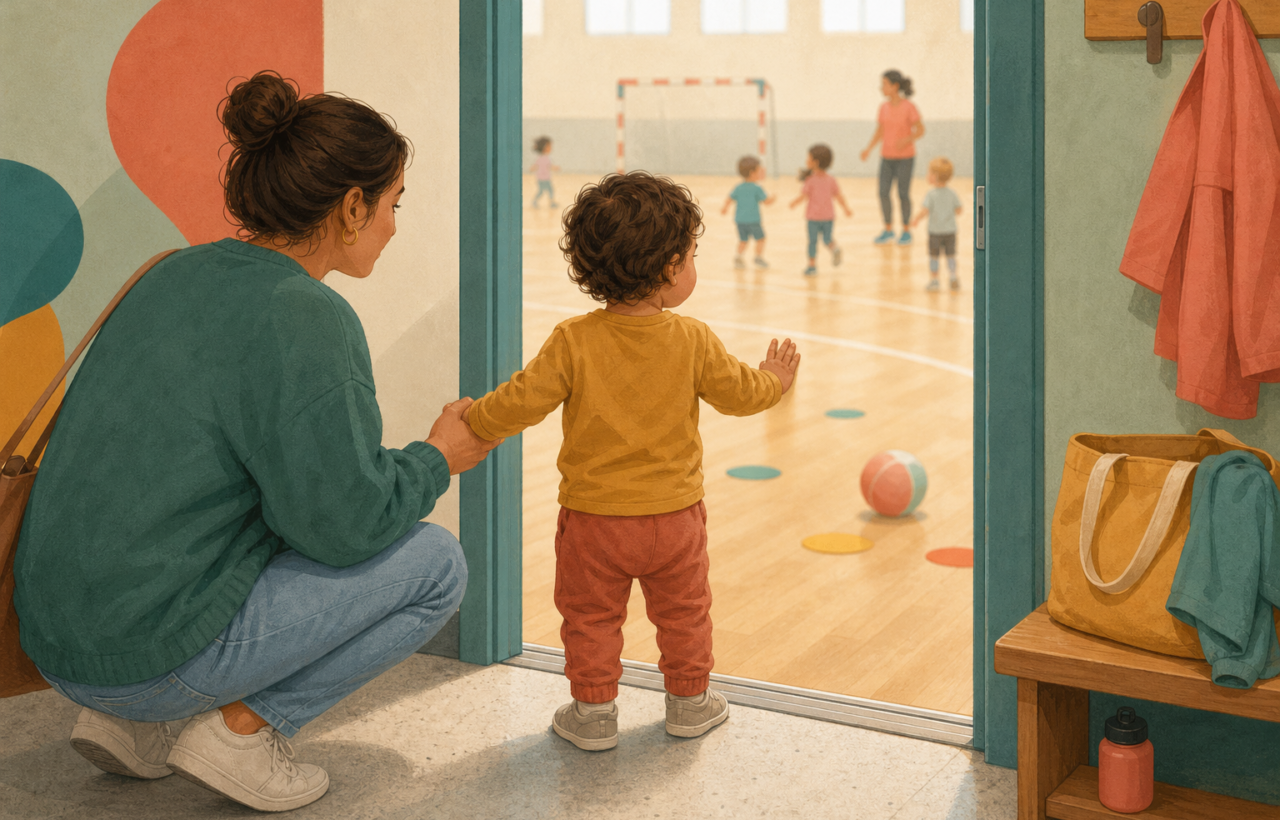
The class bag is packed, the fee is paid, and your child suddenly refuses to go through the door. If your child is under 3, they may not say, ‘I want to quit.’ Quitting may look like clinging, crying, running away, going silent, or resisting every step of the routine.
You do not have to choose between giving in immediately and forcing them through the session. First work out whether you are seeing a difficult transition, a fixable problem, a poor match, or something unsafe. Then make the smallest decision that fits the actual problem.
Find the problem hiding inside ‘I quit’

A child who seems to quit every sport is giving you information, not showing you a fixed character trait. Calling them a quitter turns several possible problems into one moral judgment. It also makes it harder to notice the detail that could make the activity work.
For a baby or toddler, resistance can begin long before the sport itself. The hard part might be changing clothes, leaving home, entering a loud room, separating from you, waiting for a turn, following a group instruction, being touched without warning, or attempting a movement that feels unfamiliar. Hunger, fatigue, illness, and an inconvenient class time can make all of those demands harder.
Observe the whole sequence rather than judging the loudest moment:
- Before leaving: Was your child rested, fed, comfortable, and well? Did resistance begin when you mentioned the class or only when it was time to transition?
- At the venue: Did their reaction change at the entrance, in the changing area, when they saw the instructor, or when the room became busy?
- During the session: Did they struggle with waiting, noise, separation, a particular movement, physical contact, or not being able to do something immediately?
- Afterward: Did they recover quickly? Did they talk about or reenact any enjoyable part at home? Did they remain unusually upset?
The timing can reveal the difference between transition trouble and a bad fit. A toddler who protests at the doorway but becomes curious after watching from your lap may need a slower entry. A child who stays distressed throughout the class, recoils from a particular person, or stops enjoying a movement they normally love needs a different response.
If your child can answer simple questions, make each question small enough to answer. Try: Is the hard part going there or being there? Is something scary, uncomfortable, or painful? Do you want me closer? Would watching first help? Avoid asking why they ‘always’ quit. A young child may not know why, and the accusation invites a defence rather than useful information.
Ask the instructor equally specific questions. What happens immediately before the child becomes upset? Is the reaction tied to one exercise, transition, person, or part of the room? Can the instructor offer more demonstration time, fewer verbal directions, a predictable routine, or permission to watch before joining?
Do not test persistence when safety may be involved. Stop the session and investigate if there is pain, a possible injury, breathing difficulty, frightening or degrading treatment, forceful handling, bullying, or inadequate supervision. Seek appropriate medical help for a health or injury concern. Raise conduct and supervision concerns with the program, and do not send your child back into an environment you do not trust while the concern is unresolved.
Choose deliberately between a pause, a retry, and stopping

You do not need to settle the child’s entire sporting future at the classroom door. Decide only what happens today and what information you need before the next session. These are three different decisions:
- Pause when your child is having an unusually hard day or you do not yet understand the reaction. Watching from the side, leaving early, or going home can prevent one overwhelmed moment from becoming a battle about the whole activity. A pause is not a promise that the class is over forever.
- Retry when the environment appears safe and there is one identifiable obstacle you can change. Move the class away from nap time, let your child enter slowly, stay within sight, ask the instructor to demonstrate before touching, or set a smaller participation goal.
- Stop or change programs when distress is consistent, the activity is developmentally mismatched, the instructor cannot accommodate a reasonable need, trust has been broken, or the schedule and cost no longer work for your family. Ending one program does not mean ending movement.
A useful retry changes one thing. Repeating the same experience while telling a child to try harder does not tell you whether the problem is solvable. If you adjust the entry routine and your child settles, you have learned something. If the same distress continues, you also have clearer evidence for stopping.
Set the review point before you return. It can be after the next session or after one clearly defined attempt. The purpose is not to trap the child into continuing. It is to prevent a fresh argument at every transition and give the planned adjustment a fair test.
Offer choices that you can genuinely accept:
- For a pause: We do not have to decide at the door. We can watch for a little while, and then we will decide whether to join or go home.
- For a retry: You do not have to do every part. Today you can stay beside me for the warm-up and choose whether to join the ball activity.
- For stopping: This class is not working for you. We are going to stop respectfully. We can still kick a ball, swim, dance, or climb in a different way.
Do not negotiate while your child is overwhelmed. Help them leave or settle first. Talk later, after basic needs have been met and both of you can process what happened. Calm timing will not guarantee a clear explanation, especially from a toddler, but it makes one more likely.
Teach follow-through without turning sport into a battle

Persistence means staying with a manageable difficulty long enough to learn or improve. It does not mean remaining in every activity regardless of fit, distress, or safety. A child who is supported through the frustration of missing a ball is practising persistence. A child who is forced into a setting that repeatedly overwhelms them may only be learning that their signals do not matter.
Age matters. A school-aged child may understand that joining a team creates responsibilities to teammates. A toddler cannot understand a season-long commitment in the same way. For a child under 3, a fair attempt might mean entering the room, watching the group, trying one part, or returning after you make a useful adjustment. It does not have to mean completing every class in a package an adult purchased.
You can still close the experience responsibly:
- Tell the provider clearly. Ask about withdrawal, credit, transfer, and make-up policies. The parent, not the toddler, should handle the administrative conversation.
- Return anything that belongs to the program. Borrowed gear, uniforms, or equipment should go back promptly.
- Name what you learned without blaming the child. You might say, The large group was hard, but you liked kicking the ball with one other person.
- Keep the useful part. If your child disliked the class but enjoyed the movement, recreate that movement through free play before buying another program.
The fee you already paid can make quitting feel like waste. But the money is an adult purchasing decision, not a moral debt the child must repay with attendance. Use the expense to improve the next buying decision: choose a trial, read the cancellation policy, delay buying specialized equipment, or select a shorter and more flexible format.
Avoid replacing one class immediately with another just to prove your child can finish something. First test the activity informally. Roll or kick a ball together, play in the water, dance at home, visit a playground, or watch a class. Your child may like the movement but not the structured version of it.
Make the next activity easier to enter and easier to leave

For babies and toddlers, organized sport is optional. Safe, enjoyable movement can happen through floor play, crawling, walking, dancing, climbing, throwing, rolling, splashing, and following you around a park. A formal class can add routine and social contact, but it is not the only route to an active childhood.
Before the next registration, reduce both the financial risk and the emotional stakes:
- Watch a session or use a trial, drop-in, or short introductory option before committing to a longer block.
- Read the cancellation, refund, transfer, absence, and make-up policies before paying.
- Borrow, rent, or buy used equipment until your child’s interest becomes clearer.
- Visit the building in advance if unfamiliar places are difficult. Show your child where they will enter, change, watch, participate, and leave.
- Ask whether a parent can stay nearby and whether children are allowed to observe before joining.
- Ask how the instructor supports children who need extra transition time, dislike unexpected touch, communicate differently, or process group directions slowly.
- Choose between two realistic options instead of offering an open-ended catalogue. Too many choices can make the decision harder without making it more child-led.
- Protect unstructured time. A child who is already tired or rushed may reject an activity they would otherwise enjoy.
During the first phase, measure fit rather than performance. Look for moments of curiosity, voluntary participation, recovery after a difficult moment, and interest in repeating part of the movement elsewhere. Also notice whether the instructor responds to distress with patience and adaptation rather than shame.
If your child has intense difficulty across many group settings, separations, or kinds of movement, keep brief notes about what happens before, during, and after each episode. Bring those observations to your child’s health-care provider. They can help you consider whether pain, hearing or vision difficulties, motor demands, communication needs, sensory differences, or anxiety may be affecting participation. The aim is to understand the barrier, not to diagnose your child from a sports-class reaction.
Key takeaways
- ‘Quitting’ describes the outcome, not the reason. Look for the precise moment participation becomes difficult.
- For children under 3, the goal is safe and positive movement, not proof that they can honour an adult-sized commitment.
- Retry only when the setting is safe and you can change something specific. Decide in advance when you will review the result.
- Stop and investigate pain, injury concerns, frightening treatment, forceful handling, bullying, or unsafe supervision.
- Make future registrations more reversible with trials, clear cancellation policies, flexible formats, and borrowed or used gear.
- A child can stop one class without quitting movement. Keep the part they enjoyed and find a better way to offer it.
Before the next session, complete two sentences: My child begins resisting when… and Next time, I will change… If you cannot fill in the first blank yet, observe before making another long commitment. That moves the decision away from a fight about character and toward a problem you can actually solve.