

Your toddler spots money under a grocery shelf and grabs it before you have decided what to say. The most useful lesson is not that money is good or bad. It is that finding something does not automatically make it ours.
With a child from birth to age three, keep the exchange short. You handle the money and the return process while your child watches or helps in one safe, simple way. A found-money moment can become useful in-the-moment practice for parent and child, but it should not become a surprise test of your child’s character.
Start with one sentence, then show what happens next

Your first sentence can become the family script you use every time: “This is money, and it isn’t ours. We’ll see if we can find the person who lost it.”
Then move through a short, visible sequence:
- Secure the money. If it is a coin, take it from a baby or toddler immediately. Coins are small objects and can be a choking hazard, so the adult should hold them.
- Name what happened without accusing your child. Say, “You found money on the floor.” Finding it is not the same as taking it from somebody.
- State the rule. Say, “When we find something that isn’t ours, we try to return it.”
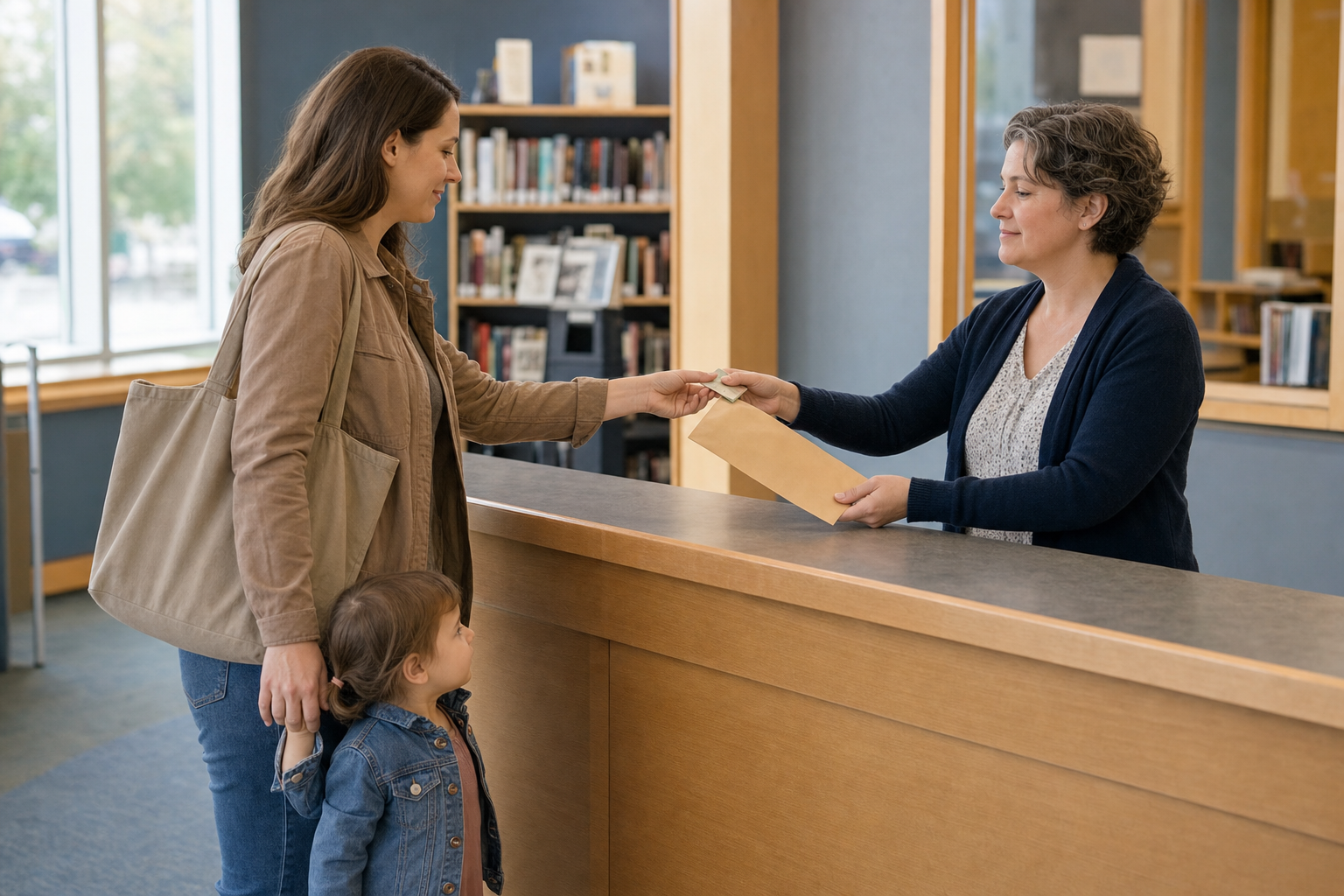
- Look for the appropriate handoff. In a business, that usually means customer service, a manager, or another employee responsible for lost property.
- Give your child a simple ending. After the handoff, say, “We gave it to the desk so the person who lost it can ask for it.”
Avoid asking, “What do you think we should do?” if keeping the money is not an option you are willing to accept. A toddler may naturally say, “Mine,” and then experience your correction as a trap. Give a limited choice instead: “Would you like to walk with me to the desk, or ride in the cart while I take it?”
If your child already put the money in a pocket, stay precise. “You picked it up because you found it. Now we need to return it.” That teaches the next step without assigning a dishonest motive your child may not have had.
Match the lesson to what your child can actually do
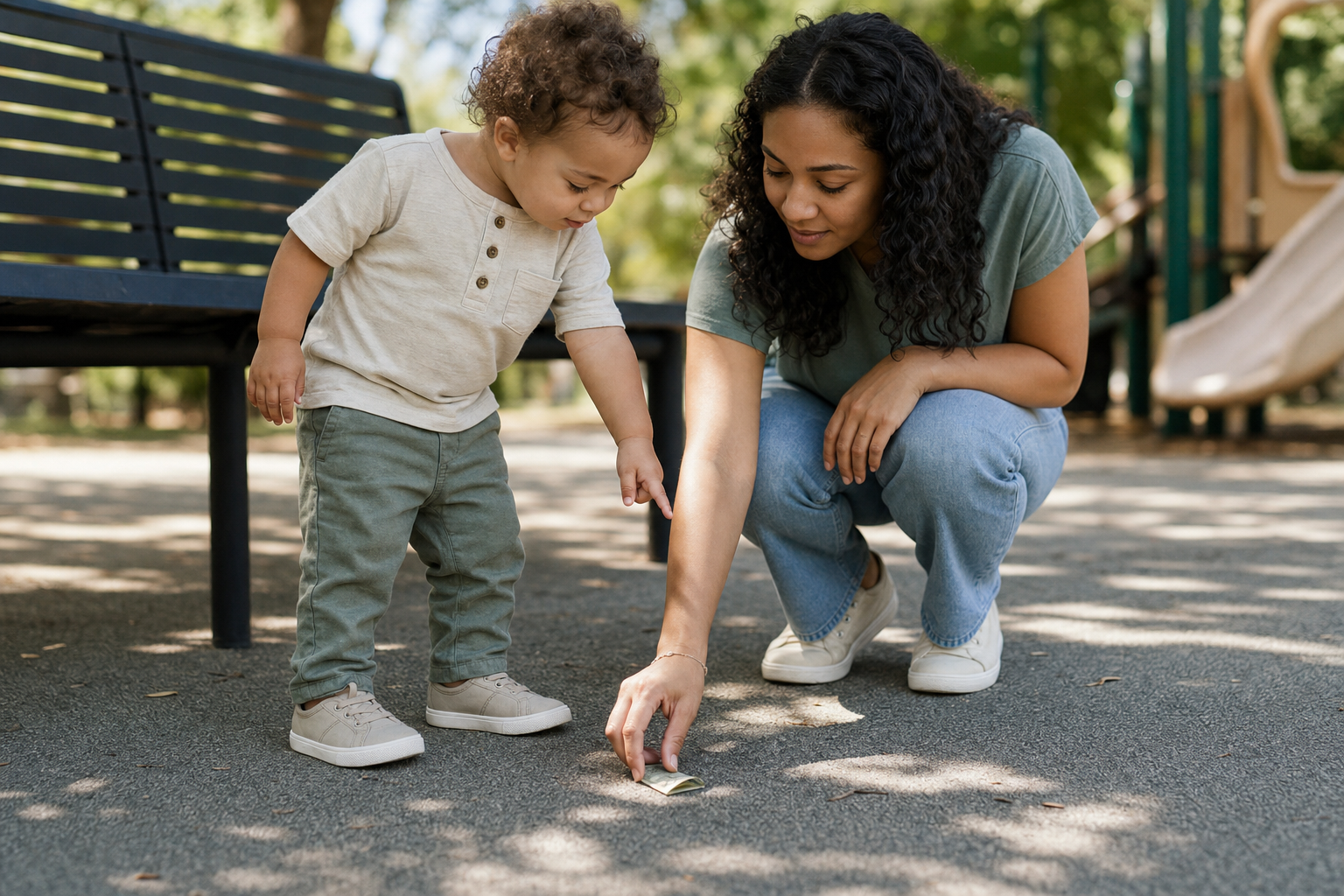
For children under three, the lesson is mostly the routine they see. You do not need a long explanation about honesty, property, or the value of money. Show the same sequence each time: stop, identify the item, find the responsible adult, and hand it over.
If your child mainly watches
Narrate only the essential actions: “We found money. We are giving it to the worker.” Your baby does not need to understand the rule for modeling it to be worthwhile. The point is to make your own response consistent.
If your toddler wants to participate
Offer one safe job. Your toddler can point to where the money was found, walk with you to the service desk, or say, “We found this.” Do not ask a young child to carry a coin, approach an unknown adult alone, or decide whether a claimant is telling the truth.
If your toddler wants to keep it
Acknowledge the disappointment without reopening the decision: “You wanted to keep the money. I understand. We still return things that aren’t ours.” You can accept the feeling and hold the boundary at the same time.
Try not to promise a reward for returning the money. A reward can shift the lesson from “we try to return other people’s things” to “we are honest when honesty pays us.” Your toddler can still feel proud of helping, but praise the action rather than attaching a prize: “You helped me take it to the desk.”
Use the handoff that fits the place
Loose cash has no name on it, so the setting matters. Choose the person or system most likely to hear from the owner:
- In a shop, restaurant, or other business: Take it to customer service, a manager, or the designated lost-property point. Say where you found it and roughly when.
- At a staffed venue or transit facility: Use its lost-property, information, or security desk rather than handing the money to an unrelated bystander.
- At a playground or in another public space: Look in the immediate area for someone who appears to be searching, but keep the money in the adult’s possession. If there is a site operator, staff member, or lost-property process, use it.
- If there is no clear custodian: Check the local lost-property procedure before deciding that the money can be kept, especially when the amount is meaningful.
- If you find a wallet, envelope, or money with identifying material: Keep everything together. Do not let your child remove cards or explore the contents. Give the intact item to the appropriate staff, security desk, or local authority.
Do not announce the exact amount and precise location to everyone nearby. Give those details to the person receiving the money. If somebody approaches you directly, an adult can ask them to describe what they lost and where they lost it before handing anything over. If there are competing claims, let staff or security handle them; your child should not be placed in the middle.
Your explanation to your child can remain simple even when the adult process is not: “The worker will keep it safe in case the owner comes back.” You do not need to narrate disagreements, policies, or uncertainty your toddler cannot resolve.
Handle uncertainty without making promises
If nobody claims the money
Returning found money and deciding what eventually happens to unclaimed money are two separate issues. Ask the business or organization how it handles lost cash and whether finders are contacted if an item remains unclaimed. Procedures differ, so do not promise your child, “We can come back and get it later.”
If the money is eventually released to your family under the applicable process, you can then make a separate parenting decision about it. For an older toddler, offer only choices that already fit your family’s approach to money, such as placing it in a savings container or setting it aside for a later purchase. The child does not need to receive the cash in order for the original lesson to count.
If the adults disagree
One parent may see a harmless windfall while another sees somebody else’s property. Do not ask your toddler to choose between those positions. Use a holding sentence in the moment: “We don’t know what will happen to the money yet. First we try to find the owner.” Discuss the unresolved part privately.
A workable family rule is: “We try to return found money. We keep it only if the responsible organization or the applicable local process clearly releases it.” Agreeing on that rule before the next discovery helps you avoid inventing an answer under pressure.
If you are tempted to test your child’s honesty
Real situations give you plenty to teach without secretly watching to see whether your child confesses, asking a question with one acceptable answer, or telling other adults about the child’s reaction while the child listens. A toddler’s first impulse to grab or keep something is not a complete verdict on their character.
Focus on the repairable next action: “You found it. Now let’s take it to the desk.” If your child resists, hold the boundary calmly and complete the return yourself. The lesson comes from seeing what your family does, not from performing the perfect response on the first try.
Key takeaways
- Use one repeatable rule: finding money does not automatically make it ours.
- For babies and toddlers, the adult should secure the money, especially coins, and manage the return.
- Give your child a safe role in the process, not responsibility for the decision.
- Use the lost-property system connected to the place where the money was found, and do not reveal every identifying detail publicly.
- Do not promise that unclaimed money will later belong to your child; ask about the applicable process first.
- Treat disappointment as a feeling you can acknowledge, not a reason to change the boundary or shame your child.
Choose your family’s one-sentence rule now and use it the next time a coin or bill appears under a seat, beside a stroller, or on a shop floor. Your child does not need a lecture. They need to see the same clear action follow the same clear words.