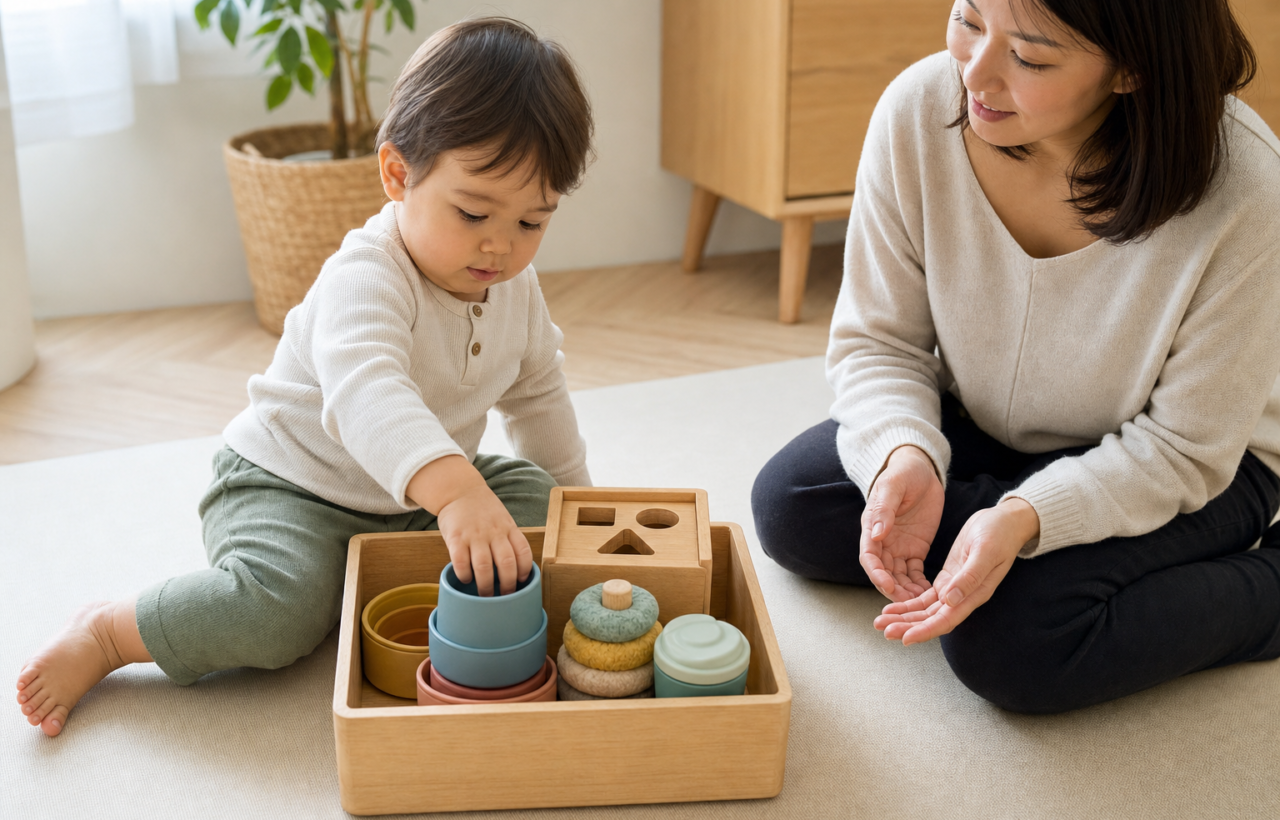
Your child does not need a tub full of clever supplies to practise using their hands. A useful fine motor activity box can be small, predictable, and made mostly from complete, age-appropriate toys you already own.
The question to ask is not how many activities you can fit inside. Ask which hand movement your child is ready to practise, which objects let them attempt it safely, and how you will know when to simplify or change the setup.
Build the box around a movement, not a shopping list
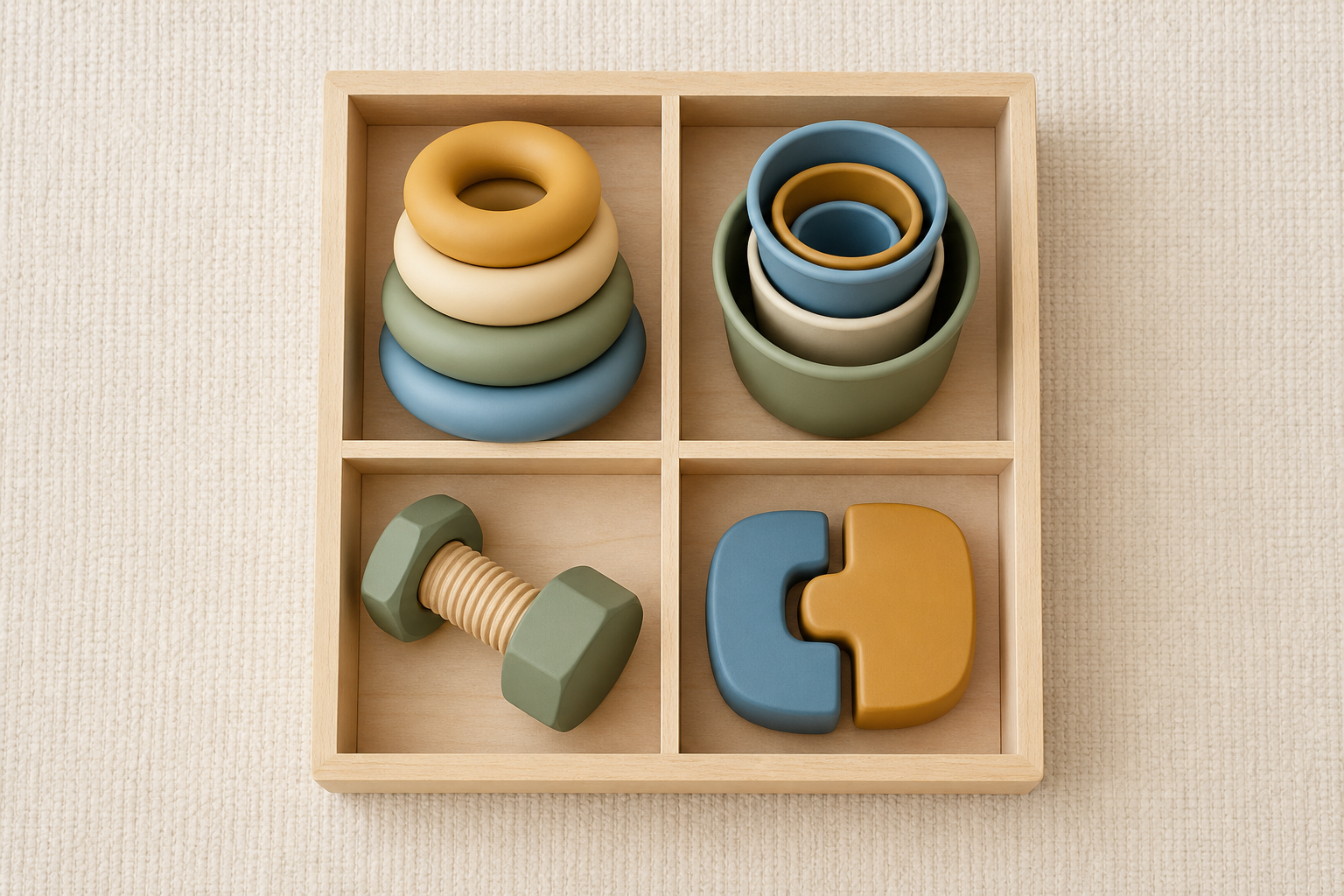
Fine motor play involves controlled movements such as grasping, releasing, turning, fitting, separating, and making marks. Vision, posture, and the use of both hands often support that work. The box simply brings together safe opportunities to repeat those actions.
Start with an action you already see. A child who repeatedly empties a cup may be ready for fill-and-dump play. A child trying to line up objects may enjoy a shape sorter. A child pulling connected pieces apart may be interested in large interlocking blocks. Following an existing interest usually gives you a clearer starting point than buying a box labelled for a broad developmental stage.
Before adding an activity, check that it passes these practical tests:
- The action is clear. Your child can grasp, release, fit, turn, join, separate, or mark with the materials.
- Every piece is suitable for the child using it. Keep complete toy sets within their stated age guidance and use them as intended.
- The setup can withstand real play. Pieces should not crack, splinter, shed, leak, or expose fasteners when pulled, dropped, or mouthed.
- You can supervise it closely. The box should come out for shared play and return to inaccessible storage afterward.
- Resetting is easy. If preparing the activity becomes a project, it is less likely to become part of ordinary family life.
The storage container is not automatically a toy. Hinges, latches, removable lids, sharp edges, and pinch points all need attention. If the container is not designed for child play, place the activity on a shallow, stable surface and move the container out of reach.
Avoid filling the box with random craft or household objects merely because they produce a satisfying pinch. Beads, buttons, coins, dry beans, loose hardware, and similar small pieces introduce hazards without being necessary for fine motor practice. A child can work on precision with a chunky puzzle handle or another purpose-designed grip while the overall toy remains appropriately sized.
Match activities to the movement your child is attempting
Development does not move in a perfectly tidy sequence. Choose from the movements below by watching what your child currently tries to do. Treat a product’s age label as a safety boundary, not a promise that the activity will be interesting or manageable for every child in that range.
- Grasp and release: Offer large, lightweight blocks or stacking cups and a wide, unbreakable container. The useful work is picking an object up, carrying it a short distance, and deliberately letting go.
- Transfer: Place a large toy piece in one unbreakable container and leave another nearby. If the distance makes the activity frustrating, bring the containers closer or hold the receiving container steady.
- Fit and post: Use a complete shape sorter, a chunky peg puzzle, or another age-rated toy with matching pieces. Avoid cutting slots into containers unless every surface and attachment is secure, smooth, and suitable for play.
- Join and separate: Large interlocking blocks, nesting cups, and stacking rings let both hands take different roles. One hand may hold the base while the other positions or removes a piece.
- Turn and open: Thick board-book pages, nesting pieces, and purpose-built turning features give the fingers something to rotate without relying on small loose parts.
- Make marks: When the product is age-appropriate and your child is no longer trying to eat it, pair a chunky washable crayon with a large sheet of paper. Remove damaged crayons before they break into smaller pieces.
If an activity is too hard, widen the target, stabilize the receiving object, shorten the reach, or remove competing pieces. Do not make it easier by completing the important movement for your child. Change the environment so they can still perform the action.
If it is too easy, resist the temptation to introduce smaller objects. Increase the challenge by changing the orientation of the target, placing it slightly farther away, or adding another safe shape to choose between. Precision can increase while every loose piece remains appropriately sized.
The most useful level sits between immediate success and impossible effort. You are looking for repeated attempts, some independent success, and enough interest to try a slightly different approach. If your child needs you to position their fingers or finish every attempt, simplify the activity.
Run the activity without taking over your child’s hands
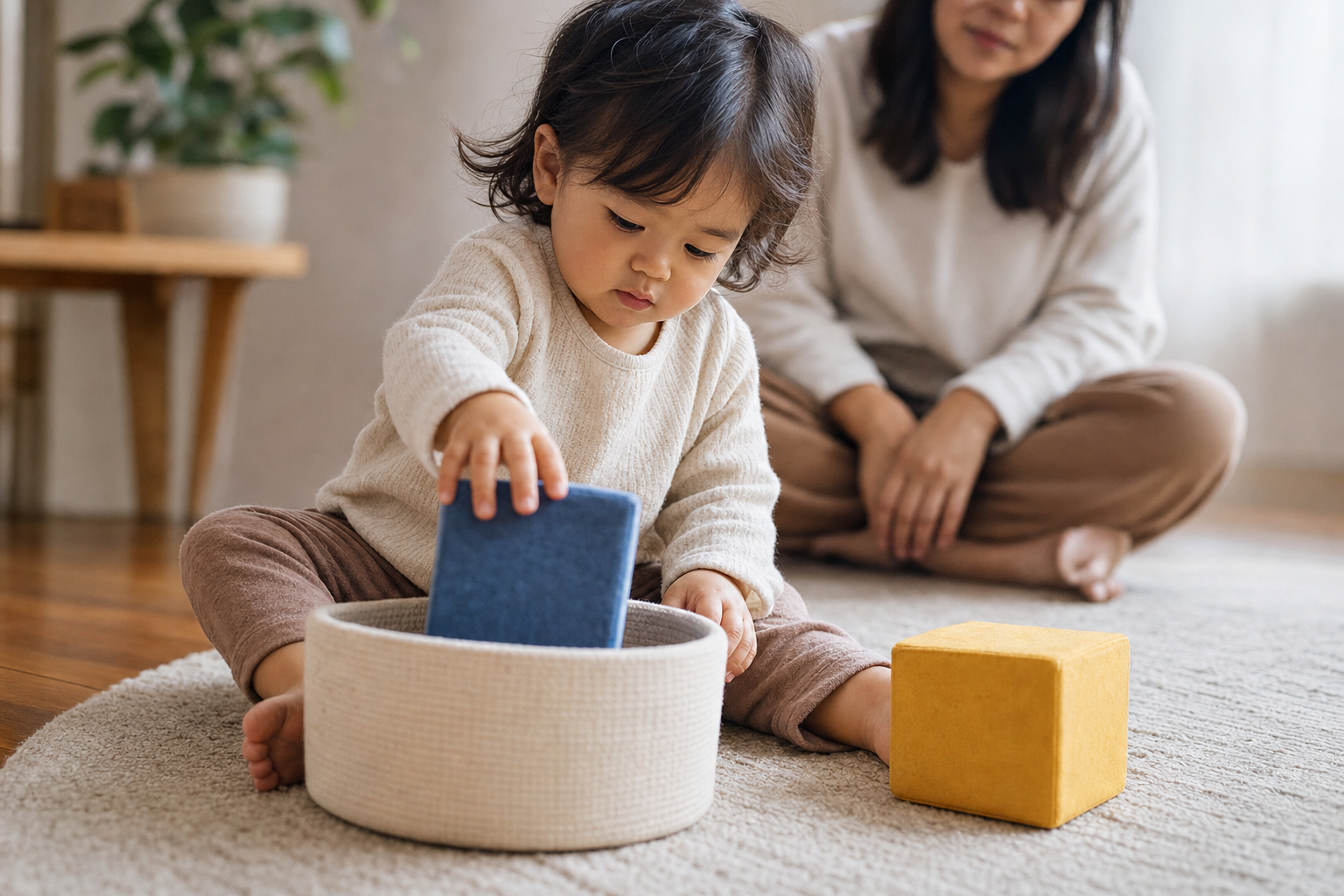
Presentation changes what your child can do with the same materials. A crowded tray can turn a simple release activity into a search task, while an unstable position can make the hands work harder just to keep the body balanced.
- Choose a safe, supported play position. Use the position in which your child normally plays comfortably and place the materials within an easy reach.
- Present a single clear setup. Put out only the pieces needed for the movement you want to observe. Keep the rest of the box closed and out of reach.
- Demonstrate briefly. Slowly perform the action and use a short phrase such as in, out, turn, or pull. Then return the pieces and pause.
- Let the attempt belong to your child. Watch before prompting. Reaching, rotating an object, changing hands, and trying the wrong opening are all useful information about how the task feels to them.
- Change only one feature when needed. Widen the opening, steady the base, reduce the distance, or remove a distracting choice. A single change helps you see what made the activity more accessible.
Hand-over-hand help can make a finished result look successful even when the task does not yet fit. Unless a qualified professional has shown you a specific technique for your child, model the movement or adjust the setup before physically directing their hands.
Stop when play becomes a struggle, materials are being used unsafely, or your child simply moves on. Fine motor practice does not need to be completed like an assignment. A brief period of willing repetition is more informative than keeping the box open after interest has gone.
An activity box is also not a developmental assessment or a treatment. If your child loses a movement they previously used, appears to be in pain, or you are concerned about how one side of their body is moving, speak with their healthcare professional rather than trying to correct it through more practice.
Make safety part of setup, play, and storage
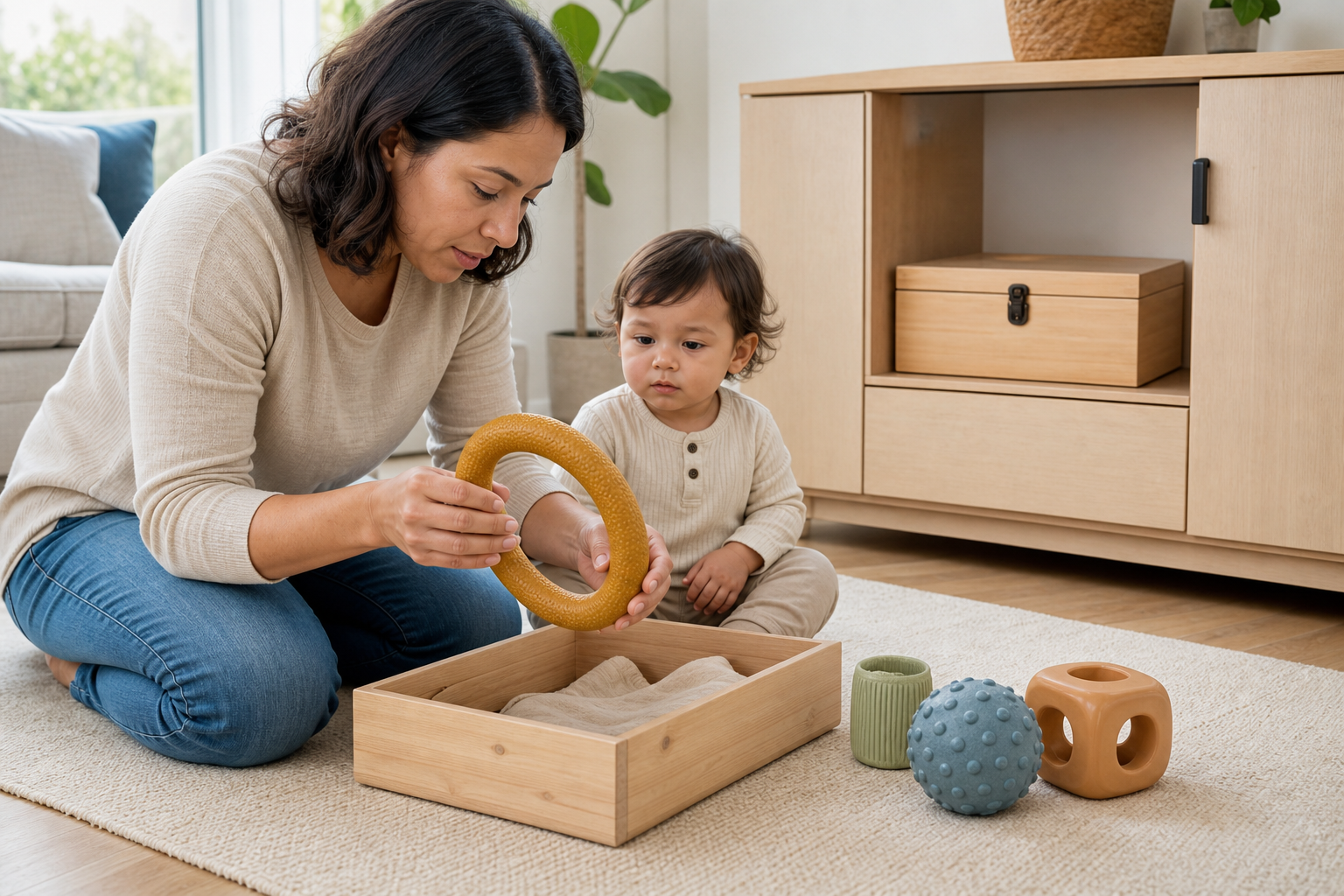
Supervision matters, but supervision does not turn an unsuitable object into a safe one. Start with materials designed for your child’s age, inspect them before play, and assume that anything within reach may be mouthed, dropped, pulled apart, or thrown.
Inspect the whole setup before it comes out
- Check every piece for cracks, loose parts, exposed filling, splinters, peeling surfaces, and weakened seams.
- Keep loose magnets and button batteries out of the box. If a manufactured toy uses batteries, its compartment must remain secured exactly as designed.
- Leave water beads, pins, coins, beads, buttons, and other tiny craft or household pieces out of baby and toddler activity boxes.
- Remove cords, ribbons, handles, or straps that could become wrapped around the neck or caught on furniture.
- If you are uncertain whether an object presents a choking hazard, do not improvise a home test. Remove it and choose a clearly age-rated alternative.
- Follow the toy maker’s cleaning instructions. Discard damaged pieces rather than relying on tape or glue where a child may mouth them.
Stay close enough to intervene
Use the box when an attentive adult can see and reach the child. If you need to cook, answer the door, care for another child, or leave the room, put the materials away first. A zipper, snap, or lidded container should not be treated as child-resistant storage.
After play, account for the pieces, clean anything that needs cleaning, inspect objects that were mouthed, and store the entire kit beyond the child’s reach. Rotate an activity when your child consistently ignores it, has clearly mastered its main action, or is trying to use it in a way the design cannot safely support. You do not need a fixed rotation schedule.
A portable activity box can be useful for holidays, family visits, and long waits, but portability should not loosen the safety rules. Pack complete sets in a securely closed bag, check the play area for escaped pieces, and use the activities only when an adult can supervise. Loose activity pieces are not a suitable distraction for a child in a moving vehicle when the supervising adult must focus on driving.
Key takeaways
- Choose the box’s contents by the movement your child is already attempting, not by the length of a supply list.
- Use complete, age-appropriate toys and keep small craft materials, loose magnets, button batteries, and water beads out.
- Present a clear activity in a stable play position, demonstrate briefly, and give your child room to attempt it independently.
- Make a task easier by widening or stabilizing the target. Make it harder by changing placement or choice, not by shrinking the pieces.
- Inspect before every use, supervise within reach, and return the entire box to inaccessible storage when play ends.
Your next box can start with one complete, age-rated toy set already in your home. Put out the pieces needed for a single movement, watch what your child tries without correcting them, and let that observation determine the next activity you offer.