

You open your baby’s diaper and see an orange-red mark. It looks enough like blood to stop you in your tracks, but blood is not the only possible explanation.
Urate crystals can leave this kind of stain, and they are usually not a cause for concern. You still should not diagnose the mark from its colour alone. Check how your baby is feeding, urinating, and acting, then use the steps below to decide whether to monitor the next diaper or contact a healthcare professional.
Why an orange-red mark is not automatically blood
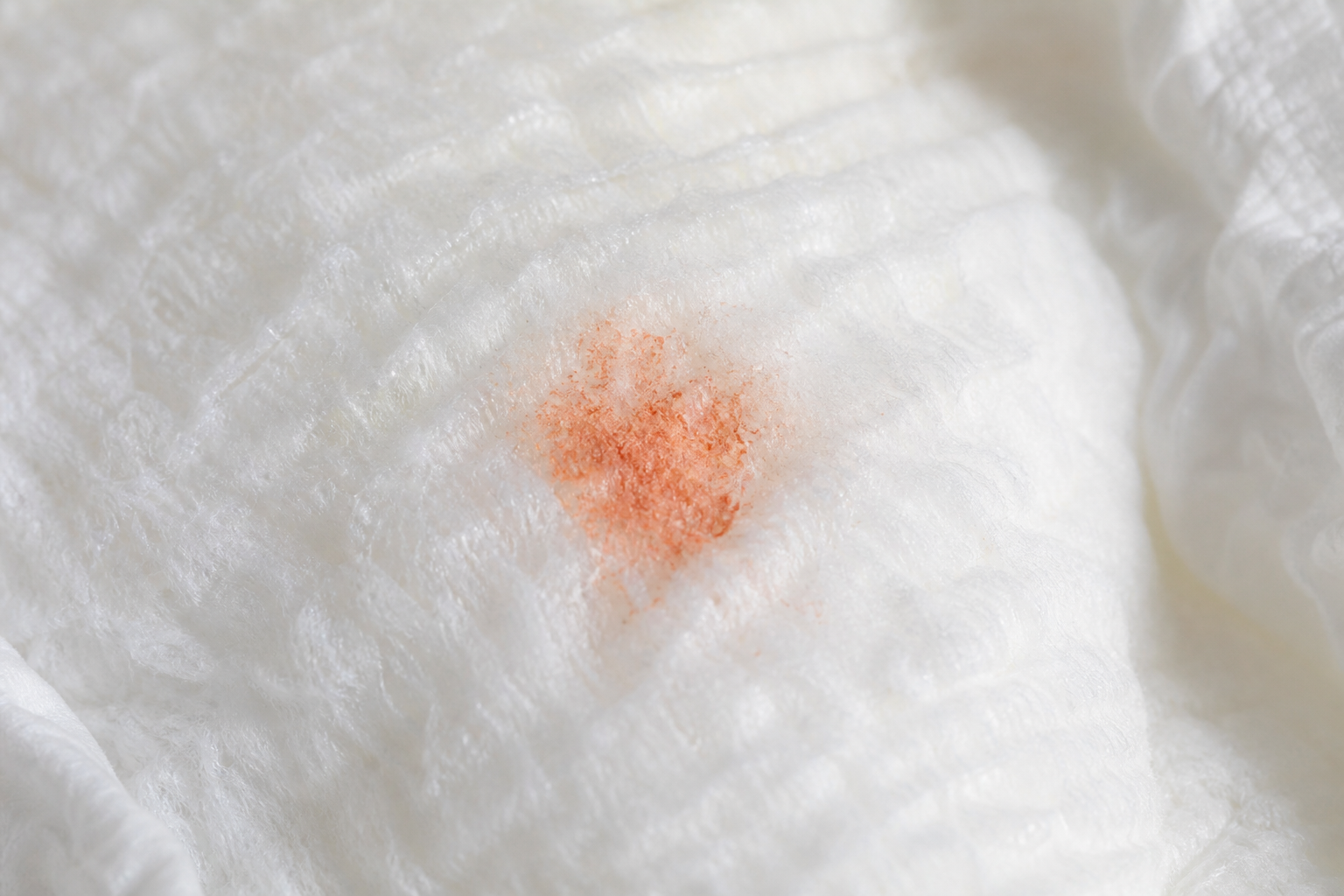
Urates are salts associated with uric acid, a normal waste product in urine. When urine is concentrated, these salts can form visible crystals and leave a rusty orange, pinkish, or red deposit in an absorbent diaper. The appearance is sometimes described as brick dust.
That colour overlap is the source of the confusion: urate crystals can produce orange or red diaper spots that resemble blood but are usually not concerning. Colour alone cannot confirm which one you are seeing, especially after liquid has spread through the diaper’s absorbent material.
A suspected urate stain is more reassuring when it is small and your baby otherwise seems comfortable, feeds normally, and is producing the expected pattern of wet diapers. Repeated staining accompanied by less urine, poor feeding, unusual sleepiness, fever, vomiting, apparent pain, or visible bleeding needs a call to your baby’s healthcare team.
Key takeaways for the next diaper
- An orange-red diaper stain is not proof of bleeding. Urate crystals are one possible explanation.
- Look at your baby as well as the diaper: feeding, wet-diaper pattern, alertness, comfort, and other symptoms provide important context.
- Take a clear photograph before discarding the diaper. A picture is more useful than trying to remember the exact colour later.
- Contact a healthcare professional if the marks continue, urine output decreases, feeding changes, your baby seems unwell, or you cannot tell whether the stain is blood.
- Do not give a young baby extra water in an attempt to dilute the urine unless a qualified healthcare professional specifically instructs you to do so.
Check the baby and the pattern, not just the stain

A diaper cannot function as a home diagnostic test. Instead of repeatedly comparing shades of red, collect the details that can help a clinician assess the situation.
- Look before you wipe. Notice where the mark sits in the diaper, whether it is mixed with urine or stool, and whether it appears to have come from the skin. Do not probe or irritate the genital or rectal area.
- Clean the area gently. Check for an obvious scratch, rash, or irritated skin that could have produced a small amount of blood. The absence of a visible skin injury does not prove that the stain is a urate deposit.
- Photograph the diaper in neutral light. Take one picture of the whole diaper and one closer image of the mark. Bright bathroom lighting and phone filters can distort orange and red tones, so avoid editing the image.
- Note the timing. Record when you found the stain, when your baby last fed, and whether the diaper was as wet as usual. If another mark appears, record that diaper too.
- Compare with your baby’s normal pattern. Do not rely on a generic diaper number when you have not been given one for your baby’s age and feeding situation. Notice whether wet diapers have become less frequent or noticeably lighter than your baby’s recent pattern.
- Check the whole baby. Pay attention to feeding, wakefulness, comfort, temperature, vomiting, diarrhea, and any signs of pain during urination. These observations matter more than the stain’s exact shade.
If you are calling immediately, ask whether the care team wants you to keep the diaper. Otherwise, a well-lit photograph and written notes are generally easier and cleaner to share.
When to contact your baby’s healthcare team
Urate crystals are often harmless, but the same-looking mark can have another cause. Contact your baby’s doctor, nurse practitioner, midwife, or other qualified clinician promptly if any of the following applies:
- The orange, pink, or red marks keep appearing or become larger.
- Your baby has fewer or less-wet diapers than is normal for them.
- Your baby is feeding poorly, repeatedly refusing feeds, or having difficulty staying awake to feed.
- Your baby has a fever, vomiting, diarrhea, unusual sleepiness, marked irritability, or seems generally unwell.
- Your baby appears uncomfortable or cries while urinating.
- You see red fluid coming directly from the genital or rectal area, blood in the stool, or ongoing bleeding from the skin.
- Your baby has a medical condition, was born prematurely, or already has a feeding or hydration plan and the diaper pattern has changed.
- You simply cannot tell whether the mark is a urate stain or blood.
Seek urgent medical help if your baby is difficult to wake, has trouble breathing, seems seriously ill, or has active or substantial bleeding. For a fever in a very young baby, follow the urgent instructions provided by your maternity or pediatric care team rather than waiting to see what the next diaper looks like.
Trust a change in your baby’s condition over reassurance based on the diaper’s colour. A stain that might be harmless does not explain away poor feeding, reduced urination, fever, or lethargy.
What to do now, and what to tell the clinician

While your baby appears well and you are monitoring or waiting for guidance, continue their usual breast milk or formula feeds according to the plan you have been given. Do not force a feed, change formula concentration, or offer water, juice, electrolyte drinks, or home remedies without professional direction. Young babies have specific fluid needs, and changing a feed can create a separate safety problem.
When you contact the care team, a short factual description will help them triage the concern. You can say: “My baby is [age]. I found an orange-red mark in [one or more] diapers beginning at [time]. Feeding is [normal or changed], wet diapers are [normal or changed], and my baby is [acting normally or showing these symptoms]. I have a photograph.”
Include any recent feeding difficulty, vomiting, diarrhea, fever, unusual behaviour, or change in urine output. Mention whether the stain appeared with urine, stool, or an irritated area of skin. Avoid declaring that it is definitely blood or definitely urate crystals; describing what you observed gives the clinician better information.
For the next diaper, take a photo, note whether it is normally wet, and look at how your baby is doing. If the mark returns or anything about feeding, urine output, or behaviour concerns you, make the call rather than waiting for the colour to become easier to interpret.
References