When you are already cleaning around a toddler, inviting them to help can sound like a plan that creates more work. At first, it often does. The way to make it worthwhile is to choose a job that is small enough for your child to finish, safe enough for you to step back, and predictable enough to become part of the day.
For a two- or three-year-old, a chore is not a miniature version of an adult task. It is one visible action with a clear ending: clothes land in the hamper, the cup reaches the counter, or the blocks go back in their bin. That is enough to begin building a useful family habit.
Start with chores your toddler can actually finish
If your child is younger than the two-to-three range covered here, treat imitation as participation rather than a standing responsibility. They can watch, hand you a safe object, or briefly join what you are doing while you remain responsible for finishing.
For children ages two and three, the most workable jobs are simple tasks connected to something that just happened. These are practical starting points:
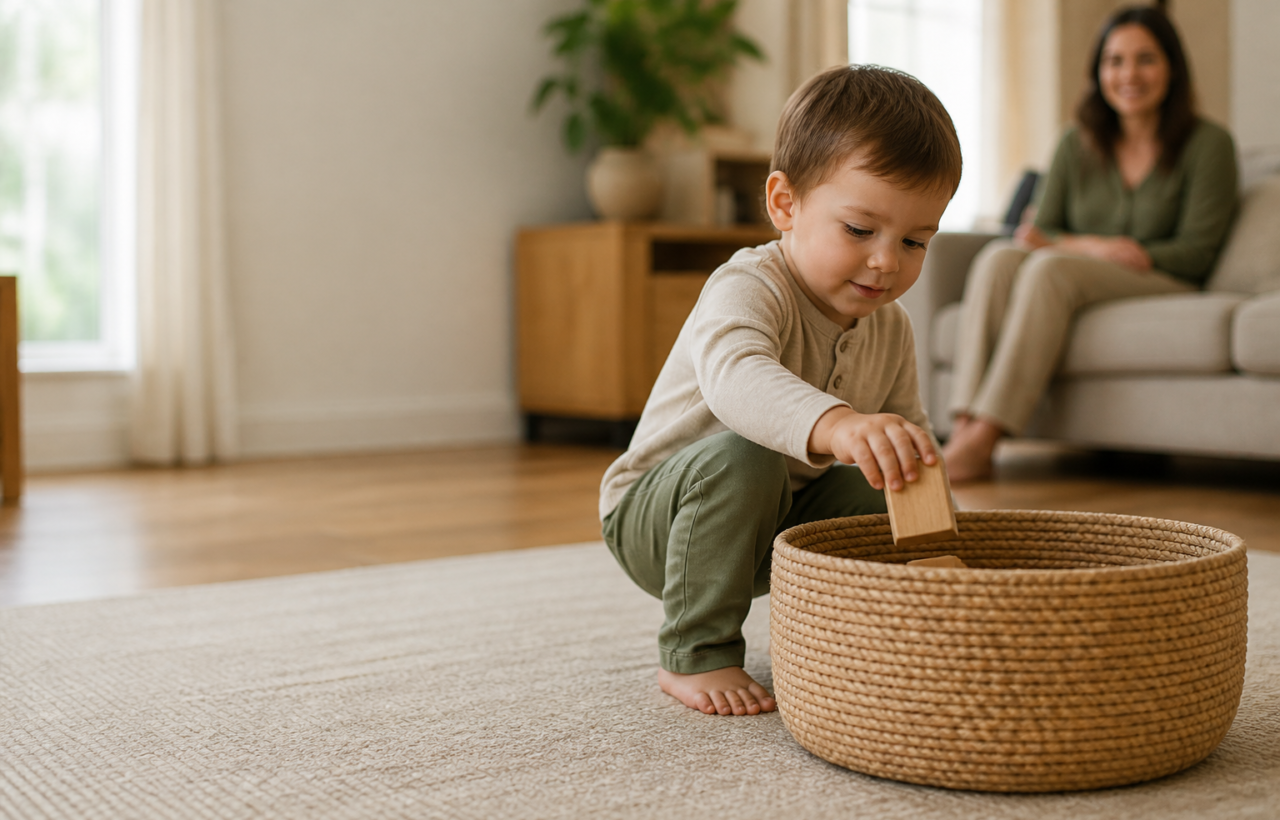
- Put away toys before starting something else. Name one category and one destination, such as blocks in the basket, instead of asking your toddler to clean the whole room.
- Clear their place after a meal. Let them carry a plastic plate, child-safe cutlery, or an unbreakable cup to a stable counter or other designated drop spot.
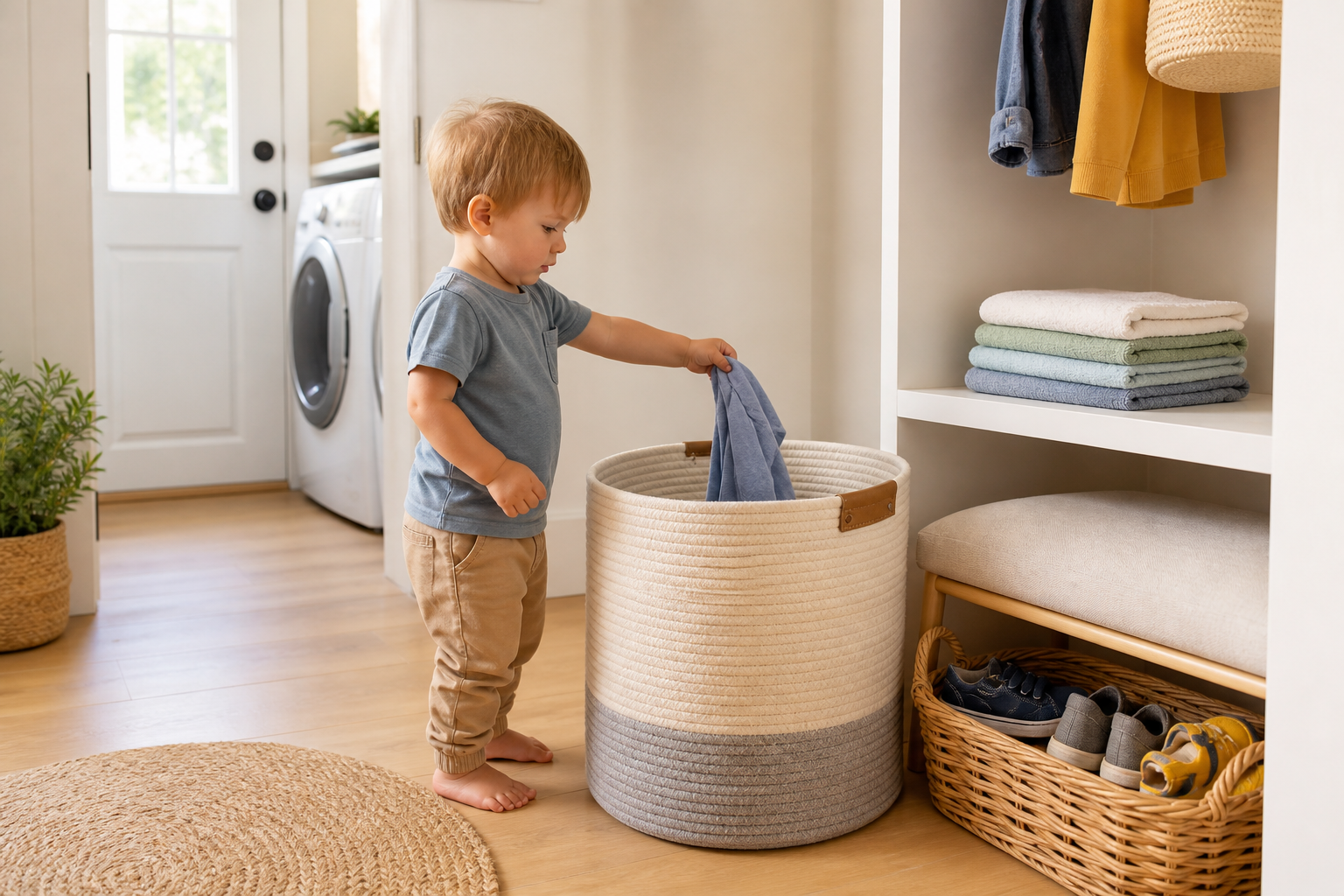
- Put dirty clothes in the hamper. Place the hamper where your child can reach it without climbing, then connect the job to changing clothes.
- Wipe a small spill. Hand over a damp cloth for an ordinary water or food spill and show exactly which area needs wiping.
- Fetch or return one familiar item. Ask your toddler to bring a towel, place a book on a low shelf, or carry another safe object to a named destination.
The wording matters. Clean up is broad and has no obvious finish. Put the cars in this bin tells your toddler what to move, where it goes, and when the task is done. If you cannot describe the finish in one short sentence, the chore probably needs to be made smaller.
Make the setup do most of the teaching
A toddler can only do a job independently when the room is arranged for toddler-sized participation. Before assigning a chore, check the setup:
- The destination is visible and consistent. Toys always return to the same open bin, and dirty clothes always go to the same hamper.
- Your child can reach everything without climbing, stretching over a hot surface, or opening an adult storage area.
- The objects are light, unbreakable, and safe to handle.
- The task has one main action. If it requires sorting, carrying, opening, pouring, and wiping, separate those actions and give your child only the manageable part.
- An imperfect result is acceptable. A toddler who gets every block into the basket has completed the job even if the blocks are not arranged neatly.
Keep household cleaners, sharp tools, hot items, breakable dishes, heavy bins, and unsuitable appliances in adult hands. A damp cloth for a small, ordinary spill is different from cleaning an unknown substance, broken item, pet mess, or anything that could be harmful. Move your child away from those hazards and handle them yourself.
Appliances also require a stage-appropriate decision. A lightweight handheld vacuum appears among chores for children ages four and five, not as a necessary starter job for a two-year-old. For a younger toddler, picking up a visible crumb or bringing you the cloth provides the same sense of contribution without adding equipment.
Adapt the task to your particular home. If carrying a plate would take your toddler near a stove, knives, stairs, or breakable dishes, create a safe drop spot closer to the table. The chore is clearing their place, not reaching the sink at any cost.
Teach the movement, then reduce your help

Knowing the words does not mean a toddler knows the sequence. Putting toys away requires finding the right object, carrying it, releasing it into the bin, and repeating the action. Teach the physical process before expecting your child to respond to a reminder.
- Show the exact action. Pick up one block, place it in the basket, and use a short cue such as, "Blocks go in the basket."
- Do the task together. You can gather the blocks while your child performs the final action of dropping them into the basket.
- Hand over one complete, manageable part. Ask your child to put away the remaining blocks while you stay nearby.
- Step back once the skill is familiar. Give the cue, allow time for your child to act, and help only when the task is genuinely stuck or unsafe.
If you repeatedly have to redo the entire job, treat that as information about the task rather than a character flaw in your child. The destination may be unclear, the objects may be awkward to carry, or the job may contain too many steps. Shrink it until your toddler has a part they can own.
Correct what affects safety or whether the item reached its destination. Let go of adult standards that do not matter yet. A shirt does not need to lie flat inside the hamper, and toys do not need to face the same direction. Taking over to improve an acceptable result teaches your child that the task was never really theirs.
A simple acknowledgment is enough: "The cup is on the counter. You cleared your place." It names what your child accomplished without turning an ordinary household responsibility into a performance.
Attach each chore to a moment that already happens

Random cleanup requests are harder to understand than a repeated sequence. Chores become more predictable when they occur before or after the same everyday event:
- Before choosing another activity, return the current toys to their bin.
- After eating, carry the unbreakable cup or plate to its drop spot.
- After changing, put dirty clothes in the hamper.
- After making a small spill, get the damp cloth and wipe it.
- Before leaving the room, return the book to its low shelf.
This approach turns the chore into part of what happens next. You are not waiting for inspiration, remembering a chart, or introducing a separate cleaning session. The activity itself supplies the cue.
If the chore is required, avoid presenting it as a yes-or-no offer. "Do you want to put the blocks away?" reasonably invites no as an answer. State the boundary calmly instead: "Blocks go in the basket before we get the books." You can still offer a choice inside that boundary, such as whether to start with the blocks or the cars.
When your toddler resists, repeat the short direction and help begin the first action. Keep the next transition paused while you work on the small task together. If your child is too overwhelmed to complete it, finish alongside them and return to the same routine next time. The boundary can remain clear without turning one basket of toys into a long argument.
Consistency does not mean adding every possible chore at once. Choose one recurring moment where the materials and destination are already easy to manage. Once your toddler recognizes that sequence, add another responsibility.
Key takeaways for choosing toddler chores
- Good starter chores for ages two and three include putting toys in a bin, clearing unbreakable dishes, placing clothes in a hamper, wiping a small spill with a damp cloth, and fetching or returning safe items.
- Give one specific action and one visible destination instead of a broad instruction such as cleaning a room.
- Keep hazardous, hot, sharp, heavy, breakable, chemical, and unsuitable appliance-related work with an adult.
- Demonstrate the movement, practise it together, and reduce your help as the action becomes familiar.
- Connect each chore to a reliable transition, such as changing clothes, finishing a meal, or moving to another activity.
- When a chore is required, state what happens next rather than disguising the direction as an optional question.
Pick one routine you already repeat every day. Put the needed bin, hamper, cloth, or dish drop spot within safe reach, demonstrate the action, and use the same short cue each time. Your toddler does not need a full chore system yet. They need one real job they can recognize, practise, and eventually finish without you taking it back.
References