
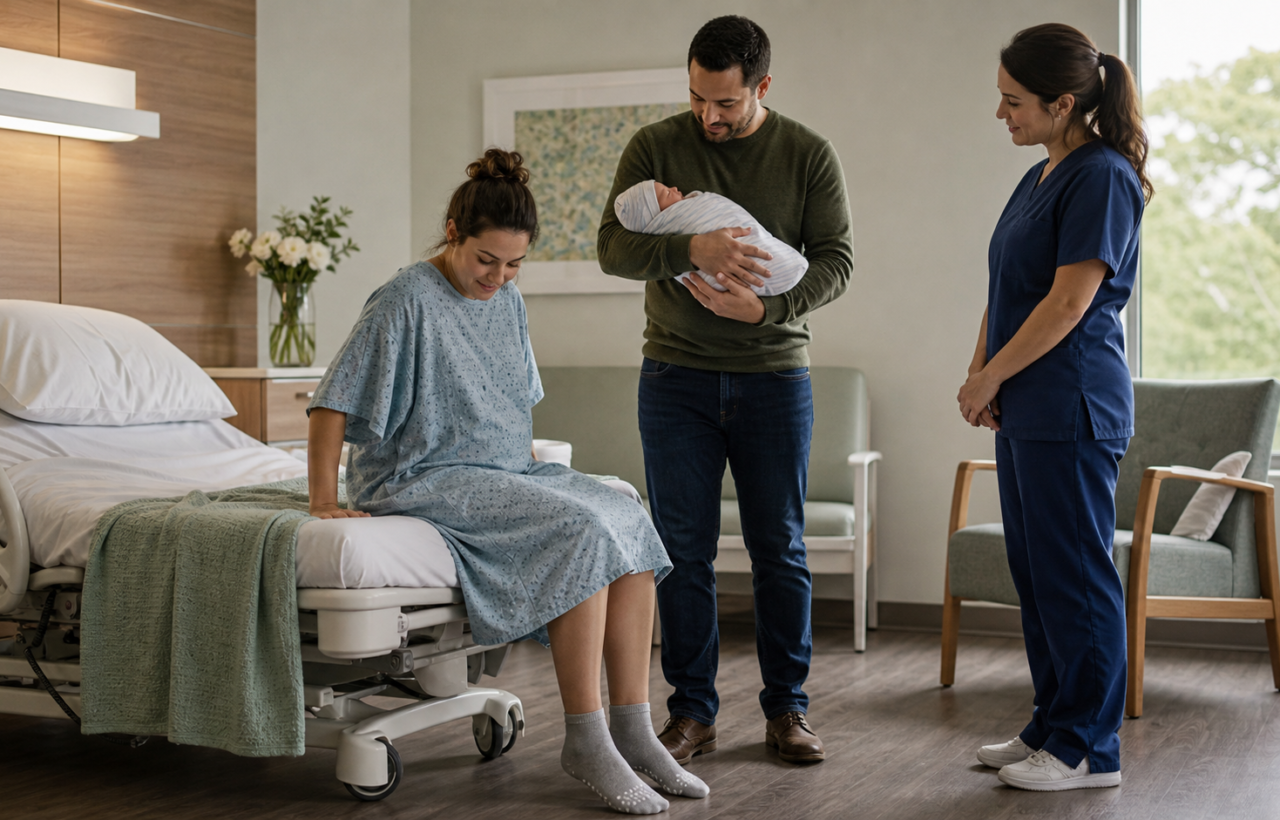
You may be ready to leave the hospital before getting out of bed feels easy. That mismatch is one of the hardest parts of C-section recovery: your newborn needs care around the clock while your body is recovering from major abdominal surgery.
For an uncomplicated birth, initial recovery commonly takes about four to six weeks. Use that as a planning window, not a deadline. Your discharge instructions and your own clinician’s advice come first, especially if you had complications or another condition affecting recovery.
Key takeaways
- Plan for roughly six weeks of recovery, but judge progress by how you feel and what your clinician clears you to do.
- Gentle movement is part of recovery. Short, careful walks support circulation and bowel function, but pain or pronounced fatigue is a reason to slow down.
- Until your six-week check, avoid lifting anything heavier than your baby unless your clinician gives you different instructions.
- Do not use the calendar alone to decide when to drive, exercise strenuously, soak the incision, or resume penetrative sex.
- If you begin feeling worse instead of better, or develop a warning sign such as fever, worsening pain, heavy bleeding, chest pain, or trouble breathing, contact a health professional promptly.
Your week-by-week recovery timeline

The first six weeks are easier to navigate when you know which changes are typical and which decisions still require medical clearance. The timeline below describes an uncomplicated recovery; it is not a promise that every symptom will disappear on schedule.
| Stage | What you may notice | What to do |
|---|---|---|
| First 24 hours | Hospital staff monitor bleeding, blood pressure, and temperature while anesthesia wears off. You may have an IV and urinary catheter, feel numb or woozy, and move gradually from liquids to solid food. | Ask for help before standing. If your care team says it is safe, begin getting out of bed and moving carefully rather than trying to walk alone. |
| Days 2 to 4 | Pain may become more noticeable as anesthesia wears off. Gas pain, swelling, and vaginal bleeding called lochia can occur. An uncomplicated hospital stay is often two to four days. | Take medication exactly as directed, accept assistance with walking, and get specific incision-care instructions before discharge. |
| Week 2 | You may feel much better than you did during the first few days, although incision pain and uterine cramping can continue. A clinician may examine the incision at a postpartum visit. | Report redness, swelling, drainage, fever, or pain that is worsening rather than easing. Ask whether your activity limits have changed. |
| Weeks 3 and 4 | Movement often becomes easier, walks may get longer, and vaginal bleeding may taper. | Increase activity gradually. If an activity causes pain or leaves you markedly fatigued, reduce the distance, duration, or effort instead of pushing through it. |
| Weeks 5 and 6 | Initial healing from an uncomplicated C-section may be substantially complete, though tenderness and other postpartum changes can remain. | Use your postpartum review to discuss lifting, strenuous exercise, driving, and penetrative sex. Being near the six-week mark does not automatically clear every activity. |
Recovery should generally move in a better direction. That does not mean you must feel symptom-free by a particular day. It means new or worsening pain, bleeding, redness, swelling, fever, or illness deserves attention instead of being dismissed as part of the timeline.
Treat activity milestones as gates, not dates
A date tells you when an activity might become possible. Clearance tells you whether it is appropriate for your recovery. Use these practical gates:
- Showering and incision care: A shower may be allowed within a day of surgery. Let mild soap and water run gently over the incision; do not scrub it or apply unapproved preparations. Follow any separate directions for your dressing, adhesive, staples, or sutures.
- Baths and swimming: Do not submerge the incision until it has healed. That may take about seven to 10 days, but the appearance of the wound and your clinician’s instructions matter more than the date.
- Lifting: Do not lift anything heavier than your baby until after the six-week check unless your clinician changes that restriction. Hand off laundry baskets, shopping bags, baby gear, and care of an older child.
- Stairs: Limit unnecessary trips, particularly during the early days. If your home has multiple levels, keep the items you use most on the floor where you spend the day.
- Driving: Clearance often comes around two to three weeks, once you are feeling better and no longer taking prescription pain medicine that makes driving unsafe. Ask your clinician directly rather than assuming you are ready.
- Exercise: Gentle walking is encouraged because it supports circulation and recovery. Weightlifting and other strenuous activity should wait until your care team clears them.
- Anything in the vagina: Avoid penetrative sex, tampons, and other vaginal insertion for the waiting period your clinician gives you. Even after clearance, stop and seek advice if an activity causes pain.
These typical wound-care and activity limits may change after complications. If your written discharge instructions differ from a general timeline, follow the instructions from the team that treated you.
Set up your home around the restrictions

The most useful recovery plan is not a promise to rest more. It is a household setup that removes the jobs you should not be doing.
Get six answers before you leave the hospital
- How is the incision closed, and what should you do with its dressing, adhesive, staples, or sutures?
- When may you shower, and what must happen before you can take a bath or swim?
- What is the exact schedule for each medication, and what should you do if pain is not controlled?
- Would a stool softener or anti-gas treatment be appropriate for you?
- What are your personal restrictions for lifting, stairs, driving, exercise, and vaginal insertion?
- When is your incision check, and which number should you call outside office hours?
Put the answers in your phone or on paper. Early recovery is not the time to rely on memory for medication timing or warning signs.
Build one easy-to-reach care station
Keep diapers, wipes, feeding supplies, your medication instructions, and other daily essentials together at a comfortable height. This reduces repeated stair trips and prevents you from reaching, bending, or carrying more than necessary.
- Ask another adult to handle cooking, laundry, shopping, cleaning, and moving baby equipment.
- Choose a feeding position that keeps the baby’s weight away from the incision. Use pillows for support if they help, and ask a nurse or lactation professional to adjust the position if feeding hurts.
- Keep meals simple and nourishing. Constipation and gas can make abdominal discomfort worse, so ask your clinician about an appropriate bowel-care plan rather than waiting until the problem becomes severe.
- Limit visitors if hosting interferes with sleep, medication timing, feeding, or short recovery walks. A visit that creates work for you is not recovery help.
- When someone offers support, give them one concrete task: bring a meal, run a load of laundry, take out rubbish, or supervise an older child.
Help is most valuable when it removes lifting and household work. You do not need someone merely standing nearby while you continue doing those jobs yourself.
Know which symptoms should interrupt the timeline

Do not wait for a scheduled postpartum appointment if you develop a concerning symptom. Some complications need prompt assessment even when the incision looks normal.
Get emergency help now
- Difficulty breathing or chest pain.
- Thoughts of harming yourself or your baby, especially if you think you may act on them or cannot stay safe. Contact local emergency services and do not stay alone.
Contact your maternity team or health care provider right away
- A temperature above 100.4 F (38 C).
- An incision that becomes warm, red, swollen, or starts oozing.
- New or worsening abdominal pain, or pain that medication does not relieve.
- Heavy vaginal bleeding that does not let up or vaginal discharge with a foul smell.
- Painful urination.
- Pain, tenderness, warmth, or swelling in one leg, particularly in the calf.
- Vision changes, sudden weight gain, or swelling of the hands, eyes, or face.
- Body aches with a breast that is swollen and red.
- Persistent sadness or symptoms of depression. If you also feel unsafe or have thoughts of harm, seek emergency help immediately.
This list covers the main warning signs after a C-section, but it is not exhaustive. Call when something feels seriously wrong, even if it does not fit neatly into a bullet point. If you cannot reach your provider and the symptom is severe or rapidly worsening, use urgent or emergency care.
Before your first night at home, confirm your follow-up dates, save the after-hours number, move essentials onto one floor, and name the person who will handle lifting and household work. Then use the timeline for orientation, not self-clearance: keep moving gently when it feels manageable, respect the restrictions, and call when recovery turns in the wrong direction.
References