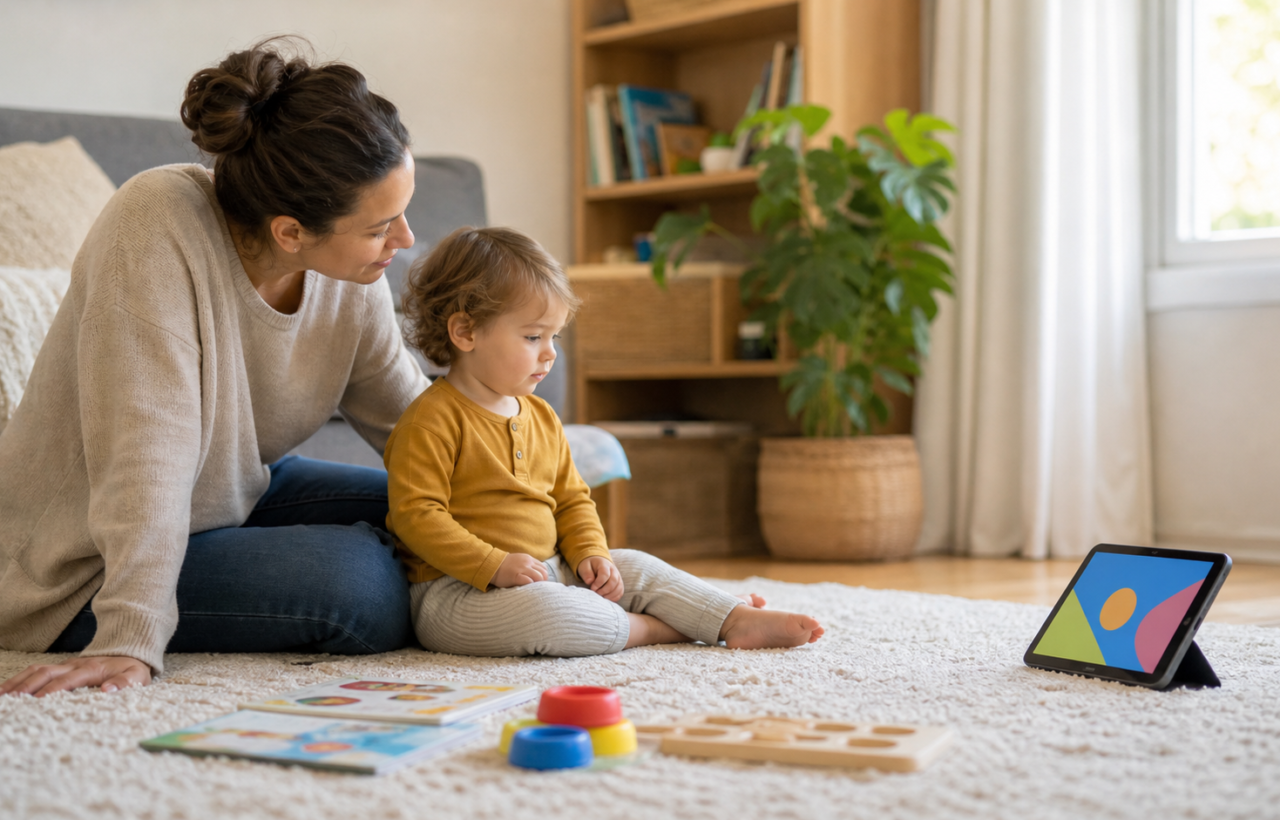
If CoComelon holds your baby’s attention completely, or your toddler cries the moment it ends, it is easy to jump from strong reaction to developmental harm. Those are not the same conclusion.
CoComelon has not been shown to damage young children’s development. The more useful questions are how your child responds before, during, and after watching; how much screen time fills the day; and what that screen time replaces.
What the evidence can and cannot tell you
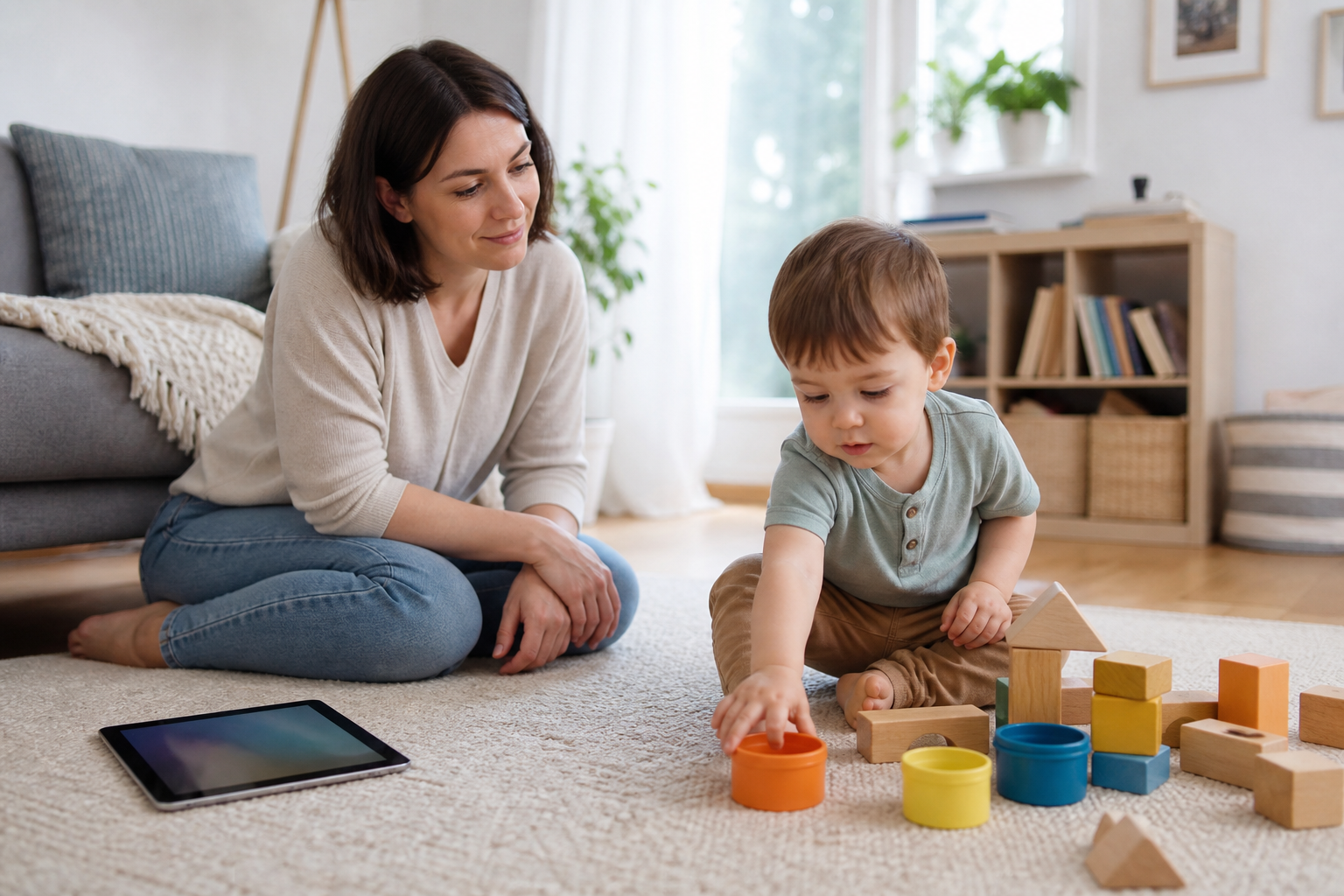
There is not enough direct empirical evidence about CoComelon itself to conclude that its pace overstimulates children or causes developmental harm. That matters because a forceful social-media claim can sound much more certain than the underlying evidence.
Research on fast children’s television is mixed. One 2011 experiment found that nine minutes of fast-paced programming was followed by a short-term reduction in executive-function performance. Executive functions include skills involved in impulse control, working memory, planning, starting tasks, and shifting between activities.
A 2015 follow-up from the same researcher pointed instead to fantastical content, rather than pacing alone, as the possible reason for the immediate effect. Both findings concerned short-term performance, not lasting developmental damage, and neither experiment tested CoComelon specifically.
That leaves parents with uncertainty, not a verdict. It would be inaccurate to declare the show developmentally harmful. It would be equally unhelpful to dismiss a repeated change you can see in your own child. Use overstimulated as a description of a temporary state, not as a diagnosis or proof that a show has altered your child’s brain.
Key takeaways
- CoComelon has not been proved harmful to babies or toddlers, and there is no direct evidence that its editing pace causes developmental damage.
- A single tantrum at turn-off does not establish overstimulation. Hunger, fatigue, disappointment, and an abrupt transition can produce the same behaviour.
- Repeated crying, anger, tiredness, or crankiness around viewing is a reason to reduce the stimulation and observe what changes.
- Total screen exposure and the activities it replaces matter more than judging one program in isolation.
- There is no universal age at which every child becomes ready for faster programming. Watch your child’s response rather than waiting for a supposed graduation point.
Watch for a pattern, not one difficult handoff
Young children often protest when something enjoyable stops. A hard ending can be a transition problem without being evidence that the program itself is harmful. Look at the whole sequence rather than the volume of one protest.
A simple observation log can make the pattern clearer. You do not need an app or a complicated scoring system. On several ordinary viewing occasions, note:
- Before: Was your child already hungry, tired, ill, bored, or upset?
- During: Could your child look away, respond to you, imitate a movement, or shift briefly to a toy? Record what you observe without treating any single behaviour as a test.
- At the ending: Was the program stopped without warning, or did your child know which song or episode would be the last?
- After: Note crying, anger, tiredness, or crankiness, which can be signs of sensory overload in a young child. Also record how your child recovered and what helped.
- Outside screen time: Does the same difficulty appear after leaving the playground, ending bath time, or putting away another favourite activity?
If the same reaction appears after many preferred activities, the main challenge may be transitions. If it repeatedly follows screen viewing, becomes more difficult after longer viewing, or eases when you reduce exposure, that pattern gives you a practical reason to change the routine. You do not need to prove a clinical label before making a smaller, calmer choice.
Change one part at a time when possible. Shorten the viewing period while keeping the time of day and ending routine similar, for example. If you simultaneously change the program, duration, snack, location, and bedtime, you will not know which change mattered.
Build a screen-time boundary that fits ages 0 to 36 months
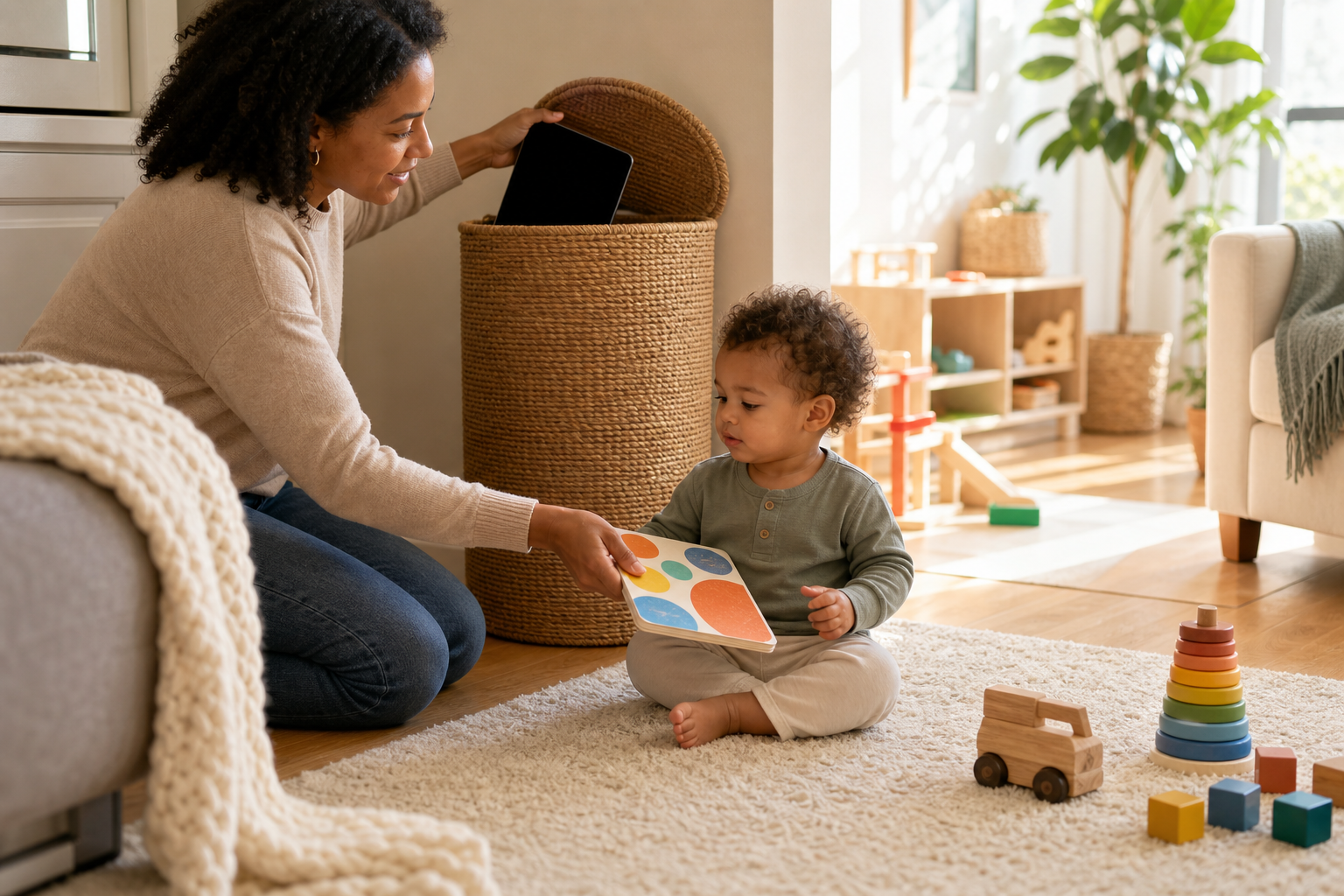
A conservative benchmark recommends no screen time for children under 2 and no more than two hours for young children over 2. A maximum is not a target, and a family doctor or pediatrician may give you more specific guidance for your child’s health and development.
For children in the 0-to-36-month stage, the clearest boundary is one you decide before pressing play:
- Name the purpose. Are you using one song for a sing-along, a short viewing period while you prepare food, or an open-ended distraction? If you cannot identify the stopping point, the session is likely to expand by default.
- Choose the endpoint first. Decide on one song, one episode, or another clear stopping point. Turn off autoplay where the platform allows it so the next video does not make the decision for you.
- Make the ending visible. Tell a toddler which selection will be the last. A baby will not understand the explanation, but a consistent cue and immediate move to the next routine can still make the sequence more predictable.
- Prepare what comes next. Put the bath toys, book, snack, blocks, or outdoor clothes within reach before the screen ends. The goal is not to bribe your child; it is to avoid an empty gap after a highly engaging activity.
- Keep screens out of passive spaces. Avoid background television, screens during meals, and devices in your child’s bedroom. These limits reduce exposure without requiring you to debate the merits of every individual show.
- Use the program as a prompt when you do watch. Sing, copy a gesture, name an object, or repeat the idea later during real play. The screen should not have to carry the full job of conversation, movement, and connection.
Also notice displacement. A short viewing period and a screen that runs through meals, play, conversation, or the bedtime routine are not developmentally equivalent habits. If CoComelon is crowding out face-to-face interaction, hands-on play, movement, or sleep, you already have a concrete reason to scale it back without waiting for show-specific proof of harm.
What to do when turning it off goes badly
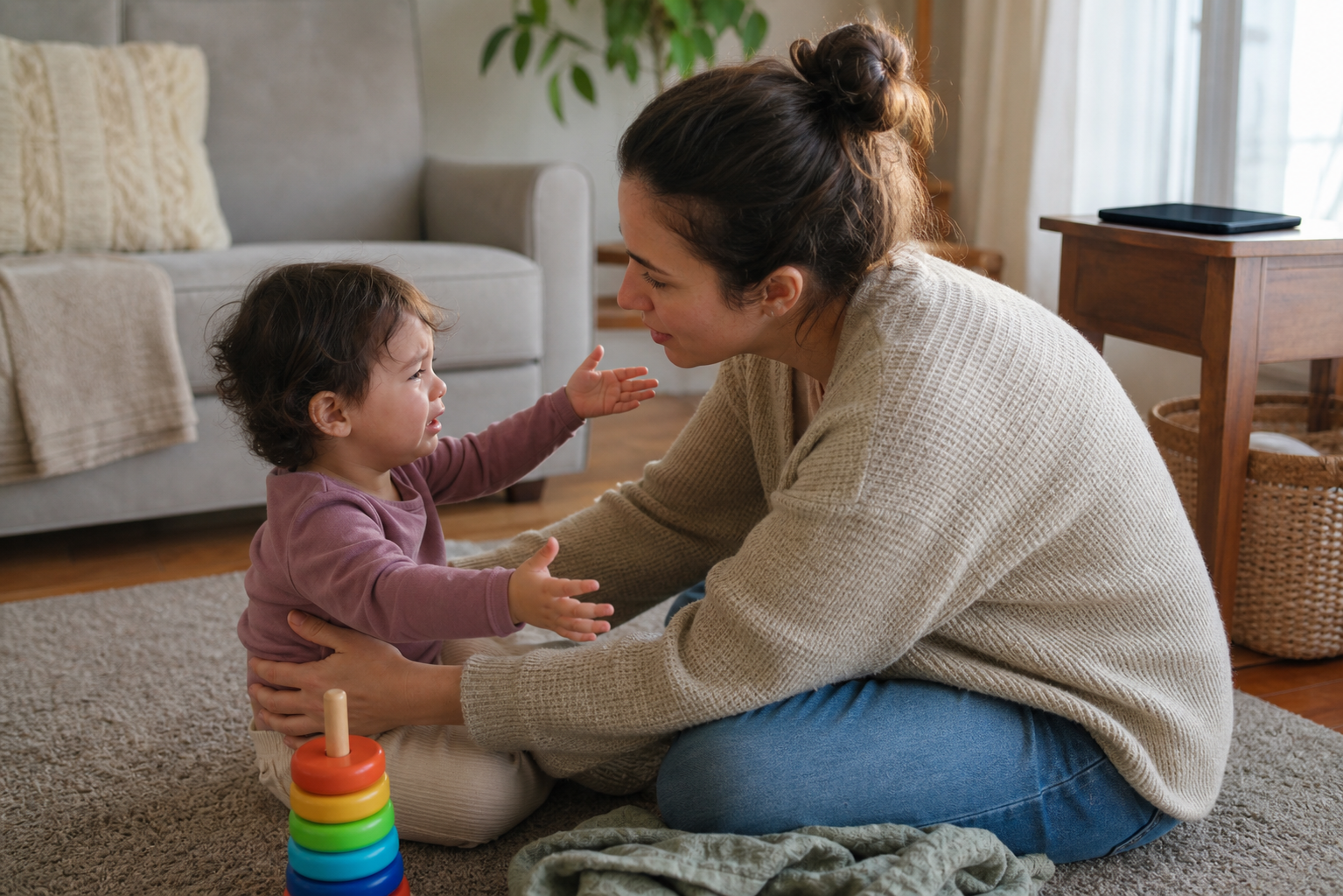
Once your child is overwhelmed, a long explanation usually asks for skills they cannot use in that moment. Keep the boundary and lower the amount of stimulation around it.
- Regulate your own voice and pace. Children can respond to a caregiver’s distress, so use fewer words and a steady tone.
- Move somewhere quieter. Reduce noise, bright activity, and competing demands. A bedroom, a quiet corner, or a calm outdoor space may help.
- Name the feeling and hold the limit. A short script is enough: You wanted more. CoComelon is finished. Now it is bath time. Validation does not require restarting the show.
- Offer a low-intensity activity. Reading, quiet music, a nature walk, or calm physical closeness can help bring the environment down a level.
- Match the strategy to the child’s age. An older toddler who can imitate you may try five-finger breathing by tracing or counting one finger for each slow breath. A baby needs co-regulation instead: less sensory input, a familiar rhythm, and being held if they welcome it.
These steps are intended to help with a temporary upset. They are not a treatment for a developmental, behavioural, or sensory condition.
When to involve your child’s clinician
A single difficult turn-off usually does not require a clinical interpretation. Bring the pattern to your family doctor or pediatrician if the distress is recurrent and intense, recovery is consistently difficult, the behaviour disrupts sleep, meals, play, or childcare, or similar distress happens frequently without screens. Ask for a developmental screening if you also have concerns about communication, attention, sensory responses, movement, or social engagement.
Any loss of skills your child previously used warrants a prompt medical discussion. Reducing screen exposure may be a sensible household change, but it should not replace an evaluation when you have a broader developmental concern.
For the next viewing, make just three decisions in advance: why you are turning it on, exactly where it will end, and what your child will do next. Then watch the transition instead of the online argument. Your child’s repeated pattern will give you more useful information than a dramatic label attached to one show.
References