
Your return date is approaching, and the logistics may feel less forgiving than the feeding itself: meetings, travel, pump parts, cold storage, and a caregiver who needs clear instructions. Returning to work does not have to mean ending breastfeeding, but the transition is easier when you treat every handoff as part of the same system.
The aim is not a perfect pumping schedule or an overflowing freezer. It is a workable plan for the next separation, a safe way to handle milk, and a fallback for the days when work or your baby changes the plan.
Define what continuing breastfeeding means for you
Start with the outcome you want, not with somebody else’s routine. You might want to breastfeed when you and your baby are together and provide expressed milk during work. You might need a combination feeding plan, or you might want to reduce feeds gradually while keeping the ones that matter most to you.
None of those choices is a test of commitment. The practical question is whether your plan fits your baby’s age and health, your milk production, the length of your separation, and the support available at work and in childcare. If you are reducing milk feeds or introducing an alternative, ask your baby’s clinician what should replace them. Feeding needs change with age, so this is not a detail to fill in from a generic online schedule.
Write the plan in four parts:
- Before you leave: Decide whether you want to breastfeed, express, or simply get ready without adding another task to the morning.
- While you are separated: Identify the work periods you can protect for expressing, where you will do it, and where the milk will go immediately afterward.
- At childcare: Agree on how containers will be labelled, stored, warmed, offered, and recorded. Include what the caregiver should do if your baby refuses milk or finishes what you supplied.
- When you reunite: Decide what needs to happen first: breastfeeding, reconnecting without pressure, cleaning equipment, or preparing supplies for the next workday.
Ask your caregiver which feeding method is appropriate and familiar for your baby’s developmental stage. If a bottle, cup, or another method is new, confirm the safest approach with your baby’s clinician or a qualified lactation professional rather than improvising.
Ask your employer equally concrete questions. You need to know whether there is a private space that can be secured, a chair and clean surface, access to power if your pump needs it, suitable cold storage, a place to wash your hands, and enough flexibility to protect expression breaks. Workplace rules and legal protections vary, so verify your local employment standards if the available accommodation is unclear.
Rehearse the handoffs before your first workday

A rehearsal is not about forcing your baby into a flawless new routine. It is a way to discover practical failures while you still have time to correct them.
- Use your pump at home and learn how every part fits together. Follow its instructions for setup, suction, flange fit, cleaning, and replacement parts. Pumping should not require you to tolerate ongoing pain.
- Have the person who will provide care practise the planned feeding method while you step away. This tests the caregiver’s comfort as well as your baby’s response.
- Complete the entire milk-handling chain: express, transfer if necessary, close the container, label it, cool it, pack it for transport, and handle the equipment according to the cleaning guidance you are following.
- Reset everything as though the next morning were a workday. Charge the pump, replace missing supplies, prepare labels, and put refrigerated or frozen items where you will remember them.
If your baby refuses expressed milk during practice, do not turn the attempt into a contest. A caregiver can try again when the baby is calm, change the holding position, or use another age-appropriate method recommended by a professional. Persistent refusal that reduces your baby’s intake needs prompt advice from the baby’s clinician or a qualified lactation consultant.
You do not need a large freezer inventory to prove that the plan will work. Build only the buffer that is useful for your expected separation and realistic for your body. If you do not know how much milk your baby is likely to need while apart from you, ask a clinician who can consider your baby’s age, growth, feeding pattern, and health.
Rehearse your clothing too. Sit down in the clothes you expect to wear and make sure you can reach the pump area without undressing more than you are comfortable with. Front openings, separate tops and bottoms, or an accessible underlayer may be easier than a one-piece outfit. Breast pads, a spare top, and an extra layer can make leaks less disruptive without turning your work bag into another nursery.
Build a workday system for expressing and storing milk
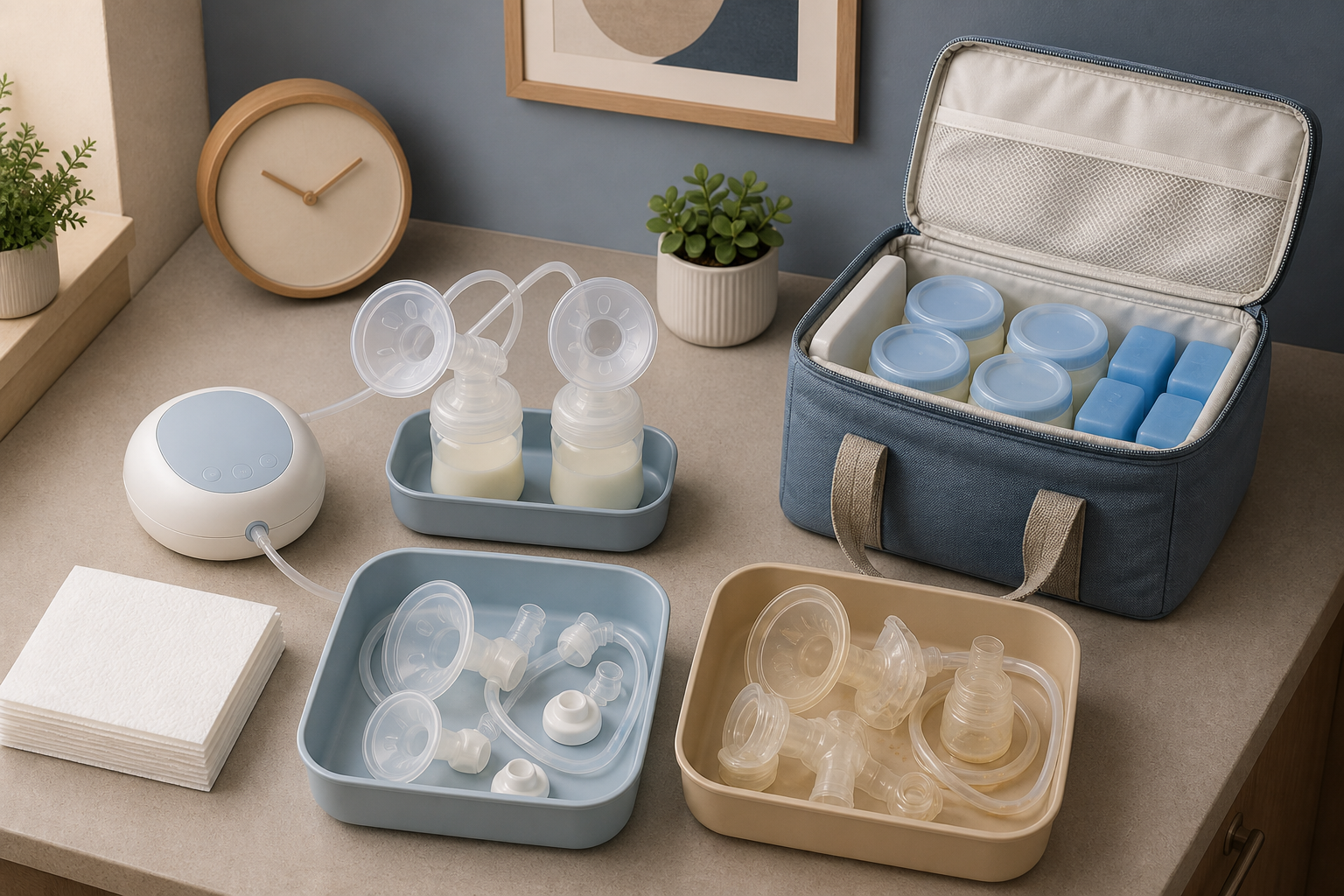
When possible, place expression blocks near the times your baby would normally breastfeed. There is no universal schedule: the useful timing depends on your baby’s stage, your usual feeding pattern, the length of the workday, and how your body responds. If exact timing is impossible, protect consistent windows as closely as work allows and seek individual guidance if you are concerned about milk production.
Protect the space and the calendar
Put expression time on your calendar before the day fills with meetings. Include setup, milk labelling and storage, and the cleaning or packing required afterward; a calendar block that covers only active pumping time will be too short.
Visit the proposed room before you rely on it. Check whether the door closes securely, the outlet works, the chair and surface are usable, and the route to cold storage is practical. If several people share the space, find out how it is reserved and what happens when it is unexpectedly occupied.
Pack for the complete process
A useful pump bag covers expression, storage, transport, cleaning, and small failures:
- The pump, power cable or charged battery, and every required connector and milk-contact part.
- Clean containers designed for breast milk, secure lids, labels, and a marker.
- An insulated cooler and suitable cold packs if milk cannot move directly into reliable cold storage.
- Supplies required by the pump manufacturer’s cleaning instructions and the current health guidance you follow.
- A clean bag for unused items and a separate leakproof bag for equipment awaiting proper handling.
- Breast pads, a spare top, and any pumping or nursing garment that makes access comfortable.
- A modest backup, such as compatible spare parts, a manual pump, or knowledge of hand expression.
Duplicate inexpensive essentials at work if that is practical. A forgotten valve, adapter, lid, or charging cable can stop the process even when the pump itself is in your bag.
Choose one authoritative storage rule set
Do not rely on a storage time remembered from social media. Safe handling depends on factors such as temperature, previous storage, container type, and how the milk was handled. Follow current instructions from your local public-health service, your baby’s clinical team, or another appropriate health authority. Your childcare provider may also have a stricter policy.
Turn that guidance into a repeatable chain:
- Prepare your hands, pump parts, and storage containers as directed by the guidance you are using.
- Close each container securely and label it with the information required by your caregiver, which may include your child’s name and the expression date or time.
- Move the milk into the required storage conditions promptly.
- Transport it in the way specified by the same guidance, using suitable cold storage where required.
- Use the earliest-dated eligible milk first if that matches the storage rules you are following.
- Record what goes to childcare and what returns so that an unlabelled container does not become a guessing exercise.
Give your caregiver the same written instructions. They should cover which container to offer first, the approved warming method, how leftovers are handled, and when to contact you. If the time or temperature history of a container cannot be verified, do not invent a rescue rule. Ask an appropriate health professional or public-health service; if safe storage cannot be established, default to protecting your baby.
Troubleshoot the failed link, not the whole plan

A difficult expression session is a data point, not a verdict on your ability to breastfeed. A pump shows what it removed during that session; it does not measure everything your body can produce or everything your baby may transfer while nursing.
If output is unexpectedly lower, check the simple failure points in order:
- Confirm that the pump is completely assembled and that small parts are seated correctly.
- Check the battery, outlet, tubing, connections, container seal, and any replaceable valve or membrane.
- Make sure the flange is centred, comfortable, and forming the intended seal. More suction is not automatically more effective, especially if it hurts.
- Notice whether the session was delayed, shortened, interrupted, or unusually rushed.
- Look for a repeated change across workdays instead of drawing a conclusion from an isolated session.
If reduced output persists, or it appears alongside concerns about your baby’s intake or growth, contact a qualified lactation consultant and your baby’s clinician. They can assess feeding and milk transfer rather than relying on pump volume alone.
If a meeting displaces an expression block and your breasts become uncomfortably full, express as soon as you can do so privately and safely. Hand expression may provide temporary relief when equipment is unavailable. Repeatedly losing the same break is a workplace problem to address with your manager or human-resources contact, not a personal failure to organize better.
Do not work through persistent pumping pain, bleeding or worsening nipple damage. Get fit and technique support from a qualified lactation professional and clinical care when needed. Seek prompt medical advice for a breast that becomes red or hot, a painful area that is not improving, fever, or flu-like symptoms. Those signs deserve assessment rather than another change to the pump settings.
Your baby’s condition matters more than whether the packed milk plan was followed perfectly. Contact the baby’s clinician promptly if feeding is consistently poor, wet diapers are noticeably fewer than usual, or you have concerns about weight or growth. Seek urgent medical assessment if your baby is unusually difficult to wake, will not feed, or appears unwell.
Key takeaways
- Returning to work does not automatically require ending breastfeeding; decide what continuation should look like for your family.
- Plan feeding, expression, storage, transport, and childcare as a connected chain, then rehearse the whole chain before relying on it.
- Ask your workplace about privacy, calendar flexibility, power, handwashing, and cold storage before your return date.
- Use one current, authoritative set of milk-storage instructions and give the same written rules to every caregiver.
- Troubleshoot equipment and scheduling problems before treating lower pump output as a supply problem.
- Persistent pain, breast redness or heat, fever, poor infant feeding, or concerns about diapers and growth call for professional help.
Your next move is to make the handoffs visible. Contact your workplace and caregiver, write down the storage guidance you will follow, and run the routine from expression to cleanup. Once each link has an owner and a fallback, a hard workday becomes a problem you can adjust rather than a decision about whether breastfeeding must end.
References