
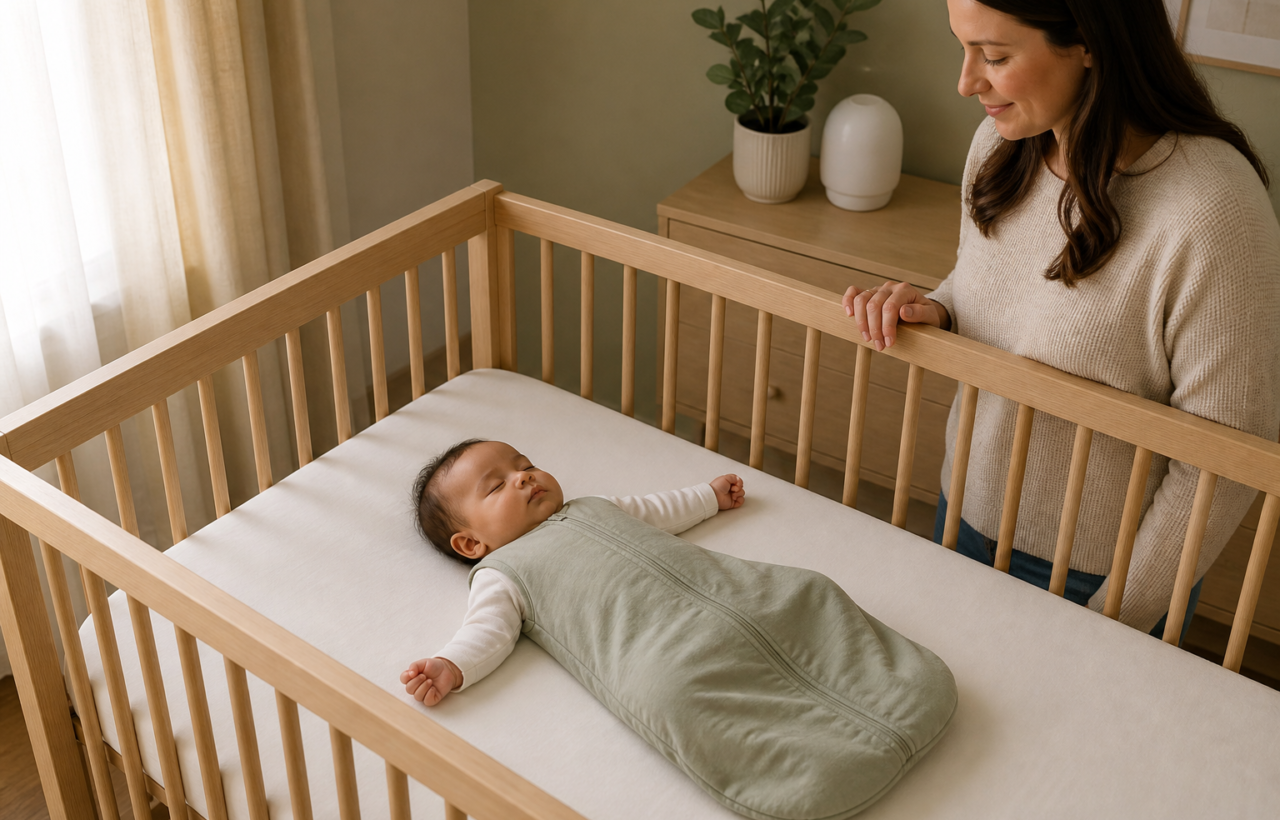
You put your baby down on their back. Later, you look into the crib and find them asleep on their stomach. Do you turn them over, leave them alone, or stay awake waiting for it to happen again?
The answer depends on whether your baby moved into that position independently and can roll in both directions. One rule does not change: throughout the first year, you should begin every nap and nighttime sleep by placing your baby on their back.
Key takeaways
- Place your baby on their back at the beginning of every sleep until their first birthday, even if they seem to prefer another position.
- If your baby gets onto their stomach independently and can confidently roll from back to stomach and stomach to back, you generally do not need to keep turning them over.
- If your baby cannot yet roll both ways, return them to their back when you notice that they have rolled onto their stomach.
- Stop swaddling as soon as your baby shows signs of trying to roll. A swaddled baby should never sleep on their stomach.
- Use a firm, flat crib or bassinet mattress with a fitted sheet. Keep pillows, blankets, bumpers, toys, positioners and other soft objects out.
- A breathable mattress, video monitor, side-sleep position or inclined product does not make deliberate stomach placement safe during the first year.
Back sleeping remains the starting position for the first year
For every sleep during the first 12 months, place your baby down on their back. That includes short naps, overnight sleep, sleep after a feed and sleep at another caregiver’s home. Side placement is not a halfway option; a baby placed on their side can roll forward onto their stomach before they have the strength and coordination to move back.
Stomach sleeping matters because an infant’s face sits close to the sleep surface. On a soft or obstructed surface, the baby may rebreathe exhaled air instead of getting a fresh supply. That can reduce oxygen and allow carbon dioxide to build up. The position can also make overheating and suffocation more likely, and a baby sleeping deeply on their stomach may be harder to wake.
The recommendation is about how you place your baby, not about forcing a mobile baby to remain perfectly still. Once rolling begins, your baby may choose a different position within minutes. What matters next is how they got there, what movements they can perform and whether the sleep space remains clear.
After the first birthday, you no longer need to place your child back onto their back whenever they choose their stomach. You also do not need to teach or encourage stomach sleeping. Let them settle in the position they choose while continuing to provide an appropriate, uncluttered sleep space.
What to do when your baby rolls onto their stomach
If your baby rolls confidently in both directions
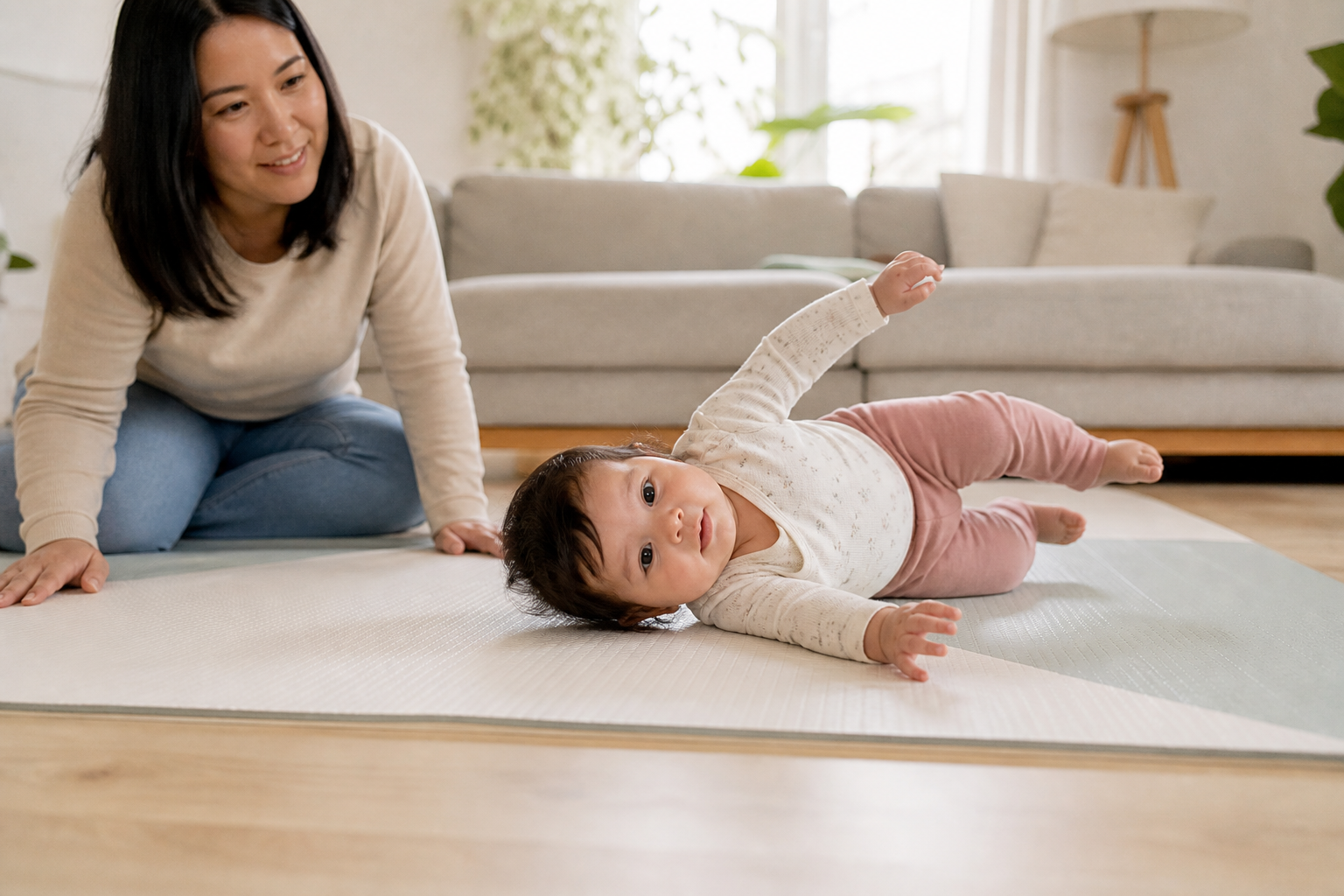
Continue placing your baby on their back at the start of every sleep. If they then roll onto their stomach by themselves, can roll from stomach to back as well, and regularly demonstrate those movements without help, you can generally leave them in the position they chose. You do not have to spend the night repeatedly flipping a capable roller.
Rolling in both directions is important because it shows that your baby can change position rather than merely tip forward. Turning the head from side to side is not the same ability. Neither is rolling in only one direction.
You can observe the difference during supervised, awake floor play. Look for your baby to initiate a complete back-to-stomach roll and a complete stomach-to-back roll without being pulled, propped or pushed. Do not use sleep as the time to test the skill.
If your baby is trying to roll or can roll only one way
Treat the first twisting, rocking or attempts to roll as the beginning of the transition. Rolling signs often appear between two and four months, but the signs matter more than a date on the calendar.
Stop swaddling at that point. A swaddle holds the arms against the body, taking away tools a baby needs to push, reposition the head or attempt to roll back. If warmth is needed, use sleep clothing that fits properly and leaves both arms free rather than adding a loose blanket.
If a one-way roller reaches their stomach during sleep and you notice it, gently return them to their back. Do not try to keep them in place with a wedge, rolled towel, pillow, bumper or sleep positioner. Adding an object beside a baby’s face creates another hazard instead of solving the rolling problem.
If you cannot tell whether the rolling is controlled, use the more cautious approach: begin every sleep on the back, keep the arms free, reposition the baby when you see them stomach-down and discuss the transition with your child’s health-care professional. A baby with a medical condition or individualized positioning instructions may need advice specific to that condition; do not substitute general sleep guidance for that plan.
If you find your baby face-down or in distress
A baby who has rolled onto their stomach and is breathing normally is not automatically having an emergency. Check that the nose and mouth are unobstructed, remove any object that should not be in the crib, and respond according to the baby’s rolling ability.
If your baby is not breathing normally, is limp, has an unusual blue or grey colour, or is very difficult to wake, call emergency services immediately. Those signs require urgent help, regardless of sleep position.
Make the sleep space ready before rolling starts
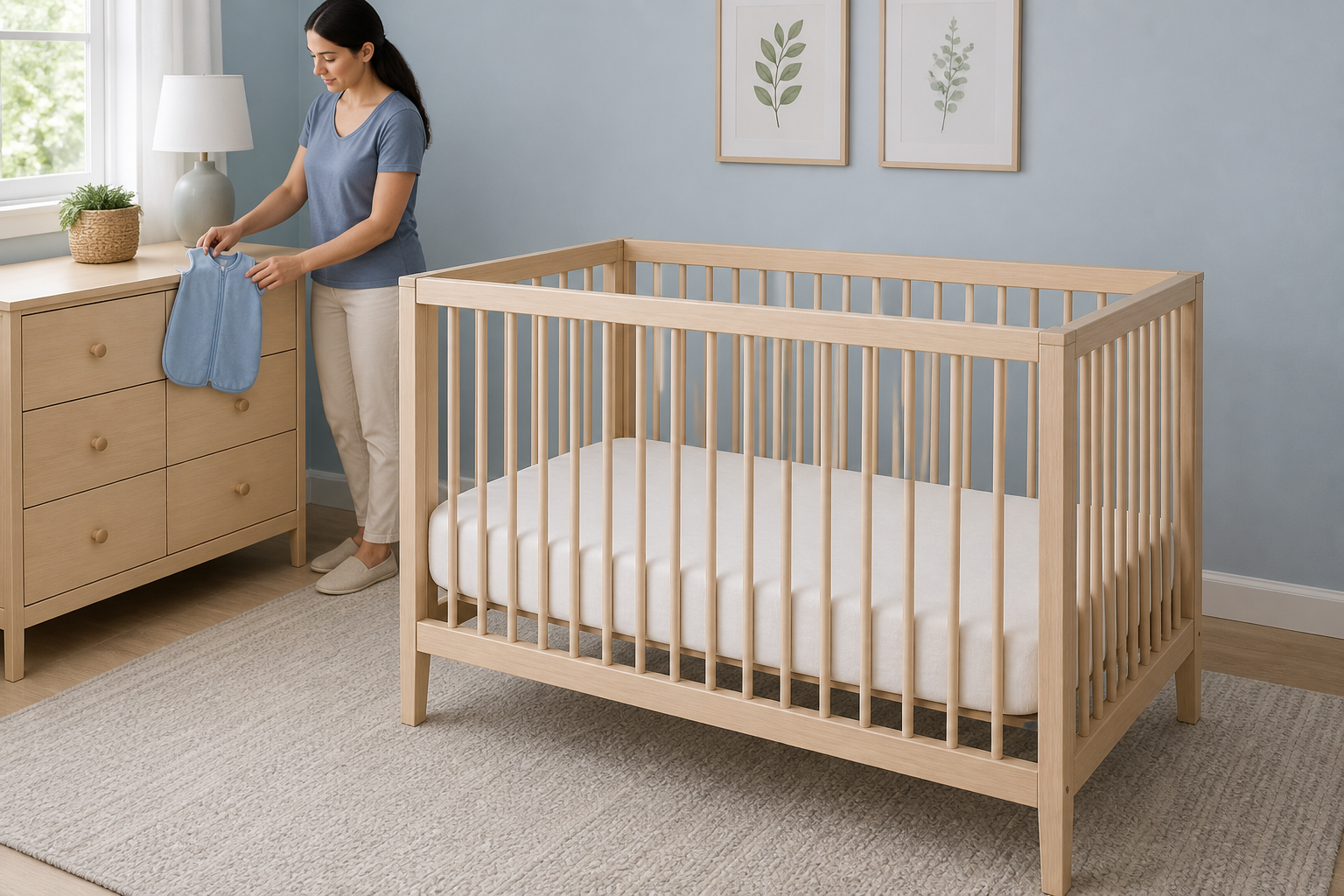
Rolling can begin between one sleep and the next. Preparing the crib before you see a complete roll means the environment is already safer when your baby first moves unexpectedly.
- Use a firm, flat surface intended for infant sleep. Choose a properly assembled crib or bassinet with its correctly fitting mattress. Do not add a mattress topper or extra padding to make it feel more comfortable.
- Use only a fitted sheet. The sheet should fit tightly and remain secured at every corner. This is particularly important with mini-cribs and other non-standard mattress sizes.
- Clear the entire sleep space. Remove pillows, loose blankets, quilts, stuffed animals, crib bumpers, nursing pillows, wedges and positioning products. If an item was added for a photograph or decoration, take it out before the baby sleeps.
- Keep the surface level. A rocker, swing or other inclined product is not a substitute for a crib or bassinet. If your baby falls asleep in one, move them to a firm, flat sleep surface as soon as you can do so safely.
- Give a rolling baby full use of both arms. Once rolling signs appear, do not use a swaddle for naps or nights. Check that sleep clothing is the right size and cannot ride up over the face.
- Room-share without surface-sharing. For at least the first six months, the safer arrangement is for your baby to sleep in the same room as you but in a separate crib or bassinet, not on an adult bed, sofa or chair.
Run the same check anywhere your baby sleeps. A clear crib at home does not protect a nap in a pillow-filled adult bed or an overnight stay where a loose blanket has been added. Tell grandparents, babysitters and other caregivers that the baby starts on their back, what their current rolling ability is, and whether swaddling has stopped.
Common shortcuts do not make stomach placement safer
“My baby sleeps longer on their stomach”
Longer or deeper sleep does not show that the position is safe. Being harder to wake is one of the concerns associated with stomach sleeping. If your baby protests when placed on their back, keep the starting position consistent rather than deliberately placing them stomach-down to extend sleep.
“I’ll use an incline to keep their airway open”
An infant sleep surface inclined by more than 10 degrees is unsafe. A young baby can slump with the chin against the chest and may not have enough neck control to restore a safer head position. Do not tilt the mattress, place anything underneath it or use a rocker as an overnight sleep space.
“The mattress is breathable, so stomach sleeping is fine”
No mattress feature cancels the back-sleep recommendation. Product language about airflow is not permission to place an infant on their stomach before the first birthday. The useful criteria remain simple: the surface is firm, flat, correctly fitted and free of loose or soft objects.
“I’ll stop the rolling with something beside the baby”
A positioner or improvised barrier can end up near the baby’s nose and mouth. It may also trap a baby who continues trying to move. Once rolling begins, the safer response is an empty crib, free arms and back placement at the beginning of every sleep.
For tonight, make three checks before you turn out the light: your baby begins on their back, the crib contains nothing except the fitted sheet, and the swaddle is gone if rolling signs have started. If your baby can roll both directions and later chooses their stomach, let their own movement – not a product or deliberate placement – determine the position.
References




