
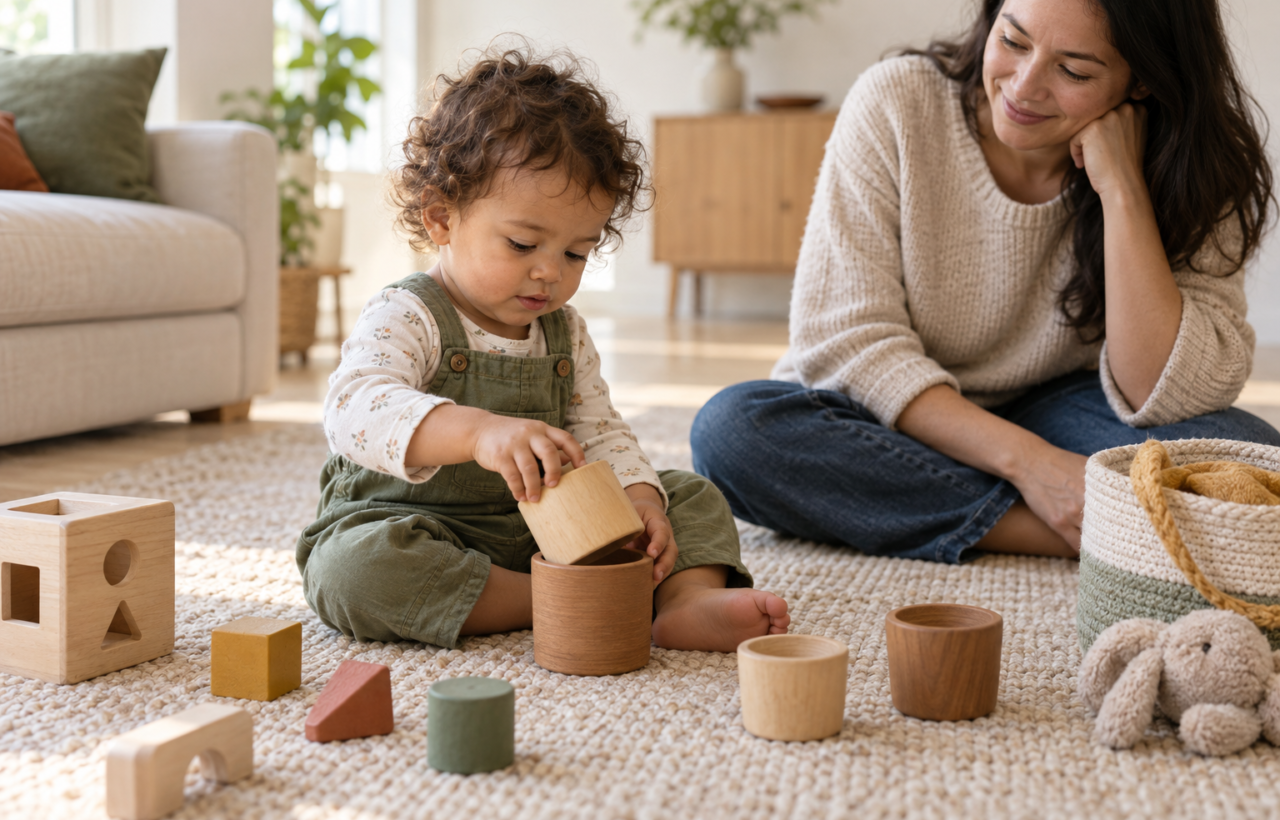
When every box promises motor skills, problem-solving or early learning, choosing a developmental toy can feel more complicated than it needs to be. You do not need a separate product for every milestone. You need a safe object that gives your toddler an interesting action to repeat, vary and eventually master.
Start with what your child is already trying to do. A toddler who carries everything needs a different play opportunity from one who keeps fitting lids onto containers. That observation will tell you more than a long list of features on a package.
Start with the action your toddler is practising
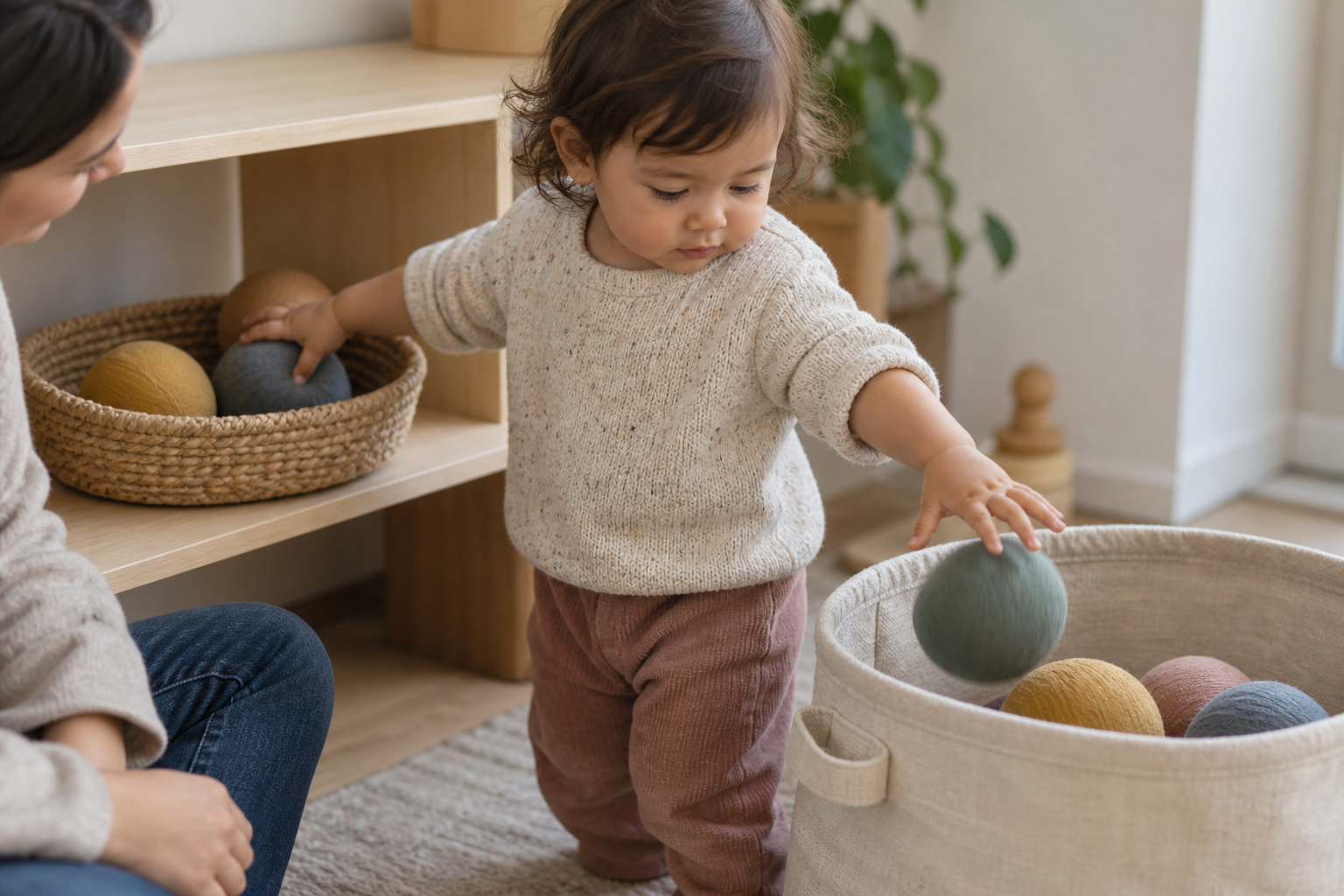
Development happens through action. Toddlers grasp, release, push, pull, carry, stack, climb, imitate and try again. A useful toy makes one or more of those actions possible without controlling every part of the experience.
Watch your toddler during ordinary play before you shop. Notice what they repeat, what they are almost able to do and what holds their attention after the first surprise wears off. Then look for a toy that gives that interest a little more room.
| What your toddler keeps doing | A useful toy feature | What the play lets them practise |
|---|---|---|
| Putting objects in and taking them out | Containers, nesting pieces or a posting toy | Grasping, releasing and understanding where objects go |
| Stacking, balancing or knocking things down | Blocks or sturdy stacking pieces | Hand control, planning and cause and effect |
| Turning, fitting or opening | A simple puzzle, shape-fitting toy or movable parts | Problem-solving and precise hand movements |
| Pushing, pulling or carrying | A stable push toy, pull toy or child-sized carrier | Whole-body coordination and purposeful movement |
| Climbing onto safe surfaces | An age-appropriate climbing structure | Balance, body awareness and movement planning |
| Copying meals, calls, caregiving or household routines | Simple pretend-play props | Imitation, sequencing and expressive language |
A varied play space may include climbing and building toys, puzzles, pretend-play materials and ride-ons, but you do not need every category at once. Choose the category that matches the action your toddler is pursuing now.
Match the challenge to your child, not just the age label
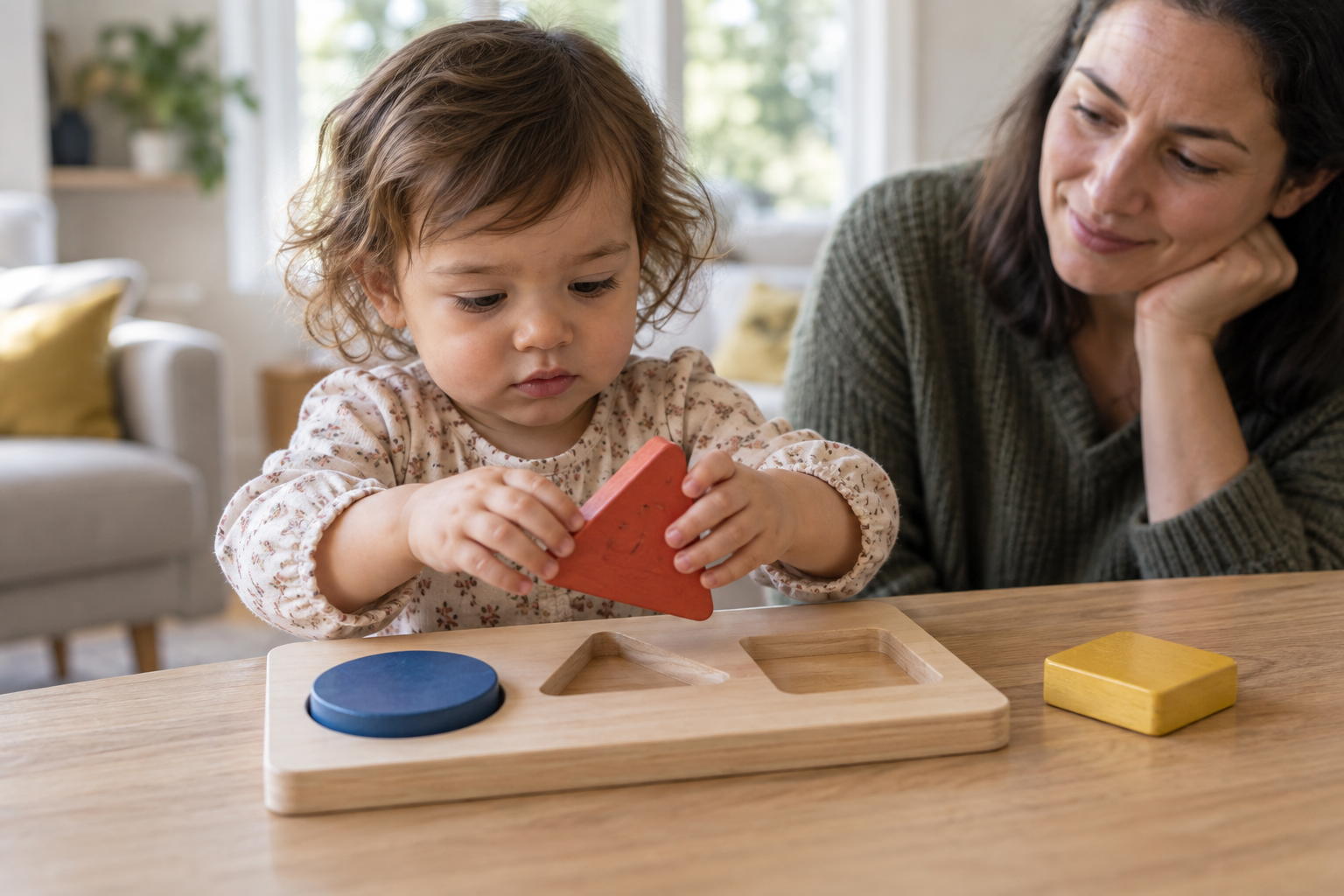
An age label is an important safety screen, but it cannot tell you whether a toy offers the right challenge for your particular child. Toddlers of the same age can approach the same toy in very different ways.
The best fit has an obvious entry point. Your toddler can begin an action without an adult operating the toy, but there is still something to work out. You might see concentration, repeated attempts, a change in strategy or a return to the toy later.
A toy may be too difficult right now when your toddler cannot produce any meaningful result, even after a calm demonstration. Frequent adult correction is another clue: if the play works only while you direct every move, the child is not really in control of it.
Before putting the toy away, change the setup. Remove distracting pieces, steady the base, begin the first action or show the movement once and pause. If that creates a way in, the toy may be suitable even if your toddler cannot complete its intended task yet.
When a familiar toy seems easy, add complexity without rushing to replace it. Blocks can become a road or a pretend meal. Containers can be sorted, carried or incorporated into a hiding game. A puzzle piece can become a character. The toy grows when the possible actions grow.
Do not read one short play session as a verdict. Hunger, fatigue, noise and an adult’s presence can all change how a toddler engages. Put the toy away and offer it again another day before deciding it has failed.
Buy for usable play value, not developmental claims
The word developmental on a package does not guarantee rich play. An expensive toy can still be passive, confusing or too limited to hold interest. A plain set of objects can be highly useful when your toddler gets to decide what happens with them.
Before buying, picture your child using the toy after the novelty has faded. These questions reveal more than a long feature list:
- Is the action clear? Your toddler should be able to see or feel what pushing, fitting, stacking or moving a part does.
- Does the child cause the interesting result? Lights and sounds are not automatically a problem, but the toddler should be doing more than repeatedly triggering a performance.
- Can it be used in different ways? Toys that allow building, carrying, arranging, pretending or combining tend to offer more possible play than toys with one correct routine.
- Can your toddler use it with decreasing help? A brief demonstration can open the play. Constant adult operation usually means the toy is serving the adult more than the child.
- Will it work in your actual home? Consider floor space, noise, storage, cleanup and the supervision it requires. A toy that is rarely available has little developmental value.
- Does it add something new? Another stacking set may not expand play if you already own pieces that stack well. Look for a new action, material, scale or pretend-play possibility.
Open-ended does not have to mean wooden, neutral-coloured or minimalist. It simply means the child can make meaningful choices. A toy with a defined purpose can still support exploration if there are multiple routes into the play and room to invent beyond the intended task.
It also helps to separate practice from performance. A toddler does not need to finish a puzzle, build a recognizable structure or act out a complete story for the toy to be worthwhile. Turning a piece, testing an unstable tower or repeating one pretend action is the play, not merely preparation for it.
Make safety and setup part of the choice
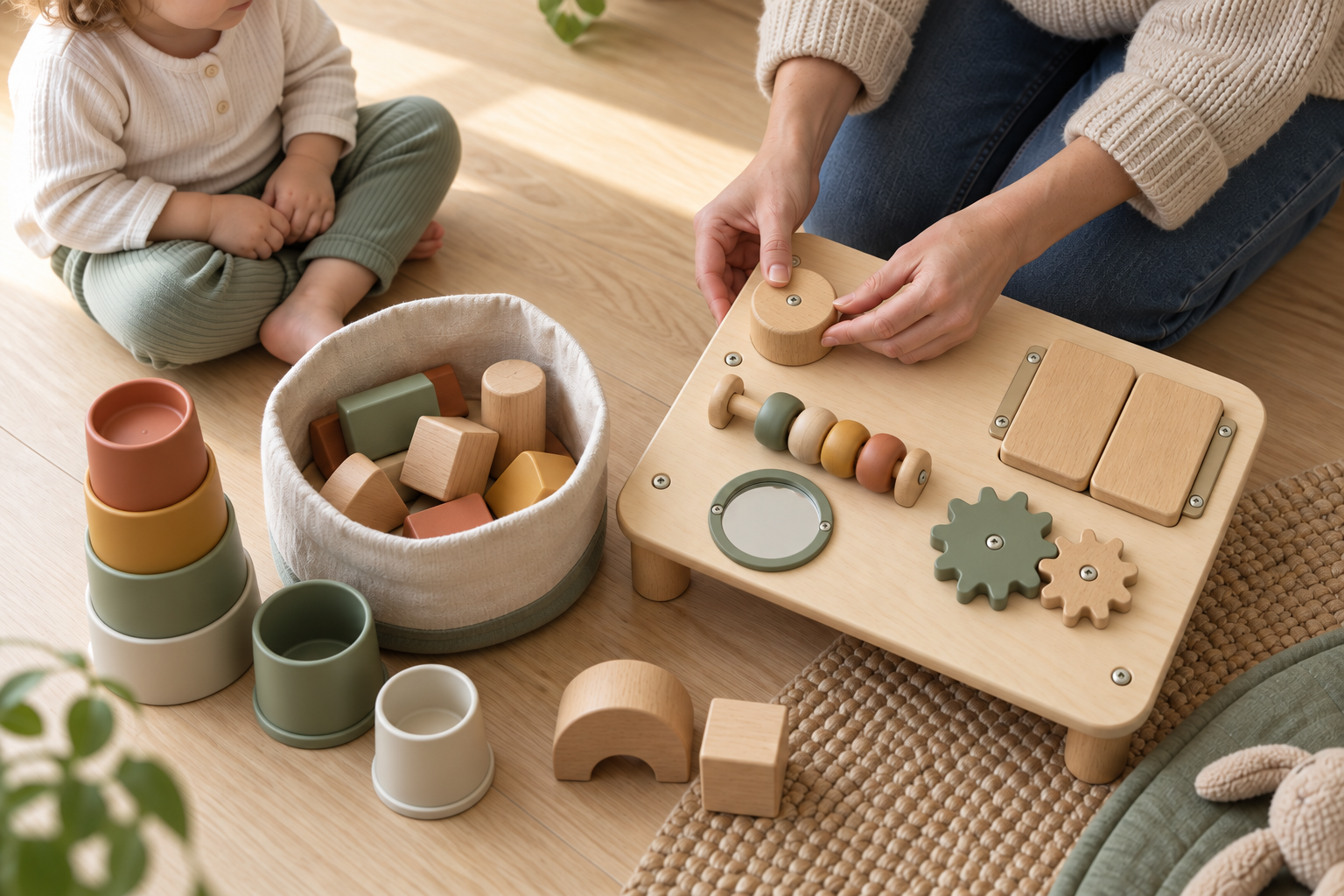
Check the toy in front of you
Use the manufacturer’s age guidance as a starting point and inspect the actual toy before offering it. Look for loose or broken pieces, sharp damage, unstable bases and parts that could detach. Recheck well-used toys because wear can change what was safe when the toy was new.
Think about every child who can reach the play area. Pieces appropriate for an older toddler may be unsafe for a younger sibling. Store those toys where the younger child cannot access them, rather than relying on the older child to keep track of every component.
Button batteries and powerful magnets must remain securely enclosed. If either becomes loose or you suspect one has been swallowed, treat it as a medical emergency and seek emergency care immediately.
Movement toys need an environment that supports their intended use. Check stability, provide clear floor space and keep ride-ons or climbing equipment away from stairs and other hazards. Stay close enough to intervene; a label cannot account for the layout of your home or how your child is using the toy today.
Set up the first successful action
A good toy can disappear inside an overflowing bin. Offer a small, visible selection with complete sets kept together. Put the toy within reach and arrange it so the first possible action is easy to notice: a block beside a container, a puzzle piece near its opening or a pretend cup beside a toy animal.
Show rather than quiz. Complete a simple action, then wait. If your toddler uses the toy differently, watch for the logic in that choice before redirecting them to the intended method. Turning every interaction into a test can replace experimentation with a search for adult approval.
When you join, describe the action your child is taking: the block fell, the wheel is turning, or the piece does not fit yet. This gives language to the experience without taking control of it. Help when frustration has stopped the play, but leave room for the pause in which your toddler may try a new approach.
Rotation can make familiar toys easier to see again. Put aside items that are being ignored while leaving current favourites available. Bring a stored toy back when it connects with a new interest. The aim is not a schedule; it is a play area your toddler can understand and use.
Key takeaways
- Choose a toy by the action your toddler is already repeating, such as stacking, carrying, fitting, climbing or pretending.
- Look for a challenge your child can enter independently, even if completing it still requires effort or occasional help.
- Value child-controlled action, multiple uses and a realistic fit with your home over developmental language on the package.
- Extend an easy toy by combining it with new objects or pretend scenarios before replacing it.
- Follow age guidance, inspect toys for damage and account for younger children who can reach the same play space.
- Demonstrate briefly, describe what happens and give your toddler time to experiment without being corrected through every step.
Before your next purchase, spend a play session watching for the action your toddler returns to most. Choose one safe toy that expands that action, make it easy to reach and let your child’s response guide what comes next.
References




