The hardest part of leaving home with a baby or toddler is rarely forgetting some obscure accessory. It is discovering, halfway through a change or a crowded outing, that the item you need is buried under everything else.
A better setup is not the one that carries the most. It is the smallest combination of bag, stroller or wagon, and packing system that you can load, move, open and reset without creating another job. Here is how to build that setup around the outings you actually take.
Start with the outing, not the product
Before comparing diaper bags or stroller wagons, choose the recurring outing that causes the most friction. A walk from home, a car-based errand, a transit trip and a long outdoor day impose different demands. Gear that feels spacious in a hallway can become awkward when you meet stairs, a narrow shop entrance or a crowded vehicle.
Write down the full sequence of that outing: getting everyone dressed, leaving the building, loading a vehicle or boarding transit, moving through the destination, handling a feed or change, and returning home. Mark the moment that usually slows you down. That moment should drive the purchase.
- If you lose time searching: prioritize a wide opening, visible compartments and a consistent place for urgent items.
- If carrying becomes uncomfortable: test the bag fully packed and pay more attention to strap fit and load position than empty weight.
- If the stroller basket overflows: decide whether the problem is excess packing, poor bag shape or a genuine need for more cargo capacity.
- If loading the car is the difficult part: folded dimensions, lifting comfort and trunk layout matter more than how impressive the gear looks when open.
- If caregivers regularly hand off: use a layout another person can understand without unpacking everything.
Now divide what you carry into three groups: non-negotiables for the child, items that solve a likely problem, and conveniences. Pack the first group, make a deliberate decision about the second, and question the third. This prevents anxiety from turning every available pocket into permanent storage.
Choose a diaper bag by testing access, comfort and fit
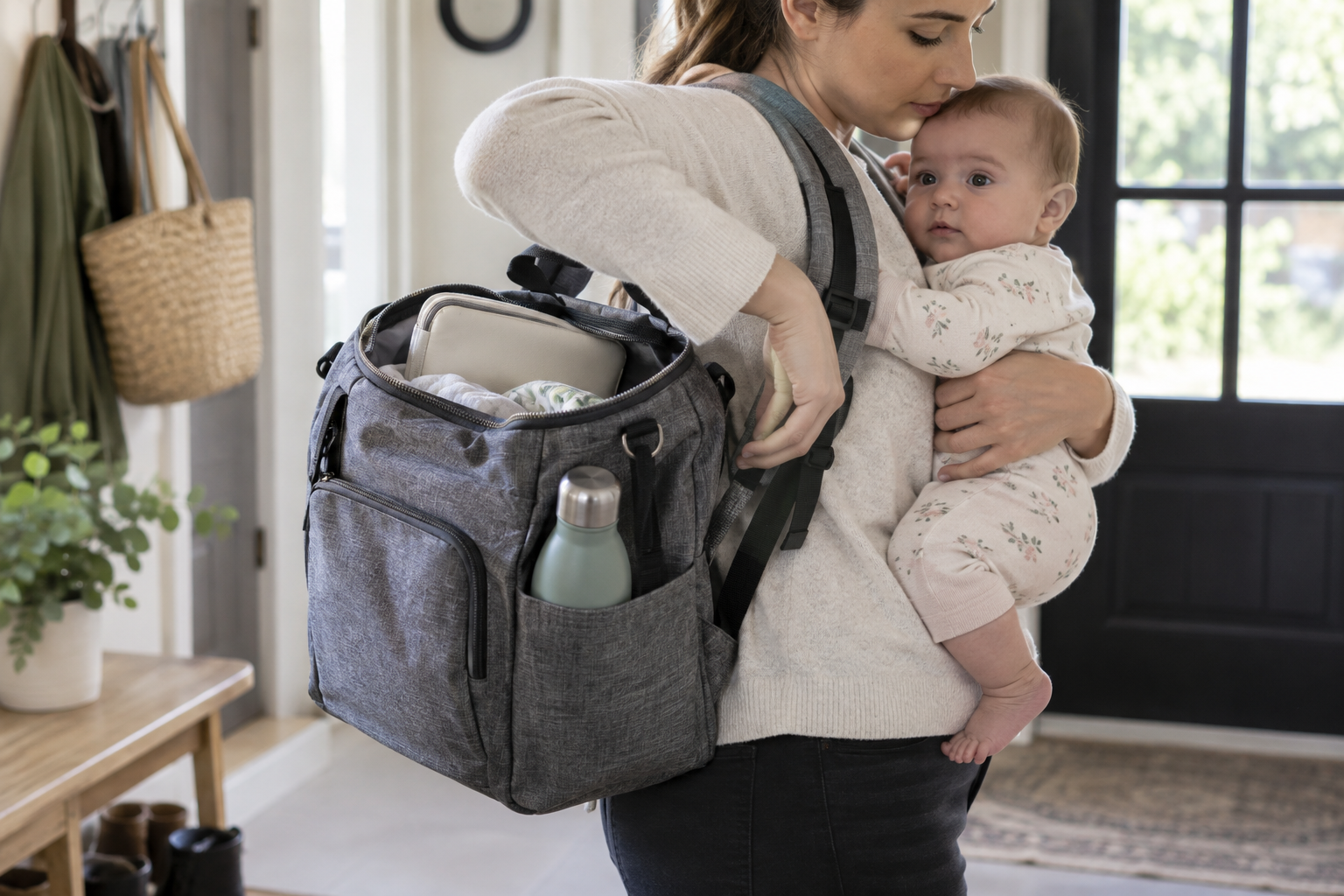
For diaper bags, practicality, carrying comfort and usable room matter more than a long feature list. The useful question is not, “How many pockets does this have?” It is, “Can I reach the right pocket while managing my child and the rest of the gear?”
Pack a candidate bag with your real load before deciding. If you are shopping in person, bring the bulkiest everyday items or objects of similar size. If you are ordering online, keep the packaging and return conditions intact until you have completed the same test at home.
- Load it honestly. Include the clothing, feeding supplies, change supplies and caregiver items you normally bring. Empty-bag comfort tells you very little.
- Wear it through ordinary movements. Put on a coat, bend, sit, lift the child as you normally would and move through a doorway. Look for slipping straps, pressure points and a bag that swings into the child or nearby objects.
- Run a retrieval test. Reach for wipes, a diaper, a change of clothing and your own keys without removing unrelated items. Anything that requires unloading the main compartment needs a better location.
- Test the destination. Place the packed bag in the stroller storage area, vehicle footwell or entryway spot where it will actually live. A good bag that never fits its assigned space is the wrong bag.
- Try a caregiver handoff. Ask the other caregiver to find the core supplies without coaching. Confusion now predicts frustration during a real outing.
Look closely at the opening. A bag can have ample capacity but poor usable space if the zipper opening is narrow or the contents collapse into one pile. A lighter-coloured interior can make small items easier to see, while a stable base can help the bag remain open during a change. Those details are valuable only if they work with your normal packing load.
Choose the carrying style around the trip. Backpack straps can free your hands, but they still need to sit comfortably when the bag is full. A tote may offer quick access but become tiring on a longer walk. A convertible bag can support different outings, though extra straps and hardware may add bulk. Test the mode you will use most rather than treating every possible configuration as equally important.
Specialized compartments deserve the same scrutiny. A changing-pad sleeve is useful only if the pad returns to it easily. A bottle pocket must fit the container you use. If you carry milk or perishable food, follow the storage guidance appropriate to your feeding routine; a pocket labelled as insulated is not, by itself, a complete food-safety plan.
Finally, decide where the bag will ride. Do not hang a loaded bag from a stroller or wagon handle unless that product’s manufacturer explicitly permits it. Moving weight away from the intended storage area can affect balance. Use the approved basket or storage position instead.
Decide whether a stroller wagon solves the right problem
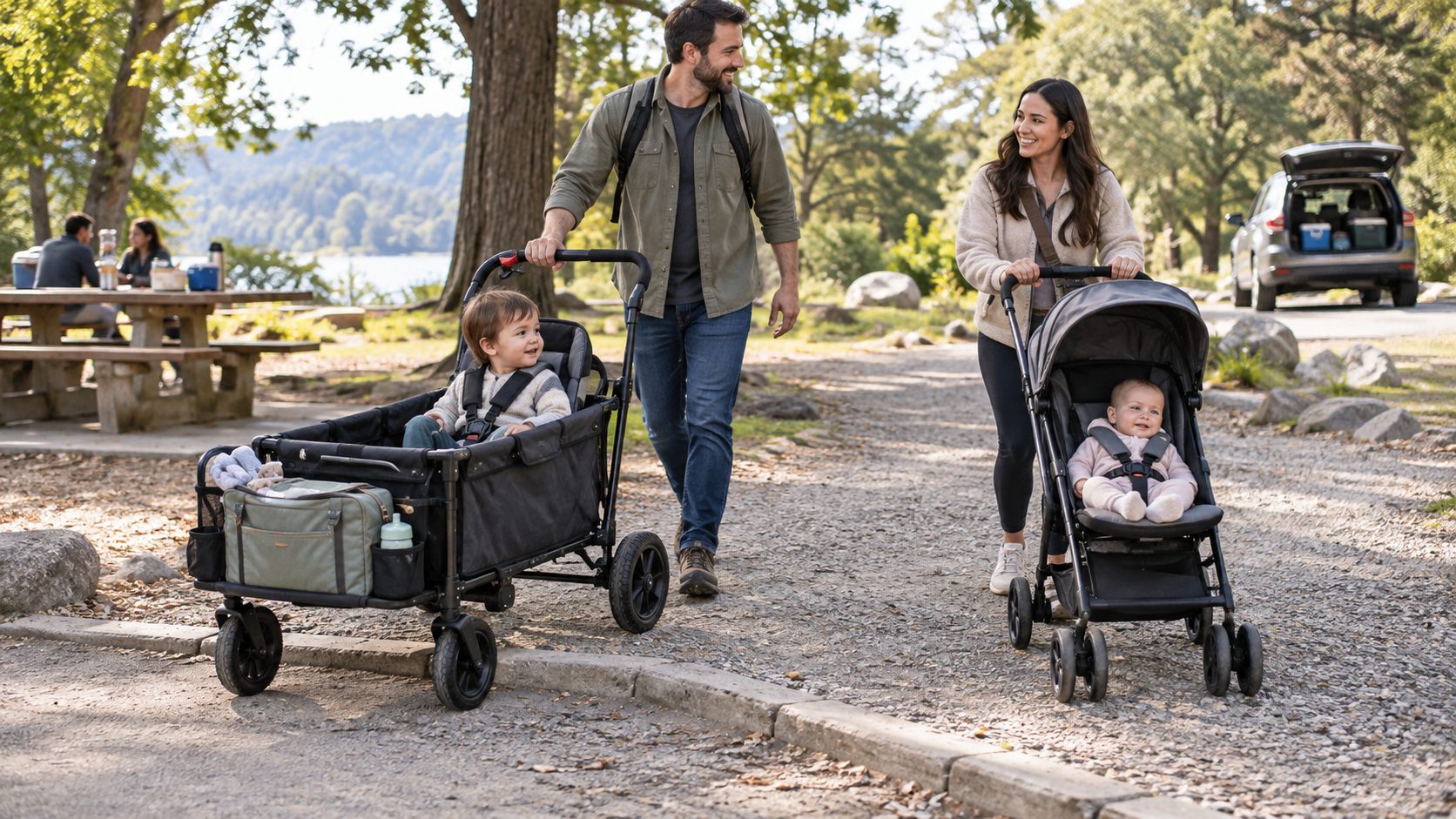
A stroller wagon can be useful when children, outdoor supplies and bulky family gear no longer fit comfortably into a conventional setup. It can also create a larger folding, lifting, steering and storage problem. Capacity is an advantage only when you can manage the vehicle-sized object that provides it.
With 44 top-rated stroller wagons put through testing, the category is broad enough that the word “wagon” does not describe one predictable format. Models can differ in how they fold, turn, store cargo and handle outdoor use. A recommendation is therefore a starting point; your child, route and storage constraints still determine whether a particular model works.
Use these as pass-or-fail checks:
- Child eligibility: read the manual’s age, weight, seating and restraint requirements. Do not improvise a seating arrangement or attach a car seat unless the exact configuration is approved by the manufacturer.
- Route fit: think through doors, elevators, curbs, shop aisles, crowded paths and the surfaces you encounter. Measure any genuinely tight space rather than relying on visual estimates.
- Control under load: try the brake, turning radius and push or pull position with a realistic load. Check whether you can stop, turn and restart without fighting the wagon.
- Folded-life fit: fold it, lift it and place it where it will be stored. Include any step required to remove seats, wheels or accessories, because that step becomes part of every departure.
- Cleaning access: inspect seams, footwells, cup holders and the route crumbs or spills will take. Confirm that the parts you expect to wash are actually removable or reachable.
- Shared-care usability: make sure each regular caregiver can operate the fold, brake, restraints and storage without relying on memory or guesswork.
A useful distinction is that the diaper bag and wagon perform different jobs. The bag should organize items you need to retrieve quickly and may need to carry away from the ride. The wagon provides passenger and cargo capacity. Even when you use both, keep the quick-access kit compact enough to remove as one unit.
If the wagon works only for occasional outings, compare that benefit with the space it occupies every day. A conventional stroller plus a well-organized bag may remain the easier default. The wagon earns its footprint when its extra capacity repeatedly removes a real constraint, not merely because it can hold more.
Pack in zones so the urgent item stays reachable
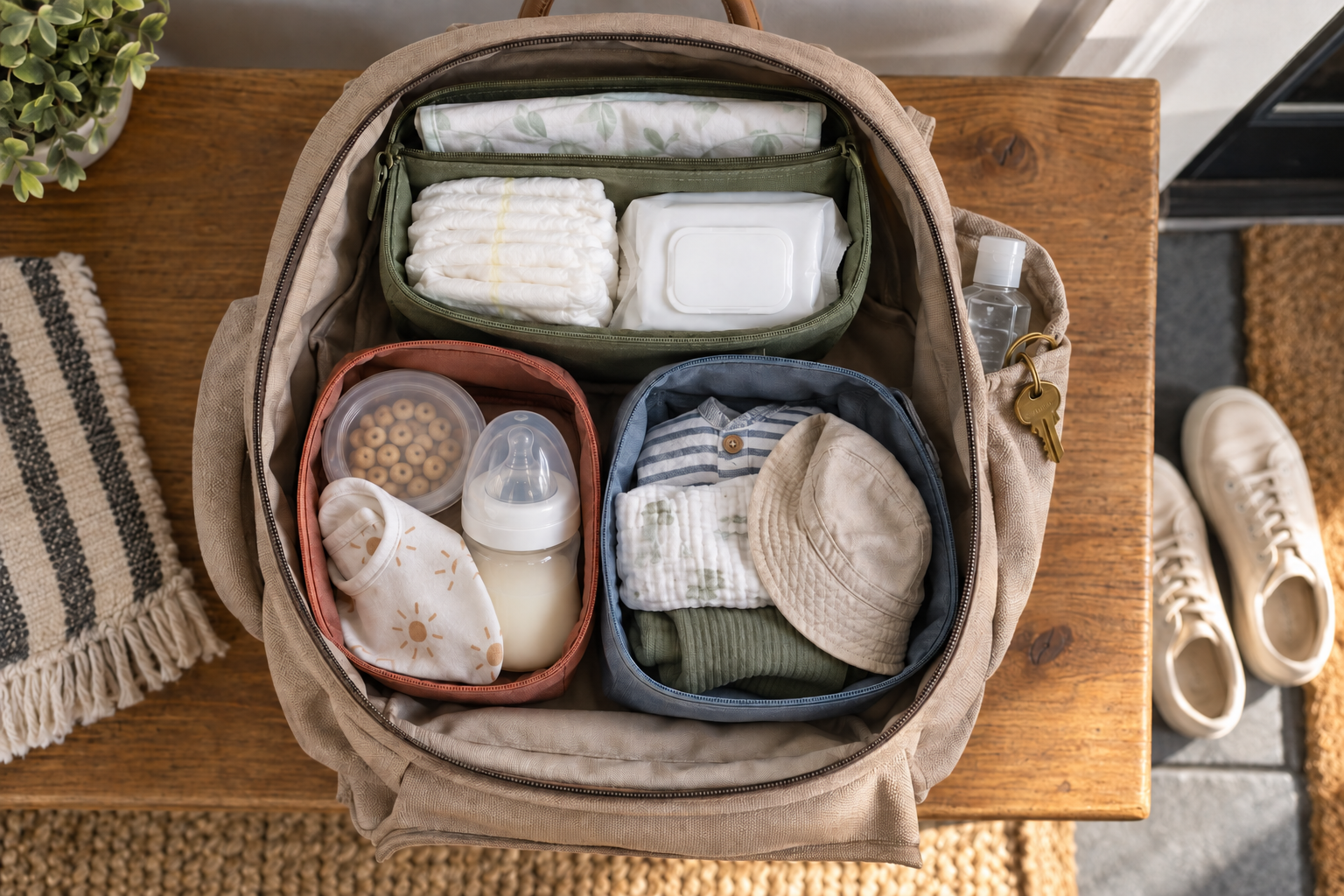
Once you have the right container, assign every item according to when and how you use it. Categories such as “baby things” are too broad. Retrieval-based zones are easier to remember under pressure.
- Immediate-care zone: the supplies used during a routine change, kept together and reachable without opening the rest of the bag.
- Feeding zone: only the feeding items appropriate to your child’s current routine, with anything leak-prone kept upright and separately contained.
- Clothing and weather zone: a compact change of clothing and the weather items selected for that outing, rather than a permanent collection for every possible condition.
- Caregiver zone: keys, wallet, phone, water and any other essentials you need without digging through child-care supplies.
- Dirty-item zone: an empty, closable container for wet clothing, used feeding items or rubbish. Starting with this space empty matters; otherwise the mess spreads into clean supplies.
Small pouches can make these zones portable, but avoid creating a puzzle of identical containers. Use visibly different colours, textures or labels. The goal is recognition at a glance, including for someone who did not pack the bag.
Keep the most frequently used item at the shallowest level. A beautifully ordered stack fails as soon as the item at the bottom is needed. Bulky backup supplies can sit deeper, but the immediate-care kit, caregiver essentials and dirty-item container should be accessible without dismantling the load.
Create a reset point near the place where the bag is stored. After an outing, remove rubbish and damp items, return objects that belong elsewhere, and replenish only what was used. Leave the empty dirty-item container open or otherwise visible until it has been replaced; that visual gap is more reliable than hoping you remember at the next departure.
A short written checklist also makes changing stages easier. When your child outgrows a feeding item, clothing size or care routine, update the list instead of continuing to carry obsolete supplies. Review the bag whenever you notice that an item has travelled repeatedly without being used. Some backups are prudent, but repeated non-use is a prompt to decide rather than an automatic reason to remove them.
Key takeaways for a setup that works outside the house
- Choose gear around a recurring outing and its hardest transition, not around maximum advertised capacity.
- Test a diaper bag fully loaded for retrieval, comfort, fit and caregiver handoff before committing to it.
- Consider a stroller wagon only after checking child eligibility, route access, control, folding, lifting and home storage.
- Keep rapid-access supplies in a removable kit, even when a wagon carries the larger load.
- Organize by moment of use, and reserve a separate empty space for wet or dirty items.
- Reset the bag after returning home so preparation does not become a rushed departure task.
Before buying anything, pack your current setup for the next real outing and rehearse the departure. Put on the outerwear you would normally wear, load the stroller or vehicle, retrieve the core care supplies, and put everything away again. The point where that sequence breaks tells you what to change. If the problem is layout, reorganize first. If it is carrying comfort, bag fit or genuine cargo capacity, you now have a precise requirement to shop for.
References
- Parents – The 10 Best Stroller Wagons We Tested to Transport Kids and All Their Stuff
- Parents – The 10 Best Diaper Bags We Tested to Keep Us Organized and Prepared While on the Go