
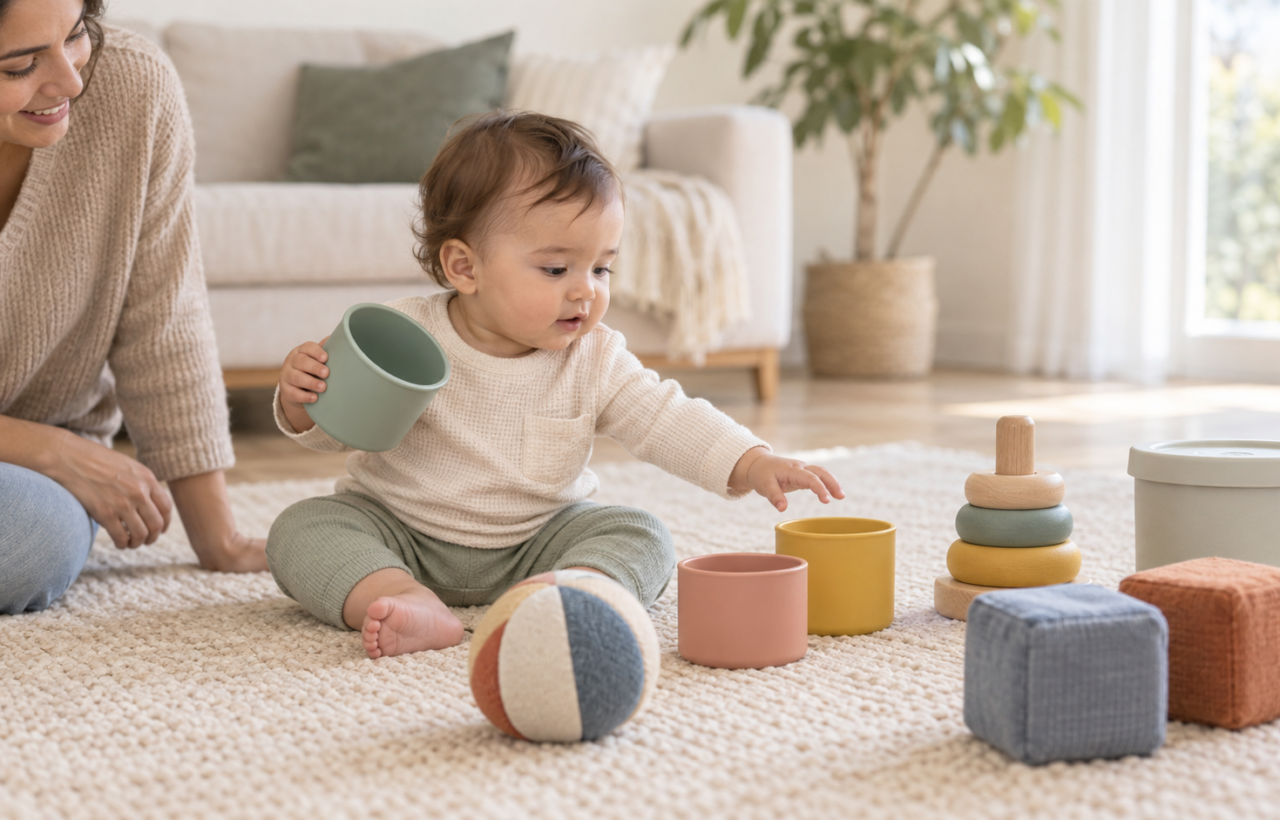
You want a toy your 10-month-old will actually use, not one that looks educational on the box and gathers dust after two minutes. At this age, the best choices usually have a simple job: something to grasp, drop, roll, open, close, fill, empty, push, or chase.
That simplicity is useful. Ten-month-olds are often crawling, beginning to toddle, and intensely curious, so a toy should reward experimentation without requiring your baby to follow complicated instructions. Here is how to build a small, practical toy collection around the way your baby plays now.
Key takeaways
- Choose toys by the action they invite, such as dropping, stacking, rolling, pressing, or turning.
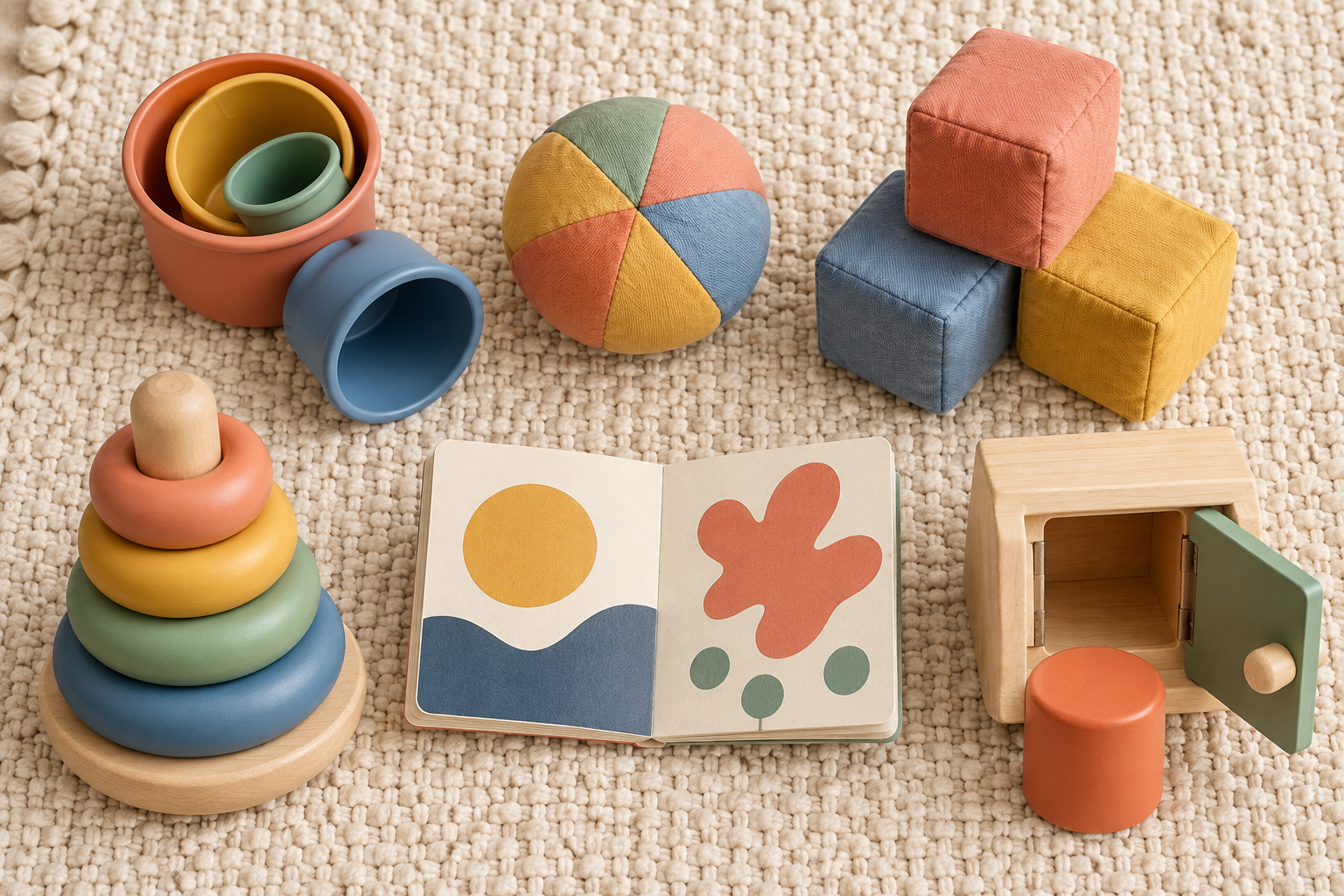
- A useful starter set can be small: nesting cups, large blocks, a ball, sturdy books, a container toy, and one simple cause-and-effect toy.
- Do not expect your baby to use a toy the way its packaging demonstrates. Mouthing, banging, removing pieces, and repeating one action can all be meaningful play.
- Match the challenge to what your baby can do now. A toy should require some effort without depending on skills your baby has not developed yet.
- Check every toy for loose parts, accessible batteries, cords, tipping, sharp damage, and pieces that could fit in your baby’s mouth.
- Your attention adds more developmental value than extra features. Describe the action, pause for a response, and let your baby repeat it.
Start with the action, not the educational label
“Developmental” is a broad marketing term. It does not tell you whether a toy fits your baby’s current abilities. A more reliable question is: What can my baby do with this?
Look for an answer that is physical and obvious. Your baby can drop a block into a bowl, roll a ball, lift a flap, squeeze a soft toy, turn a chunky page, or press a large button. Those actions give your baby a clear relationship between effort and result.
Be cautious when the main attraction is a crowded panel of lights, songs, and automatic movement. Those features are not inherently bad, but they can make it hard to tell what your baby caused. A simpler toy often leaves more room for prediction, repetition, and invention.
The right difficulty matters too. If every result happens with a light accidental touch, your baby has little to work out. If the lid is too tight, the button too stiff, or the pieces too precise, the toy becomes an adult-operated performance. Look for a challenge your baby can affect after watching you demonstrate it once or twice.
Six toy types that earn their place
Nesting cups and containers
Nesting cups can be separated, stacked, knocked down, filled, and emptied. A wide container with a few large objects offers the same basic play: take something out, inspect it, and try to put it back.
At first, make the task easy. Place one or two cups loosely inside each other, or put a large block in a shallow bowl. A deep box packed with pieces may make the interesting action harder to see. As your baby’s control improves, add more pieces or demonstrate a short sequence such as “in, in, out.”
Large blocks and easy-grip pieces
Choose blocks that are easy to grasp and too large to be mouth-sized. Your baby may not build a tower yet. Passing a block between hands, holding two together, banging them, releasing one, and toppling your small tower are worthwhile uses.
Build only a low structure and let your baby knock it over. If you immediately rebuild, you create a repeatable game with a clear beginning and result. Name the action rather than correcting the technique: “Up,” “down,” and “you knocked it over” are enough.
A soft or lightweight ball
A ball encourages visual tracking, reaching, crawling, and back-and-forth play. Start close. Roll it slowly across the floor while your baby is sitting, or roll it only a short distance ahead of a crawling baby. A ball that shoots across the room every time it is touched creates more retrieving for you than play for your baby.
Texture can make a ball easier to hold, but inspect ridges, plugs, seams, and attached decorations. If the ball is damaged or a component can loosen, retire it rather than treating the damage as cosmetic.
Sturdy board or cloth books
A book is both an object to manipulate and a reason to talk together. Choose pages your baby can grab without tearing easily, clear pictures, and a format that tolerates frequent handling. Flaps should be firmly attached and large enough that they do not become loose little pieces.
You do not have to read every word. Point to one picture, name it, wait, and follow what catches your baby’s attention. If your baby turns three pages at once or closes the book, continue from there. The shared attention matters more than finishing in order.
Simple cause-and-effect toys
A spinner, pop-up feature, large button, or easy lever can help your baby connect an action with an outcome. Test the mechanism yourself. It should move without excessive force, and the result should follow the action closely enough for the connection to be apparent.
Give your baby time before pressing the button for them. Demonstrate once, place the toy within reach, and pause. If they touch the area without activating it, describe what happened and let them try again. Constantly completing the action can turn active exploration into watching.
Everyday objects chosen with care
You do not need to buy a product for every kind of play. A clean plastic bowl, a sturdy measuring cup without detachable parts, or a wooden spoon can support filling, emptying, tapping, and imitation. Treat household objects as supervised play materials, not automatically safe toys.
Check for cracks, sharp edges, detachable silicone or rubber pieces, and a size that could obstruct your baby’s airway. Do not offer keys, remotes, medication containers, magnets, battery-powered objects, or anything you need your baby to learn is off-limits. A toy version is less confusing than occasionally allowing the real item.
Match the toy to the baby in front of you
Age recommendations are a starting point, not a promise that every 10-month-old will enjoy the same challenge. Development does not arrive as one synchronized package. A baby may be eager to move across the room but uninterested in placing pieces, or content to sit and examine objects while another baby chases anything that rolls.
- If your baby mouths everything: prioritize washable, one-piece toys with no peeling surface, loose filling, or detachable decoration. Mouthing is not a reason to stop offering toys; it is a reason to choose materials carefully and inspect them often.
- If your baby wants to crawl: try a slow-rolling ball or place an appealing toy just within achievable reach. Do not keep moving it away once your baby approaches; reaching the goal is part of the game.
- If your baby is pulling to stand: use only a genuinely stable play surface that will not roll, fold, or tip when pulled. Test it with more force than your baby is likely to apply, and stay close.
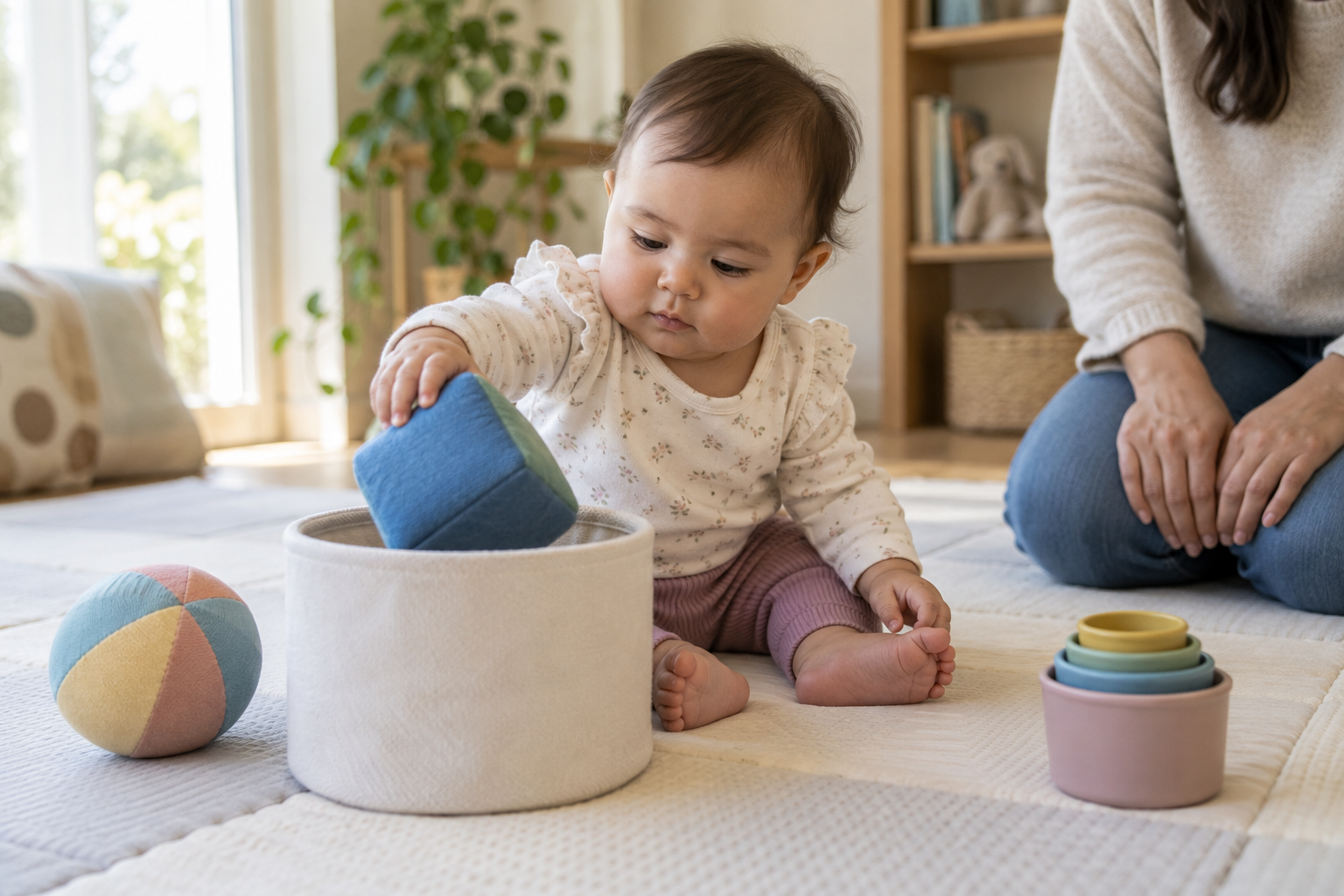
- If your baby loves removing pieces: offer a shallow container with a few large objects. Putting pieces back may come later; do not turn removal into a correction exercise.
- If your baby loses interest quickly: reduce the number of toys in view. One ball and two cups may invite more focused exploration than a floor covered with choices.
- If your baby becomes frustrated: simplify one part of the task. Loosen the lid, use a shallower container, separate the nesting cups, or hold the toy steady. Help just enough to reopen the possibility of success.
Do not use a shape sorter, stacking toy, or activity cube as a milestone test. Your baby does not need to perform the advertised “correct” sequence for the toy to be useful. Watch what they attempt, then decide whether the toy offers a manageable next step.
Run a safety and fit check before play
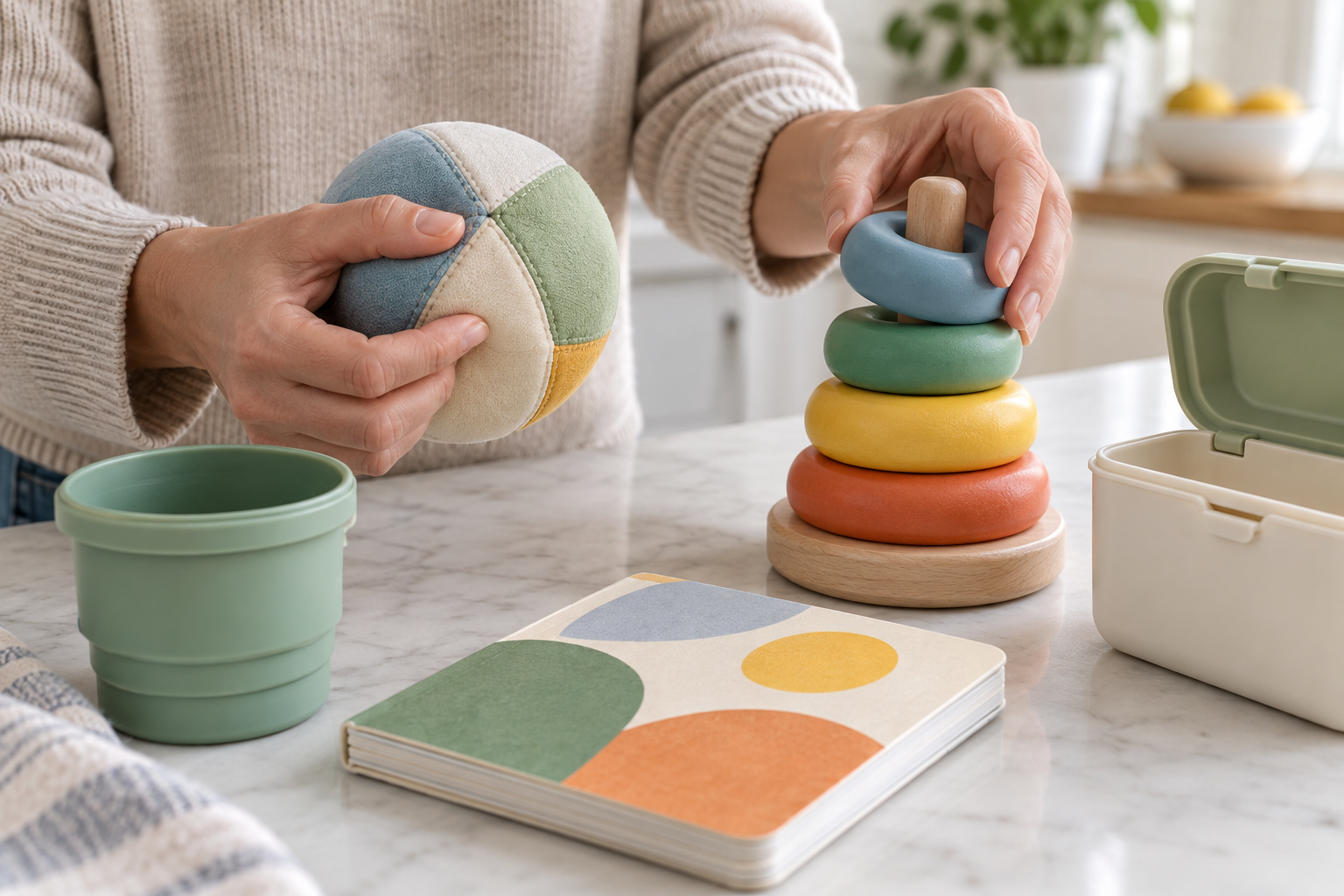
A toy category is never a guarantee of safety. Design, condition, setup, and the way your baby uses the item all matter. Read the manufacturer’s age and use instructions, then examine the individual toy before handing it over.
- Check the size: reject the toy or any removable part that could fit completely inside your baby’s mouth.
- Pull on attachments: test ears, wheels, knobs, labels, ribbons, and decorative pieces. Stop using the toy if anything is loosening.
- Inspect battery compartments: batteries should be inaccessible during play. A missing fastener, cracked cover, or exposed battery means the toy is out of use. If a button battery may have been swallowed, seek emergency help immediately rather than waiting for symptoms.
- Look for cord and loop hazards: avoid long strings, cords, or loops that could wrap around the neck or catch on furniture.
- Test stability: anything used near a baby who pulls up must resist tipping and sliding. A wheeled toy is not a stable handhold simply because it has a handle.
- Inspect the surface: feel for sharp edges, splinters, cracks, peeling coatings, exposed stuffing, and pinch points.
- Use the floor: place active toys on a clear floor rather than a bed, sofa, changing surface, or tabletop from which your baby could fall.
- Recheck over time: washing, chewing, impacts, and repeated use can change a toy. Include toy inspection in cleanup instead of treating the first check as permanent.
Supervision is especially important when a toy is new. Watch how your baby actually uses it. Babies often find leverage points, openings, and alternate uses that are not obvious when an adult examines a toy.
Turn a small toy collection into richer play
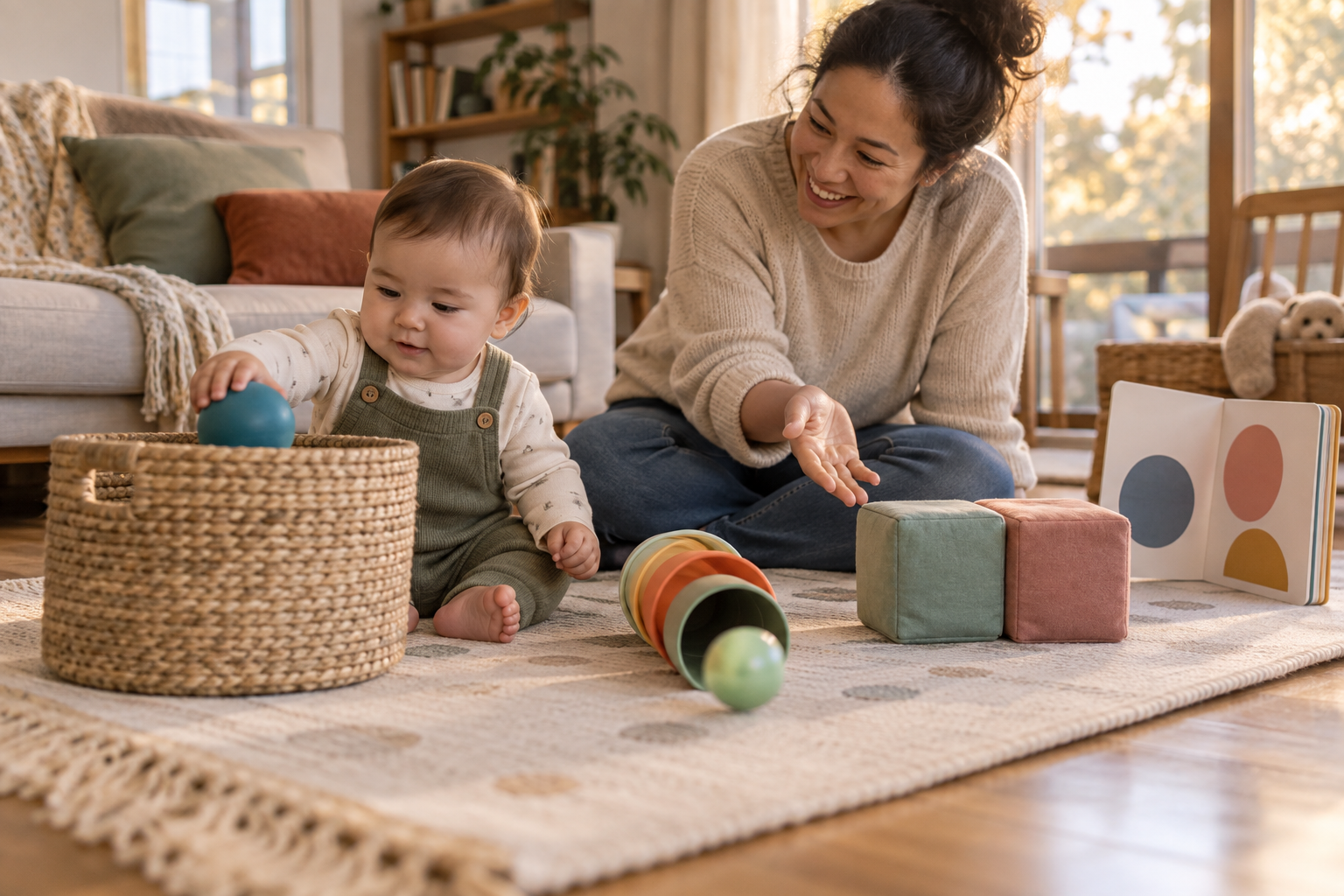
You do not need a new toy every time your baby changes. You can change the play by changing the setup. Put a familiar ball in a box, stack two familiar cups, hide part of a block under a cloth, or place two objects far enough apart that your baby must choose and move between them.
Keep only a few options within reach and store the rest. When interest fades, swap one or two items rather than replacing the entire selection. A familiar toy presented in a new position can create a fresh problem without introducing a completely unfamiliar object.
Your interaction can follow a simple rhythm:
- Place the toy where your baby can reach it safely.
- Show one action without giving a long explanation.
- Pause and allow your baby to respond.
- Follow the action your baby chooses, even if it differs from yours.
- Add a short word or phrase: “roll,” “inside,” “open,” or “you found it.”
- Repeat while your baby remains engaged, then stop when they turn away, push the toy aside, or become upset.
Start with the smallest useful set: cups, blocks, a ball, books, a container, and one cause-and-effect toy. Watch which actions your baby repeats over the next several play sessions. That observation will tell you more about the next toy to choose than a long list of features on a package.
References




