
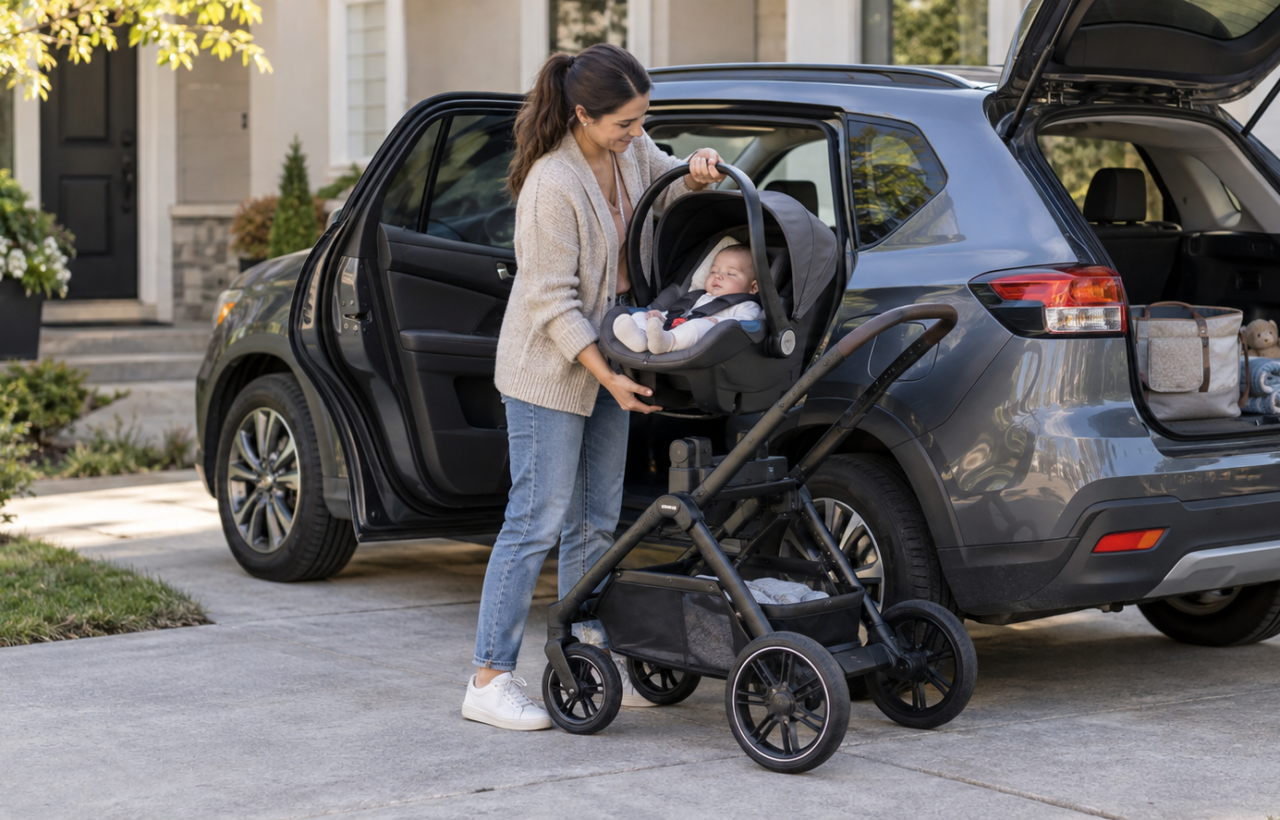
You can buy a capable infant car seat and a capable stroller and still feel frustrated every time you leave home. The trouble is usually a mismatch: the carrier crowds a passenger, the folded stroller fills the trunk, or attaching the two takes more effort than the outing saves.
A travel system is designed to make the handoff from the car to the stroller easier because your baby can stay secured in the infant carrier. That convenience is useful only when the complete system fits your baby, vehicle, body, storage space and everyday route.
Choose for the trip you repeat, not the trip you imagine
Start by writing a single sentence about how you will normally leave home. Be literal: “I will carry the stroller down apartment stairs, put it in a compact trunk and use it for short errands” is more useful than “I need something good for travel.”
Your usual route tells you which features deserve priority:
- If most outings begin in the car: concentrate on the car seat’s installation, space for front passengers, ease of docking the carrier and the stroller’s folded size.
- If you walk most days: give more weight to the stroller’s handling, brake, basket access, weather coverage and comfort after your baby stops riding in the infant carrier.
- If you use stairs or public transit: check the weight, grip points and folding sequence. A compact fold is not helpful if it requires loose parts that you cannot manage while supervising your baby.
- If storage is tight: measure the trunk opening, cargo area, hallway and closet where the stroller will actually live. Published folded dimensions matter more than how small a stroller looks in photographs.
- If caregivers will share the system: everyone who regularly drives or pushes should be able to install, adjust, fold, lift and release it. A mechanism that suits one person’s reach or hand strength may frustrate another.
Separate your requirements into “must fit,” “must operate” and “nice to have.” Trunk fit belongs in the first group. A fold that every caregiver can manage belongs in the second. A matching cup holder probably belongs in the last. This keeps a long feature list from hiding a basic incompatibility.
Confirm three different kinds of fit
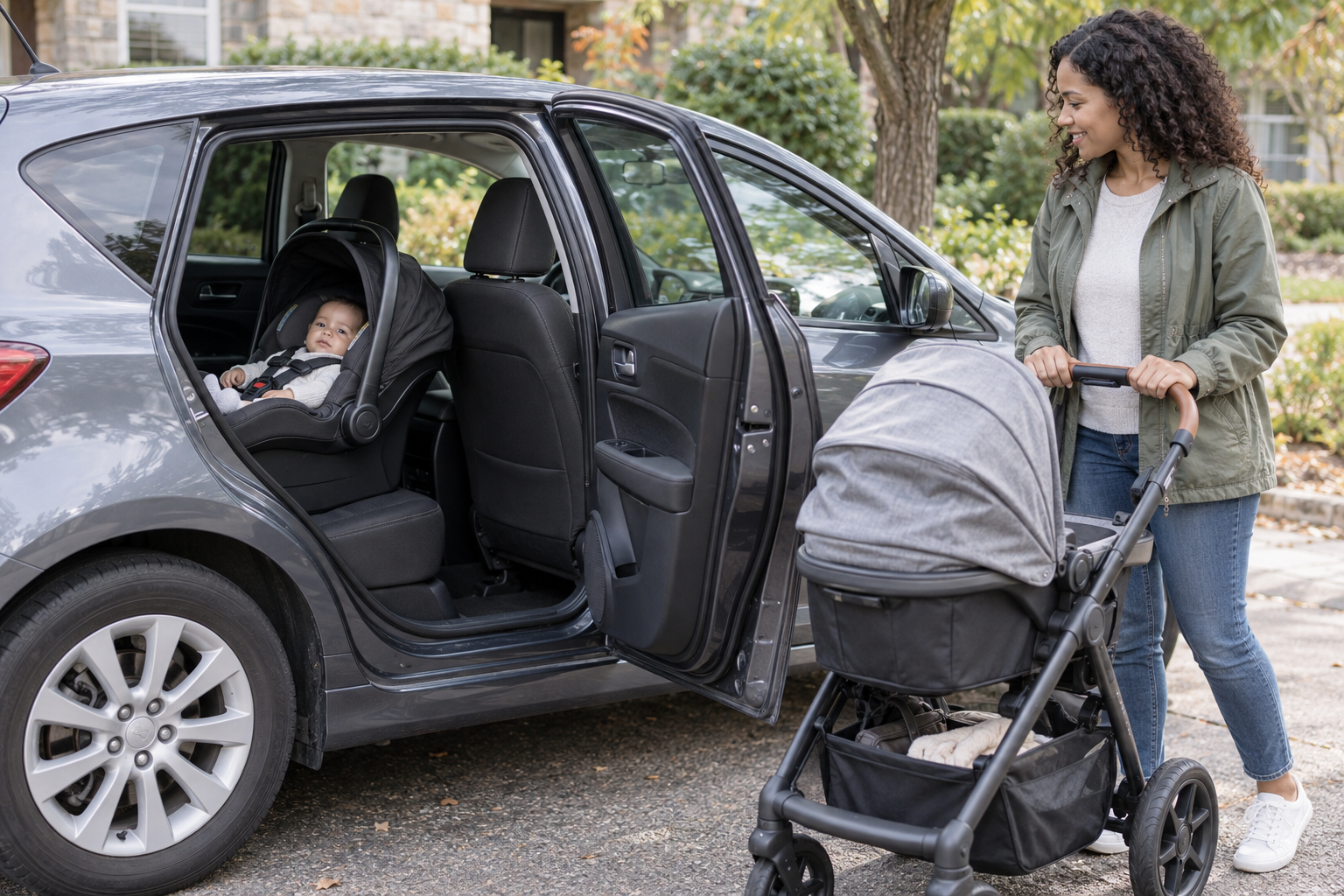
A travel system may be sold as one package, or it may combine a separately purchased stroller, infant seat and adapter. Either way, compatibility must be exact. A shared brand name, similar connector or reassuring click is not enough.
Fit for your baby
Read the infant seat’s current size criteria and instructions for harness position, permitted inserts and handle placement. Use only padding and accessories the manufacturer explicitly allows. An extra cushion can change the way the harness fits even when it appears to make the seat more comfortable.
Check the stroller separately. The stroller seat can have different eligibility requirements from the attached infant carrier, so do not assume that the regular seat is suitable from birth. Verify the approved configuration in the stroller manual before planning to use it without the carrier.
If your baby’s size or medical needs make the fit unclear, pause before using the seat. Ask the baby’s healthcare team and a trained child-passenger-safety professional in your area for individual help.
Fit in your vehicle
Check the seat in the vehicle and seating position where it will be used. Set the driver’s and front passenger’s seats where the actual occupants need them before deciding that everything fits. A car seat that can be installed only after making another seat unusable is not a practical fit for your household.
Follow both the car seat manual and the vehicle manual for the permitted installation method and position. If you cannot reproduce the installation described in those instructions, do not improvise or rely on a general online demonstration. Get hands-on help from a qualified child-passenger-safety professional.
Fit on the stroller
Match the exact infant-seat model, stroller model and adapter version. Confirm the required orientation, attachment indicators and release method in the manufacturers’ instructions. Do not infer compatibility from a similar shape, a marketplace listing or another product with the same logo.
If you are mixing components rather than buying a boxed system, ask the manufacturers to confirm the combination using the complete model identifiers. Save that confirmation with the manuals. Also check whether the adapter can remain attached when the stroller folds and whether using it changes access to the basket, brake or other controls.
Attaching a car seat to a stroller does not expand the seat’s approved uses. Its positioning, harness and accessory instructions still apply wherever it is attached. Treat the system as transportation equipment, not as a substitute for your baby’s usual sleep space.
Run the complete routine before committing

A quick push around a smooth showroom floor tests very little. The useful trial is the sequence you will perform when you are carrying a diaper bag, watching your surroundings and trying to get home.
- Set the vehicle seats for their usual occupants. Install the infant seat or its base in the intended position, following the manuals.
- With the carrier empty, practise docking and releasing it in the car. Check that each regular caregiver can see or feel the indicators described by the manufacturer.
- Attach the empty carrier to the stroller and release it again. Repeat the motion until you know the first successful attempt was not luck. Never use your baby to test a floor model or an installation that has not been verified.
- Fold and unfold the stroller in the configuration you will use. Notice whether you must remove the carrier, stroller seat or adapters, and identify where those loose pieces will go.
- Lift the folded stroller across the actual trunk lip, place it inside and close the hatch. Confirm that there is still room for the items you normally carry.
- Load your usual diaper bag into the basket. Make sure you can reach it with the carrier attached and that it does not interfere with the brake, wheels or folding mechanism.
- Push, turn and operate the brake in the retailer’s permitted test area. Test handle adjustments, harness controls and the canopy with the seats empty.
Pay attention to awkwardness as well as weight. A light stroller can still be difficult to lift if its grip points are poorly placed for you. A heavier model may be manageable if it folds into a balanced shape. Similarly, “one-hand fold” is useful only if the release is within your reach and the stroller does not need another hand to keep it from falling open.
If you are ordering online, compare the published folded dimensions with measurements from your trunk opening and cargo floor, not just the vehicle’s advertised cargo capacity. Keep the packaging and understand the return conditions until you have confirmed physical fit. Car seats and strollers are large enough that a technically returnable item can still be expensive or inconvenient to send back.
Judge the stroller beyond the infant-carrier stage
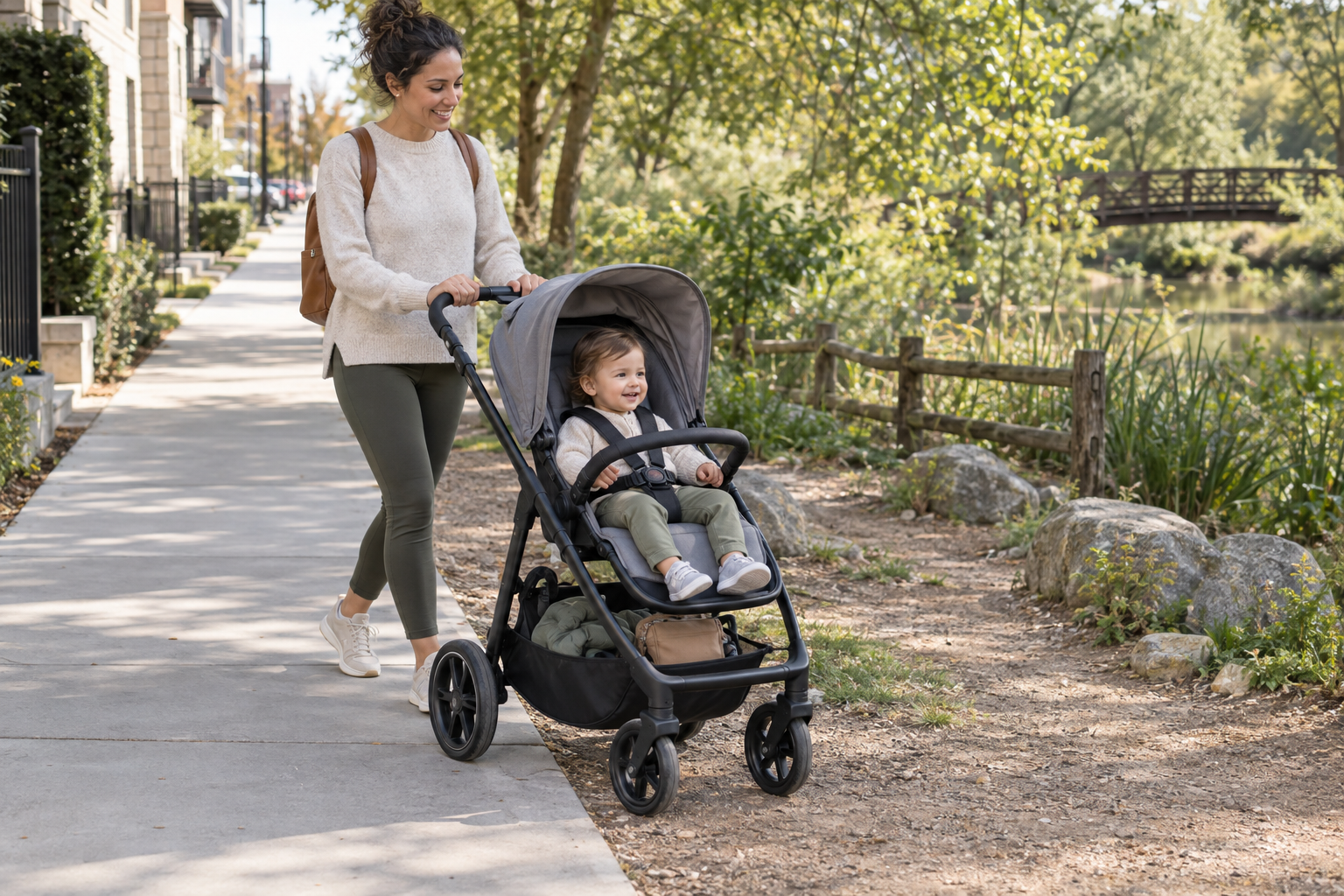
The infant carrier is one stage of the system. Your child will eventually move out of it according to the manufacturer’s limits, while the stroller may remain part of daily life. A bundle is poor value if its most durable component is the part you least want to use.
Evaluate the regular stroller seat with the same care you gave the car-seat connection. Check its approved use criteria, harness adjustment, recline options, canopy, brake, basket and cleaning instructions. Think about whether you would choose that stroller if the infant carrier were not included.
Calculate the cost of the configuration you actually need, not just the price printed on the bundle. Depending on your routine, that total may include an adapter, an additional approved base, weather protection or another manufacturer-authorized accessory. Then remove anything you would not have bought on its own. A discount on an unwanted component is not a saving.
Also check what must be removed for cleaning and storage. Fabric that can be cleaned according to clear care instructions will matter after spills. A self-standing fold may matter in a hallway. Adapters that remain attached may save time. These ordinary details often shape ownership more than decorative finishes or a long accessories list.
Key takeaways
- Choose around the outing you repeat most often, not a rare holiday or an imagined future routine.
- Treat compatibility as model-specific. Verify the infant seat, stroller and adapter together using manufacturer instructions.
- Confirm child fit, vehicle fit and stroller fit separately; success in one does not prove the others.
- Test the whole sequence with the carrier empty, the vehicle configured normally and every regular caregiver involved.
- Do not let the convenience of stroller attachment override any car-seat installation, harness, positioning or accessory instruction.
- Assess the stroller as a standalone product because it may remain useful after the infant-carrier stage ends.
Your next step is not to open more comparison tabs. Write down your normal route, exact vehicle and storage measurements, then take a short list of compatible systems through the complete routine. The best choice is the one you can install correctly, operate without improvising and keep using when the convenient carrier stage is over.
References




