

You spot a thick patch of wax in your baby’s ear, or notice your toddler moving unusually close to see something. The useful first question isn’t, “What condition is this?” It is, “Has my child’s comfort, hearing, vision, or usual behaviour changed?”
Babies and young toddlers can’t reliably describe pressure, pain, muffled sound, or blurry vision. Their behaviour gives you clues, but no single behaviour makes a diagnosis. This guide will help you decide what is reasonable to watch, what deserves an appointment, and what should be assessed urgently.
Key takeaways
- Wax visible near the ear opening is often normal. Clean the outside of the ear, but leave the ear canal alone.
- Never insert a cotton swab, finger, scoop, or camera tool into your child’s ear. These can push wax deeper or injure the canal or eardrum.
- Ear pulling by itself doesn’t identify an infection. Pain, discharge, bleeding, illness, and a change in response to sound are more useful clues.
- Sitting close to one book or screen doesn’t prove that a child is nearsighted. Look for a repeated pattern of squinting, unusual head positioning, eye misalignment, or difficulty noticing things at a distance.
- A suspected button battery, chemical exposure, injury, severe pain, or sudden loss of function needs urgent professional help.
Leave ordinary earwax where it is
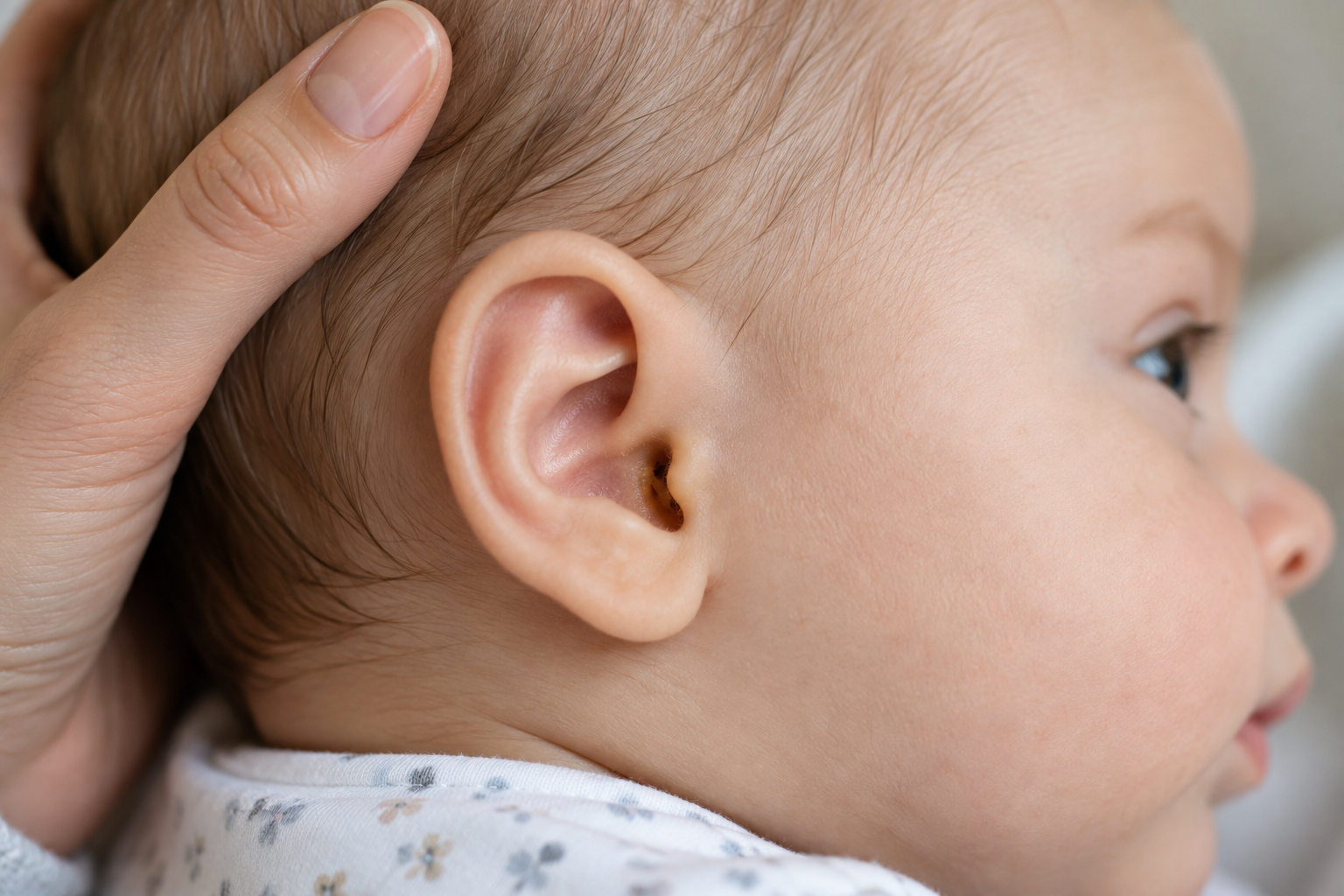
Earwax has a job. It helps trap debris, and the ear normally moves it toward the opening over time. A baby can have a noticeable amount of earwax without anything being wrong. The amount you can see also doesn’t tell you whether there is an infection.
If your child is comfortable, seems well, and responds to familiar voices and everyday sounds as usual, visible wax alone is generally something to leave alone. You can use this simple routine:
- Use a soft, damp cloth to wipe the outer ear and its folds.
- Remove only material that has already reached the outside. Do not push the cloth into the opening.
- Stop if touching the area seems painful.
- Ask a clinician to examine the ear if wax appears to block the canal, hearing seems different, or the buildup keeps returning.
Cotton swabs, metal or plastic scoops, fingernails, and phone-connected ear cameras can turn a harmless situation into an injury. They may pack wax farther into the canal, scratch delicate skin, or damage the eardrum. Ear candles should not be used.
Don’t pour oil, peroxide, water, or over-the-counter drops into a young child’s ear unless a qualified clinician has recommended that product for that child. Drops and flushing may be inappropriate when there are ear tubes, an injured eardrum, an infection, or an object in the canal. If a button battery could be present, put nothing into the ear and seek emergency help.
Ear touching is also easy to overread. Babies may touch their ears while tired, self-soothing, or exploring their bodies. Treat it as one clue, not a diagnosis. Repeated touching accompanied by obvious pain, discharge, bleeding, a bad smell, fever, unusual sleepiness, or reduced response to sound deserves medical advice. Fever guidance changes substantially with age, so call your child’s healthcare provider rather than relying on a generic cutoff.
Watch for a pattern of vision difficulty, not one habit

Myopia, or nearsightedness, makes distant details harder to see while closer objects may remain clear. A toddler usually won’t tell you that the far side of the room looks blurry. You have to notice how the child uses their eyes during ordinary play.
Getting close to a favourite picture, toy, or screen can simply reflect interest. It becomes more informative when the same behaviour keeps appearing with different objects, at different distances, and in different settings. Watch for:
- Repeated squinting or frowning when looking across a room.
- Consistently moving very close to see pictures, faces, or objects.
- Frequently closing or covering one eye.
- Using the same unusual head tilt or head turn to look at things.
- An eye that repeatedly turns inward or outward, especially if the pattern is becoming more noticeable.
- Difficulty following a moving face or toy, reaching accurately for visible objects, or noticing familiar people at an expected distance.
- A new change in visual behaviour rather than a stable quirk your child has always had.
Write down what you see instead of repeatedly testing your child. Note the object, distance, lighting, which eye seemed affected, and whether the behaviour happened again. A short video of an intermittent eye turn or head position can help a clinician see something that may not occur during the appointment.
Digital screen exposure has been linked with a greater chance of childhood myopia, but that does not mean one screen session caused a child’s vision problem. Myopia has more than one influence, and an observed association is not a diagnosis.
The practical response is modest: don’t let long, uninterrupted periods of close screen viewing crowd out varied play. Change activities, let your child’s eyes shift between near and far objects, and make room for outdoor play. These are useful routine choices, not a promise that myopia can be prevented. A child who repeatedly appears unable to see well still needs appropriate screening or an eye examination.
Separate urgent warning signs from appointment-level concerns
Seek urgent help
- You know or suspect that a button battery was placed in an ear. Do not probe the canal or pour in liquid.
- An object is lodged in the ear or eye, especially if removal attempts could push it deeper.
- There has been a chemical splash to the eye. Begin rinsing with clean, lukewarm water and seek emergency instructions immediately.
- An injury is followed by bleeding, severe pain, marked swelling, or a sudden change in the way your child sees or responds to sound.
- Your child appears seriously unwell, is unusually difficult to wake, or has rapidly worsening symptoms.
Don’t spend time trying to identify the exact injury before getting help. The risk in these situations comes from delay or from attempting removal at home.
Contact a clinician promptly
- Ear pain, drainage, bleeding, a persistent bad smell, or a noticeable change in response to voices and sounds.
- Wax that appears to close the canal or prevents a clinician from examining the eardrum.
- An eye that repeatedly turns, a drooping eyelid that obscures the pupil, or persistent trouble tracking objects.
- A white or grey appearance in the pupil that is visible in person or keeps appearing in photographs, rather than a single obvious glare artifact.
- New light sensitivity, eye pain, persistent redness or swelling, or a clear change in how your child navigates familiar spaces.
- Any concern that persists, becomes more frequent, or interferes with play, communication, sleep, or everyday activity.
If none of these warning signs is present but a behaviour keeps recurring, bring it to a routine child-health appointment. You don’t need to wait until your child can explain what feels different.
Bring observations that make the appointment more useful

A clinician needs more than “something seems off.” Before the visit, make a short note covering:
- When you first noticed the concern and whether it is changing.
- Whether one ear or eye seems different from the other.
- What your child was doing when the behaviour appeared.
- Any pain, fever, recent illness, discharge, bleeding, redness, swelling, or sleep change.
- Any change in response to familiar sounds, faces, toys, steps, or objects across a room.
- Anything placed in the ear or used as a home treatment.
- Previous ear tubes, eye or ear injuries, relevant medical care, and family history of childhood hearing or vision problems.
- A photo or brief video if the visible sign comes and goes.
Useful questions include: Is the ear canal actually blocked? Can the eardrum be examined safely? Does my child need formal hearing or vision testing? Is a referral appropriate? What home care is safe for this child, and which change should make us seek help sooner?
For today, keep tools and liquids out of the ear, observe vision during normal play instead of staging tests, and record any repeated change. If pain, injury, or loss of function enters the picture, move from watching to calling.
References
- Parents – Excessive Baby Earwax? Learn How to Handle It Safely
- Parents – Why Are More Kids Getting Nearsighted? Research Reveals a Common Cause




