

Your teen goes to bed tired, then becomes alert the moment the house gets quiet. Or they seem to sleep for hours and still wake exhausted, irritable, and unable to get started. When ADHD is part of the picture, simply announcing an earlier bedtime often misses the problem.
A more useful approach is to identify where sleep is breaking down, then make the evening require less planning, remembering, stopping, and switching. Start with observation, not a lecture.
First, locate the part of the night that is failing

Sleep difficulty is not one single problem. People with ADHD may take longer to fall asleep, wake more often during the night, experience insomnia, or spend more time in bed without actually sleeping. That distinction matters because each pattern points to a different conversation with your teen and, when needed, their clinician.
- Winding down is the problem: Your teen cannot disengage from homework, gaming, messaging, or another absorbing activity. The bedtime routine starts late or expands into a chain of forgotten tasks.
- Falling asleep is the problem: Your teen completes the routine and gets into bed but remains alert, restless, or mentally busy.
- Staying asleep is the problem: They fall asleep but wake repeatedly during the night.
- Feeling restored is the problem: They appear to spend enough time in bed but still wake exhausted. Sleep quality, not only time in bed, may be relevant.
- Mornings are the visible problem: Getting up takes repeated alarms and conflict. Look backward at the whole night before treating the morning as a motivation issue.
Keep a simple sleep log that covers both school nights and non-school nights. Record when the routine began, when lights went out, approximately when sleep began, any awakenings, the wake time, evening caffeine or electronics, and how your teen functioned the next day. If they take medication, record when each prescribed dose was taken without changing the schedule.
Use the log as a shared troubleshooting tool, not surveillance. Let your teen review or complete it. You are looking for patterns: alertness that consistently lasts into the evening, irritability as medication wears off, repeated waking, or a large difference between structured and unstructured days.
Why ADHD can turn one late night into a loop

ADHD and poor sleep can intensify each other. Inadequate or disrupted sleep can make attention, working memory, processing speed, impulse control, and emotional regulation harder the next day. Those are already areas in which many teens with ADHD need more support, so tiredness may show up as increased distractibility, hyperactivity, irritability, impulsive behaviour, or conflict rather than quiet sleepiness. A difficult ADHD day may therefore be a sleep clue, not proof that your teen is refusing to try.
Time in bed also does not tell the whole story. A small physiological study involving 62 adolescents ages 13 to 17, half of whom had ADHD, found that the ADHD group spent less time in slow-wave deep sleep and more time in stage 2 sleep. A study of that size cannot predict an individual teen’s sleep, but it helps explain why someone may wake unrefreshed despite appearing to have logged enough hours.
There may be more than one contributor. Differences in sleep-wake regulation can make settling difficult. A stimulant medication may remain active into the evening for one teen, while another becomes irritable or dysregulated as it wears off. Anxiety or depression can interfere with falling asleep or staying asleep. The practical lesson is to avoid assuming that every late night is caused by screens, defiance, or poor discipline.
Sleep loss then creates its own loop. A tired teen has fewer executive-function resources for homework, transitions, and emotional control. Tasks drift later, conflict rises, and the evening becomes more stimulating just when the brain needs predictable cues. Breaking that loop usually means reducing the demands around bedtime, not adding more reminders to remember.
Build a routine that carries the executive-function load
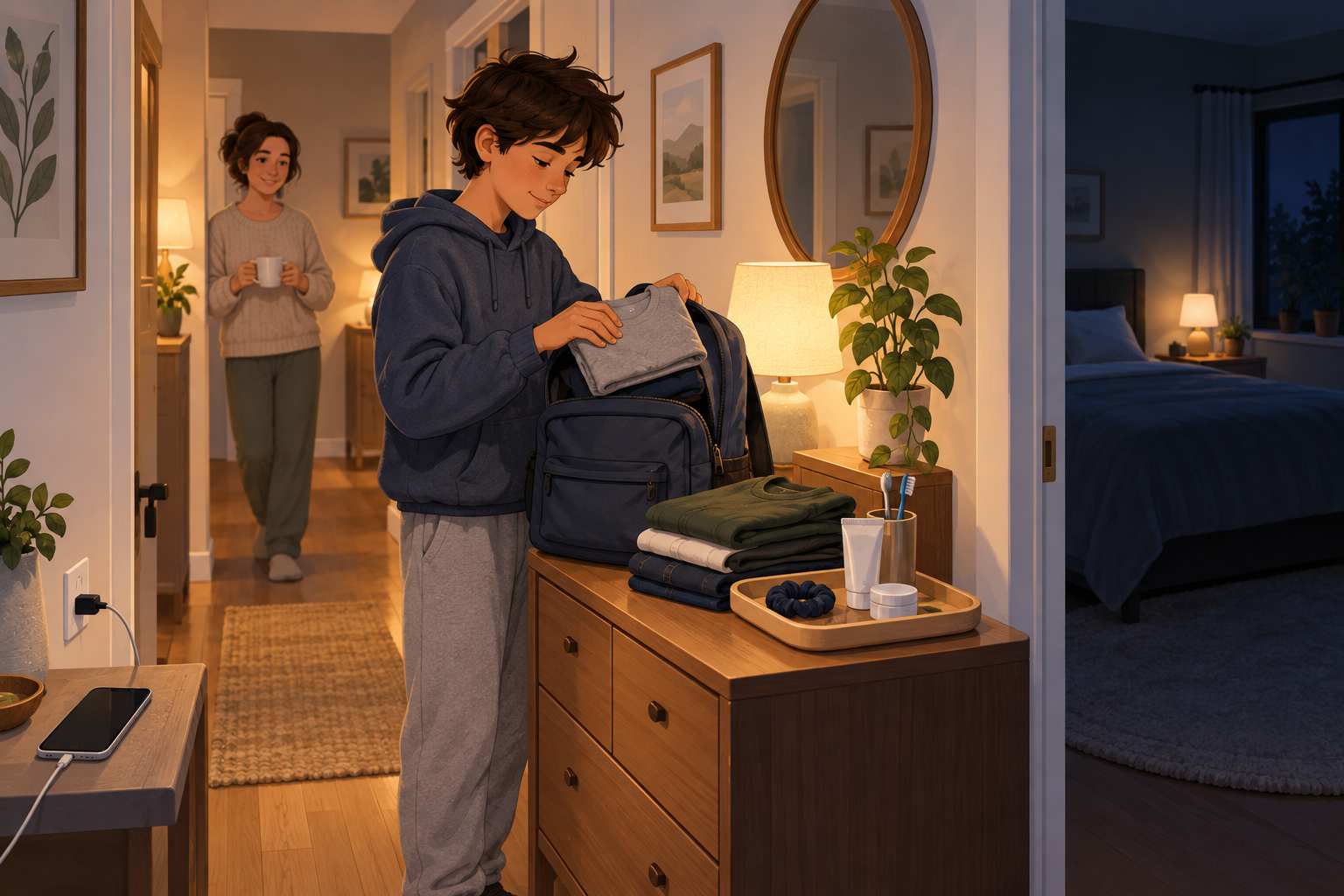
A useful bedtime routine is not a command to go to sleep. It is an external sequence that reduces decisions and repeatedly signals what comes next. Consistent sleep and wake times, calmer evening activities, less evening caffeine and electronics, earlier opportunities for movement, and white noise when helpful are practical places to start.
- Agree on stable anchors. Choose a regular time for the routine to begin, a lights-out window, and a wake time that can stay reasonably consistent across days and weeks. You cannot force the exact moment sleep begins, but you can make the cues leading to it predictable.
- Move physical activity earlier. Give your teen an opportunity to expend energy after school, before dinner, or earlier in the evening. Avoid turning exercise into one more task that must be completed immediately before bed.
- Close stimulating activities deliberately. Decide in advance when homework, gaming, messaging, and streaming stop. An external alarm or device setting can end the activity so a parent does not have to become the alarm every night.
- Use the same short sequence. A workable example is to plug in the phone, wash up, prepare essential items for morning, choose a quiet activity, and go to bed. Remove any step that regularly causes the routine to collapse, or move it to an earlier part of the day.
- Make the sequence visible. Put it where the actions occur: on the bedroom door, beside the charger, or on a bathroom checklist. Use your teen’s own words so the plan feels like a tool they helped design rather than a set of posted orders.
- Keep the final environment predictable. If your teen finds white noise calming, use it consistently as part of the sleep cue. Keep the last activity quiet and easy to stop.
Make screens a systems problem
Telling a teen with ADHD to use more willpower against an absorbing device places the hardest decision at the hardest time of day. Limiting electronics in the evening may support better sleep, but the boundary is easier to follow when it is built into the environment.
- Choose the phone’s overnight location before the evening begins.
- Use a recurring device downtime setting instead of negotiating the stopping point nightly.
- Have a defined replacement ready, such as reading, listening to calm audio, or another quiet activity your teen will actually choose.
- Apply the plan consistently enough that the boundary becomes predictable rather than a response to that day’s behaviour.
Involve your teen in deciding where the device stays and what replaces it. They do not have to like every boundary, but they should understand the sleep problem the household is trying to solve.
Use fewer reminders, placed earlier
Repeated verbal reminders can turn the routine into a nightly argument while still leaving your teen responsible for remembering every step. Prefer one agreed cue, a visible sequence, and environmental prompts. If the same step fails repeatedly, change the system: place supplies where they are used, prepare school items earlier, or simplify the sequence.
Consistency does not mean perfection. A late event or difficult night does not erase the routine. Return to the usual anchors at the next opportunity rather than compensating with an entirely new set of rules.
Know when routine changes are not enough

Medication deserves particular care. Some teens metabolize stimulant medication more slowly, which may extend alertness into the evening. Others experience a period of irritability or emotional difficulty as the medication wears off. These effects can look very different from one teen to another, especially while a medication or dose is being adjusted.
Do not skip, move, reduce, or otherwise change prescribed medication on your own. Record the timing and pattern, then take that information to the prescriber. A clear note such as alertness continues well past the routine on medication days or irritability begins as the dose appears to wear off is more useful than simply reporting that bedtime is bad.
Ask for professional help when sleep continues to be difficult despite a consistent routine, when repeated waking or exhaustion persists, or when daytime attention, mood, school functioning, or relationships are being affected. Start with your teen’s primary care clinician or ADHD prescriber. Bring the sleep log, the current medication list, and a description of what happens before, during, and after the night.
Anxiety and depression can disrupt both sleep onset and sleep maintenance, so prominent worry, persistent low mood, or a marked change in behaviour should not be treated as a bedtime-habit problem alone. A clinician can consider those possibilities alongside medication effects and sleep conditions.
Sleep-focused psychotherapy may also be appropriate. Cognitive behavioural therapy for insomnia, commonly called CBT-I, can help adolescents address persistent insomnia. Ask whether a clinician trained to work with adolescents and sleep is available; a household routine is useful support, but it is not a substitute for assessment or treatment.
Key takeaways
- Identify whether the difficulty is winding down, falling asleep, staying asleep, waking restored, or some combination.
- Treat bedtime as an executive-function task: make the sequence short, visible, predictable, and easy to begin.
- Keep sleep and wake cues consistent, reduce evening caffeine and electronics, and move opportunities for physical activity earlier.
- Track possible medication patterns, but take any question about dose or timing to the prescriber instead of experimenting at home.
- Seek professional help when the pattern persists or affects daytime life, and ask whether CBT-I, a medication review, or an assessment for anxiety or depression is appropriate.
Your first move tonight does not have to be an earlier bedtime. At a calm moment, ask your teen which part of the night feels hardest, then choose one environmental change together: a consistent routine cue, a phone parking place, or a visible sequence. Put the plan where it will happen and watch the pattern. If medication, mood, repeated waking, or continuing exhaustion stands out, take that pattern to a clinician rather than trying to out-discipline it.
References




