
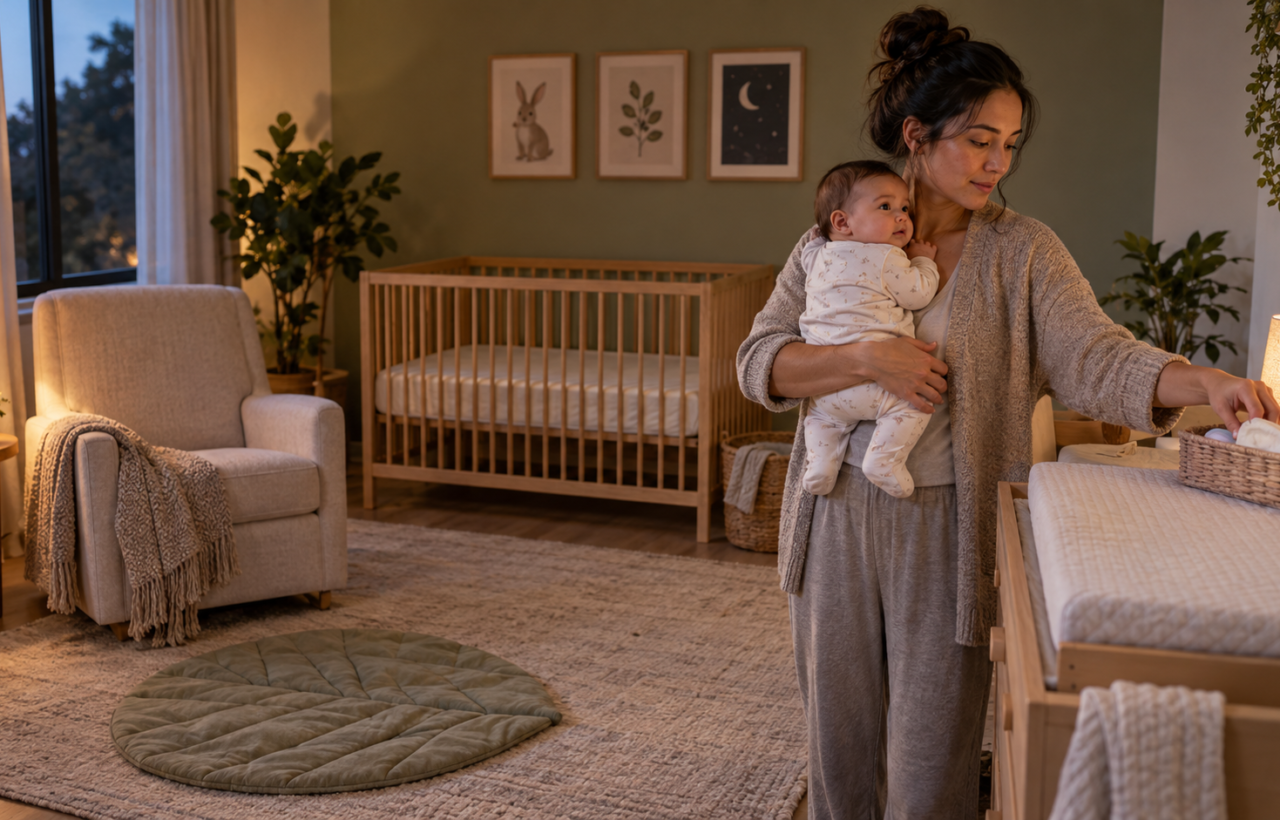
The product that makes a nursery feel calmer is rarely the one that looks softest in a photo. It is the one you can use correctly when your baby is tired, your hands are occupied, and the room has already become messy.
Before you buy another basket, lotion, play mat, chair, or soothing accessory, map the routine it is supposed to improve. You will make a better decision by shopping for a specific job than by shopping for a general feeling of comfort.
Start with the moment that keeps going wrong
Do not begin with product names. Begin with the verbs in your day: sleep, change, feed, soothe, play, clean, and store. Then look for the point where each routine becomes awkward.
For one ordinary day, notice the following:
- What are you trying to do when the friction starts?
- What is already in your hands?
- What do you have to reach for, move, wash, or search for?
- Does the routine fail because something is missing, or because too many things are in the way?
- Will the same setup still work when your baby starts crawling, pulling up, or reaching farther?
This separates a product problem from a layout problem. If clean changing supplies are across the room, rearranging the supplies may solve the issue. If you cannot sit comfortably beside your baby during floor play, an adult-friendly seat or supportive floor cushion may be more useful than another toy. If the room feels overstimulating before rest, clearing a quiet corner may help more than adding a soothing gadget.
Give every possible purchase a one-sentence job description. For example: this washable mat creates a clear place where the baby and an adult can play together, or this closed caddy keeps the changing sequence together while remaining out of the child’s reach. If you cannot name the job precisely, the item is likely to become nursery clutter.
Build four useful zones, even in one small room
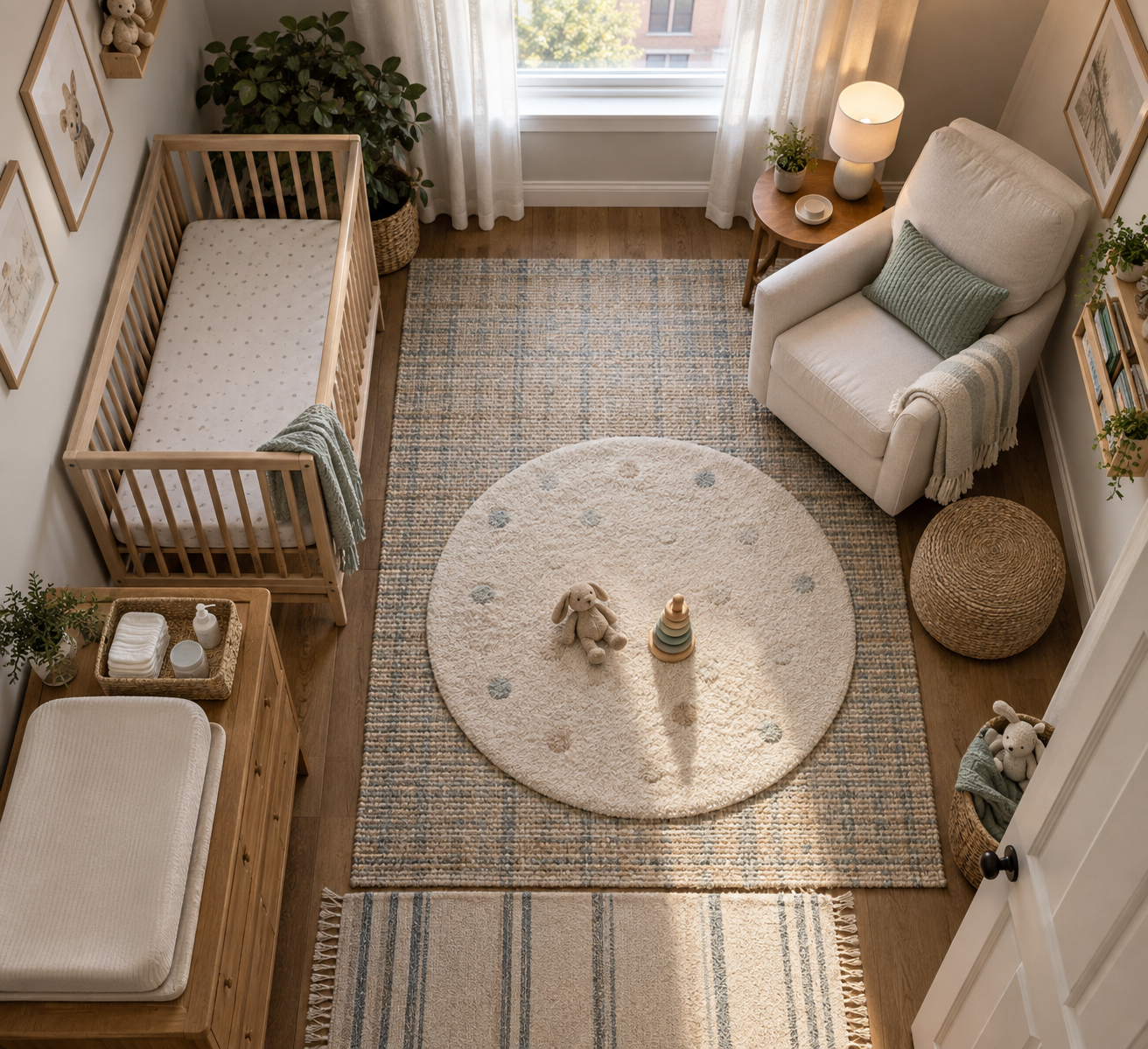
A zone does not require a large nursery or a dedicated piece of furniture. It is simply a place with one clear purpose. Keeping those purposes distinct helps you avoid using an attractive product in a way it was not designed to be used.
The sleep zone
A nursery item can look cozy and still be unsuitable for sleep. Treat the manufacturer’s stated use as a boundary: check whether the product is specifically intended for sleep, assemble it exactly as directed, and follow every size, developmental, and discontinuation limit in its instructions. If its intended use is ambiguous, do not improvise. Ask your child’s health-care professional or consult current local public-health guidance before using it as a sleep space.
Keep decorative objects in the room rather than assuming they belong in the sleep setup. Words such as basket, nest, comfort, or lounger describe a product category or feeling; they do not establish that an item is appropriate for unsupervised sleep.
The care zone
Arrange care supplies in the order you use them, while keeping medicines, creams, wipes, cords, and other unsuitable items inaccessible to your child. The most convenient location changes as mobility changes. A shelf that is unreachable to a newborn can become an easy target for a baby who pulls to stand.
Test the setup with one hand occupied. Can you reach the next necessary item without stepping away or turning your back? Can you dispose of or contain the mess immediately? Can you put everything away without leaving loose packaging or open containers behind? Those questions reveal more about practical comfort than the softness of the storage basket.
The shared floor-play zone
Floor play works better when the space accommodates the adult as well as the baby. A nursery-style family setup that combined crawling, climbing, tactile play, parent-sized structures, and a quieter creative area offers a useful design principle: make it possible to join your child instead of supervising from an uncomfortable distance.
At home, that does not require a climbing structure or a room full of sensory materials. A clear, stable, washable surface and a small rotation of developmentally appropriate objects can be enough. Follow each item’s intended age and use, supervise active play, and remove anything damaged or outgrown. Recheck the area whenever your child gains a new movement skill.
The quiet reset zone
A quiet zone is not automatically a sleep space. It can be a clear corner, a comfortable place for you to sit with your child, a few familiar books, or one calm activity. Its job is to offer less input after active play, not to accumulate more products marketed as calming.
Keep the transition simple enough to repeat: put active toys away, move to the quieter area, and choose one familiar activity. Consistency comes from the sequence and your presence. A new device cannot compensate for a routine that changes every time.
Run every product through the same decision filter
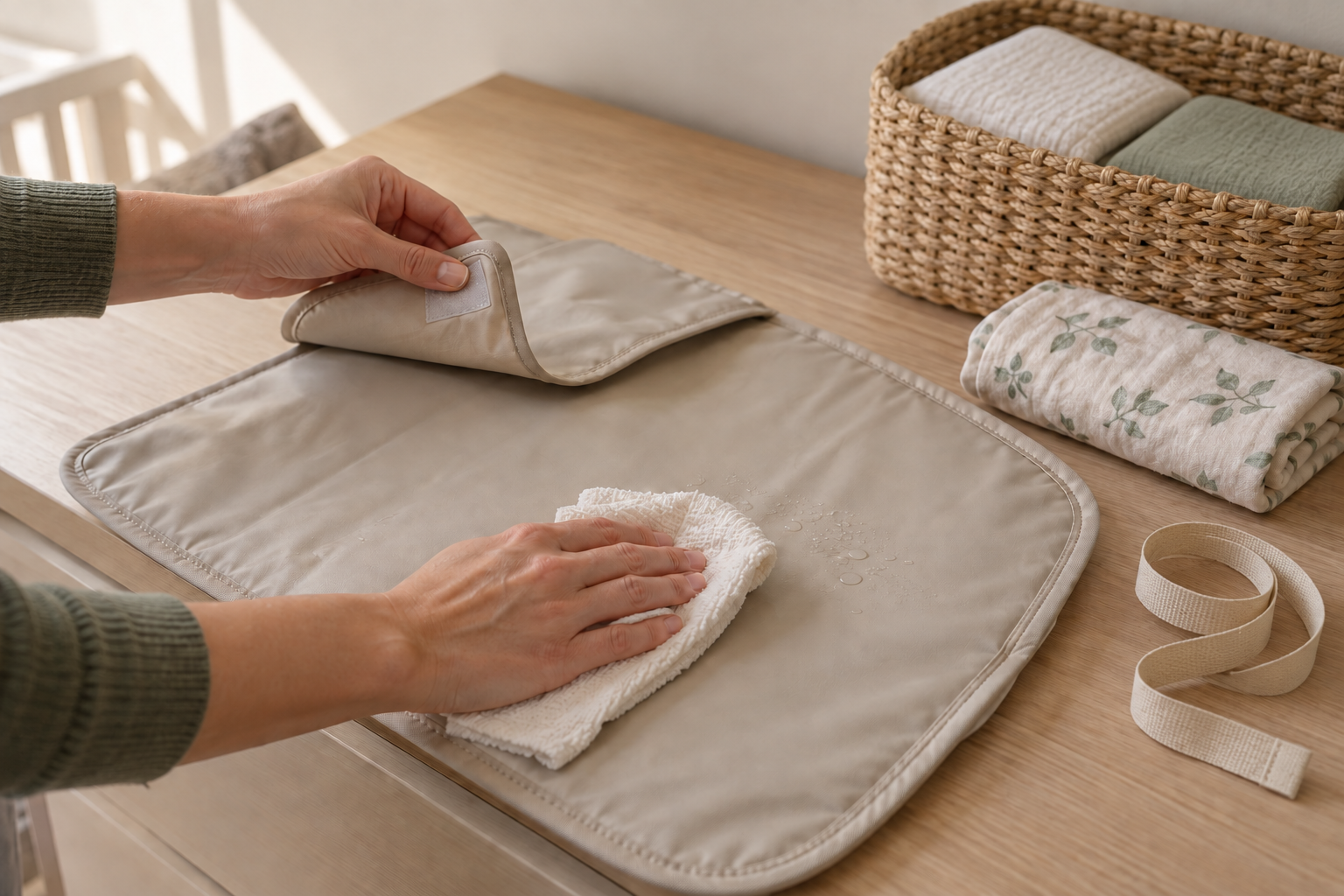
Nursery shopping becomes easier when every candidate has to pass the same tests. Use these questions in a store, while shopping online, or when deciding whether to keep a gift.
- Is the intended use explicit? The instructions should clearly cover the activity you have in mind. Similar-looking products can have different permitted uses.
- Does it fit your baby now? Check the manufacturer’s current size, developmental, assembly, and supervision requirements. Do not buy on the assumption that you can adapt the item later.
- Can the caregiver use it properly? Imagine the full routine, including picking up the baby, reaching supplies, cleaning the item, and putting it away. Comfort that creates unsafe reaching or awkward lifting is not functional comfort.
- Can you maintain it after a real mess? Check how covers, seams, inserts, trays, and crevices are cleaned. A difficult cleaning process often turns a daily product into an avoided one.
- Does it earn its footprint? Measure the intended location and the route required to move around it. Include drawers, doors, adult knees, and the space needed to lift or carry the baby.
- What event makes you reassess it? Rolling, crawling, pulling up, climbing, exceeding a stated limit, or losing interest can all change whether a product still belongs in the room.
Style is a valid final filter, but it should not be the first one. A familiar baby basket receiving a Chocolate colourway with gold detailing is a neat example of how an interiors-led update can make established nursery gear feel newly desirable. The finish may help an item work visually in your home, but it does not change the product’s intended use, care requirements, or fit for your routine.
If two products pass the practical tests equally well, choose the colour and finish you prefer. If only the prettier option fails a use or safety test, the decision is already made.
Separate comforting touch from skin-care marketing

Some of the most useful comfort routines require little or no gear. A cuddle before rest, gentle contact during play, or getting down on the floor beside your baby can be the whole activity. The product is optional; your attention is not.
A family event that paired an infant-massage demonstration with sensitive-skin products illustrates how easily touch and skin care can be presented as one package. They are still separate decisions. A lotion does not create the bond, and a meaningful touch routine does not require a branded product.
If you want to include lotion or another skin-contact product, keep the evaluation simple:
- Read the full label and use the product only on the areas and in the manner directed.
- Do not treat words such as gentle, natural, baby, or sensitive as proof that a product will suit every child.
- Introduce one new skin product at a time so you are not changing several variables at once.
- Follow your baby’s cues during touch. Pause if they pull away, stiffen, or become upset.
- Stop using a product if irritation appears. Persistent, worsening, or severe skin symptoms belong with a qualified health-care professional, not another round of product experiments.
Keep the container in your hand or stored securely rather than leaving it within reach. Dispense only what you intend to use, and avoid stretching, pressing, or manipulating your baby’s joints. If your child has an existing skin condition or other medical concern, ask their clinician before adding a new product or massage routine.
Key takeaways
- Shop for a named routine problem, not a vague promise of calm.
- Keep sleep, care, shared play, and quiet reset functions distinct, even when they occupy the same room.
- Verify intended use and manufacturer limits instead of inferring safety from a soft appearance or comforting product name.
- Test whether the product works for the caregiver, cleans easily, fits the room, and has a clear reassessment point.
- Use colour and finish as a tiebreaker after function, fit, care, and safe use have been settled.
- Treat touch as the comfort practice and lotion as a separate, optional skin-care choice.
Before your next nursery purchase, write down the routine, the exact snag, the product’s job, its safe-use boundary, its cleaning path, and the developmental change that will trigger a review. Try a layout change first. If the snag remains and a product can answer every part of that note, you know what you are shopping for.
References
- Scary Mommy – How Scary Mommy Celebrated Parenting’s Sweetest Moments With The Power Of Touch
- My Baba – Snuz Just Gave Its Bestselling Baby Basket A Chocolate Makeover




