
Your baby has started solids, and suddenly every changed nappy can make you wonder whether lunch was a mistake. A gut-friendly meal does not have to be bland, beige or packed with a specialist supplement.
The practical goal is much simpler: prepare soft, varied food that suits your baby’s current eating skills and makes it easy to notice how they respond. These weaning ideas designed with little tummies in mind follow that approach. No recipe can promise to prevent gas, constipation, reflux, allergy or illness, but thoughtful ingredients and adjustable textures can make early meals easier to manage.
What gut-friendly should mean in your kitchen
“Gut-friendly” is not a medical category. Treat it as a useful cooking brief, not a health promise. Choose everyday foods that become genuinely soft, keep early combinations easy to understand and adjust each meal to the way your baby currently eats.
A short ingredient list is especially useful when a food is unfamiliar. If your baby seems uncomfortable afterwards, you will have fewer possible triggers to consider. Once the individual ingredients are familiar, you can combine them more freely.
Use this flexible pattern when you are cooking without a recipe:
- Choose soft produce such as pear, apple, courgette, broccoli, peas, carrot, avocado or sweet potato.
- Add a gentle base such as oats or potato when the meal needs more body.
- Include a suitable protein or fat, such as lentils, chickpeas, avocado or an already-tolerated animal food.
- Use water or your baby’s prepared usual milk to loosen the finished food to an appropriate texture.
- Leave out added salt, added sugar and honey. Flavour can come from the ingredients themselves or from familiar salt-free herbs and spices.
Variety does not have to arrive in the same bowl. Offering different foods across successive meals is often more manageable than building a complicated puree. It also lets you see what your baby actually likes instead of allowing a sweeter ingredient to mask everything else.
Simple recipes to put into rotation
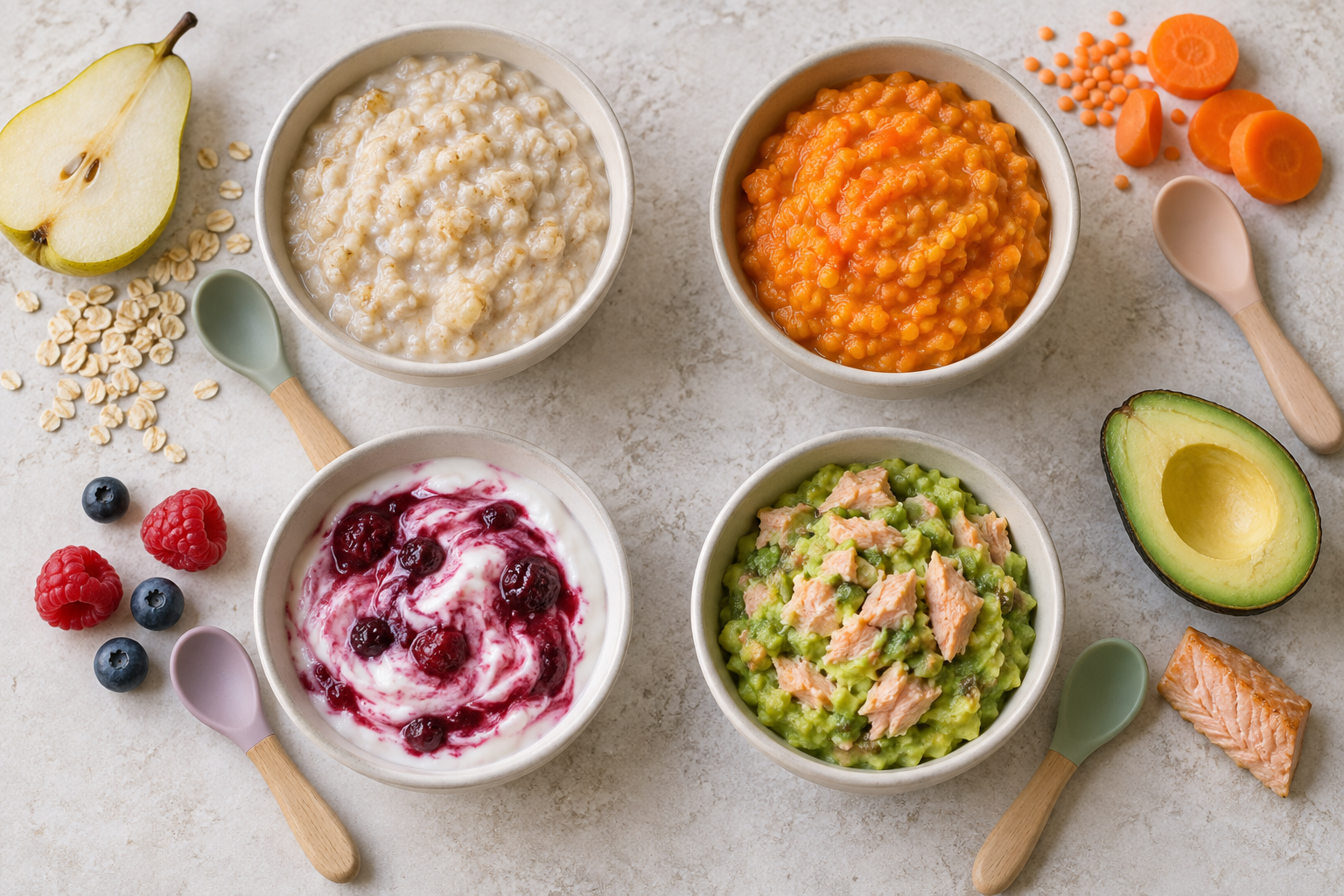
These recipes deliberately rely on texture cues rather than rigid cooking times. A pear can be firm or very ripe, lentils vary between brands and a chunky mash needs less liquid than a smooth puree. The reliable test is the food in front of you: it should be thoroughly cooked and easy to crush before you serve it.
Pear and oat spoon mash
You will need a ripe pear, plain oats and water. Prepared usual milk can be used to loosen the food after cooking if desired.
- Peel, core and chop the pear.
- Cook it with a splash of water until every piece yields easily under a fork.
- Stir in the oats and enough water to keep the mixture loose. Continue cooking until the oats are completely soft.
- Mash or blend to suit your baby’s current texture stage. Add a little water or prepared milk if it becomes too thick.
- Stir thoroughly, check the temperature and offer a small serving. Refrigerate or freeze untouched extra food promptly.
This is an easy base to change as your baby develops. Blend it smooth at first, fork-mash it later, or leave the soft pear slightly more textured when your baby can manage it.
Sweet potato and red lentil pot
You will need peeled sweet potato, split red lentils and water. A little olive or rapeseed oil can be stirred into the finished dish if it is already part of your baby’s meals.
- Rinse the lentils until the water runs clearer.
- Cut the sweet potato into small, even pieces so it cooks at the same rate.
- Simmer the lentils and sweet potato in fresh water until the lentils have broken down and the potato crushes without resistance.
- Mash or blend, adding cooking water gradually until the texture is moist and easy to eat.
- Check carefully for any firmer pieces before serving.
Red lentils thicken as they cool. Check the bowl again immediately before serving and loosen it if the spoonful has become sticky or dense.
Broccoli, pea and potato crush
You will need peeled potato, broccoli florets, peas and water. Use fresh or frozen vegetables without added salt or sauce.
- Cook the potato until it is very soft.
- Add the broccoli and peas and continue cooking until they can also be crushed easily.
- Drain, keeping some cooking water.
- Mash everything together for a textured meal, or blend with reserved water for a smoother result.
- If pea skins remain too coarse for your baby’s eating skills, blend the mixture more thoroughly rather than serving it as it is.
Reserve a few fully softened pieces before mashing if your baby is ready to practise self-feeding. The pieces still need to match the shape, size and softness recommended for your baby’s developmental stage.
Apple, carrot and chickpea mash
You will need peeled apple, peeled carrot and thoroughly cooked chickpeas. If you use canned chickpeas, choose a no-added-salt option when available and rinse them well.
- Chop the apple and carrot into even pieces.
- Cook them until both are completely tender; the carrot should not retain a hard centre.
- Add the chickpeas and warm them through.
- Blend with water until the chickpea skins are broken down and the mixture suits your baby’s texture stage.
- For a coarser version, mash thoroughly and inspect each spoonful for firm chickpea pieces.
Chickpeas can produce a thicker, slightly grainier mash than fruit or potato. More blending and a little extra liquid usually improve the texture. Do not force your baby to finish it; a new flavour may take time to become familiar.
Avocado and banana bowl
You will need ripe avocado and ripe banana. Both should give immediately when pressed with a fork.
- Mash the avocado and banana together immediately before serving.
- For a smoother texture, press the mixture carefully with the back of a fork or blend it.
- If the mixture feels sticky, loosen it with a little water or prepared usual milk.
- Discard leftovers from the serving bowl rather than saving food that has been in contact with your baby’s spoon or hands.
This quick bowl works well as part of a varied menu, but it does not need to become the default whenever you are short on time. Keep one of the cooked savoury bases portioned in the freezer so convenience does not always mean serving the same sweet flavours.
Courgette and potato puree or soft mash
You will need courgette, peeled potato and water. An already-tolerated ingredient such as cooked lentils, plain full-fat yogurt or well-cooked egg can be added separately when appropriate for your baby.
- Cut the potato and courgette into small pieces.
- Cook the potato until nearly soft, then add the quicker-cooking courgette.
- Continue until both vegetables crush easily.
- Drain excess water, then mash or blend. Add liquid back gradually so the result does not become watery.
- Serve the base alone when either vegetable is new. Add a familiar protein or fat on a later occasion to turn it into a fuller meal.
Courgette releases water as it cooks, so wait until after blending before deciding that the meal needs more liquid. This small pause prevents a puree that slides off the spoon but provides very little substance in each mouthful.
Match the texture to your baby, not the recipe name
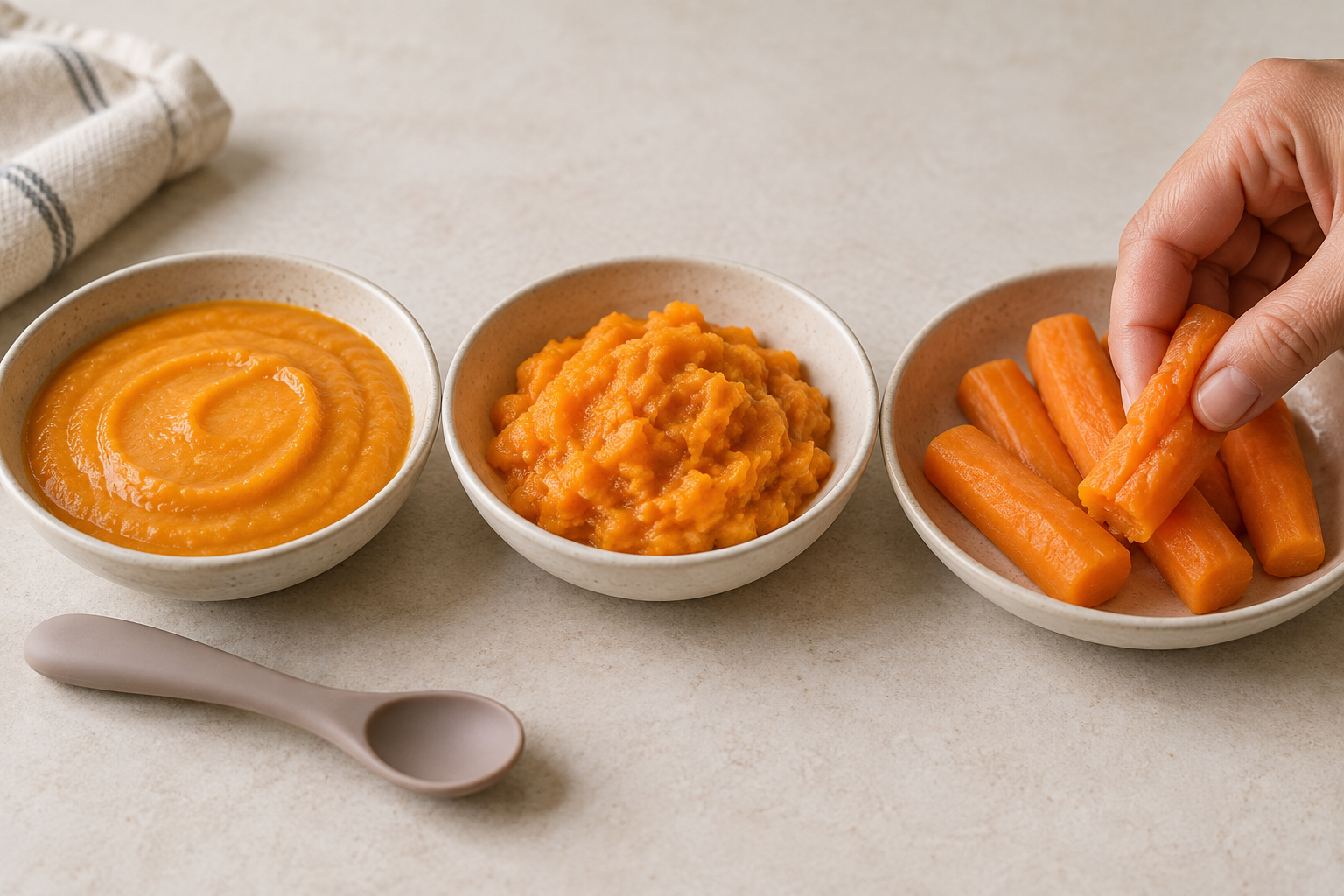
A food is not safe merely because it is called a puree, and a soft finger food is not automatically suitable for every baby. Feeding readiness, posture, oral skills and previous experience all matter. If your baby was born prematurely, has trouble swallowing, coughs during meals or is receiving feeding support, follow the texture plan given by the relevant clinician.
- For a smooth result, blend thoroughly and add liquid in small splashes. Run a clean spoon through the bowl to find hidden lumps.
- For a mash, use a fork and check that every piece collapses with light pressure. Remove tough skins, fibres and firm fragments.
- For self-feeding, use foods that are soft enough to squash easily. Choose the shape and size recommended for your baby’s current developmental stage.
- Keep your baby upright, alert and closely supervised whenever food is present. Do not place a piece of food directly into the baby’s mouth.
- Keep hard pieces, whole nuts and other obvious choking hazards out of reach, including food from an older sibling’s plate.
Gagging and choking are not the same, but a written description is not enough preparation for an emergency. An accredited infant first-aid course can teach you how to recognize an obstructed airway and respond correctly.
Allergens need their own care. If a recipe contains an allergen your baby has not eaten before, follow the introduction advice provided by your local health service or clinician. A simple meal makes a possible reaction easier to identify than a crowded mixture of unfamiliar foods. Ask for individualized advice before experimenting if your baby has a known allergy, a previous food reaction or a condition that changes their feeding plan.
Difficulty breathing, sudden swelling around the mouth or tongue, collapse, unusual floppiness or reduced responsiveness after eating requires emergency help. Do not wait to see whether it settles.
Read patterns, not a single nappy

Stool colour, smell and firmness can change as new foods enter your baby’s diet. One different nappy does not prove that an ingredient is unsuitable, just as the words “gut-friendly” cannot guarantee that a meal will agree with every baby.
Look at the whole pattern. Was the ingredient genuinely new? Did the same response appear again? Was your baby otherwise comfortable, feeding normally and behaving as usual? Those details are more useful than trying to diagnose an intolerance from gas or a single loose stool.
If a clear symptom repeatedly follows the same food, pause that ingredient and contact your baby’s health professional before offering it again. Seek medical advice for repeated vomiting, persistent diarrhoea or constipation, blood in the stool, marked pain, ongoing feeding refusal, poor growth or a recurring rash. These signs deserve assessment rather than another homemade remedy.
A brief food note can help when something seems wrong. Record the ingredients, texture, approximate amount eaten and what happened afterwards. There is no need to document every spoonful indefinitely; use the record to clarify a pattern and share it with the professional assessing your baby.
Also resist the urge to solve ordinary digestive changes with probiotic powders, herbal products or “gut reset” remedies. Products intended for adults may be inappropriate for babies, and a supplement is not a substitute for medical assessment when symptoms persist.
Key takeaways
- Use “gut-friendly” as a prompt for soft, varied, manageable food, not as a medical promise.
- Start with short ingredient lists and combine foods more freely once the separate ingredients are familiar.
- Let softness and your baby’s feeding skills determine the final texture; the recipe label is not a safety test.
- Introduce unfamiliar allergens according to professional guidance, and keep the rest of that meal simple enough to identify a reaction.
- Judge digestive responses as patterns. Persistent symptoms, blood, significant pain, poor feeding or poor growth need medical advice.
- Cool extra food promptly, store it safely, reheat only the portion you need and discard leftovers from the serving bowl.
For your next meal, choose the recipe closest to ingredients already in your kitchen and textures your baby already manages. Make a plain base, adjust it at the bowl and offer a small amount without pressure. That gives your baby room to explore while giving you a clear, practical way to decide what to serve next.
References




