

Your toddler wants you on the floor just as dinner needs making. Your baby becomes alert and chatty when you need to answer a message. In either moment, it is easy to feel that a good parent should stop everything and provide enthusiastic entertainment.
Your child does need connection, but connection is not the same as constant play. What matters most is a dependable pattern: you notice your child, respond to them, make room for their interests and remain a safe, predictable presence. You can create that pattern without enjoying every game or making yourself available all day.
Your child needs your attention, not a performance
Play gives young children opportunities to practise communication, problem-solving, emotional regulation and creativity. When you join them, there is an additional emotional benefit: for a little while, their ideas are important enough to hold your attention.
That benefit does not depend on whether you are naturally playful. You do not have to create elaborate sensory activities, make every toy educational or produce an entertaining voice for every stuffed animal. You are showing interest, not auditioning for a role.
During play, look for a few simple signals of connection:
- You notice what has caught your child’s attention before redirecting them.
- You respond to a sound, gesture, expression or request.
- You let your child affect what happens next when it is safe to do so.
- You stay emotionally available even when you set a limit.
- You end the interaction predictably instead of disappearing into another task.
A child can receive all of those signals while rolling a ball, looking at a board book, stacking cups or handing you one object after another. The activity is only the setting. The emotional message is: I see what you are doing, and being with you matters to me.
Build one small pocket of child-led time

If play tends to get crowded out, give it a clear beginning and end. Formal Parent-Child Interaction Therapy uses five minutes of daily child-directed special time, while other parenting approaches use pockets ranging from five to 15 minutes. Those numbers are not a universal prescription or a test of your parenting. Their practical value is that a small, focused period is easier to protect than an open-ended promise to play more.
Try this simple routine:
- Remove the competing demand. Put the phone away and choose a moment when you are not also cooking, working or trying to leave the house.
- Offer a safe, manageable choice. With a toddler, that might be blocks or toy animals. With a baby, place a few suitable objects within reach or sit where you can follow their gaze and movements.
- Let your child begin. Watch before suggesting. Their first action tells you what currently interests them.
- Join without taking control. Copy a sound, roll the object back, describe what they are doing or respond to the story they are creating.
- End clearly. Give your toddler a simple warning when the end is approaching, then say what comes next. With a baby, use the same calm phrase and transition into the next familiar routine.
The hardest step is often the fourth. Adults tend to improve the tower, organize the pretend story, quiz the child about colours or demonstrate the correct way to use a toy. That changes the experience from being known to being managed. Unless safety is involved, allow the crooked tower, repeated action or unfinished idea to stand.
If you miss a day, do not turn the routine into another source of guilt. Return to it when you can, especially when your child seems to be seeking more contact than usual. The goal is repeated connection over time, not an unbroken streak.
Follow the child you have in front of you
Child-led play looks different across the first three years. A young baby cannot announce a game, but they can turn toward a voice, look at an object, kick, reach, smile, babble or look away. Following their lead means responding to those signals rather than trying to keep the interaction going at all costs. Looking away can be a request for a pause, not a failure to engage.
For a mobile baby, joining might mean sitting nearby while they repeatedly put an object into a container, crawl toward something interesting or pass an item to you. Repetition can feel uneventful to an adult. You do not need to add a lesson. Responding to the action is enough.
A toddler may bring stronger preferences and more elaborate ideas. Let them choose between two activities you can genuinely tolerate, then allow them to direct the details. If they want the toy cow to sleep in a truck, it does not need correcting. If they hand you a role, follow it as far as your time and comfort allow.
Some days, your child’s preferred activity will be one you dislike. You can set an honest boundary without rejecting the child: “I don’t want to play that game, but I can read with you or build blocks.” A warm, dependable alternative communicates more care than reluctant play filled with distraction or irritation.
Use clear boundaries instead of all-day half-attention

Many parents spend long stretches partly available: answering a child while reading a message, moving a toy while thinking about work or saying “in a minute” without establishing when that minute will come. The child keeps seeking attention because the answer remains uncertain, while the parent feels as though they have been playing all day.
A clearer pattern is easier on both of you: be unavailable when you must, then become genuinely present when you can. For a toddler, make the sequence concrete: “I am putting away the dishes. You can play beside me. When I am finished, we will read one book.” Use a promise you can keep. Predictability matters more than offering a bigger promise that may disappear.
A baby will not understand the full explanation, but your calm voice, physical presence and familiar sequence still provide information. Being temporarily occupied never means ignoring hunger, discomfort, distress or a need for age-appropriate care. It means accepting that you can be a responsive caregiver without participating in every waking moment.
Connection also does not have to happen around a toy. Reading, cooking, walking, gardening and doing simple chores together can all create distraction-free contact. For a baby, diaper changes, feeding and getting dressed offer repeated chances to make eye contact, respond to sounds and narrate what is happening. A toddler can carry a safe item, stir with help, match socks or talk with you on a walk.
Choose forms of connection you can offer warmly and repeatedly. If pretend play drains you but books, music or walks do not, use those strengths. Your child needs access to you as a person, not a parent performing a particular style of fun.
Independent play belongs in a connected relationship
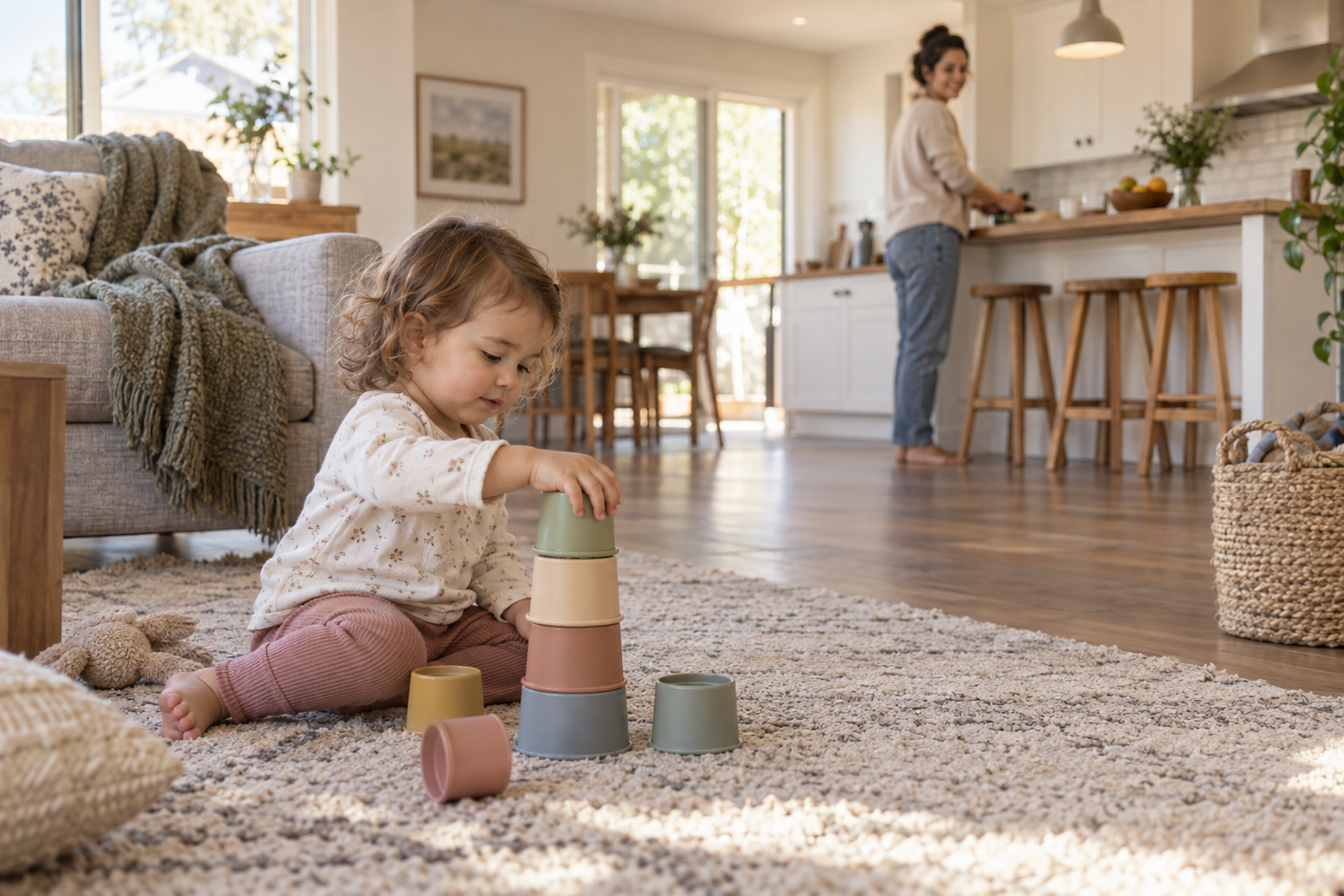
Stepping back is not the opposite of meeting emotional needs. Independent play gives children room to generate ideas, solve small problems and remain with an activity without an adult supplying every next move. Your availability provides the secure background; it does not require your constant involvement.
You can make the transition easier without becoming the play director:
- Prepare a safe play area with a small number of age-appropriate choices.
- Begin nearby and observe what your child selects.
- Join briefly if that helps them settle into the activity.
- Tell a toddler what nearby task you are moving to instead of slipping away.
- Remain close enough to provide the supervision their age and surroundings require.
- When you return, notice what they did rather than judging the result: “You kept adding blocks” is more informative than “Good job.”
Do not treat independent play as a performance target. A child may play alone on one day and stay close on another. The practical distinction is between giving them an opportunity to direct their own activity and demanding separation when they need care or reassurance.
Boredom does not automatically mean you need to produce a new activity. Pause before solving it. Your toddler may return to an old toy, move beside you or invent something with the materials already available. If they cannot settle, you can offer a limited choice without assuming responsibility for entertaining them indefinitely.
Key takeaways
- Your baby or toddler needs a responsive, predictable and safe relationship more than constant entertainment.
- A short period of undivided, child-led attention can be more connecting than a long period of distracted participation.
- Follow your child’s gaze, gestures, sounds or ideas instead of improving, testing or directing the activity.
- Set honest limits and offer a form of connection you can give warmly.
- Independent play and parental connection are partners: stay available and supervise appropriately without controlling every moment.
The next time your child asks you to play, choose one response you can fully mean. Join them for a defined pocket of time, invite them into an ordinary task or give a clear no followed by a reliable later yes. Your consistency will carry more emotional weight than the game you choose.
References



