You had scoliosis as a child. Now you have noticed that your baby or toddler sometimes leans to one side, one shoulder looks higher, or clothing sits unevenly across the back. The question underneath the observation is often more frightening than the observation itself: Is my child heading toward the brace, appointments, or surgery that I remember?
Family history deserves a place in your child’s medical record, but it cannot predict the ending. Your job is not to diagnose a spinal curve at home. It is to notice a persistent pattern, give the clinician useful family history, and make sure the next step reflects your child’s body rather than another relative’s experience.
Family history changes the questions, not the answer
Scoliosis describes an abnormal sideways curve of the spine. The name alone does not explain why a curve developed, whether it will change, or what care a particular child may need. A parent’s diagnosis is therefore a clue for the clinician, not a diagnosis for the child.
Keep three kinds of information separate in your mind:
- Family facts: which relatives had scoliosis, when it was found, and how it was managed.
- Current observations: what looks different in your child, when you see it, and whether it keeps happening.
- Predictions: assumptions that your child will develop the same kind of curve or need the same treatment.
The first two belong in a medical conversation. The third does not yet have enough evidence behind it.
This distinction matters when your own childhood treatment was difficult. A brace or operation can make you inspect every posture for danger. It can also make you hesitate to seek an assessment because you do not want your child drawn into the same process. Use a simpler rule: a recurring observation leads to an examination, not to a conclusion.
Look for a pattern, not perfect posture

Babies and toddlers rarely hold themselves in a perfectly balanced pose. They twist toward toys, collapse into a parent’s lap, favour one side when tired, and change position as they learn new movements. A momentary lean is less informative than an asymmetry that repeatedly appears during ordinary movement or in several natural positions.
Things worth showing your child’s clinician include:
- One shoulder or shoulder blade repeatedly appearing higher or more prominent.
- One side of the rib area looking fuller or more raised than the other.
- The trunk consistently leaning to one side when the child is sitting or standing as they normally would.
- An uneven waist or hip line that remains visible rather than disappearing when the child changes position.
- Clothing or a diaper waistband repeatedly sitting at an angle despite being put on evenly.
- A curved-looking back that you notice in more than one position or on more than one occasion.
None of these observations proves that a child has scoliosis. Asymmetry can have other explanations, and a photograph cannot show what is happening inside the spine. Do not force a baby into a forward bend or repeatedly reposition a toddler to perform a home test.
Instead, make the pattern easier for a clinician to assess:
- Note what the child was doing when you saw the asymmetry: lying down, sitting, crawling, standing, walking, or being carried.
- Record whether it disappeared after the child changed position.
- Take clear, dated photos during natural movement when the difference is visible. Do not pose or restrain the child to create a comparison.
- Write down any changes in movement, comfort, limb use, energy, or breathing that happened at the same time.
A recurring asymmetry generally belongs in an appointment with your child’s pediatrician or primary care clinician. Seek prompt medical assessment if it appears suddenly, follows an injury, or comes with breathing difficulty, marked weakness, loss of a movement the child previously used, or signs of severe pain. Those accompanying symptoms should not wait for routine monitoring at home.
Turn the family story into useful medical history
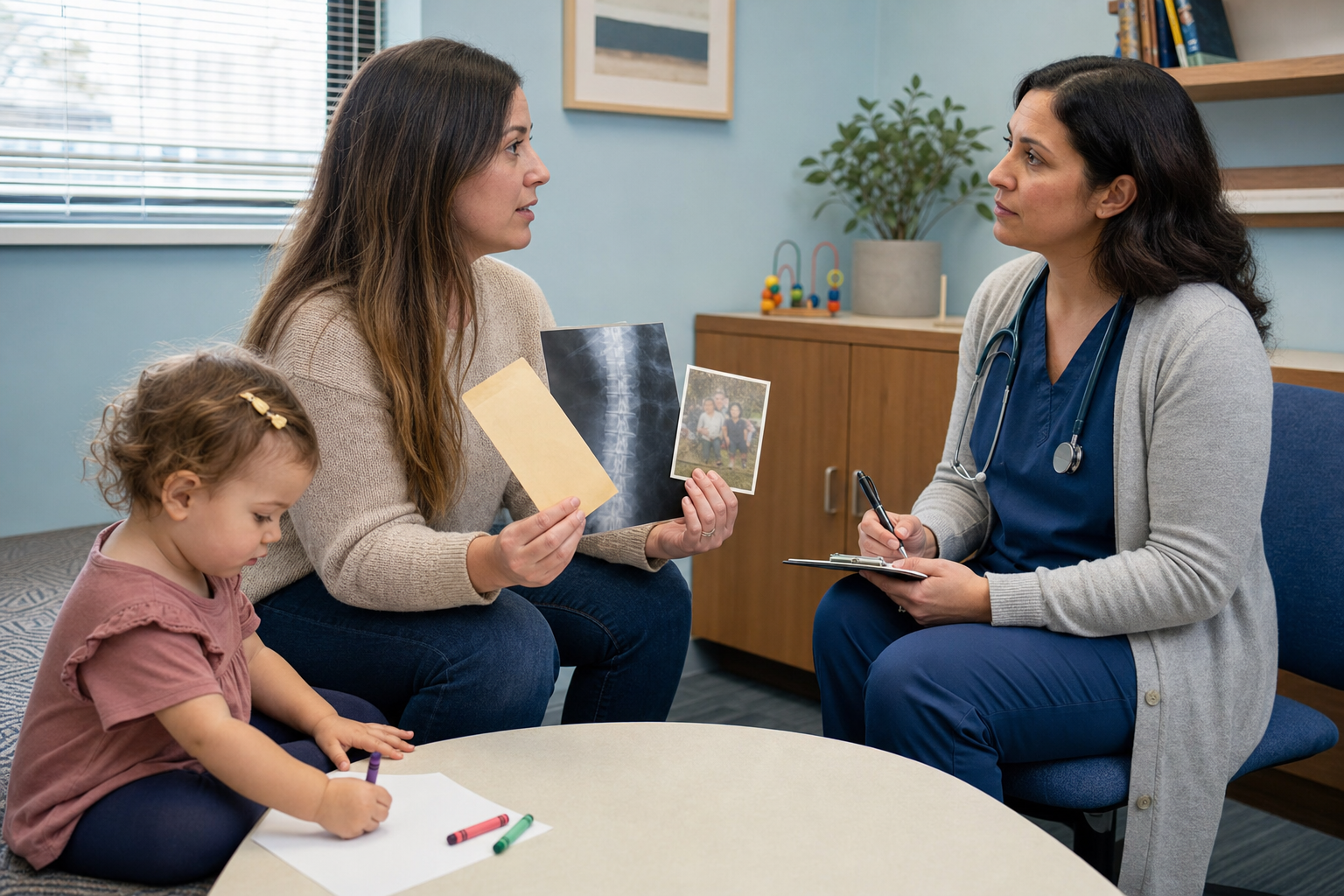
Scoliosis can become family shorthand: Grandma had a curved back, Dad wore a brace, or an aunt had an operation. That is meaningful context, but a clinician can use it more effectively when you separate confirmed details from family memory.
Before the appointment, write down what you know about affected relatives:
- Their relationship to your child.
- The diagnosis they were given, using the original wording if it is known.
- The life stage when the curve was first noticed or diagnosed.
- Whether they were monitored, wore a brace, had an operation, or received another form of care.
- Whether anyone remembers the curve changing during a period of growth.
- Any other diagnosed muscle, nerve, bone, or connective-tissue condition in the family.
- Which details are uncertain rather than confirmed.
Old records can help if they are already available, but do not delay your child’s appointment while trying to reconstruct another person’s entire medical history. A short, accurate note is more useful than a confident but uncertain family story.
You can open the conversation plainly: Scoliosis has occurred in our family, and this is what I have repeatedly noticed in my child. Then show the dated observations. This gives the clinician both context and a current reason to examine your child.
If a curve is suspected, separate evaluation from treatment

A clinician may examine the child’s back and overall symmetry, watch how the child sits or moves, and consider the finding alongside growth and development. The clinician can then decide whether observation, imaging, or referral to a pediatric specialist is appropriate. Family history by itself does not determine which of those steps is needed.
Use the visit to get a concrete plan. Ask:
- Does the asymmetry appear positional, or is there concern about the spine itself?
- Is anything else in the child’s movement or development relevant to this finding?
- Is a pediatric orthopedic assessment appropriate now?
- If the plan is observation, when should the child be checked again?
- Which changes should bring us back sooner?
Try not to hear referral as another word for surgery. It means that a clinician with relevant pediatric expertise should assess the finding. Likewise, a diagnosis does not identify a treatment in advance: not every child with scoliosis needs a brace or surgery.
Age, growth, the nature of the curve, possible underlying conditions, and change over time can all matter to the plan. That is why a parent’s old brace schedule or surgical history cannot be copied onto a baby or toddler.
Do not buy a brace, begin corrective exercises, or use forceful manipulation for a suspected curve without an appropriate medical assessment. An unprescribed device may fit incorrectly, and attempting to treat the appearance can delay finding out what is actually causing it. If the clinician recommends monitoring, leave with a defined follow-up date or a clear trigger for returning rather than a vague instruction to keep an eye on it.
A short FAQ for families
Is scoliosis inherited?
Scoliosis can appear in more than one generation of a family, which makes family history relevant. But that history cannot tell you by itself whether your child has a curve, what kind it might be, or whether it will change. It is more accurate to say that scoliosis runs in the family than to say that your child has inherited your exact condition.
Should every sibling have an X-ray?
Family history alone is not an instruction to arrange imaging. Mention it at each child’s routine medical visits and ask whether an examination or specialist referral is appropriate. If you notice persistent asymmetry in a sibling, raise that child’s specific signs rather than relying on another family member’s diagnosis.
Did the way I carried or positioned my baby cause the curve?
A visible lean does not reveal its cause. Do not assign blame based on an appearance, and do not change sleep positioning or attempt to hold the spine straight as a home treatment. Show the pattern to your child’s clinician and follow individualized advice after an examination.
Will my child need the treatment I had?
No one can answer that from the family story alone. Your child’s current examination and any clinically appropriate follow-up must guide the decision. Even a confirmed diagnosis does not automatically lead to bracing or surgery.
Before your child’s next visit, write down the family details you can confirm and save dated photos when the asymmetry naturally appears. If the pattern keeps returning, book an assessment rather than waiting for a future school screening. You can pass useful vigilance across generations without treating your own outcome as your child’s future.