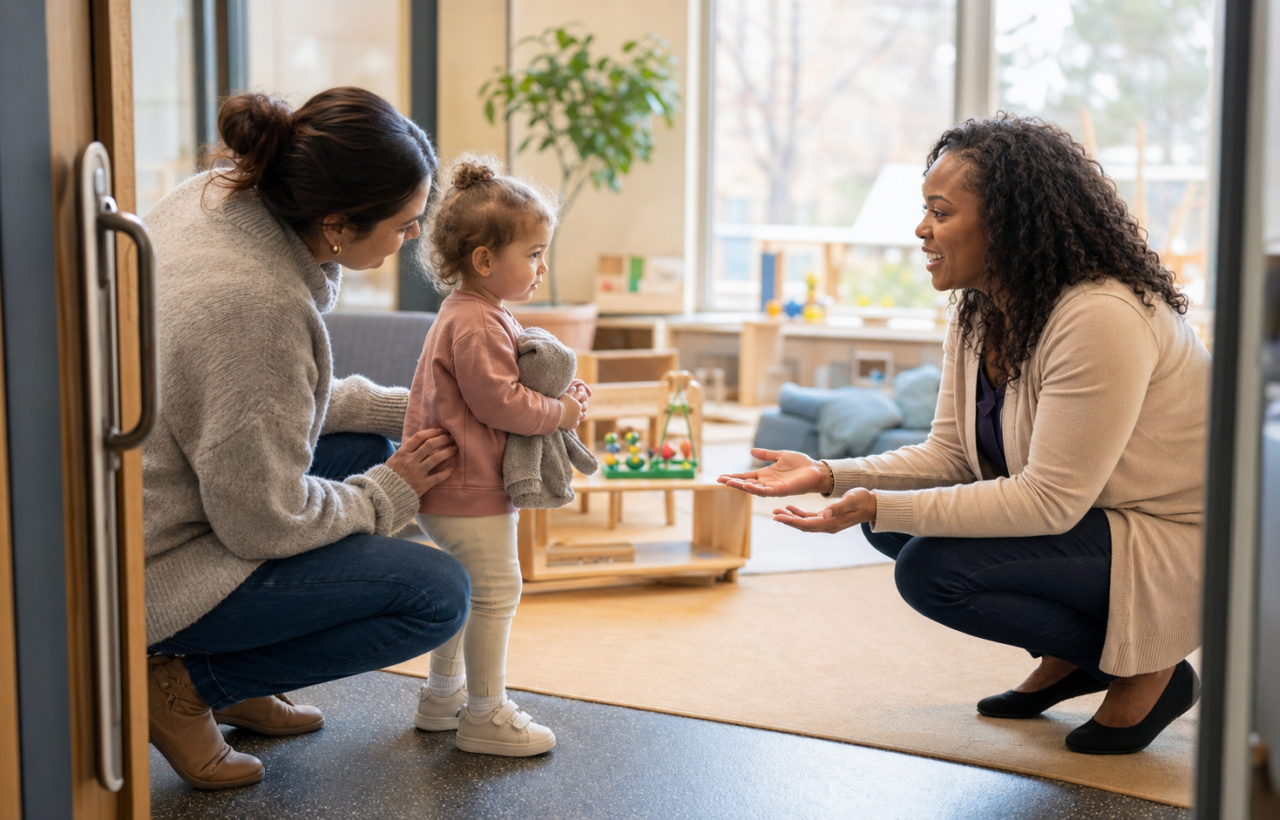
Your child may have explored the classroom happily during a visit, then cried the moment you tried to leave. Or the first day may be approaching, and you are wondering how much preparation a baby or toddler can really understand. A new setting can be hard even for an adventurous child; being the new child can feel frightening.
The useful question is not whether your child will cry. It is whether the adults can make the transition predictable, support your child through the hard moments, and notice whether settling is gradually becoming easier. For families in the baby and toddler years, school may mean daycare, nursery, preschool, or a new classroom within a familiar centre. The same practical plan applies, adjusted to the setting’s policies and your child’s communication level.
Key takeaways
- Prepare your child for the sequence of the day instead of promising that school will be fun.
- Give the receiving educator specific information about comfort, communication, food, sleep, diapering or toileting, and health needs.
- Use a short, truthful goodbye. Do not sneak away, negotiate repeatedly, or leave before an educator has taken responsibility for your child.
- Judge the transition by what happens after the handoff: whether your child accepts comfort, has calm moments, participates, and manages basic routines.
- Ask for more support when distress is intensifying, affecting the rest of the day, disrupting health or development, or raising a concern about the setting itself.
Prepare for the sequence, not an ideal first day
A baby cannot understand a calendar, and a young toddler may not understand what starting next week means. They can become familiar with people, places, objects, and repeated language. Build your preparation around those concrete details.
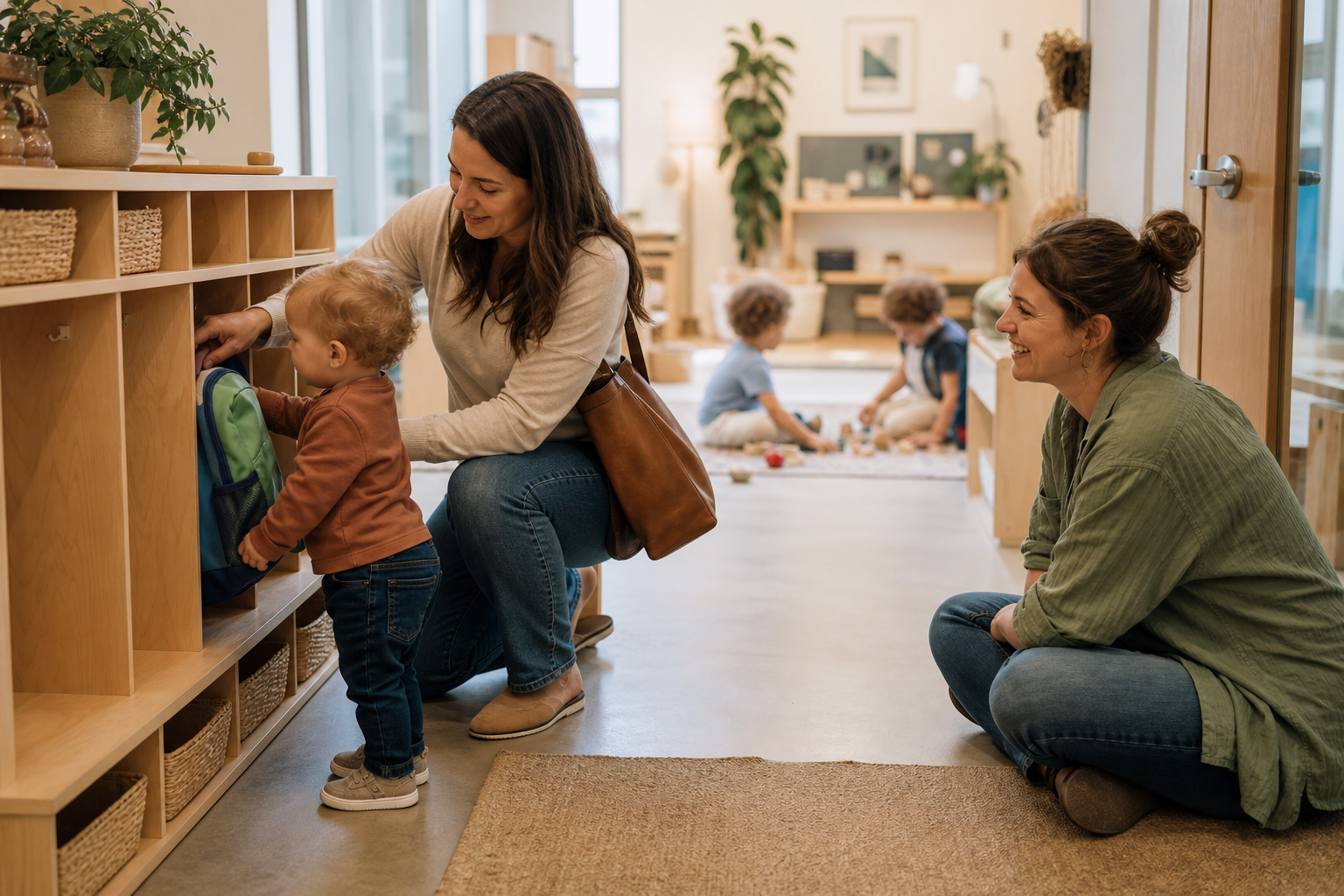
Start by asking the school exactly how arrival works. Find out which entrance you will use, who normally receives children, what happens immediately after arrival, whether a comfort object is allowed, and how staff communicate with families. Ask whether the setting uses gradual visits, shortened initial days, or the regular schedule from the start. Follow the agreed transition method consistently rather than inventing a different arrangement at the classroom door.
If the school permits it, show your child the route, entrance, room, and educator before the first full day. Photos can help when another visit is not possible. Name what your child will actually see: the cubby, play area, change table, eating space, sleep area, and the adult who will meet them. For a pre-verbal child, the value is not a detailed explanation. It is the repetition of the same names and sequence.
Use a short, accurate preview at home. For example: We will put on your shoes, go to school, and meet Sam at the door. I will say goodbye. You will stay with Sam, and I will come back after outdoor play. Choose the return cue from the child’s real schedule. Avoid saying that you will be back soon if you cannot make soon meaningful, and avoid promising that your child will love every part of the day.
Give the educator a compact care profile rather than trying to explain everything during an emotional drop-off. Include:
- Your child’s preferred name and pronunciation, along with the names used for close caregivers.
- How your child signals hunger, fatigue, discomfort, or a need for connection.
- Words, sounds, signs, or gestures your child uses for important needs.
- Comforting methods that help and anything that reliably makes distress worse.
- Current eating, bottle or cup, sleep, diapering, and toileting routines.
- Sensory preferences that affect care, such as discomfort with loud group activities or resistance to certain clothing textures.
- Allergies, medications, medical instructions, and emergency information submitted through the school’s required formal process, not only in a casual message.
Prepare the practical details before the morning rush. Label permitted belongings, confirm what food and care supplies are required, check the comfort-item policy, and make sure every authorized pickup person knows the procedure. A preventable search for a missing bottle, form, or entry code can make an already unfamiliar morning more chaotic.
Use a drop-off routine you can repeat

Your job at the door is not to persuade your child to approve of the separation. It is to complete a safe, understandable handoff. Calm does not have to mean cheerful, and brief does not have to mean cold.
- Arrive ready to hand over the items the school needs without searching through bags.
- Greet the receiving educator by name so your child can see who is taking over.
- Help your child place a bag or comfort object where the educator directs.
- Say the same short goodbye and give a concrete return cue.
- Allow the educator to receive your child physically or engage them in the next activity.
- Leave once the handoff is complete unless staff ask you to do something different.
A useful goodbye might be: You do not want me to go. Maya will take care of you. I am leaving now, and I will come back after snack. This acknowledges the feeling, identifies the responsible adult, and makes a promise you can keep. If your child reaches for you or cries, you do not need to argue that school is fun or insist that there is nothing to be upset about.
Do not disappear while your child is distracted. Sneaking out may avoid the immediate protest, but it removes the actual goodbye from the routine. Do not repeatedly return after leaving unless the school contacts you or there is a safety concern. Reappearing in response to every escalation can make the boundary harder for the child and the educator to understand.
There is an equally important limit: never walk away before a staff member has clearly received your child. If the expected educator is absent, the room is not ready, or staffing looks different from what was agreed, pause and confirm who is responsible. A consistent goodbye matters only after a safe handoff is established.
If you feel upset, you do not need to pretend the separation is meaningless. Keep the information you give your child simple, complete the handoff, and process your own worry with another adult away from the doorway. Your child’s distress does not mean you have to turn the goodbye into a long discussion.
Measure recovery, not just tears at the door
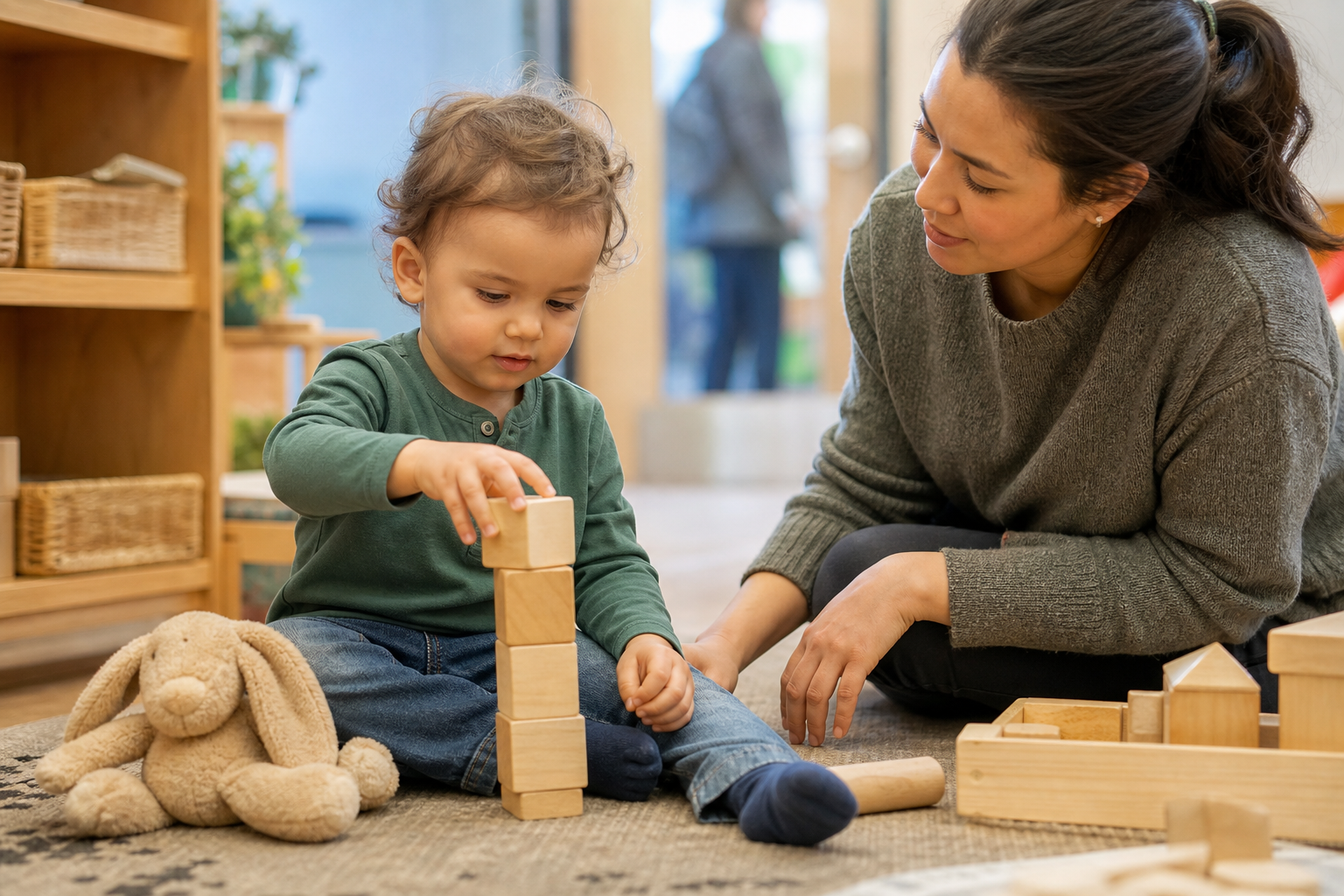
A difficult drop-off and a difficult day are not automatically the same thing. Ask what happened after you left. A child who cried at separation but then accepted comfort, watched other children, explored a toy, ate, rested, or joined part of the routine is giving you different information from a child who remained overwhelmed and unreachable throughout the day.
Replace the broad question How was the day? with questions an educator can answer from observation:
- What happened immediately after the handoff?
- Could an adult comfort or engage my child? What helped?
- Were there calm, curious, or playful moments?
- How did eating, drinking, diapering or toileting, and rest compare with the child’s usual pattern?
- Which transitions were hardest?
- Did anything in the room repeatedly trigger or reduce distress?
At home, reconnect before trying to collect a report. A baby or young toddler may show the effort of the day through clinginess, fatigue, crying, changes around meals, or a stronger need for physical contact. Offer the ordinary care they need and narrate the completed sequence: You went to school. I left, and I came back. Now we are home.
Avoid questioning that supplies a frightening answer, such as asking whether school was scary or whether the child cried all day. If your child can talk, ask about concrete parts of the setting: what they touched, where they ate, which song they heard, or who helped with their coat. Accept a short answer or no answer.
Keep a simple private log if you and the staff are struggling to see a pattern. Record the handoff, recovery, participation, basic care, and behaviour at home. Note meaningful context such as illness, poor sleep, a different caregiver, or a change in the classroom. The purpose is to spot a trend and improve the plan, not to score your child or demand constant surveillance from educators.
When you adjust the plan, change the part connected to the observed problem. If the room entrance is overwhelming, arrange for a familiar educator to receive your child at a quieter point if the school can accommodate it. If hunger is contributing to the morning difficulty, coordinate food timing within the school’s routine. Avoid changing the goodbye, pickup person, comfort object, and daily schedule all at once; too many simultaneous changes make it difficult to tell what helped.
Know when adjustment needs a closer look
There is no useful stopwatch for deciding that a child should be settled. Temperament, age, communication, previous separations, attendance pattern, classroom changes, and the quality of adult support all matter. Look for direction: Is your child beginning to accept comfort, anticipate part of the routine, or show moments of interest? Or is distress spreading and becoming more intense?
Ask for a meeting with the educator or director when your child cannot recover after the handoff, remains unable to participate in ordinary care, becomes increasingly distressed, or shows sustained changes in sleep, eating, play, or behaviour at home. Bring observations rather than a verdict. You can say: We are seeing this at home, and you are seeing that at school. What seems to happen before the distress? What helps? What specific plan will we try, and when will we review it?
Contact your child’s health-care provider when the change is affecting feeding, hydration, sleep, physical health, or development, or when your child loses a previously established skill. An educator can describe classroom behaviour, but they cannot determine whether a medical or developmental concern is contributing. Bring the setting’s observations to the appointment.
Treat a safety concern differently from ordinary separation distress. Pay attention if your child consistently shows fear linked to a particular person or place, has an unexplained injury, or if staff cannot give a coherent account of important events or basic care. Ask direct questions and follow the setting’s safeguarding process. If you believe your child faces immediate danger or maltreatment, do not keep sending them while waiting for the adjustment to improve; use the appropriate local emergency or child-protection channel.
Before the next school morning, write your goodbye sentence, confirm who will receive your child, and send the educator the care details they need. Then keep the handoff steady and watch what happens after you leave. That gives your child a pattern they can learn and gives the adults enough information to respond well.