
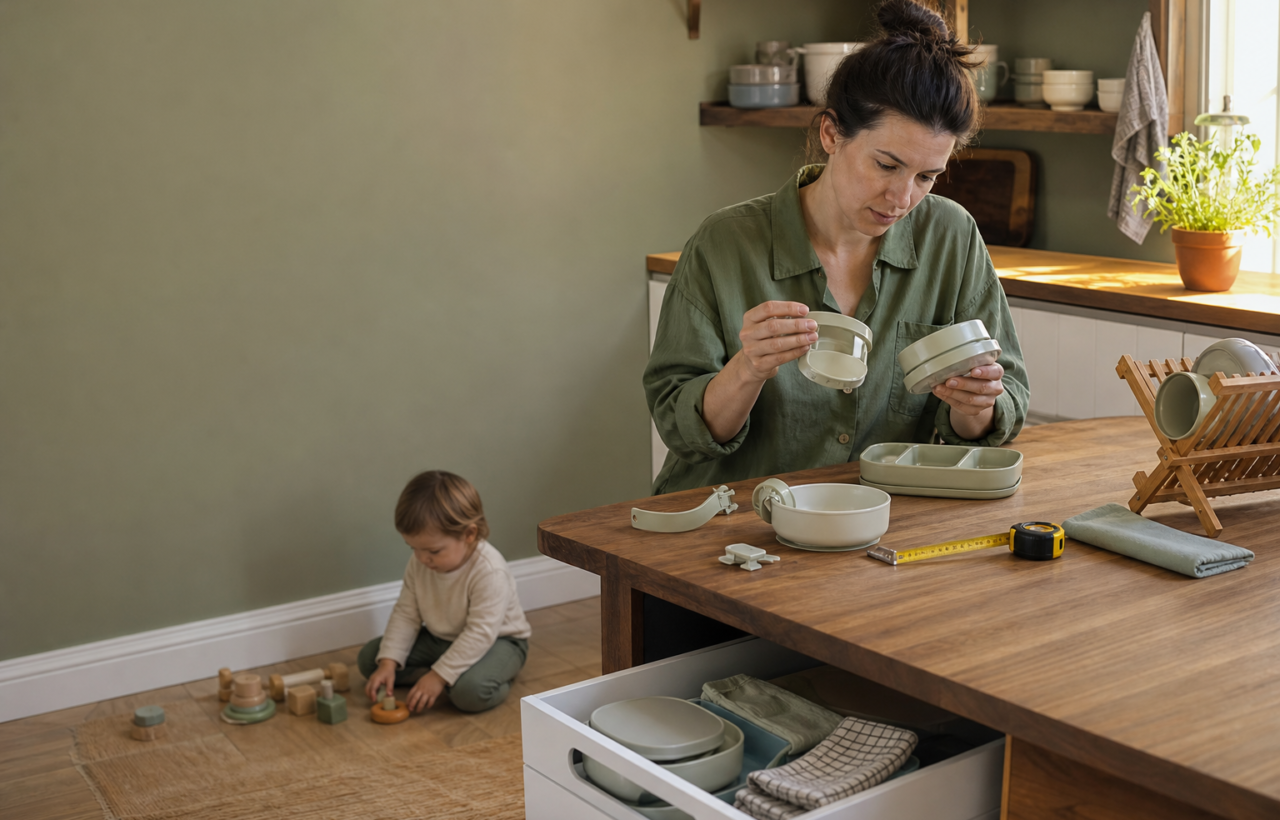
A baby or toddler product keeps appearing in your feed. It promises an easier meal, a calmer outing, better sleep or less mess. The demonstration looks convincing, but the useful question is simpler: will this product remove a recurring problem in your home without creating another one?
You don’t need to ignore trends or buy every clever idea before your child outgrows it. You need a repeatable way to separate a timely purchase from an attractive piece of clutter. The framework below helps you decide whether to buy now, borrow, look for a suitable secondhand option, wait or skip.
Key takeaways
- Name the recurring problem before looking at products. If you can’t describe the difficult moment clearly, you aren’t ready to shop for its solution.
- Match the product to your child’s current abilities and your present routine, not to an imagined future stage.
- Treat health and safety claims differently from convenience claims. Verify intended use, limits, warnings and recalls for the exact model.
- Count setup, cleaning, drying, charging, storage, refills and app management as part of ownership.
- Choose the least-committing option that solves the problem. Waiting, borrowing or using what you already own can be the better decision.
Start with the difficult moment, not the product

Trend-driven shopping often starts backwards. You see an appealing object, picture it in your life and then search for a reason to need it. Reverse that sequence. Begin with a moment that repeatedly costs you time, creates a mess, interrupts care or makes an ordinary transition harder.
Describe the moment without mentioning a product. Instead of saying, “We need a bottle organizer,” try, “Clean feeding parts get mixed with pieces that still need washing.” Instead of, “We need a new travel gadget,” try, “The item we need during outings is always buried beneath everything else.” A precise problem leaves room for a no-cost fix as well as a purchase.
Run a short friction audit during several ordinary days:
- Notice when the problem occurs. Record the activity immediately before it, such as preparing food, leaving home, cleaning up or settling your child.
- Identify the exact point of friction. Is something hard to find, awkward to carry, slow to clean, uncomfortable to use or easy to forget?
- Write down your current workaround. A product has to beat that workaround in real conditions, not merely look better in a demonstration.
- Look for repetition. If each occurrence has a different cause, one specialized purchase is unlikely to solve the larger problem.
Before shopping, try the smallest practical change. Move the supplies, remove an unnecessary step, prepare one component earlier or reuse a suitable item you already have. If the friction disappears, you have solved the problem without adding something else to maintain.
Put every tempting product through four filters
Current fit: can your child use it now?
An age range on a listing is only a starting point. Check the abilities, body fit and behaviour required for the intended use. Does the product assume that a child can sit, grasp, climb, drink in a particular way or remain in a certain position? Does the manual list a condition that ends safe use? Those details matter more than seeing another child of a similar age use it online.
Ask which configuration you would use this week. If the main benefit belongs to a future stage, save the product name and revisit it when the need actually appears. Buying early uses storage space, shortens any practical return window and gives you less information about your child’s eventual fit.
Safety: can you verify the intended use?
Popularity, attractive design and positive reviews do not establish that a product is appropriate for your child. Be especially careful with anything used for sleep, transport, bathing, feeding, medicine, climbing, restraint or access to a hazardous area. A failure in those settings can have consequences beyond inconvenience.
Check the exact model identifier against official local warnings and recall information. Read the manufacturer’s intended-use, assembly, cleaning and stop-use instructions. Confirm every listed age, ability, size or weight condition that applies. Reviews for a related model or an older version cannot answer those questions reliably.
Do not improvise around a missing component or use a product in a position the instructions do not cover. If a safety-critical item’s history, condition or instructions cannot be verified, pass on it. Convenience is not worth making an uncheckable assumption.
Hidden labour: what happens before and after use?
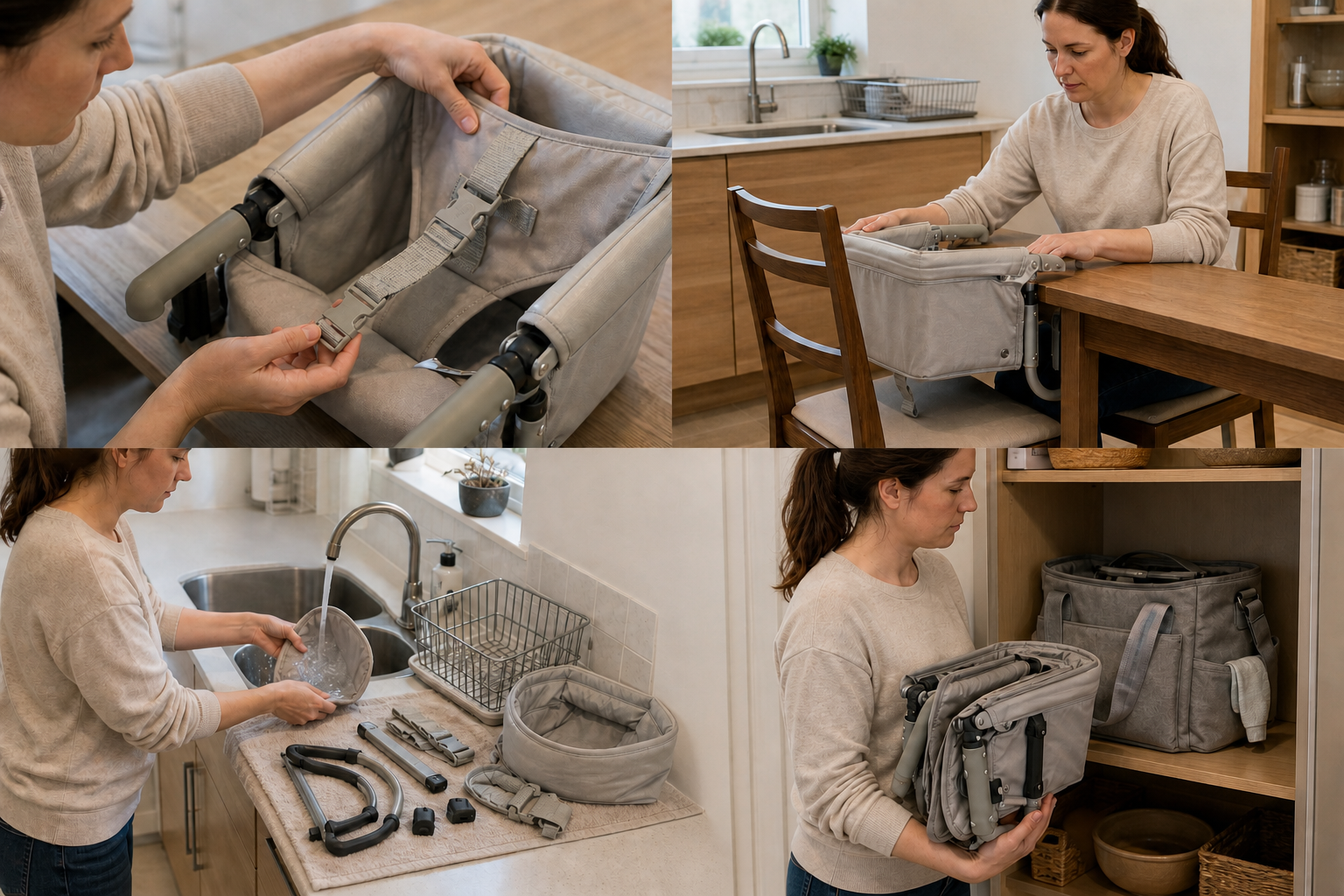
A demonstration usually shows the satisfying middle of the routine. Ownership includes everything around it. Mentally follow one complete cycle: retrieve the product, assemble it, use it while caring for your child, clean it, dry or recharge it, restore any supplies and put it away.
Look closely at the inconvenient parts. Can food reach seams that are hard to wash? Do small pieces need separate drying space? Does the item have to be charged before an outing? Will it occupy a counter because there is no realistic storage spot? Does an app require an account, permissions or ongoing data entry? If another caregiver cannot understand the setup, will you become the only person who uses and maintains it?
A useful product should remove more effort than it transfers. If it saves a minute during use but creates a longer reset after every use, the clever feature may be solving the wrong part of the routine.
Total value: what will the solution really cost?
Start with the purchase price, then add required accessories, proprietary refills, replacement parts, batteries and any paid digital features. Count only the uses you realistically expect during your child’s current stage. A lower-priced item used repeatedly can offer better value than a sophisticated product that fits only an occasional situation.
Also plan the exit. Find out whether the product can be returned after opening, passed on responsibly, recycled or used for another purpose. A claim that something “grows with your child” is valuable only if its current configuration works well and you are likely to use the later ones.
Spot the gap between a good demo and good ownership

The most shareable feature is not necessarily the most useful one. Short videos reward visible transformations: an object unfolds, a mess disappears or several functions click together. Your routine is less tidy. Your child may be hungry, moving, tired or uninterested while you operate the product.
Use these questions to inspect the part of the pitch that isn’t shown:
- What has been prepared off-camera? Look for pre-measured supplies, charged batteries, empty compartments, clean components or a cooperative child.
- What needs to happen afterward? Include disassembly, washing, drying, waste disposal, refilling and finding a storage place.
- Does it solve the adult’s recurring task or simply entertain the child briefly? Either benefit can be valid, but you should know which one you are buying.
- Does the main feature depend on an ecosystem? Check whether continued use requires special bags, cartridges, mounts, accessories, subscriptions or a functioning app.
- Is the claim measurable? Words such as easier, smarter and calmer need a specific meaning in your home. Decide what step should disappear or what task should become simpler.
- Does the pitch turn ordinary uncertainty into urgency? If so, pause. A deadline created by a trend is not the same as a need created by your child’s routine.
Read critical reviews for failure modes rather than star averages. Search within them for the parts that matter to you: cleaning, noise, fit, durability, storage, connectivity or customer support. Then confirm that the review refers to the exact version you are considering.
Choose the right level of commitment
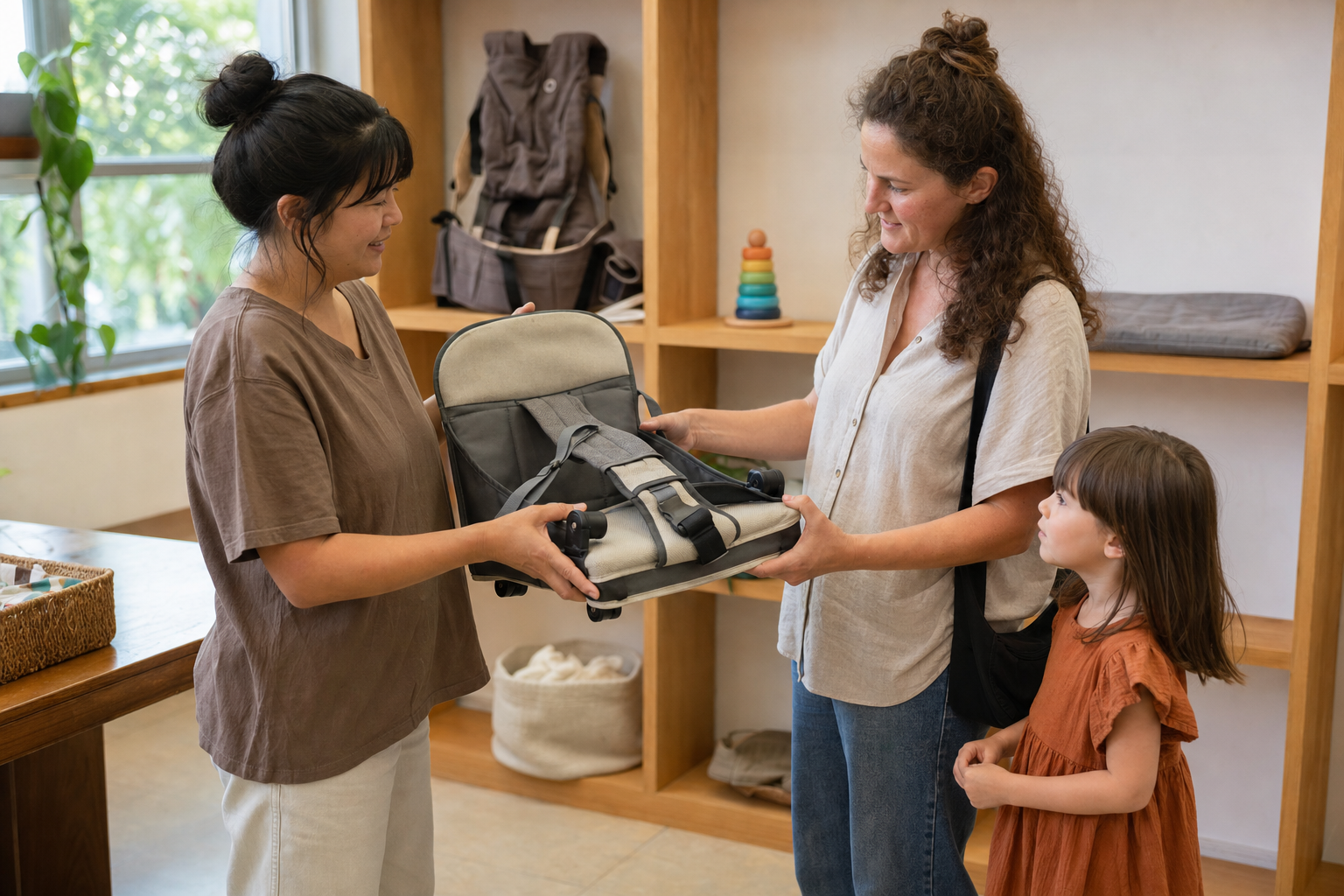
A product can be useful without deserving an immediate new purchase. Match the commitment to how certain you are about the problem, fit and length of use.
| Decision | When it fits | Check before proceeding |
|---|---|---|
| Buy now | The problem recurs in your current routine, the product directly removes it and you accept the maintenance. | Confirm intended use, exact model, total cost, storage space and return terms. |
| Borrow or rent | The stage may be brief, your child’s response is uncertain or you need the item only for a particular situation. | Verify that the item can be safely inspected, cleaned and used as instructed. |
| Buy secondhand | The product is complete, its condition and history are verifiable, and safe use does not depend on information you lack. | Check the exact model for warnings or recalls and reject damaged, altered or incomplete items. |
| Wait | The need is expected but has not appeared, or the main benefit belongs to a later developmental stage. | Save the requirements rather than becoming attached to one model; better information may change your choice. |
| Skip | The product duplicates something you own, solves an occasional annoyance or adds more cleaning, storage or administration than it removes. | Test a small routine change and see whether the original problem remains. |
Borrowing and secondhand buying should never be shortcuts around safety. If you cannot verify the history, instructions, condition or required components of an item whose failure could cause harm, choose another option.
For your next tempting product, write down five things before opening a checkout page: the recurring problem, the requirement for current fit, the hidden ownership task, the safety information you must verify and the exit plan. If one of those lines stays blank, wait. A trend deserves space in your home only when it makes this stage of family life tangibly easier.