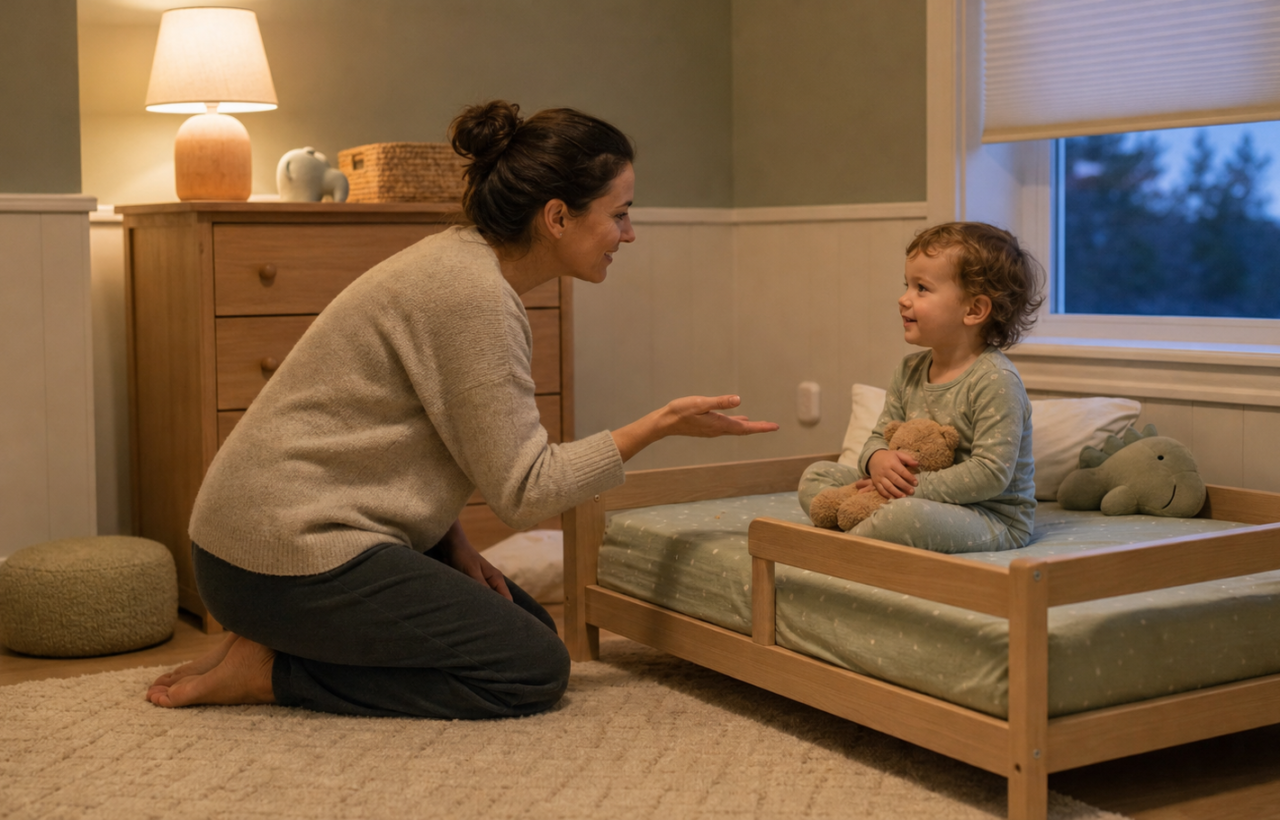
If you are watching your toddler pull up on the crib rail, asking for a “big bed,” or suddenly resisting a sleep space they once accepted, it can be hard to tell whether you need to act or simply wait.
The crib-to-bed transition is not a graduation that must happen by a certain birthday. It is a safety and sleep decision. First decide whether the crib is still safe. Then make the bedroom ready for a child who can get up without you.
Key takeaways
- Move your toddler when they can climb out, the crib has reached its stated limits, or the crib otherwise no longer contains them safely.
- If the crib remains safe and your toddler is comfortable in it, there is no need to switch just because another child the same age already has a bed.
- Once your toddler can leave the bed, treat the whole bedroom and any accessible route beyond it as part of the sleep space.
- Change the bed while keeping the bedtime routine, comfort cues, and household response as familiar as possible.
- Expect your toddler to test their new freedom. A short, calm, repeatable return to bed works better than starting a fresh negotiation each time.
Decide from safety, not from age

Start with the crib itself. Find the model number and manufacturer’s instructions. Check the crib’s stated limits, the required mattress position, and any directions for converting it. If your toddler has reached a product limit or can climb over the rail, stop treating the move as an optional milestone. The fall risk matters more than whether bedtime in a bed feels convenient.
Do not lower the mattress beyond the positions allowed by the manufacturer, remove structural pieces that are not meant to come off, or add a homemade barrier. If you cannot find the instructions, contact the manufacturer instead of guessing.
If the crib is still being used within its instructions and your toddler is not climbing out, look at readiness as a cluster of behaviours and safety signals, not a single decisive moment. Useful clues include consistently asking for a bed, following a simple bedtime direction, and coping reasonably well with the current routine. These clues can make the transition easier, but your toddler does not have to demonstrate every one before a safety-driven move.
Some reasons feel urgent but are not readiness signs by themselves. A friend’s child moving first is not a deadline. A larger bed will not automatically fix bedtime resistance or early waking. And a new baby needing a sleep space does not make an otherwise content toddler ready overnight. If the crib remains safe, choose a relatively settled period rather than combining the move with travel, a new caregiver, a room change, or another major disruption.
If you need the crib for a new baby, avoid framing the change as the baby taking it away. Present the bed as your toddler’s new sleep space and make separate plans for the baby. That keeps the boundary clear without turning the crib into something your toddler has lost to a sibling.
Once the crib rail is gone, the entire room is the sleep space

A crib limits what a toddler can reach. A bed does not. The most important preparation is therefore not the bedding or bedroom theme; it is checking what your child could touch, pull, climb, open, swallow, or wrap around themselves while you are asleep.
Do the safety check from your toddler’s height. Get low enough to see reachable cords, tempting handles, gaps behind furniture, small objects under the bed, and climbable routes that are easy to miss from adult eye level. Repeat the check with the lighting you use overnight.
- Stabilize furniture. Secure dressers, bookcases, and other tip-prone items according to their instructions. Do not leave a chair, toy box, or other easy climbing step beside a window or tall piece of furniture.
- Control window access. Secure windows appropriately and remove access to blind or curtain cords. Place the bed away from windows, cords, heaters, radiators, and anything heavy that could fall.
- Clear reachable hazards. Remove medicines, cleaning products, batteries, small objects, breakables, sharp items, plastic bags, chargers, and electrical cords. Do not assume an item is safe because it sits on a surface your toddler has not climbed before.
- Inspect the bed. Use a sleep product intended for your child’s stage and follow its assembly instructions. Check that the mattress fits correctly and that there are no trapping gaps between the bed, guard components, wall, or nearby furniture. Use only parts approved for that product rather than improvising a rail with cushions or furniture.
- Plan for the doorway and stairs. Decide what happens if your toddler leaves the room. Any accessible hallway, staircase, bathroom, or sibling’s room needs the same kind of practical review. Use child-safety equipment only as directed, and keep the room quickly accessible to an adult. Do not lock your toddler in the bedroom.
- Check emergency basics. Keep the path adults need to reach the room clear, and make sure the home’s smoke and carbon monoxide alarms are installed and working as required where you live.
Finish by asking one useful question: “What could my child do here while no one is watching?” That question catches more problems than asking whether the room merely looks child-friendly.
Change the bed, but keep bedtime recognizable

The bed is already a large change. You can reduce the number of other variables by keeping the same room when possible, following the same order of bedtime steps, and using familiar sleepwear, stories, phrases, and comfort items that are already appropriate for your child.
A simple transition plan looks like this:
- Prepare the room before announcing the move. Complete assembly and childproofing first, so excitement does not push you into using an unfinished setup.
- Offer small choices. Let your toddler choose between two acceptable sheets, books, or pyjamas. Do not make the move itself a nightly vote if the crib is no longer safe.
- Practise during the day. Show your toddler how to get into and out of the bed safely. Point out where their head and feet go and where you will sit for the usual story.
- Use one concrete rule. “Your body stays in bed after goodnight” is easier to understand than a long explanation about being grown up. If your household allows a quiet book or comfort item in bed, make that boundary equally clear.
- Keep the familiar sequence. Use the same steps in the same order: for example, wash, pyjamas, story, cuddle, bed, and goodnight. The exact routine matters less than its predictability.
- Agree on the adult response. Every caregiver should know what to say and do when your toddler gets up. Inconsistent responses can turn leaving bed into a way to discover which version of bedtime is available tonight.
Avoid building the move into a test of maturity. “Big kids do not cry” or “the baby needs your crib now” adds emotional pressure without teaching the new skill. Your toddler needs to learn where sleep happens and what you will do when they leave, not prove that they are older.
When your toddler gets out of bed, make your response predictable

The new freedom to stand up and walk around is likely to be interesting even for a tired child. Getting out of bed does not automatically mean the move was a mistake. It often means your toddler is checking what the new boundary actually does.
When they leave, keep the response brief. Guide them back, repeat the same short bedtime phrase, and end the interaction. Address a genuine need, such as discomfort or a necessary bathroom visit, but avoid adding another story, snack, game, or long discussion every time they appear. Those additions can make leaving bed the route to more attention and more bedtime.
If your toddler becomes upset, you can respond calmly without abandoning the boundary. Offer the kind of brief reassurance that fits your usual approach, return them to the sleep space, and repeat the same goodnight cue. Calm does not mean emotionally distant; it means the response stays understandable from one return to the next.
Look for patterns rather than judging the entire transition from one difficult bedtime. Is your toddler leaving at the same point in the routine? Are they looking for a particular object, reacting to a dark corner, or reaching something in the room that was previously inaccessible? Fix the specific problem instead of continually adding new rules.
If the move was optional, the crib remains within its instructions, and the new setup is producing distress you cannot settle safely, pausing may be reasonable. Returning to the crib is not an option if your toddler can climb out or has exceeded its stated limits. In that case, simplify and secure the room, keep the response consistent, and ask your child’s healthcare professional for help if persistent sleep problems are affecting the child or family. If a sudden sleep change comes with pain, breathing concerns, or signs of illness, treat it as a health concern rather than a bedtime-boundary problem.
Tonight, start with two jobs: find the crib instructions and inspect the bedroom from toddler height. If the crib is still safe, you can choose a calm time to make the change. If it is not, prepare the room and decide on your return-to-bed response before the next sleep. The useful measure of success is not perfect stillness on the first night. It is a safe sleep space and a boundary your toddler can learn because it stays the same.
References