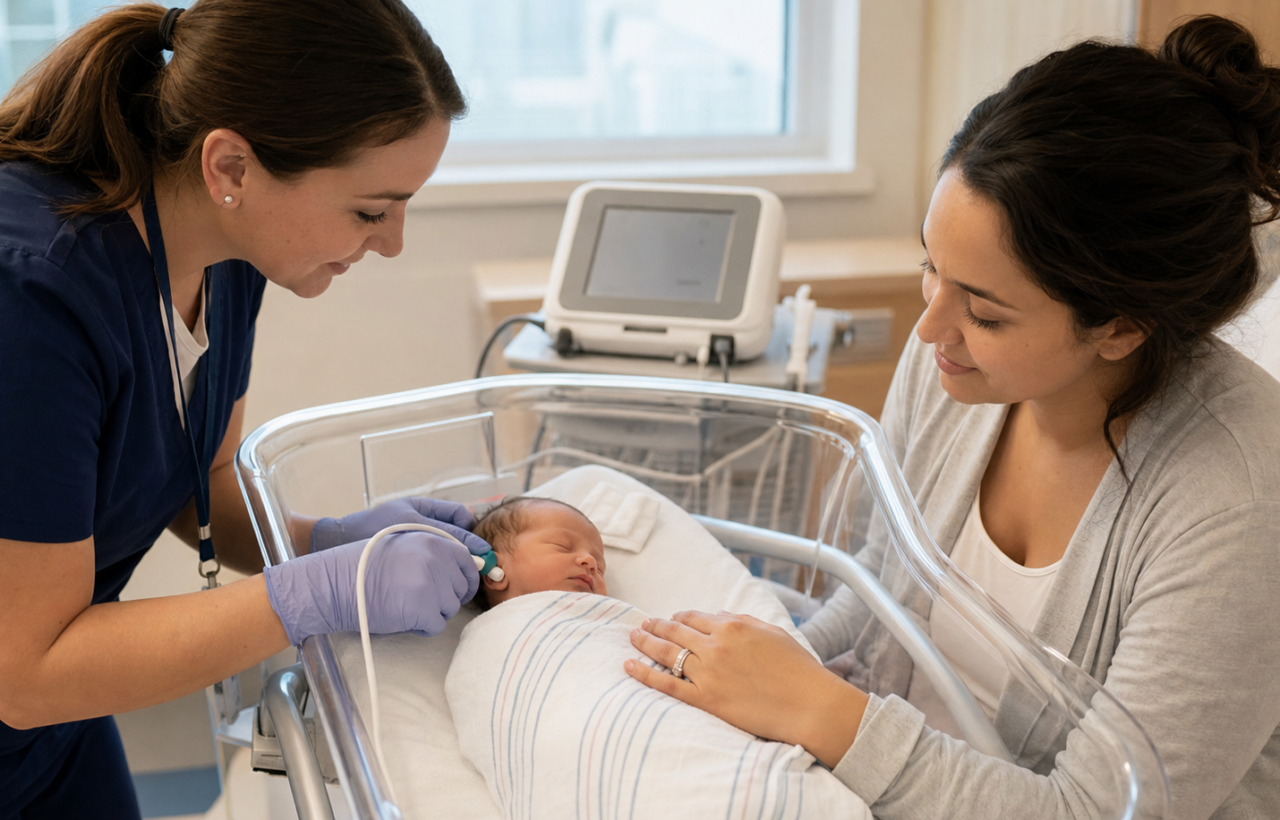
Your baby’s newborn hearing screen says refer, did not pass, or incomplete. Those words can sound like a diagnosis, but they aren’t. They mean the screening did not record a clear pass and your baby needs another test.
Most newborns are screened before leaving the hospital, so this result often arrives while you’re recovering, learning to feed your baby, and absorbing discharge instructions. Before you leave, get three facts in writing: which ear needs follow-up, what kind of screening was used, and when the next appointment should happen.
Key takeaways
- A newborn hearing screen is a quick check, not a diagnosis of hearing loss.
- Fluid, vernix, movement, crying, background noise, or a poor probe seal can prevent the equipment from recording a pass.
- A temporary explanation is possible, but it should never be used as a reason to skip the repeat screen.
- Follow-up is still necessary when only one ear receives a refer result.
- A pass is reassuring, but it does not replace later evaluation if you notice concerns about how your baby responds to sound.
How the screening works and why conditions matter
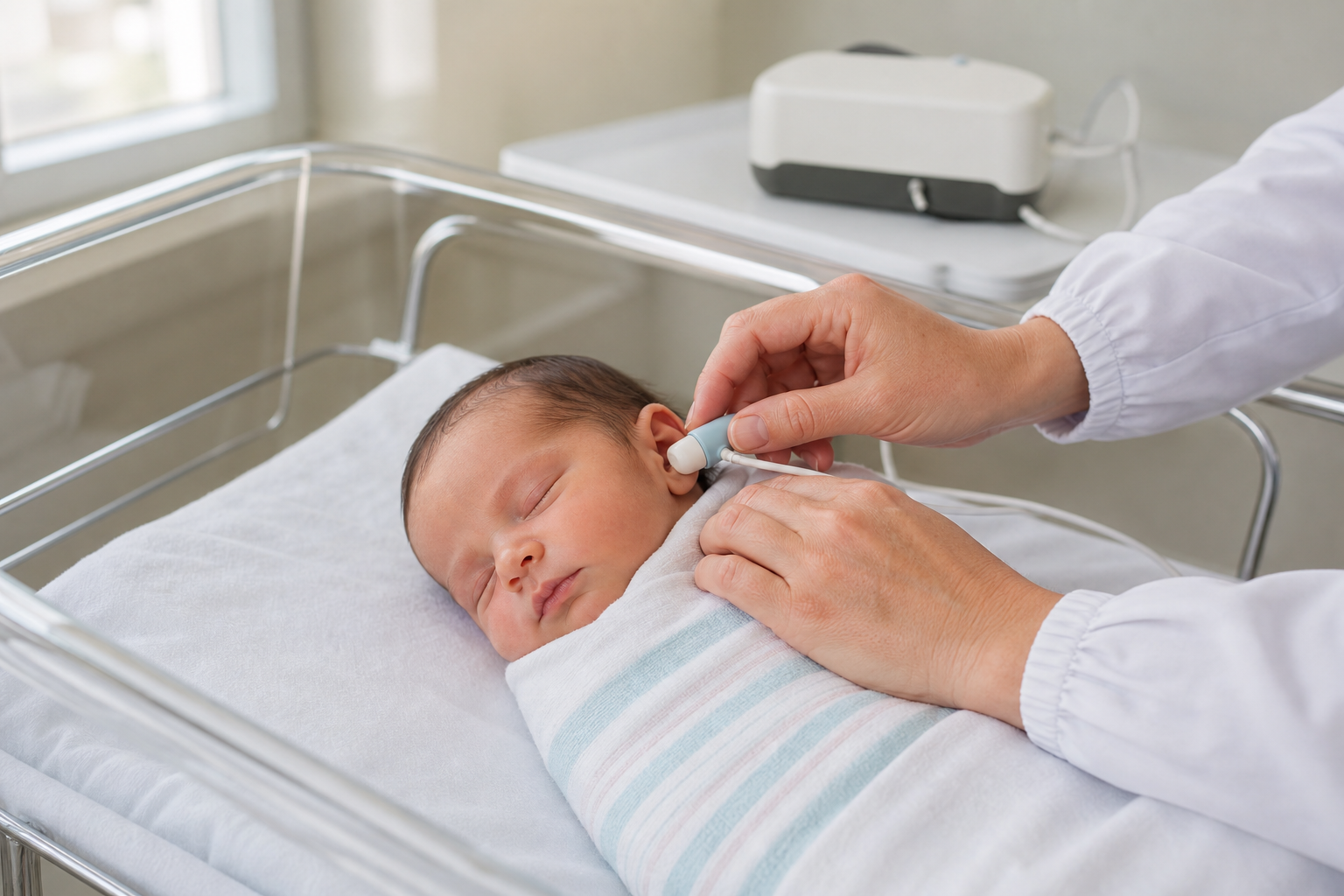
Your baby does not have to turn toward a sound or show that they heard it. Instead, the equipment looks for a tiny physical response from the ear or hearing pathway. The screening is painless and is easiest to complete while a baby is quiet or asleep.
Otoacoustic emissions screening
An otoacoustic emissions screening, often shortened to OAE, places a small probe in the ear canal. The probe plays soft sounds and checks for an echo produced by the inner ear. The baby does not need to respond deliberately.
Because the response must travel through the outer and middle ear, material in the ear canal or fluid behind the eardrum can interfere with the reading. Newborns may still have vernix or birth fluid in and around the ear shortly after delivery. A probe that shifts while the baby moves can also lose its seal.
Automated auditory brainstem response screening
An automated auditory brainstem response screening, often called AABR, uses small sensors placed on the baby’s head and earphones or earpieces that deliver soft sounds. It checks whether the hearing pathway leading toward the brainstem produces an expected response.
Crying, muscle movement, loose sensors, and electrical or background interference can make that small response difficult to record. In either type of screening, not passing the first test can reflect the testing conditions rather than permanent hearing loss.
That distinction is reassuring, but it has a limit: you cannot tell from the result alone whether fluid, noise, hearing loss, or another factor caused it. A repeat screen or diagnostic assessment is what resolves the uncertainty.
What happens after a refer or incomplete result

- Confirm the exact result. Ask whether the record says refer, did not pass, or incomplete, and whether the result applies to the left ear, right ear, or both. Incomplete can mean the screening could not be finished or did not produce a usable recording; it does not mean the ear passed.
- Book the follow-up before you leave, if possible. Use the timing given by the hospital or newborn hearing program. If the appointment is not made for you, ask for the correct phone number and the name of the program responsible for arranging it.
- Attend the repeat screening even if your baby reacts to sound at home. A startle, blink, or settling response cannot show how each ear is hearing. A baby with a one-sided concern may still react using the other ear.
- Ask what follows another refer result. Your baby may be sent to a pediatric audiologist for diagnostic testing. Unlike screening, a diagnostic assessment is designed to investigate whether hearing loss is present and to provide more detailed information.
- Reconnect quickly if an appointment falls through. Call the hospital screening program or your baby’s health-care clinician if you do not receive the expected appointment, cannot attend it, or are unsure who is managing the follow-up.
Do not try to clear a suspected blockage with cotton swabs, ear drops, or another home treatment unless your baby’s clinician specifically directs you to do so. A newborn’s ear canal is delicate, and a screening result does not identify something that should be treated at home.
For the next appointment, follow the clinic’s preparation instructions. Screening is generally easier when your baby is settled, so ask whether the clinic wants you to time a feeding or let your baby fall asleep after arrival. Bring the hospital result or discharge paperwork, even if you expect the records to have been transferred.
Questions to ask before leaving the hospital
A short checklist is useful because the word refer is not enough information to manage the next step. Ask:
- Did my baby pass in either ear?
- Was the result refer, did not pass, or incomplete?
- Was OAE, AABR, or another screening method used?
- Is a repeat screening already booked? If so, where and when?
- Who should I call if no appointment information arrives?
- Who will receive and explain the follow-up result?
- Should I bring or do anything specific to help my baby sleep during the appointment?
If your baby was discharged without being screened, do not assume a routine physical examination will cover hearing. Contact the birth hospital or your baby’s clinician and ask how to arrange newborn hearing screening.
A pass is reassuring, but keep noticing your baby

A passing newborn screen means the equipment recorded the expected response during that screening. It is not a lifetime guarantee, and it cannot answer every question about how a baby processes sound.
As your baby grows, notice whether responses to voices and everyday sounds emerge and remain consistent. Tell your baby’s clinician if your baby rarely responds to sound, stops showing responses they previously had, responds much more reliably from one side, or later shows a concern involving speech or language development. Ask for a professional hearing evaluation even if the newborn screen was recorded as a pass.
Home checks such as clapping behind your baby cannot rule out hearing loss. The response changes with sleep, attention, distance, and the loudness of the sound, and it does not test each ear independently. Your observations are valuable because they identify a reason to seek assessment, not because they can replace it.
For now, put the written result and follow-up contact in your phone before the discharge papers disappear into the diaper bag. One confirmed appointment turns an unclear screening result into a concrete next step.
References