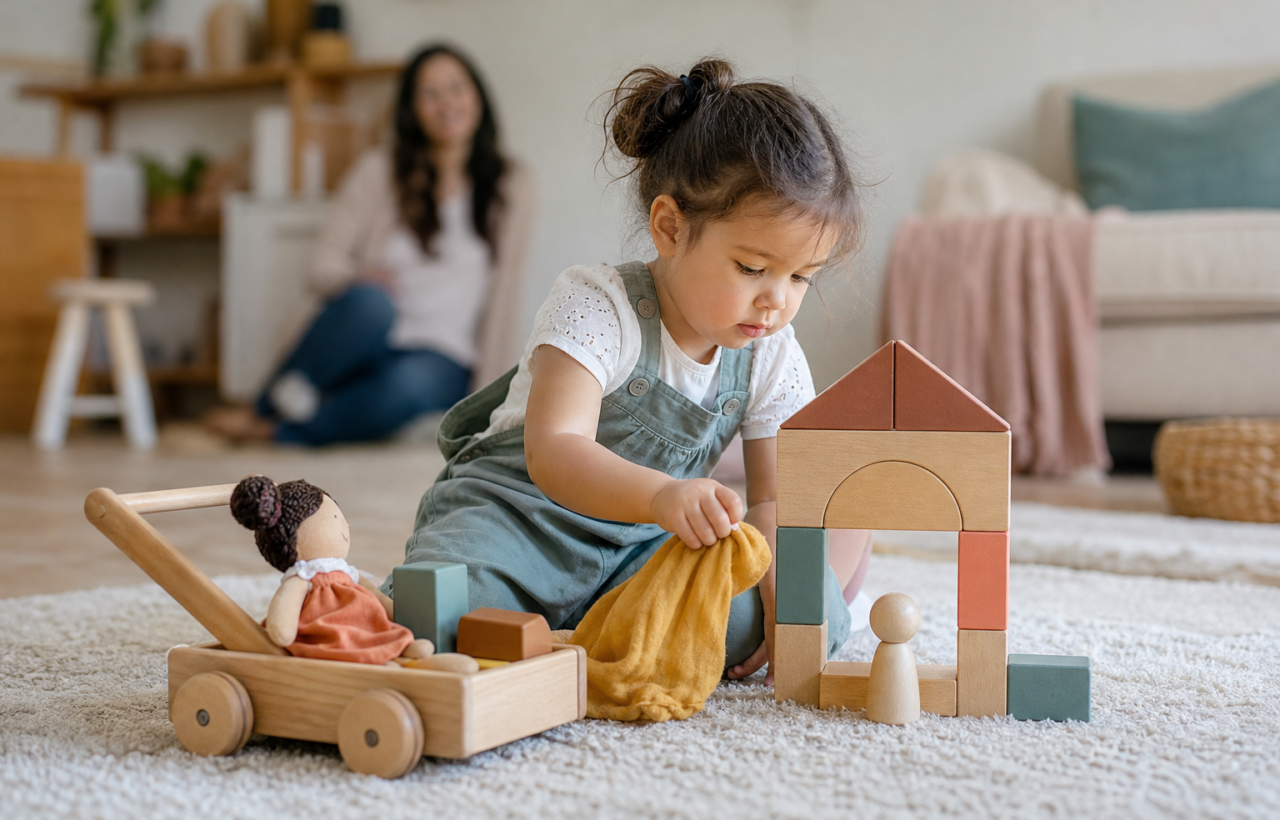
You are shopping for a 2-year-old, and the toy aisle is offering you two unhelpful extremes: a complicated set with dozens of pieces or a flashing toy that does most of the entertaining itself. Neither guarantees much play once the wrapping paper is gone.
A better imaginative gift gives the child a clear action and leaves the outcome open. Think carry, feed, stack, deliver, build, hide, draw, knock down and begin again. That balance can make room for imagination while encouraging independence, without requiring a 2-year-old to follow an adult’s script.
Key takeaways
- Start with an action the child already repeats, such as carrying objects, copying household routines or building and knocking things down.
- Choose a toy the child operates, combines and changes, rather than one that performs the entire activity for them.
- Look for one recognizable anchor, such as a doll, basket, vehicle or set of large blocks, with a few flexible accessories.
- Check the manufacturer’s age label, every detachable part and the actual play environment before buying.
- Make the gift ready to use, demonstrate one simple premise and then let the child decide what happens next.
Start with the play the child already repeats
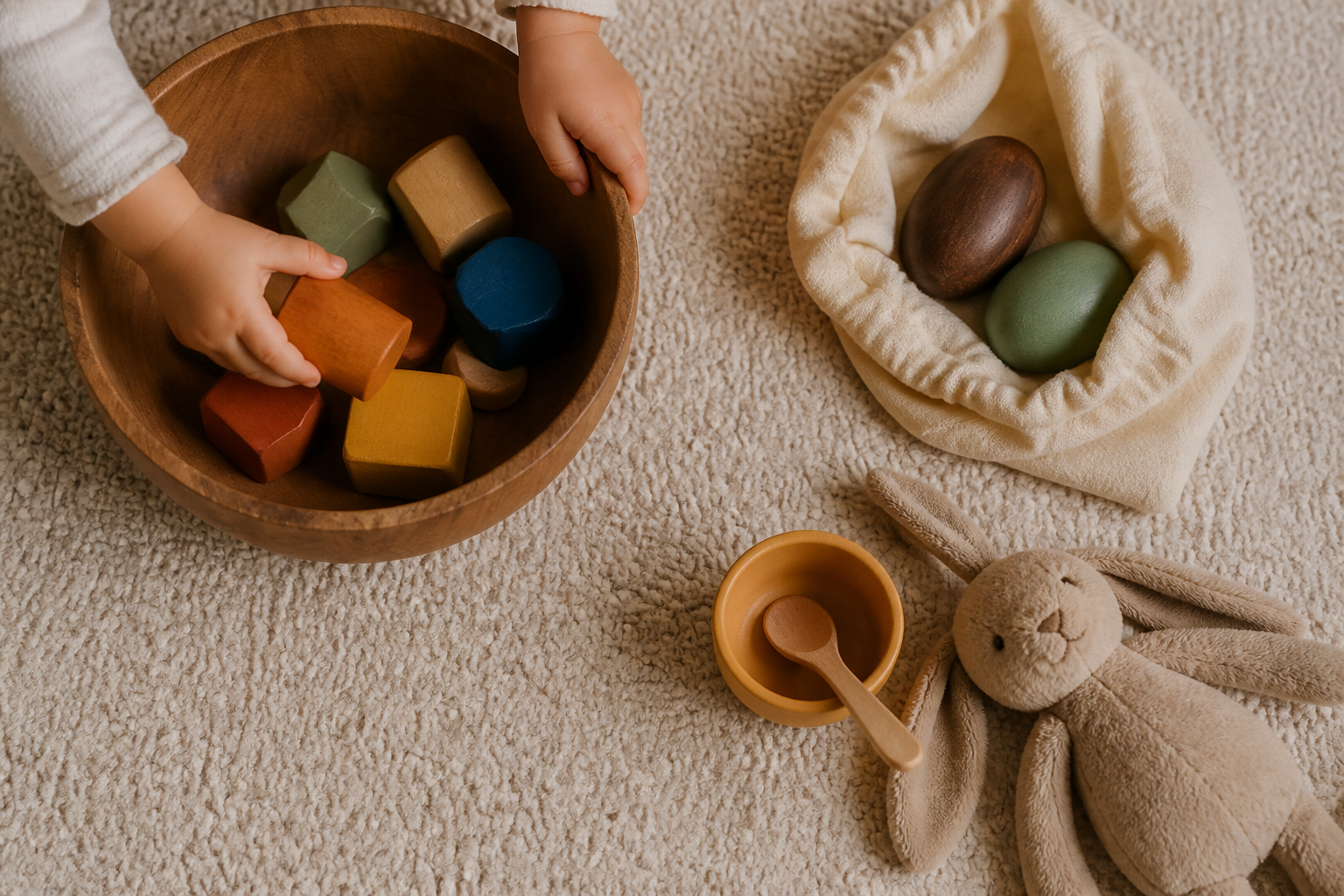
You do not need to predict which profession, character or hobby a 2-year-old will eventually love. Watch what they do now. Repeated actions are better shopping clues than a heavily themed package.
| What you notice | A useful gift direction | What may get in the way |
|---|---|---|
| They carry objects from room to room | A sturdy basket, small cart or tote with large pretend groceries, animals or household props | A large collection of tiny accessories that constantly separates |
| They fill, empty and rearrange containers | Nesting containers, large blocks or chunky objects that can be packed and moved | An activity that only works when pieces are used in one prescribed order |
| They copy meals, caregiving or cleaning | Simple kitchen, doll-care or child-sized household props | An electronic set that supplies every sound, instruction and line of dialogue |
| They build and immediately knock things down | Large construction pieces, stacking shapes or chunky vehicles | A delicate model that adults will keep correcting or protecting |
| They make animals or toys interact | A few puppets, plush animals or age-labelled figures, possibly paired with blocks | A crowded cast with too many named characters and fixed story rules |
These observations are clues, not developmental tests. Two children of the same age can use the same object very differently. One may turn a basket into a delivery vehicle, while another fills it with toy food and calls it a picnic. That flexibility is exactly what you want.
If you are buying for someone else’s child, ask the parent one concrete question: “What does your child keep pretending to do?” It will usually produce a more useful answer than asking which toy they want. Also ask about duplicates, storage space, noise and whether paint, dough or water play is welcome in the home.
Gift ideas that create stories instead of prescribing them
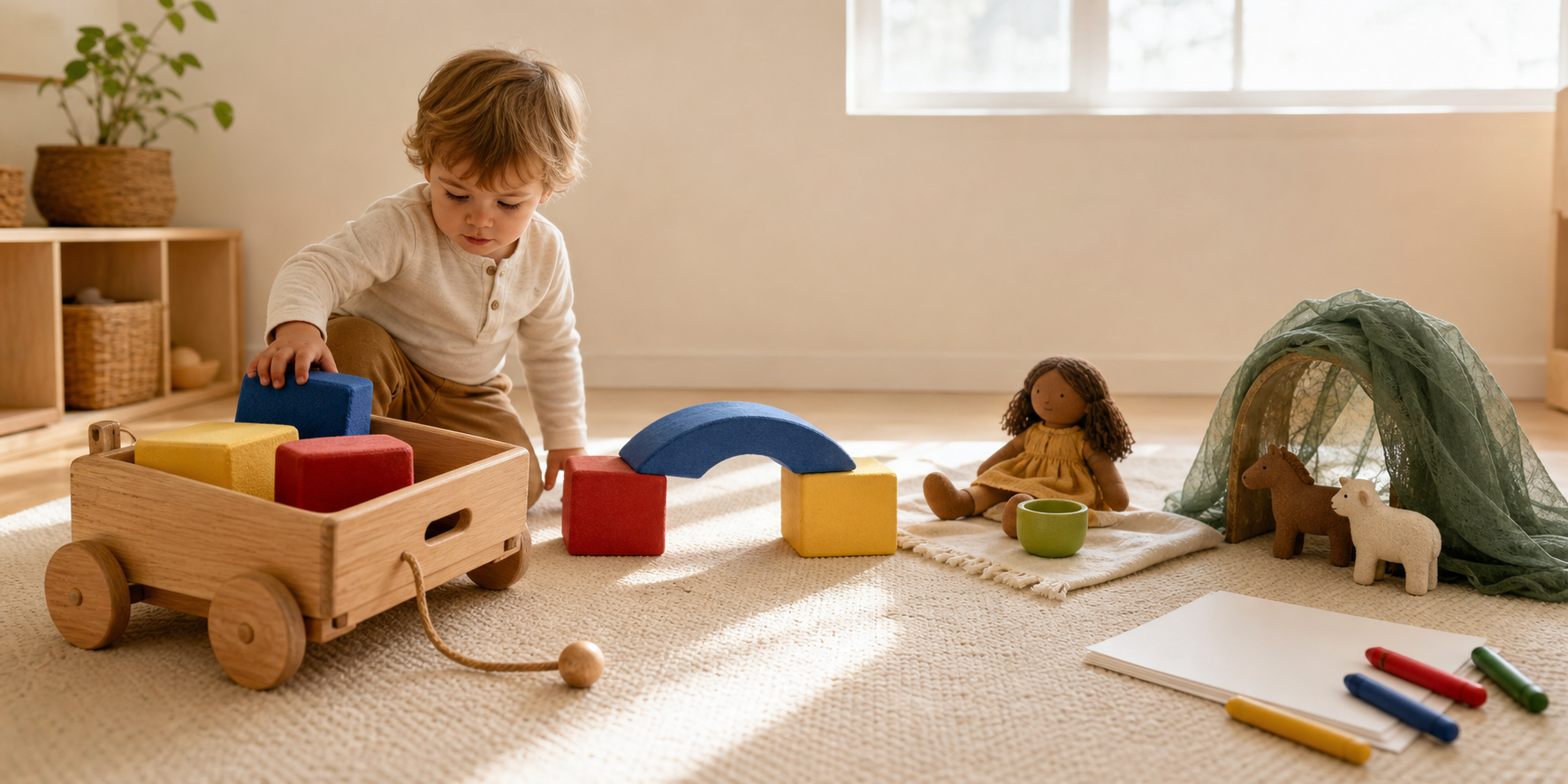
Pretend-care sets
Start with a washable doll or plush animal, then add only the props needed to begin: a small blanket, brush, cup and spoon. The child can feed the toy, put it to bed, take it somewhere or decide that the cup is a bathtub. A compact set leaves more room for invention than a large kit in which every object has a narrowly assigned purpose.
This is also an easy gift to tailor without turning it into a shopping project. Use a toy the child already owns as the central character and give it a bed, carrier or set of care accessories. You avoid duplication while expanding an existing kind of play.
Markets, kitchens and delivery games
A basket with sturdy pretend food, cups and plates can become a grocery store, cafe, family dinner or delivery service. You do not need a full play kitchen for this to work. A low shelf, small table or clean cardboard box can provide the counter.
A delivery kit is an especially flexible variation. Pair a small bag with large cards, a few safe parcels and a box that can serve as a mailbox. The child decides who receives what. Avoid real packaging that contains staples, plastic film or other detachable material.
Building materials with a few characters
Large blocks are not limited to towers. They can become beds, roads, animal pens, tables or walls. Add a chunky vehicle or a small number of age-appropriate animals, and construction naturally turns into storytelling.
Choose pieces that connect or balance without requiring precise hand movements. The goal is not to complete the picture on the box. It is to let the child build something, use it and rebuild it when the story changes.
Story baskets, puppets and simple dress-up pieces
Pair a sturdy book with one or two safe props that echo its world: a plush animal, puppet, vehicle or piece of pretend food. The child does not have to reproduce the book. The props simply offer a place to begin.
For dress-up play, favor pieces a young child can put on and remove with little help, such as hats, aprons, loose vests and small bags. Skip complicated costumes, restrictive garments and anything with cords or ties around the neck. A dress-up gift should help play start, not turn an adult into the permanent costume technician.
Art, music and movement materials
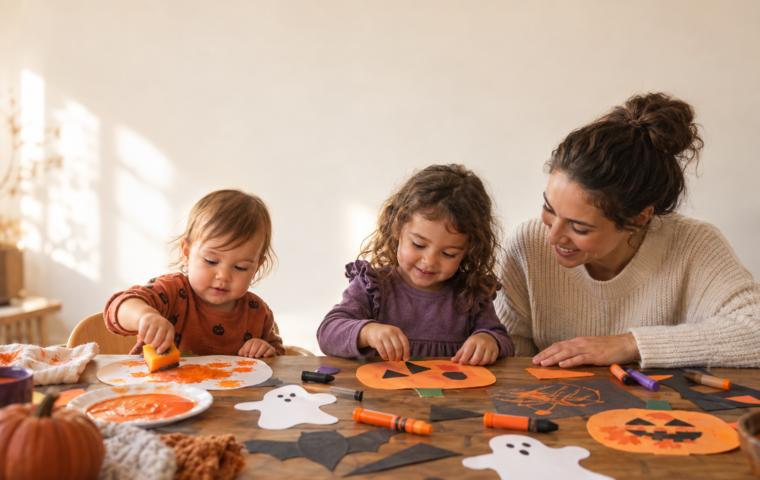
Washable crayons with generous paper, age-labelled modelling material with chunky tools, or simple musical instruments let the child decide what to make. These gifts work best when the adult receiving them is comfortable with the setup and cleanup. If mess is a concern, a large drawing surface and a small set of washable materials are more considerate than an elaborate craft box.
An indoor play tunnel can be a cave, train, animal home or route into a pretend shop, but it only makes sense where there is enough clear floor space and an adult can supervise. Imaginative potential does not cancel the practical question of where the gift will be used.
Use the replay test before you buy
The most revealing question is not “What does this toy do?” Ask, “What can the child decide to do with it after the first idea is finished?” Packaging often demonstrates one polished scenario. You are looking for the possible second, third and completely unintended scenarios.
- Who supplies the action? If pressing a button makes the toy deliver the character, song and outcome, the child has fewer decisions to make. Lights and sounds are not automatically a problem, but they should support the play rather than replace it.
- Can the object change jobs? A block can be a phone, bed, parcel or wall. A toy with only one correct result may still be enjoyable, but it is less useful as the centre of imaginative play.
- Will it work with what is already at home? Blocks, dolls, animals, vehicles and containers become more valuable when they can enter one another’s stories.
- Can the child begin without a long setup? A gift that depends on an adult assembling a scene every time may sit unused, especially during busy parts of the day.
- Can the household reset it easily? Count the loose parts, imagine where they will live and notice whether losing one piece makes the whole toy unusable.
- Will adults feel compelled to correct the play? If there is a strong temptation to preserve, display or complete the gift properly, it may be a better collectible for an adult than a plaything for a 2-year-old.
Open-ended play does not require an abstract toy with no recognizable purpose. Many 2-year-olds benefit from an obvious starting point: a baby needs a meal, a truck needs a road or a puppet needs somewhere to sleep. The useful distinction is whether that premise opens a story or dictates its ending.
You can also improve a modest gift by making it playable immediately. Remove retail packaging, complete any adult assembly and put the main pieces in an easy-to-carry container. Keep the safety information and care instructions.
When the gift is opened, model one short premise rather than demonstrating every feature. Put the bear to bed, deliver one parcel or build a garage. Then stop. If the child changes the rules, that is not a mistake; it is the imaginative part of the gift beginning to work.
Check safety and household fit before checkout
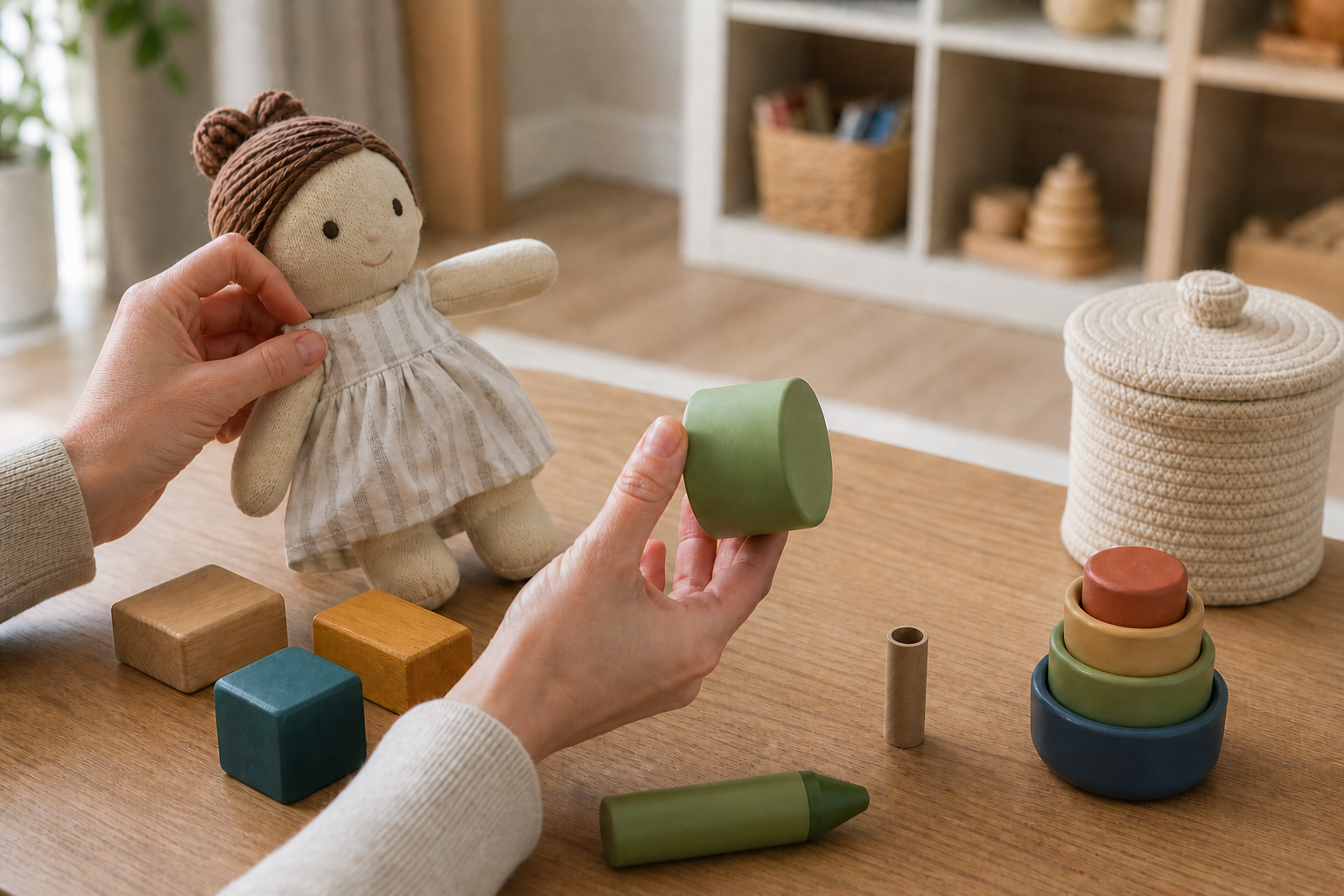
“Toddler toy” is a broad retail label. Use the manufacturer’s age recommendation and warnings for the exact product, then inspect the actual pieces. Do not assume a familiar character, a soft appearance or placement in the children’s aisle makes an item suitable for a 2-year-old.
- Reject loose or easily detached pieces that could go into the child’s mouth, particularly if the child still explores objects that way.
- Check that batteries are inaccessible during ordinary play and that any battery compartment remains securely closed.
- Avoid accessible magnets, sharp edges, long cords, neck loops and brittle pieces that could break.
- Keep sets intended for older siblings separate. A large-piece toddler set can become unsafe when small accessories from an older child’s set are mixed into the same container.
- Choose age-labelled art and modelling materials, supervise their use and follow the package directions. A material described as non-toxic is not an invitation to eat it.
- Inspect second-hand toys for damage, missing safety information and incomplete fasteners before giving them to the child.
- Match movement toys to the available floor space and surface. A toy that encourages climbing, riding or fast movement needs an environment where it can be used under appropriate supervision.
Household fit matters after safety. A beautiful gift that cannot be stored, washed or tolerated at breakfast will spend its life in a closet. When you are unsure, choose a smaller coherent set over a giant assortment. A basket, one anchor toy and a few flexible props are enough to begin.
Before you shop, write down the action you most recently saw the child repeat. Choose one age-labelled gift that lets them use that action in more than one story, and leave room for the child to supply the rest.
References