Maybe your toddler sits willingly one day and refuses the next. Maybe accidents began as soon as you switched to underwear. Or perhaps you are still wondering whether your child is ready. The most useful response is usually not a more intense method. It is a simpler, more predictable plan.
Small, practical adjustments can make potty training more manageable, but a trick only helps when it removes a real obstacle. Start with what your child can already do, make the bathroom easy to use, and teach the same short sequence repeatedly.
Key takeaways
- Use a group of readiness signs, not age alone, to decide whether to begin active training.
- Make the potty stable, accessible, and easy to reach in clothes your child can help remove.
- Offer the potty at predictable transitions instead of asking about it constantly.
- Praise communication and participation, not only pee or poop landing in the potty.
- Respond to accidents with a neutral cleanup routine. Pause if repeated attempts are turning into fear or a power struggle.
- If peeing or pooping hurts, or you are concerned about constipation, contact your child’s healthcare professional before pushing ahead.
Start with readiness you can actually observe
A birthday does not automatically make a child ready to use the potty. Look for a cluster of everyday abilities that let your child participate in the process.
- Your child notices or communicates that a diaper is wet or dirty.
- You can sometimes recognize a pause, posture, sound, hiding place, or other signal before your child pees or poops.
- Your child can reach a potty and sit with enough support to feel secure.
- Your child can follow a short direction such as going to the bathroom or helping pull clothing down.
- Your child shows curiosity about the toilet, underwear, handwashing, or what other family members do in the bathroom.
- Your child can tolerate at least some of the clothing changes and bathroom steps without becoming overwhelmed.
This is not an entrance exam. Your child does not need to perform every item perfectly. You are looking for enough participation to practise a routine together. If most of the process currently has to be done against your child’s resistance, preparation is likely to be more useful than a full switch to underwear.
Preparation can be concrete. Let your child sit on the potty while clothed, practise pushing elastic-waist trousers down, flush with supervision, and wash hands. Name body signals when you notice them: You stopped playing. Your body might be getting ready to poop. This builds familiarity without requiring your child to produce anything on demand.
Choose the start window carefully as well. Travel, illness, a household move, a new childcare arrangement, or an unusually overloaded caregiver can make consistency difficult. Waiting for a steadier stretch is not giving up. It is choosing conditions in which your child can understand what is changing.
Remove the physical friction before training begins
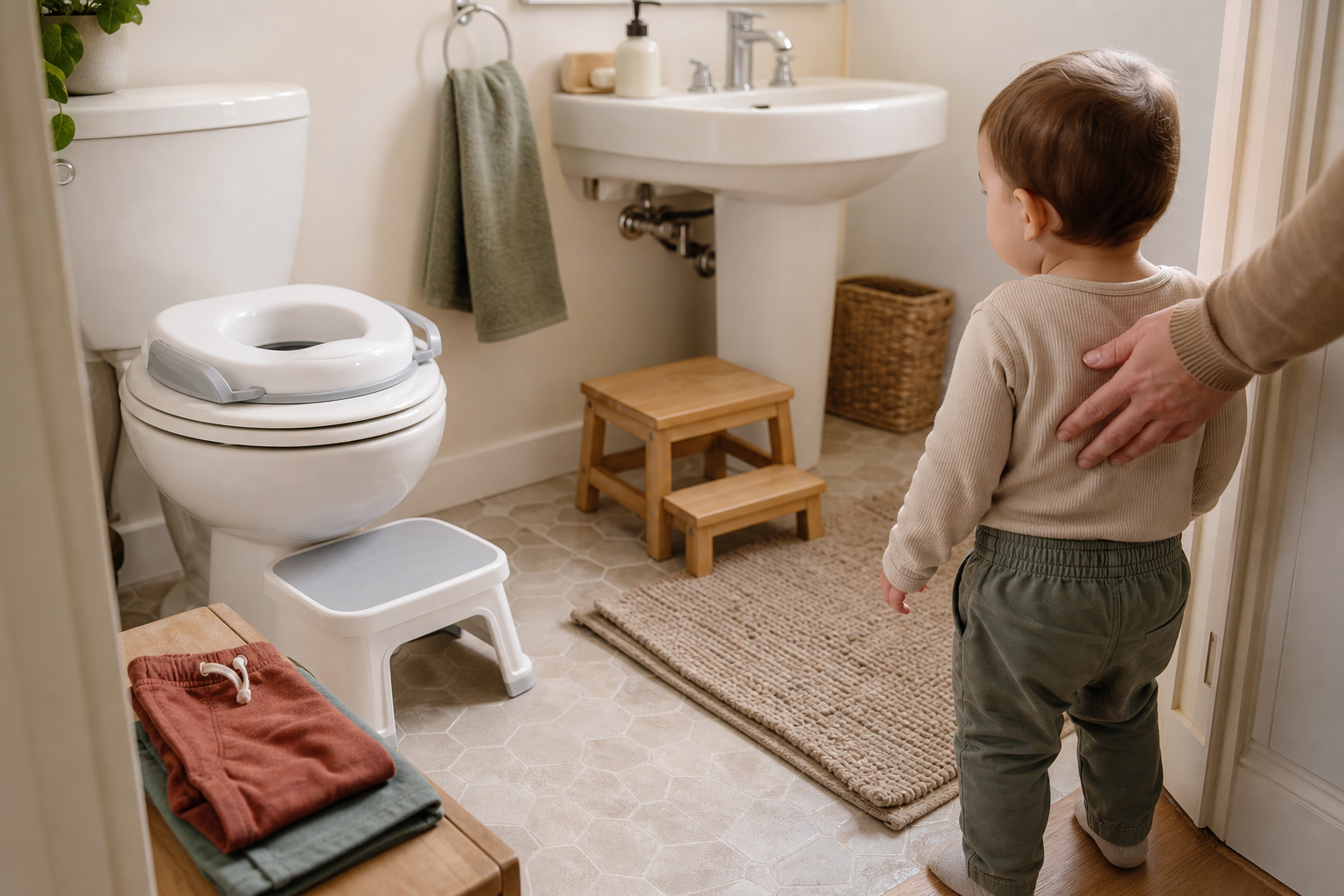
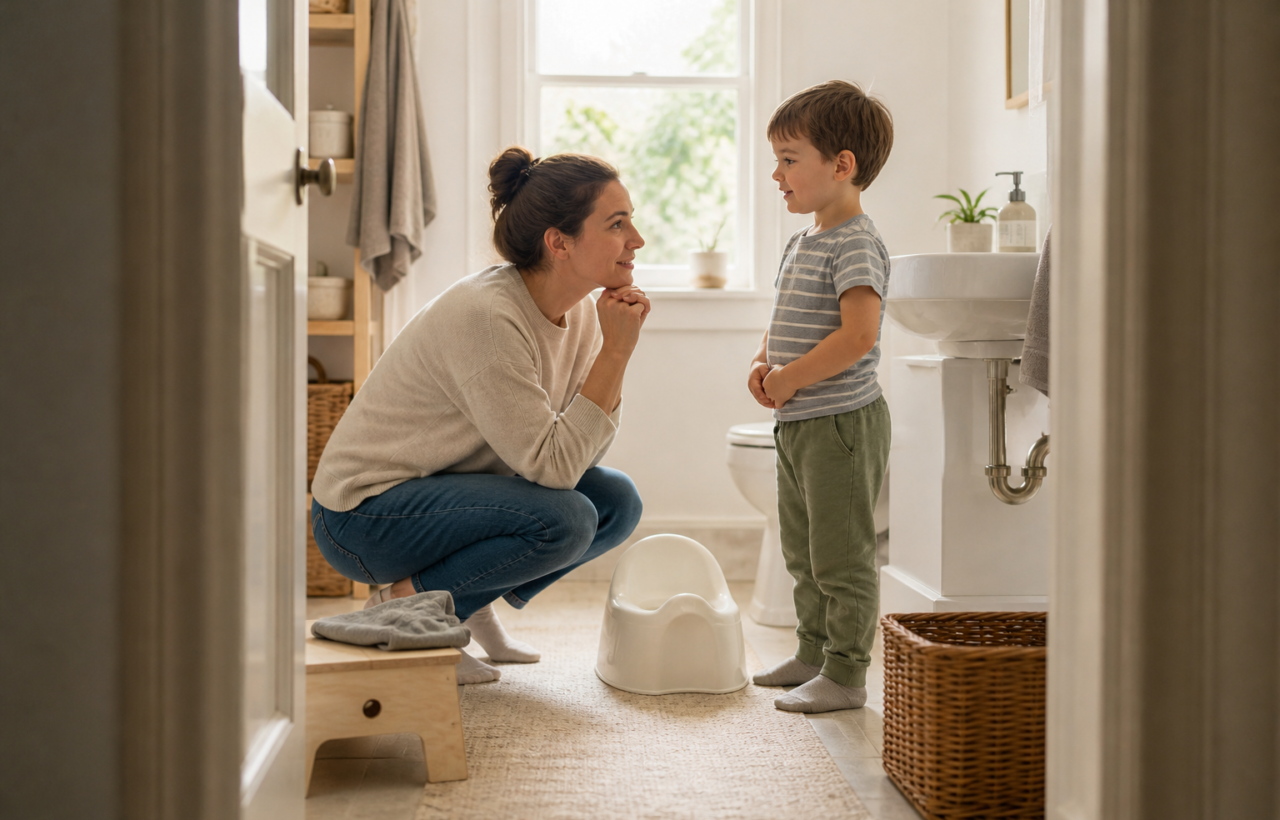
Many apparent behaviour problems are setup problems. A child may avoid a toilet that feels high, unstable, cold, noisy, or difficult to reach. Clothing can also turn a clear body signal into an accident when a child cannot get it out of the way.
- Provide a stable position. Use a floor potty or a secure toilet reducer with appropriate foot support. Your child should not feel as though they are balancing over an opening.
- Clear the route. Keep the path to the bathroom unobstructed and the potty in a consistent, accessible place.
- Simplify clothing. Elastic-waist trousers and other easy layers let your child participate. Complicated fasteners, tight clothes, and bulky layers add steps when the urge is already present.
- Keep supplies together. Put toilet paper, clean clothes, wipes or cleaning supplies for the caregiver, and a handwashing aid where they can be reached safely when needed. Keep cleaning products out of your child’s reach.
- Use consistent language. Pick simple family words for pee, poop, wet, dry, potty, and toilet. Ask other caregivers to use the same terms.
- Offer limited choices. Your child can choose a potty book, underwear design, or hand soap. Avoid offering so many choices that every bathroom visit becomes a negotiation.
Supervise young children in the bathroom, especially around water, stools, toilet lids, and cleaning products. Independence during potty training means giving your child manageable jobs within a safe setup, not leaving them to handle the entire bathroom alone.
Teach one predictable bathroom sequence
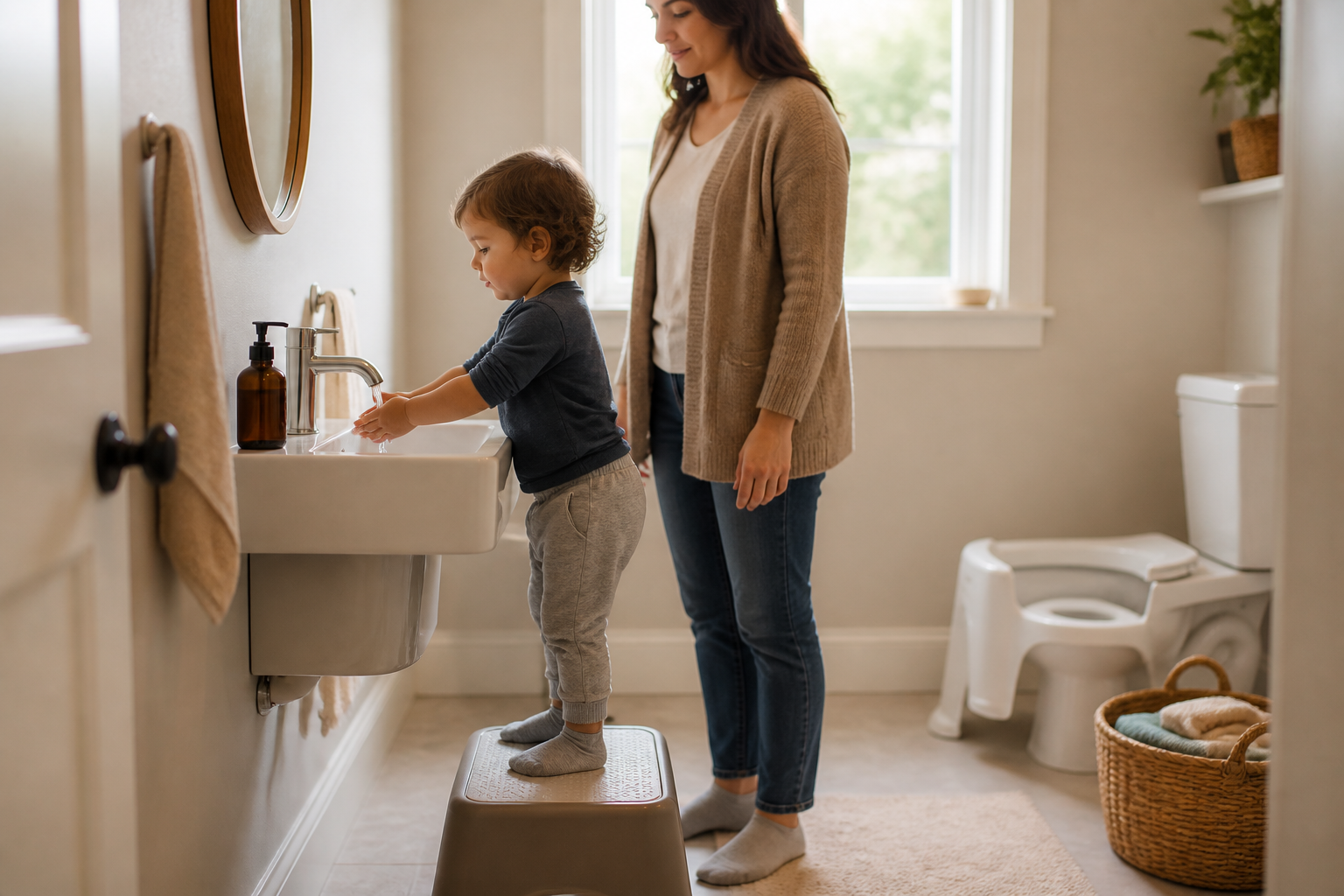
Repeatedly asking, Do you need to go? often produces an automatic no. A toddler who is busy playing may not recognize the signal early enough to answer accurately, and a child who hears the question all day may begin treating it as background noise.
Instead, choose a few transitions that already happen in your day. Waking, finishing a meal, leaving home, returning home, and beginning the bath or bedtime routine can all serve as clear cues. You do not need to use every possible transition. Choose the ones your household can repeat calmly.
- Name the cue: We finished breakfast, so it is potty time.
- Help your child reach the bathroom and manage clothing, leaving any step they can do safely for them to attempt.
- Offer a comfortable sit without forcing your child to remain there.
- If pee or poop happens, describe it simply and acknowledge what your child did.
- If nothing happens, end neutrally: Nothing yet. We will try again later.
- Finish with clothing, flushing if appropriate, and handwashing in the same order.
A short, repeatable visit teaches more than a long sit filled with pleading. Holding a child on the potty until something happens can turn the bathroom into a contest. The goal is for your child to connect a body signal with a place and a sequence, not to obey until their body performs.
Respond promptly when your child signals outside the routine, even if you suspect it is a delay tactic. A false alarm still gives your child practice noticing, telling you, walking to the bathroom, and trying. Those are part of the skill.
Use motivation without making success the price of approval
Potty training contains several behaviours your child can control and one outcome they cannot always produce on command. Praise the controllable parts: noticing a signal, telling you, going to the bathroom, helping with clothes, sitting, trying, flushing, and washing hands.
Keep praise specific. You told me your body needed the potty gives your child more information than Good job. It also lets you acknowledge progress even when the trip ends without pee or poop.
If you use a reward, define exactly which behaviour earns it and deliver it immediately. A sticker for completing the bathroom routine is easier to understand than a distant promise. Stop or change the reward if your child begins sitting only to bargain, repeatedly forcing attempts, or becoming distressed when their body does not cooperate.
This is where an unusual little tactic can be worthwhile. A designated potty book, a short bathroom song, a toy that demonstrates the steps, or novelty soap may help a hesitant child enter the routine. Judge the tactic by its job. Keep it if it reduces one specific point of resistance. Drop it if it creates a new demand or keeps your child sitting long after the attempt is over.
Avoid shame, disgust, threats, or withdrawing affection after an accident. Also avoid turning food or drinks into punishment. Your child needs accurate feedback about what happened, but they should not have to protect their relationship with you by controlling a developing body skill.
Handle accidents and refusal as information
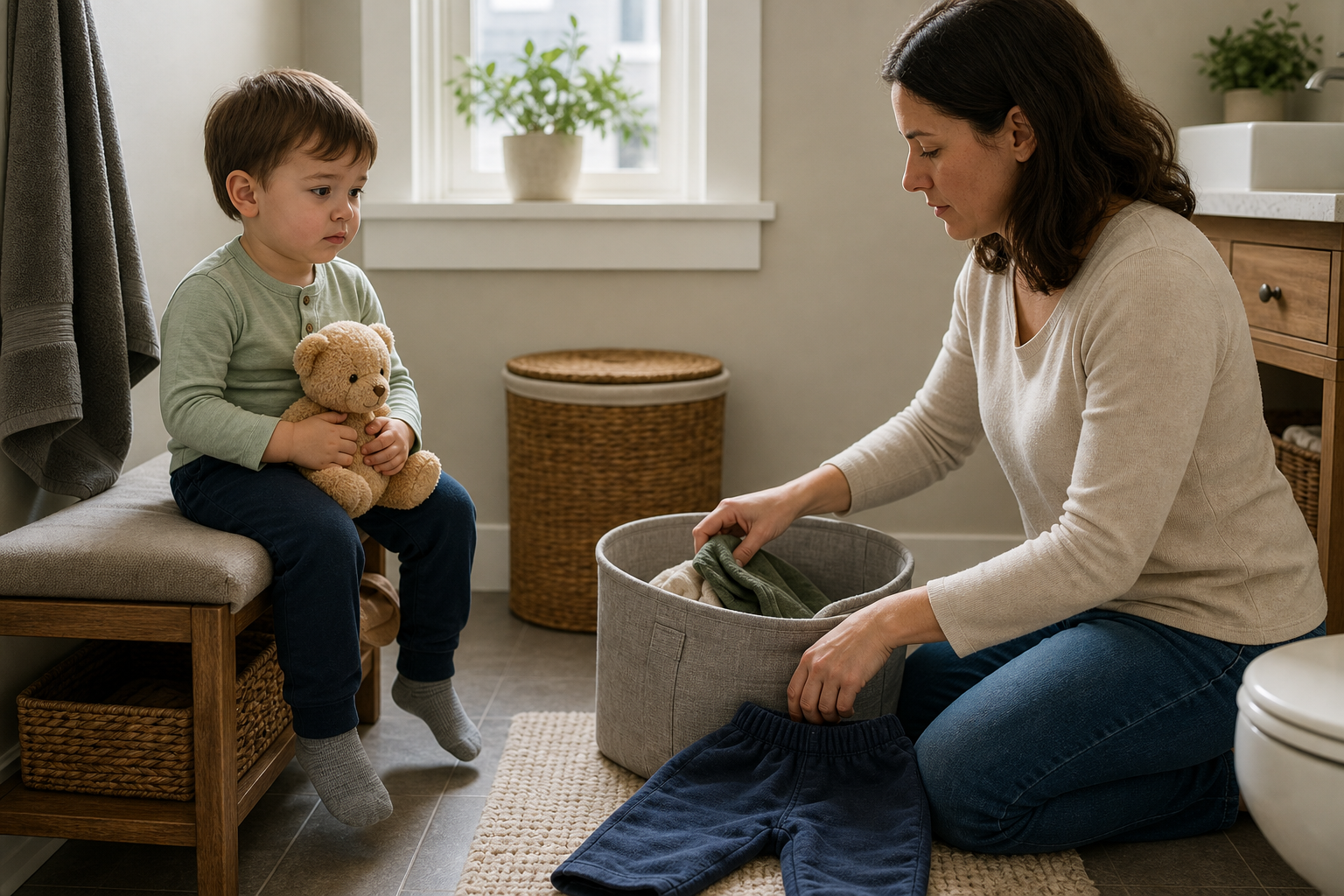
An accident does not need a speech. Use the same calm script each time: Your clothes are wet. Pee goes in the potty. Let us get you dry. Help your child take part in a simple, age-appropriate way, such as carrying dry clothes or placing wet clothing in the designated spot. Participation teaches the routine; forced cleanup turns it into punishment.
After cleanup, look for the point where the sequence broke down. Was the bathroom too far away? Did clothing get stuck? Was your child deeply involved in play? Did a caregiver use an unfamiliar cue? Did your child signal, but too late to arrive? Change that point of friction rather than treating the whole attempt as a failure.
If your child says no, cries, stiffens, runs away, or appears frightened, stop that attempt before it becomes a physical struggle. Repeated resistance across bathroom visits is a reason to reduce pressure. You can return to diapers or training pants without calling it a failure, continue low-pressure bathroom practice, and try active training again when participation improves.
Pain requires a different response from ordinary reluctance. Do not try to reward, distract, or insist your child through painful peeing or pooping. If elimination hurts, your child appears to be withholding because of pain, or you are worried about constipation, contact your child’s healthcare professional. A behavioural strategy cannot resolve an underlying health problem.
Give every caregiver the same small plan
A child can manage different bathrooms, but conflicting expectations make a new skill harder to understand. Share a short plan with partners, relatives, and childcare providers rather than asking everyone to remember an entire philosophy.
- The words you use for body signals and the potty.
- The transitions when you normally offer a bathroom visit.
- The readiness signals your child commonly shows.
- What your child can do independently and where they still need help.
- The neutral phrase you use after an accident.
- How you respond when your child refuses.
- Where spare clothes and cleanup supplies are kept.
For outings, pack more than underwear. Bring complete clothing changes, a bag for wet items, and any familiar seat or reducer your child needs. Find the bathroom when you arrive instead of waiting for an urgent signal. If the public toilet is loud or unfamiliar, explain what will happen before your child sits.
Keep daytime learning separate from sleep protection. A child who uses the potty while awake may still need their usual diaper or training pant during naps or overnight. Do not turn a wet bed into evidence that daytime progress was not real.
Your next step can be small. Put the potty in its intended place, choose the words your household will use, and watch for your child’s signals during an ordinary day. If your child can join the sequence without a fight, begin practising it consistently. If not, keep building the missing skills and return to active training when the bathroom feels more familiar.
References