
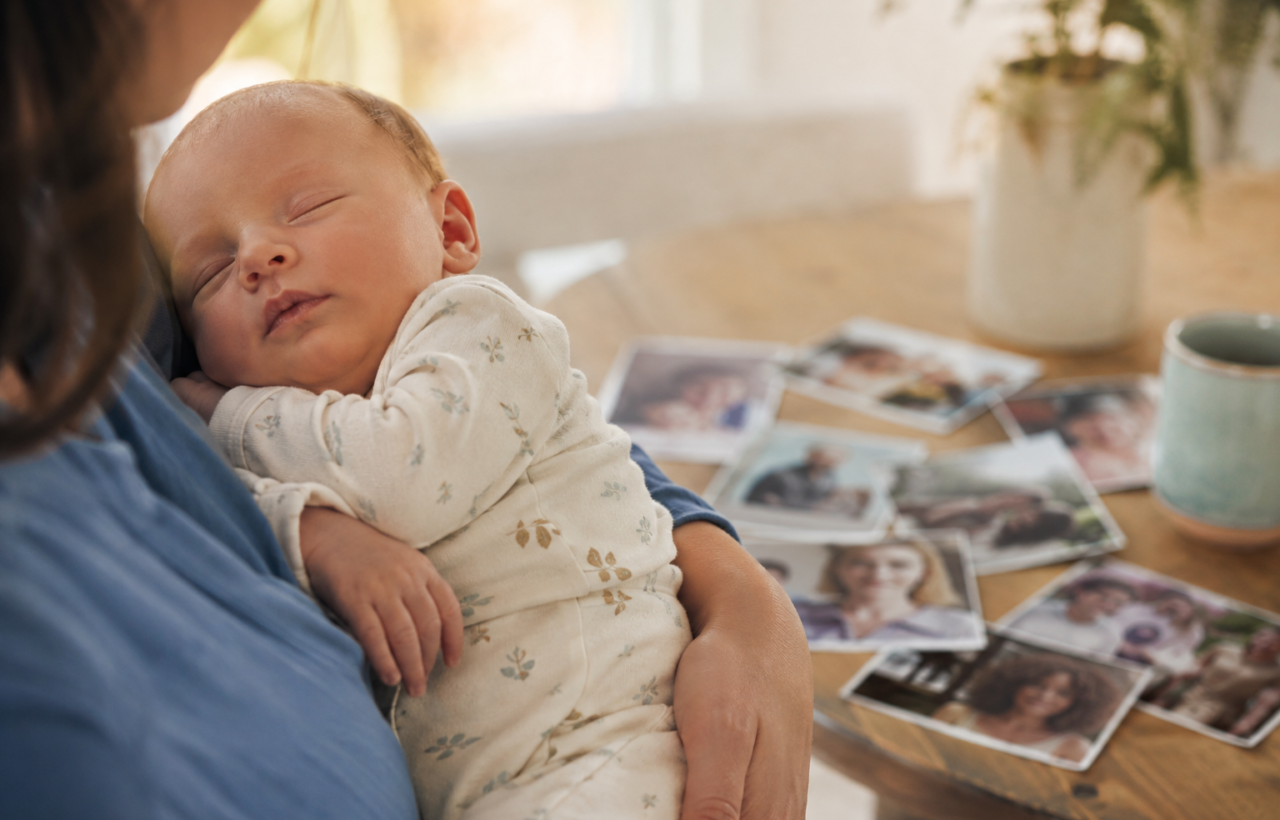
You may be comparing an ultrasound profile with family photos, or looking at your newborn and wondering whether those eyes, that hair, or that tiny frame will stay the same. Family traits offer clues, but they cannot produce a reliable preview of your baby’s finished appearance.
The useful distinction is between inherited possibilities and features that are still developing. Once you know which is which, you can enjoy the guessing without treating a newborn trait as a permanent result.
Key takeaways
- Your baby receives half of their DNA from each biological parent, but the particular combination is unique.
- Most visible traits are influenced by several genes, so simple dominant-versus-recessive charts cannot predict an exact face.
- Hair colour and texture may change, while eye colour can take at least six months after birth to stabilize.
- Ultrasound measurements and newborn size do not reliably predict your child’s adult build. Growth over time is more informative than one early measurement.
Why your baby may not match the family forecast

A baby is not a blended average of two parents. A child inherits about 50% of their DNA from each biological parent, but siblings do not receive identical halves. The genetic variants passed along in one pregnancy can differ from those passed along in another.
That is why two children with the same biological parents can have noticeably different eyes, hair, lips, or face shapes. Full siblings share roughly half of their DNA overall, yet the shared pieces are not a fixed package of appearance instructions.
Visible traits are also rarely controlled by one gene acting alone. Several genes may contribute to a feature, one gene may affect how another behaves, and inherited variants may not be visible in either parent. A recessive variant can remain hidden for generations before the right combination allows it to appear.
Dominant does not mean guaranteed, stronger, more common, or better. It describes how a particular genetic variant can be expressed when paired with another variant. That simple model is helpful for a few inheritance patterns, but it is too limited to reconstruct a baby’s appearance.
Even resemblance itself is not fixed. Growth, bone development, and changing fat distribution continue to alter facial proportions; bone structure keeps developing into the twenties. A newborn who seems to resemble one parent may look more like the other several years later.
Use your family tree as a catalogue of possibilities, not a set of odds. A trait that appears repeatedly on both sides may be a reasonable guess, but an absent or less visible trait is not ruled out.
Hair and eye colour need time to reveal themselves
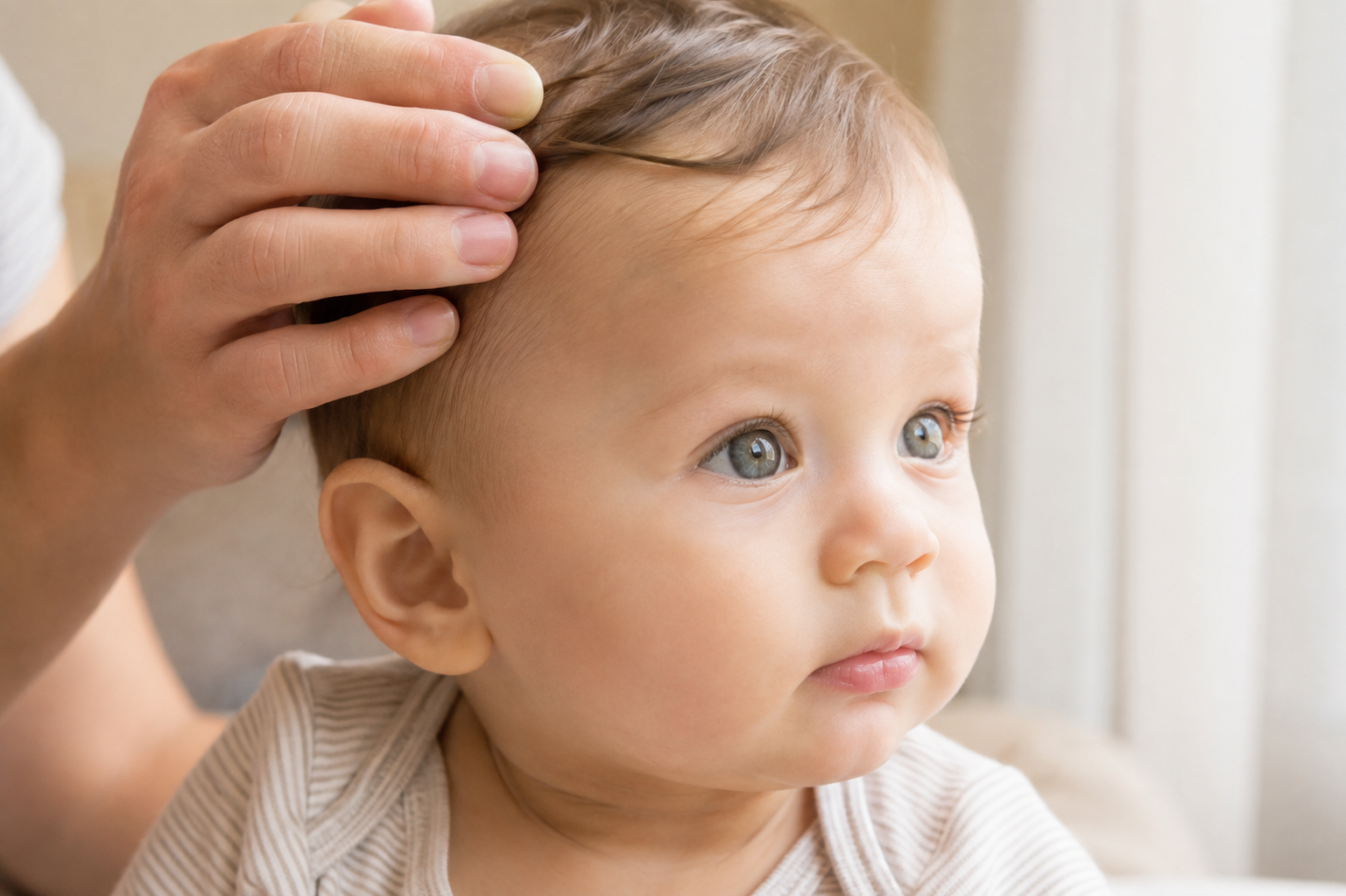
Hair colour comes from several moving parts
Hair colour depends partly on pigment-producing cells called melanocytes and on the pigments they make. Eumelanin contributes black and brown tones, while pheomelanin contributes yellow and red tones. The number and activity of these cells, the balance of pigments, and the genes regulating them all help place hair somewhere along a broad colour spectrum.
This complexity explains how two brunette parents can have a blond child. Both parents may carry lighter-colour variants that are not expressed in their own hair, then pass the relevant combination to their baby. The same principle is why a family hair-colour chart can show what is possible but cannot give a dependable percentage for each outcome.
Hair observed in infancy is not necessarily the final colour or texture. Inherited hair traits can change as a child grows, and some genes affecting darkness or curl may become more active with hormonal changes at puberty. When you describe your baby’s hair, think of it as their current hair rather than a permanent genetic label.
Eye colour is more complicated than brown versus blue
The familiar school exercise in which brown eyes dominate blue eyes captures only part of eye-colour inheritance. Multiple genes influence pigment in the iris, and each parent may carry variants that are not obvious from their own eyes. Two brown-eyed biological parents can therefore have a light-eyed child.
Timing adds another layer. Pigment-producing cells in the iris become active after birth as the eyes encounter light. If a baby’s eyes are bluish-grey or are not very dark at birth, their colour will commonly shift. It can take at least six months for infant eye colour to stabilize.
Before the six-month mark, call the colour current rather than final. Six months is not a guaranteed finishing date, either; at least means the process can take longer. If you want to notice the change, compare occasional unfiltered photos taken in similar daylight. Different lighting, camera processing, and clothing colours can make the same eyes look different from one picture to the next.
Birth size is not a preview of adult build

An ultrasound size estimate may feel like an early answer about whether your child will be tall, small, or broad. It is not. Fetal measurements can be affected by fluid, the pregnant person’s body type, the timing of the scan, and the limits of the measurement itself. A newborn’s length and weight also do not reliably predict adult height or weight.
Height has a large genetic component, but there is no single tall gene. Researchers have identified more than 12,000 genetic associations with height. Health conditions, nutrition, activity, hormones, medications, sleep, and other environmental influences can affect how growth unfolds. Genetic potential is a range, not a guaranteed endpoint.
For curiosity, the American Academy of Pediatrics offers two rough ways to estimate eventual height:
- Toddler method: Double the child’s height at age 2.
- Biological-parent method: Add the two biological parents’ heights, divide by two, then add 2.5 inches for a child assigned male at birth or subtract 2.5 inches for a child assigned female at birth.
These are broad estimates, not tools for judging whether a baby is growing or eating adequately. For a real growth question, look at the child’s measurements plotted over time with their health-care provider. The pattern along a growth curve is more useful than comparing one percentile, one birth measurement, or one formula with a relative’s height.
Turn appearance predictions into useful observations
You do not have to stop guessing who your baby will resemble. Just give each guess the right status:
- During pregnancy: Treat ultrasound images and family traits as possibilities. An ultrasound shows development and a profile at that moment, not the finished face.
- In the first six months: Expect eye colour to remain in progress, especially when the eyes are light or bluish-grey.
- Throughout the first three years: Date your observations. Hair colour, texture, facial proportions, and apparent resemblance can change as your child grows.
- When relatives make confident predictions: Replace definitely with might. Hidden variants and new gene combinations make surprises normal.
- At health visits: Keep appearance guesses separate from growth assessment. Use your child’s recorded growth pattern, not adult-height shortcuts, to discuss a concern with a health-care professional.
If you want a record of the slow reveal, take an occasional photo in the same place and similar natural light. You will get a more honest view of changing hair, eyes, and facial proportions than you will from a prediction calculator.
The next time the family asks who your baby will look like, try a better question: which traits might appear, and which ones are still changing? That leaves room for genetics to do what it actually does – create a child related to the family, but never assembled from a fixed family template.
References




