

If you are preparing for twins, the most useful question is not simply, “Will everything cost twice as much?” It is, “Which costs will double, which can be shared, and when will the money actually leave our account?”
A workable answer starts with a planning benchmark, then replaces that broad number with your household’s real expenses. That gives you a budget you can use for decisions about gear, child care, work, housing, transportation, and financial help.
Start with a benchmark, not a prediction
A family with twins may need to plan for nearly $26,000 per year. Dividing that benchmark across a year produces a planning average of about $2,167 per month, but your expenses will not arrive in equal monthly instalments.
Treat the estimate as a pressure-test figure, not a bill or a promise. Your actual cost depends on what you already own, whether you receive hand-me-downs, how the babies are fed, what child care you use, whether either parent changes working hours, and whether your current home and vehicle still work for your family.
Do not start by multiplying a single-baby shopping list by two. That misses shared purchases and, more importantly, can leave out changes to income and child care. Build the budget around your household instead.
Build your twins budget in four passes

A long list of baby products can feel precise while still giving you the wrong total. The clearer method is to separate setup costs, recurring spending, household changes, and income effects.
- Record one-time setup costs. Include each baby’s sleep space, car seats if you travel by car, a stroller or other transport system, feeding equipment, initial clothing, and any storage or furniture you have decided is necessary. Write down what you already own before adding anything to the purchase column.
- Estimate recurring twin expenses. Create lines for diapers, wipes, feeding, clothing replacements, health-related out-of-pocket costs, transportation, and paid care. Use prices you can verify locally and quantities based on how your household expects to operate. Mark uncertain entries instead of disguising guesses as fixed costs.
- Count only the household costs that change. Your entire rent or mortgage is not a twin expense if you would pay it anyway. The relevant figure is the added cost of a move, a vehicle change, higher transportation spending, or another adjustment made because your family is growing.
- Add the effect on income. Compare the money that will actually reach your account during leave, reduced hours, a delayed return to work, or a change in shifts. Include benefits, reimbursements, or family support only after the amount and timing are confirmed.
Your monthly worksheet can stay simple:
- Net household income received
- Minus existing essential bills
- Minus recurring twin expenses
- Minus contributions toward upcoming one-time costs
- Plus confirmed benefits or support
- Equals the monthly margin or shortfall
This calculation separates affordability from optimism. If the result is negative, changing a few small shopping choices may not solve it. Look first at the largest adjustable categories, such as paid care, working arrangements, transportation, housing plans, and recurring purchases.
Decide what needs two, what can be shared, and what can wait
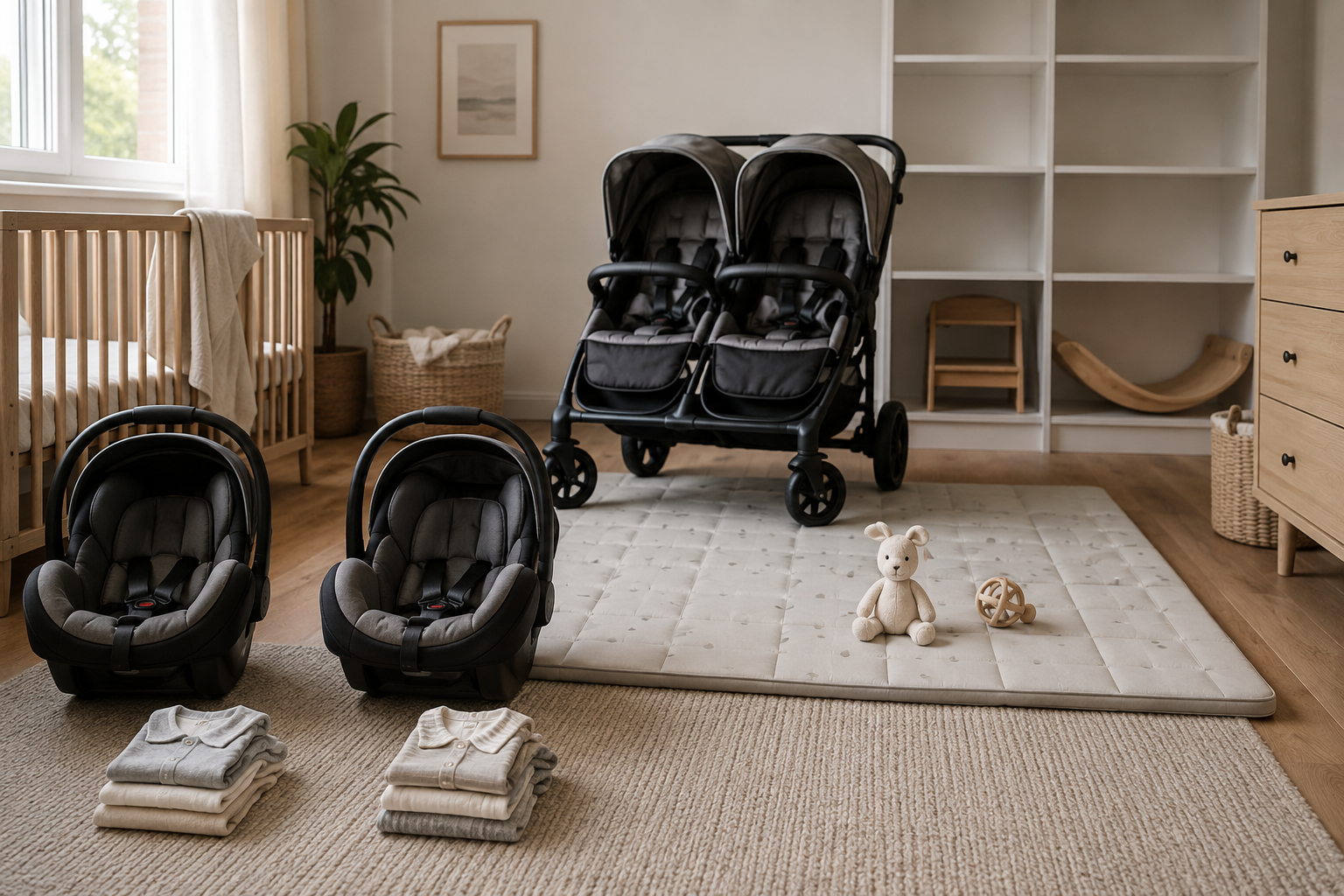
Twins create two opposite budgeting mistakes. You can overbuy by automatically ordering duplicates, or underspend on items that each baby genuinely needs. Sort every planned purchase into three decision buckets before you place an order.
- Each baby needs one. Put per-child safety essentials here, including a properly fitting car seat for each baby when travelling by car and a safe sleep space for each baby. Saving money is not a reason to use a recalled, damaged, expired, or incompatible car seat; verify its history and manufacturer requirements before relying on a second-hand seat.
- The household can share one. Put shared systems and spaces here. A changing area, storage unit, bathing setup, or some feeding equipment may serve both babies. Whether sharing works depends on how often the item is used and whether simultaneous use is necessary.
- Wait until preferences or needs are clear. Put large stocks of one diaper size, one bottle type, one clothing size, specialized soothing products, and convenience gear here. Buying a trial quantity protects you from being left with products that do not fit or work for either baby.
Use the same test for gifts and hand-me-downs. Ask whether the item replaces something already in your budget, whether it is safe and usable, and whether accepting it creates another expense. Free gear that requires a different system, extra accessories, paid storage, or an earlier vehicle upgrade is not always free in practice.
When comparing prices, calculate the usable cost rather than the sticker price. An inexpensive item that does not fit your routine, cannot be used safely, or duplicates something you already have offers no real saving. A more durable shared item may be better value when both babies will use it repeatedly, but only if you actually need its features.
Put the cash flow on a calendar

An annual total can look manageable while the timing is not. Setup purchases may cluster before the babies arrive. Income may change during parental leave. Child-care deposits, a return-to-work commute, or a vehicle decision may arrive later. If you track only the yearly total, those transitions can catch you without enough cash on hand.
Create a month-by-month timeline covering the next stage your family can reasonably plan. Mark:
- When each parent’s income is expected to change
- When benefits, reimbursements, or other confirmed support should begin and end
- When one-time purchases and deposits are due
- When paid child care or a different work arrangement may start
- When the babies are likely to outgrow gear that must be replaced
- Which costs are essential and which can be postponed if cash is tight
For a known future expense, create a sinking fund: divide the amount you need by the pay periods remaining before it is due, then treat that contribution like a current bill. This turns a large future payment into a visible decision now.
Run the timeline under a baseline plan and a disruption plan. In the disruption version, delay uncertain income, allow for higher variable spending, and ask which optional purchases you would pause first. The purpose is not to predict every problem. It is to identify whether one delay would force you to miss an essential payment or use debt.
If your plan works only by carrying expensive debt, skipping essential bills, or drawing from money reserved for another critical need, pause before committing to the largest adjustable expenses. A qualified financial counsellor or financial planner can help you assess the consequences using your full financial picture; a general cost estimate cannot do that for you.
Key takeaways
- Use nearly $26,000 per year as a broad planning benchmark, not as your household’s guaranteed total.
- Separate one-time setup, recurring spending, household changes, and lost or reduced income.
- Count the added cost of housing or transportation decisions, not the bills you already pay regardless of family size.
- Buy duplicates when each baby needs an individual item; share when simultaneous use is unnecessary; delay preference-dependent purchases.
- Map expenses and income changes by month because an affordable annual total can still create a short-term cash shortage.
- When the budget does not balance, address the largest adjustable cost before spending hours trimming small purchases.
Open your latest bank statement and build the first version with the income and essential bills you can verify. Add the next phase of twin costs, mark every uncertain amount, and give each planned purchase a category: two, shared, or wait. That first honest draft will tell you what needs a decision now and what does not.
References




