
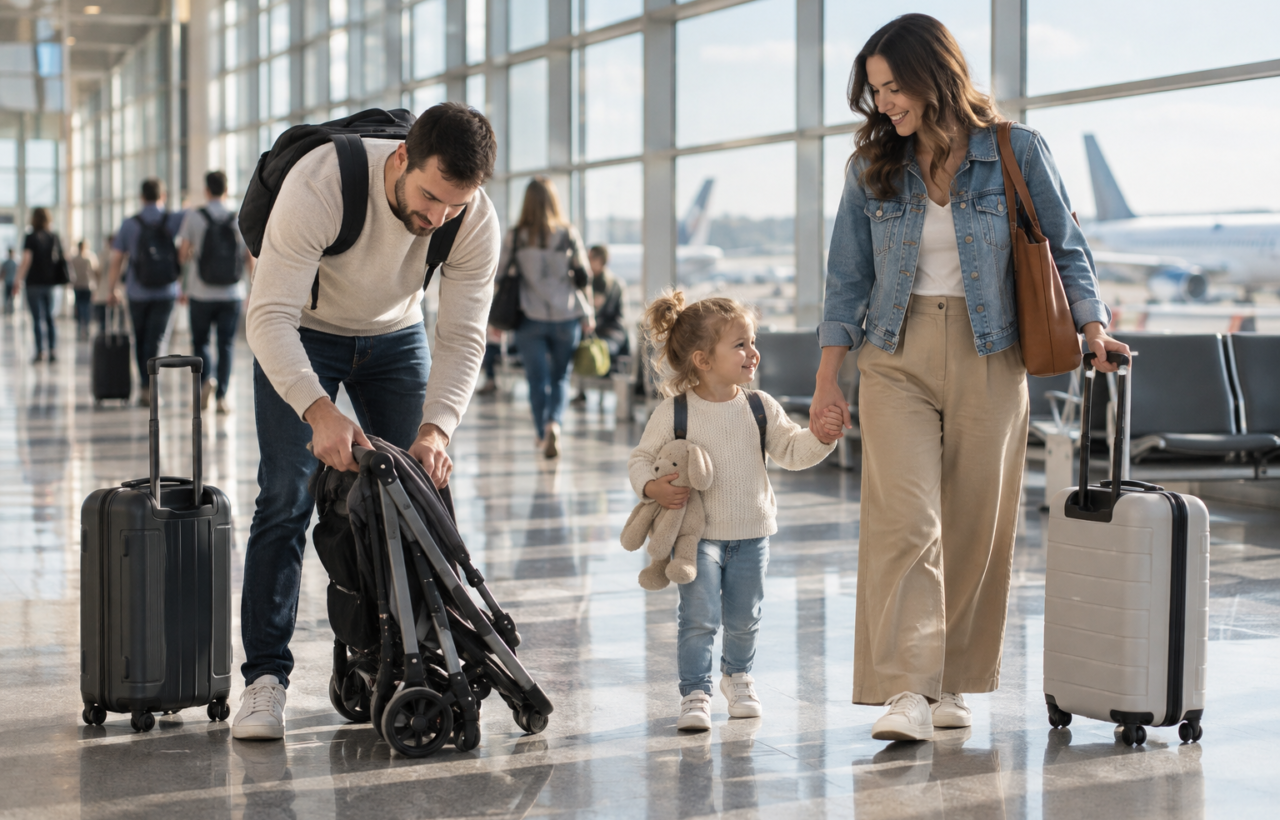
You can compare stroller weights for hours and still bring the wrong one. The choice becomes clearer when you picture the hardest moment of your trip: folding at the aircraft door with a bag on your shoulder, carrying everything down station steps, or finding space in a car already full of luggage.
Families ask compact strollers to work across airplanes, trains and road trips, but those trips create different problems. Your best option is the stroller that fits your child safely and removes friction from the transitions you will repeat most often.
Choose for the hardest transition in your itinerary
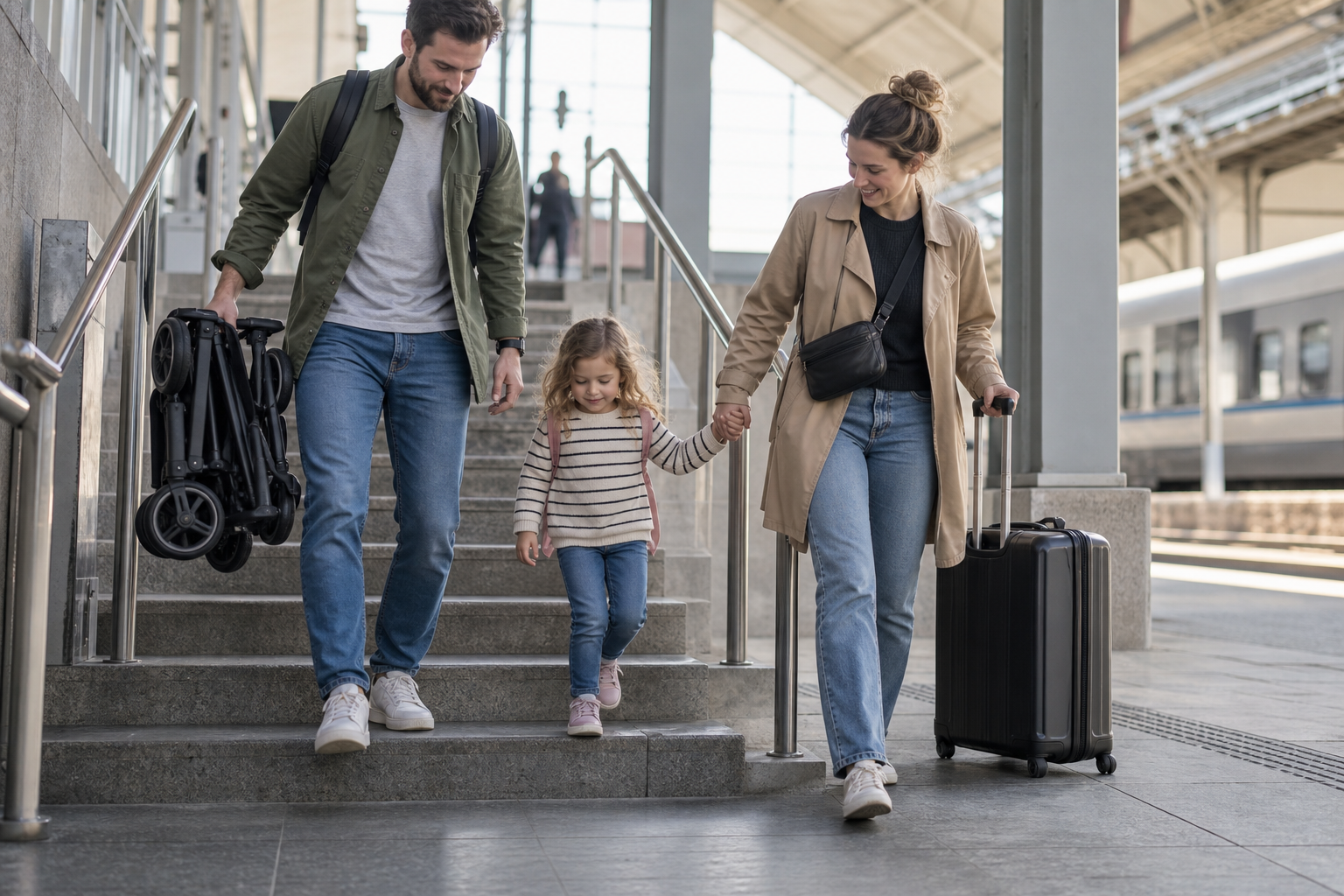
Start with the trip, not the stroller aisle. Write down every point where you will have to fold, lift, store or reopen the stroller. Then circle the transition you expect to handle most often or with the least help. That is the moment your shortlist has to serve.
- Flying: You may need to move through security, empty the basket quickly, fold near the gate and carry the stroller after your child gets out. A compact fold matters, but so do a reliable latch and a sensible place to grip the folded frame.
- Travelling by train or public transit: Steps, narrow doors, crowded platforms and short boarding windows make manoeuvrability and a quick fold especially valuable. Consider whether you can carry the stroller and manage your child without depending on someone else.
- Taking a road trip: The decisive measurement is often the space left after suitcases, feeding supplies and other family gear are loaded. The stroller also needs to remain accessible during stops rather than disappearing under the rest of the boot.
- Walking for much of the trip: Wheel behaviour, steering, seat comfort, shade and recline may matter more than achieving the smallest possible fold. A very compact stroller can become tiring if the destination has uneven paths or long walking days.
If your trip uses several forms of transport, separate requirements from preferences. Safe fit, manageable carrying and compatibility with your tightest storage space belong in the required column. Colours, matching accessories and features you might use once belong in the preference column.
Airline language needs special care. A cabin-compatible or compact-fold description is not a promise that the stroller will enter the cabin. Rules, aircraft storage and boarding decisions can differ. Check the operating carrier’s current stroller policy for every flight, including any connecting segment, before treating overhead storage as part of your plan.
Fit the stroller to the child you are travelling with now
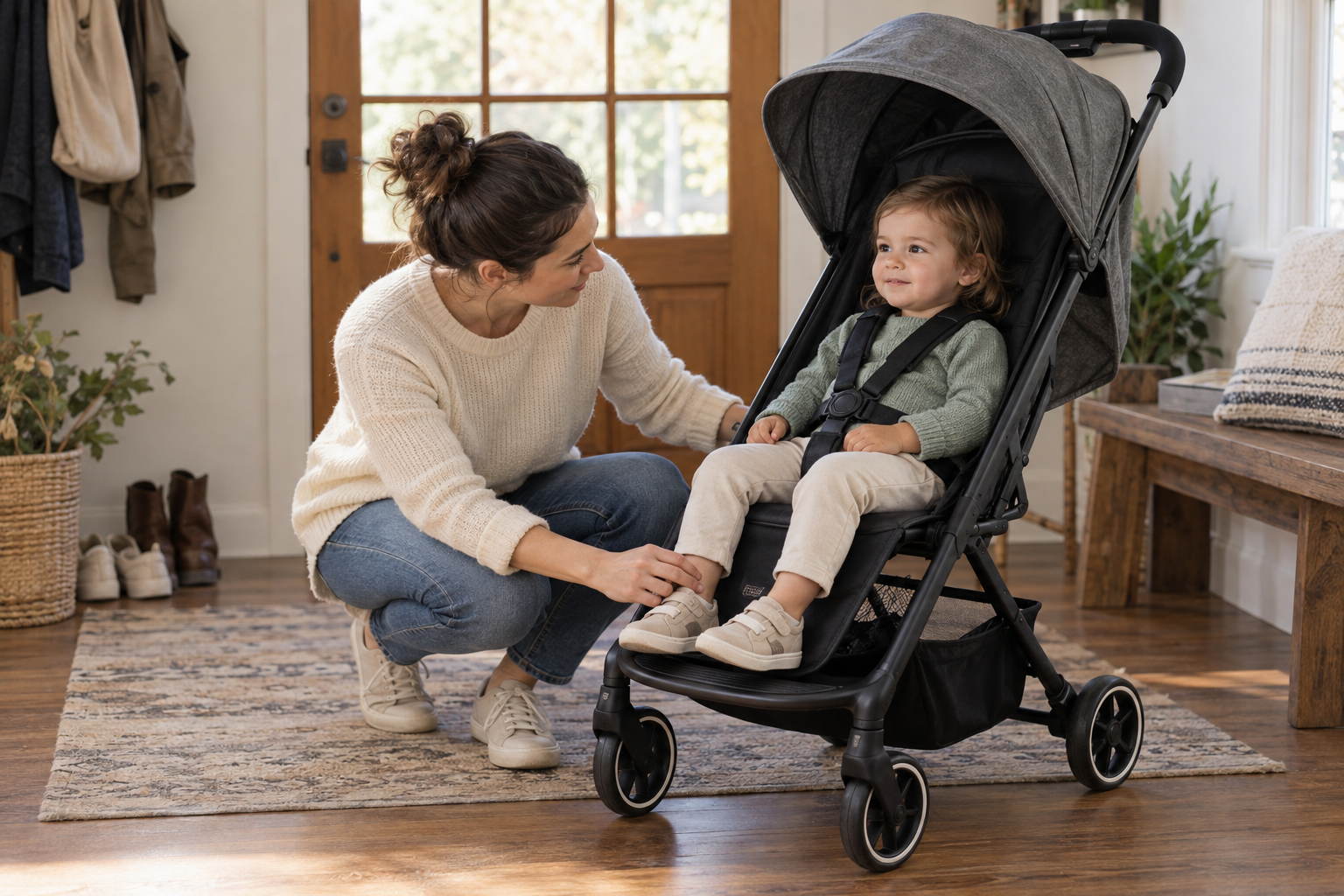
A travel label tells you how a stroller is marketed, not whether its seat is appropriate for your child. Check the manual for the approved age, weight, developmental stage and seating configuration. If the manufacturer does not approve the configuration for your child, do not use it even if the seat appears to recline deeply.
- For an early infant: Confirm that the exact stroller and configuration are approved for that stage. A nearly flat-looking seat is not automatically a newborn-approved seat.
- For a child who naps on the move: Test the usable recline, canopy coverage and leg position with the child seated. Check whether you can adjust the recline without waking or awkwardly lifting them.
- For a larger toddler: Look at headroom, seat depth, harness placement and foot support. A stroller can remain within a stated limit while feeling cramped in everyday use.
- For the person pushing: Walk at your normal pace. Notice whether you shorten your stride, kick the rear frame, stoop toward the handle or struggle to reach the brake.
- For your normal day bag: Check that essentials fit in the approved storage area and remain reachable when the seat is reclined. Do not plan to hang a heavy bag from the handle; that changes the stroller’s balance and can create a tipping hazard.
The harness should adjust securely without twisting, and the brake should be easy for you to set and release without accidental contact while walking. Try both in the clothing and shoes you are likely to use on the trip.
If you are borrowing or buying used, identify the exact model and obtain its instructions before making it part of the itinerary. Inspect the frame, locking joints, wheels, harness and brake. Missing labels, a fold that does not lock, unexplained frame movement or damaged restraint parts are reasons to stop using it until the manufacturer or a qualified service provider confirms the next step.
Run a complete fold, carry, push and pack test
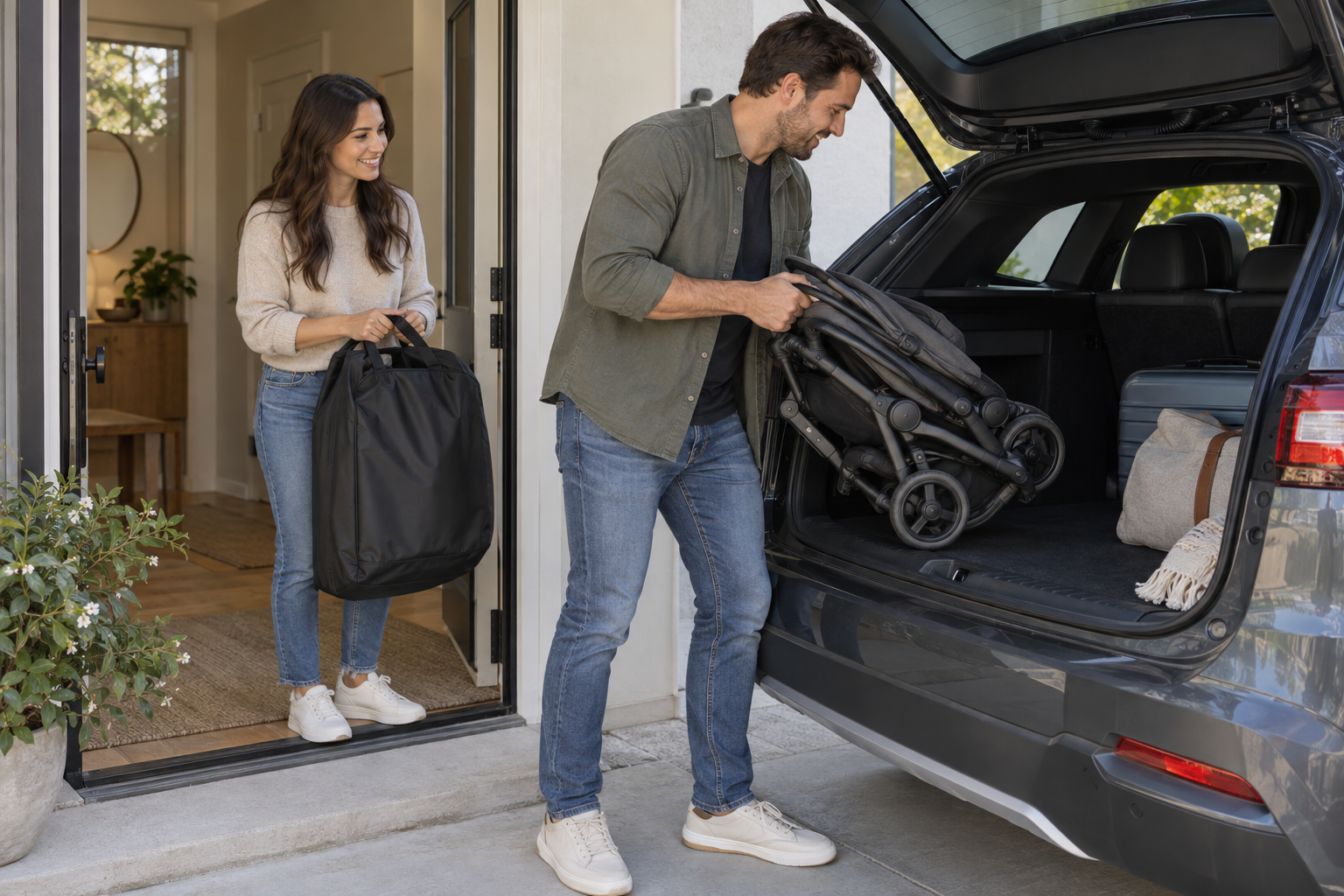
A specification sheet can narrow the field, but it cannot show whether a stroller works with your hands, stride, luggage and child. Run the same sequence on every serious candidate so a polished demonstration does not hide an awkward daily task.
- Load the basket with the items you would genuinely carry, staying within the manufacturer’s limit.
- Adjust and fasten the harness. Recline and raise the seat through the positions you expect to use.
- Push at your normal pace, turn in a confined space and cross an ordinary doorway threshold. Try steering briefly with the hand you would have free while travelling.
- Set and release the brake, then confirm clearly that it has engaged.
- Remove anything that must come out before folding. Complete the entire fold, including the final lock or latch; a one-hand release is not the same as a one-hand fold if closing the frame still takes another step.
- Lift the folded stroller by its intended handle or strap. Carry it far enough to notice whether wheels, footrests or handles strike your leg and whether the weight feels balanced.
- Place it in the actual car space or luggage arrangement you expect to use. Reopen it and confirm that the frame locks before putting your child back in.
Repeat the sequence without assistance if you expect to travel alone. A feature only counts if you can use it in the conditions you will actually face.
Do not compare weight in isolation. The carrying experience also depends on balance, folded shape, protruding wheels and the grip position. Include the rain cover, cup holder, bumper bar or other approved accessories you expect to carry when you judge the real load.
| Feature choice | Where it helps | Tradeoff to check |
|---|---|---|
| Very compact fold | Small car spaces, crowded transport and frequent storage | Seat room, basket access, wheel size or recline may be reduced |
| Larger wheels or more suspension | Uneven pavement and longer walking days | The folded stroller may be bulkier or harder to carry |
| Deeper recline and fuller canopy | Children who regularly nap during outings | The seat and canopy can add folded bulk |
| Larger storage basket | Long days away from your accommodation | Contents may need to be removed before folding, and access can change when the seat reclines |
| Carry handle or shoulder strap | Stations, stairs and boarding handoffs | Comfort depends on placement and balance, not merely the presence of a strap |
There is no universal winner in those tradeoffs. If the difficult part of your trip is getting through airports and into a small rental car, folded size may lead. If the difficult part is several days of walking on rough streets, pushing comfort may deserve priority. Your regular stroller may be the better travel choice when destination use matters more than transport convenience.
Prepare the stroller for every handoff
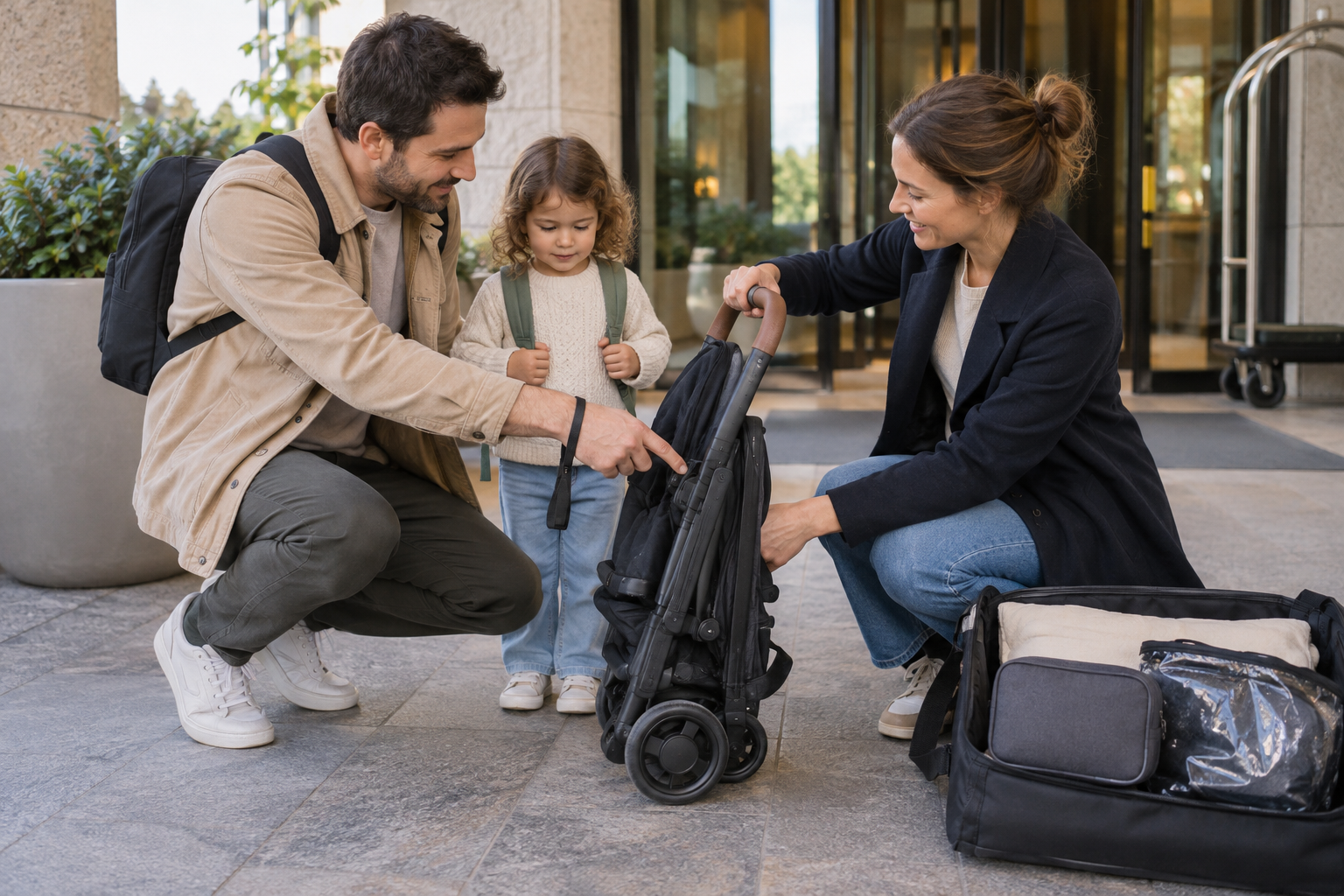
A good choice can still become a nuisance if the family reaches the gate, platform or roadside stop without a handoff routine. Practise the routine before departure and make it the same each time.
Before you leave
- Verify stroller rules directly with each airline or transport operator. Note where it can be used, where it must be folded and whether it will be returned at the arrival gate or with checked baggage.
- Learn the fold and opening sequence without relying on a video or instruction sheet. Show another adult travelling with you where the release, safety lock and brake are located.
- Label the stroller and any travel bag with your contact details. Photograph its condition and keep the identifying model information available.
- Remove loose toys, organizers, cup holders and other detachable pieces before the stroller is handed over. Pack any required tool or approved adapter with the equipment it belongs to.
- Inspect the harness, brakes, wheels and frame locks. Resolve damage before the trip rather than hoping the stroller will survive one more journey.
- On a road trip, load the stroller after the items you will not need during stops. Test that you can remove it without unloading the whole car.
At the handoff and after arrival
Move essentials from the basket to your personal bag before the boarding line starts moving. Take your child out safely, detach loose accessories, close the canopy, fold the frame and engage its transport latch. If you use a travel bag, practise putting it on without resting the stroller where it can roll or obstruct other travellers.
After baggage handling or any hard journey, inspect the stroller before seating your child. Open it fully, confirm that its joints have locked, check the wheels and test the brake. Do not keep using a frame that will not lock, a wheel that is coming loose or a harness that has been damaged.
Keep luggage within the storage locations and limits approved by the manufacturer. A suitcase or loaded tote hanging from the handle can make the stroller unstable, especially when the child gets out and no longer provides weight in the seat.
Key takeaways
- Choose around the hardest repeated transition in your actual itinerary.
- Confirm that the exact seat configuration is approved for your child’s current stage and size.
- Test the complete fold, latch, lift, carry, pack and reopening sequence.
- Treat cabin storage as airline-dependent, even when a stroller is described as compact.
- Accept bulk where it buys something your trip genuinely needs, such as easier pushing or a more useful nap setup.
- Empty the basket, remove loose accessories and inspect the stroller after every transport handoff.
Before you buy or pack, recreate the hardest handoff with your real day bag and storage space. Fold the stroller, latch it, lift it, carry it, pack it and reopen it. If that sequence works and your child fits safely, you are choosing for the trip you are actually taking.
References




