
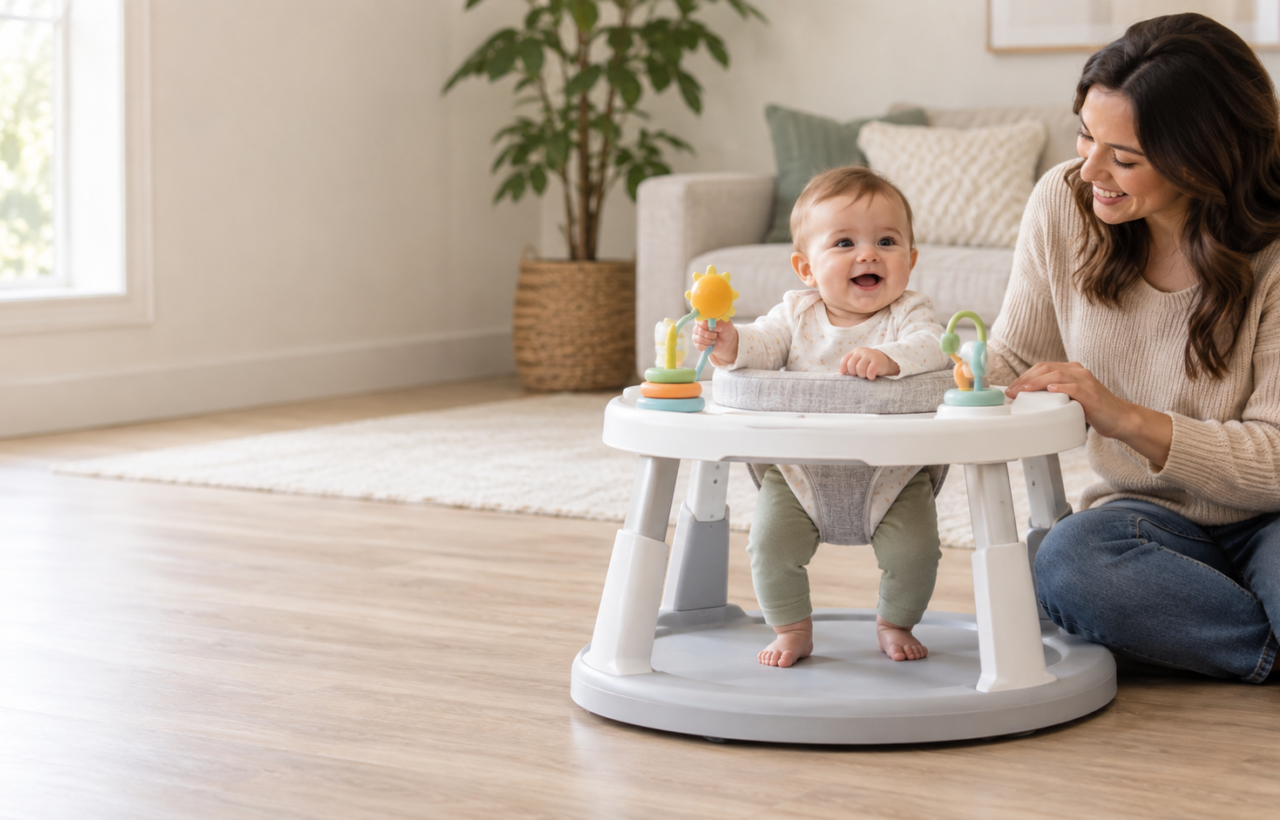
You’re not just choosing a collection of colourful toys. You’re choosing where your baby will be positioned, how freely they can move, and whether the centre will be practical enough to use safely on an ordinary day.
The best place to start is not a brand, price, or toy count. First choose the right type for your baby’s current stage. Then check the fit, the footprint in your home, and the work involved in keeping it clean.
Choose the type before you compare the toys
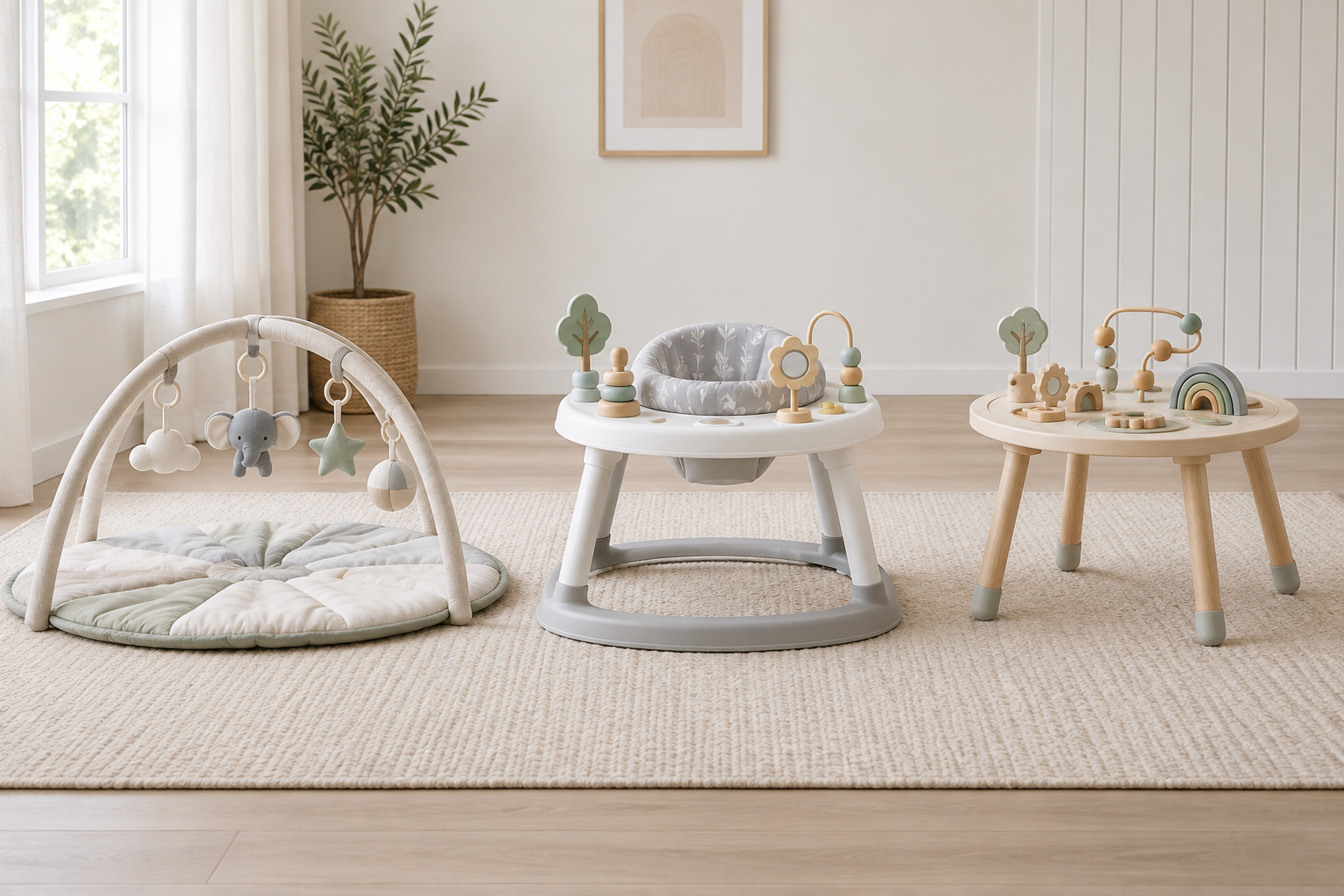
“Baby activity centre” can describe several very different products. A floor gym gives a young baby room to lie on their back, practise tummy time, reach, turn, and eventually roll. A stationary activity centre places a baby in a supported seat surrounded by toys. A convertible model may begin as one of those formats and later become a toddler play table.
| Type | When it can make sense | What to prioritize |
|---|---|---|
| Floor mat or activity gym | Your baby is playing on their back or tummy and is not ready for a supported seat | Comfortable padding, reachable toys, washable fabric, and open sides that make it easy to place and lift your baby |
| Stationary seated centre | Your baby meets the exact age, height, weight, and developmental requirements for that model | A stable base, an adjustable foot platform, comfortable support, and a seat that is easy to remove for cleaning |
| Convertible centre | You want the toy to remain useful after the seat is outgrown | Simple conversion, parts you can store, detachable activities, and a table your toddler will realistically use |
| Mobile baby walker | Not recommended | Choose a stationary centre or floor-based play space instead |
There is no single starting age for every activity centre. Some floor gyms are designed for newborns, while some seated products are intended for babies who are at least four months old. The age, height, weight, and configuration limits for the specific model should decide when you begin and when you stop.
Skip mobile walkers, even when they are sold beside stationary centres. Walkers can tip, fall down stairs, or let a baby reach hazards that would otherwise be out of range. They also do not make babies walk earlier and may interfere with natural walking development. A stationary model removes the roaming risk, but it still requires close supervision.
For a younger baby, a floor gym is often the more adaptable choice. Toys placed within view can encourage reaching and visual tracking during back play, while tummy time helps build muscles used for later movement. Look for toys you can reposition as your baby’s reach and head control change. A toy that is attractive but always out of reach will not hold much practical value.
Check the fit, not just the age on the box
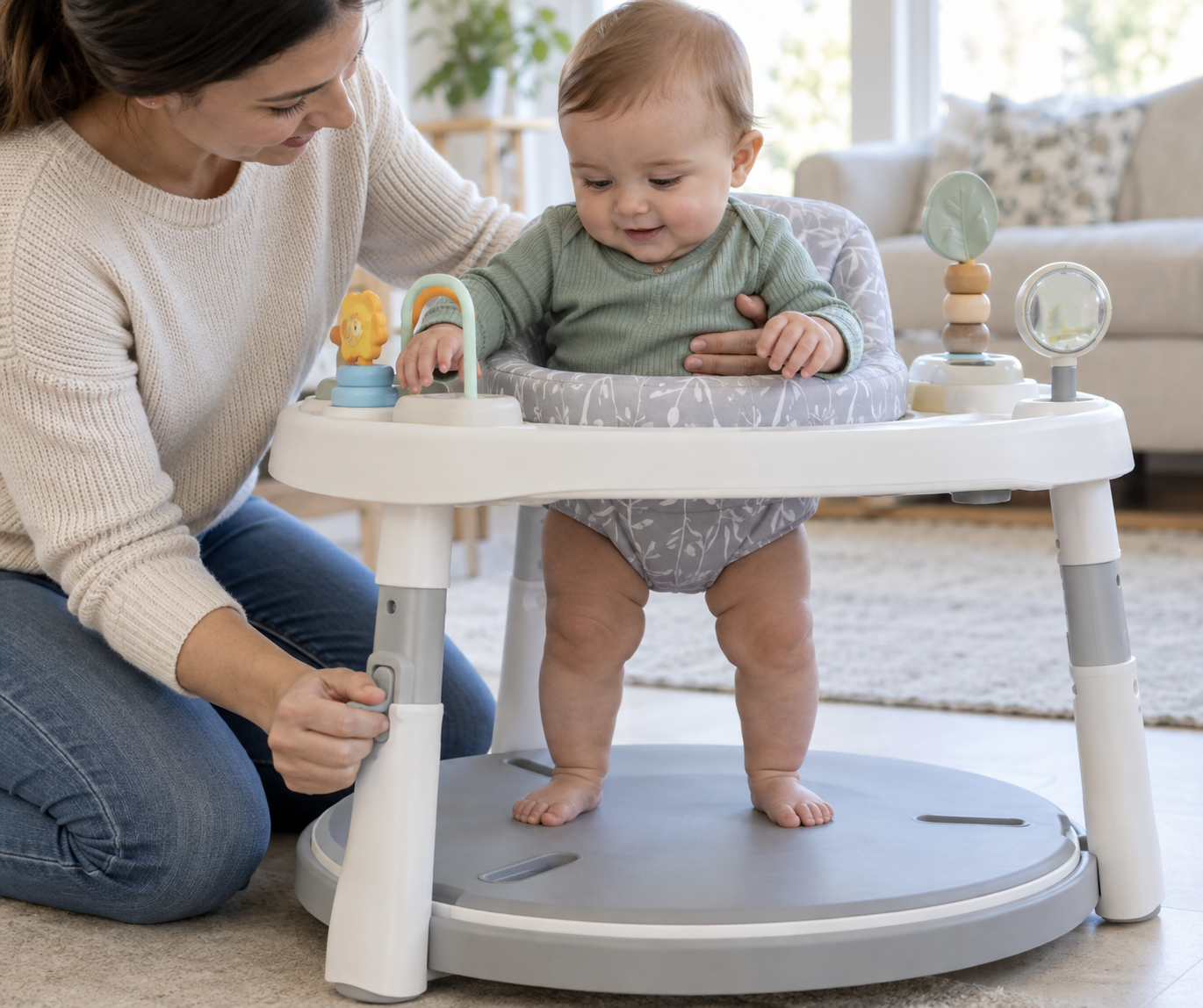
An age range is only one part of the fit. Two babies of the same age can have different heights, weights, proportions, and movement skills. Before using a seat attachment, check every limit printed for that particular configuration. Convertible centres may have one limit for the seat and a different usable stage for the table.
In a supported standing centre, your baby’s feet should rest flat on a firm surface. An adjustable platform matters because it lets you change the height as your baby grows. If your baby’s feet dangle or only their toes reach, adjust the platform. If the model cannot provide the intended fit, do not improvise with loose cushions or boxes; use a different configuration or wait.
Use this fit check before the first play session:
- Confirm the exact model’s age, height, and weight limits, including the separate limit for any removable seat.
- Place the empty centre on the floor where it will be used. Press gently at several points around the base and check for rocking, sliding, or unlocked connections.
- Put your baby in only after the centre is stable. Check that the seat is supportive without pinching and that the legs move comfortably.
- For a model with a foot platform, adjust it until both feet can make the contact described in the manufacturer’s instructions.
- Watch your baby reach and turn. Toys should be accessible without forcing an awkward lean or trapping a hand between components.
- Record the stop limits somewhere you will notice them, then recheck the fit as your baby grows.
If your baby technically meets the label requirements but the posture still looks awkward, stop using the seated configuration and ask your pediatrician for individualized advice. The same applies if you are unsure whether a supported position suits your baby’s development.
Buy for the room and routine you actually have
A centre that looks manageable in a product photo can dominate a living room. Read the assembled dimensions, not only the package size. Mark the footprint on your floor with painter’s tape and leave enough room for you to approach, lift your baby out, and move around the base without stepping over it.
Choose the permanent or usual play location before buying. It needs a flat surface and clear separation from stairs, pools, ovens, cords, unstable furniture, and anything your baby could pull closer. You also need an unobstructed view from the place where you expect to sit or complete a brief task. If the only available spot is out of sight or beside a hazard, that model is too large for the room.
Cleaning deserves the same attention as the toy features. The most usable designs have wipeable surfaces, washable fabric, and detachable components. Before buying, find out whether the seat cover or mat is machine washable, whether it can be removed without dismantling the frame, and whether the toys have crevices that will collect spit-up or food. A product can be developmentally interesting and still become a poor purchase if cleaning it is so inconvenient that you stop bringing it out.
Storage is equally concrete. If the centre must disappear every evening, check whether it folds, which pieces detach, and whether those pieces remain secure after repeated removal. If it converts into a toddler table, decide where you will keep the seat and unused toys. A multi-stage claim has value only when the later configuration fits your space and you can keep track of the conversion parts.
Do not let a high toy count make the decision for you. A few well-positioned activities can provide different kinds of play: reaching for a hanging object, feeling a texture, turning a wheel, or pressing something and noticing the result. What matters is whether your baby can engage with the activities from the position the centre supports.
Use it as a short, supervised play station
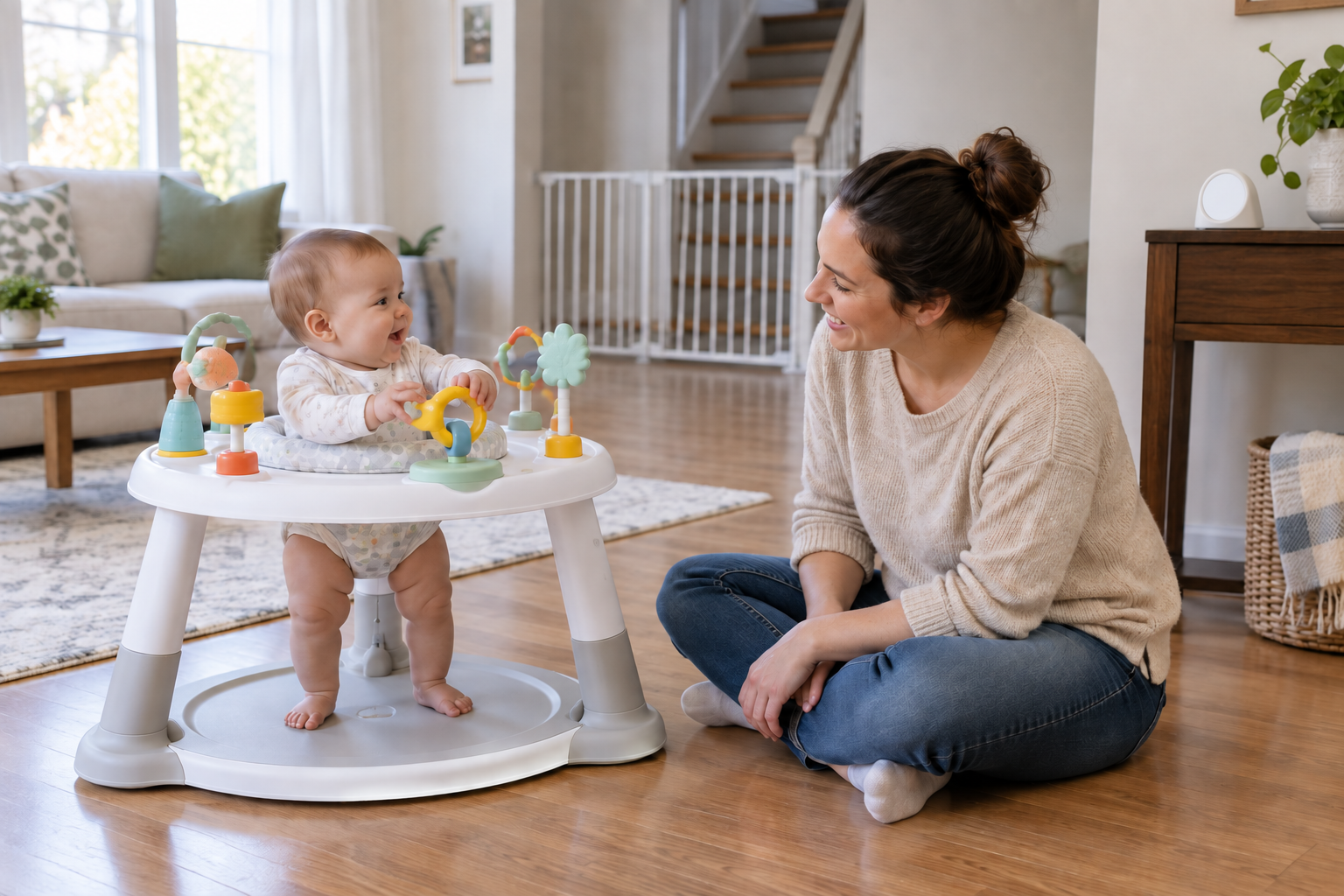
An activity centre can give your baby a contained change of scene while you handle a brief task nearby. It is not a substitute for supervision, unrestricted floor movement, or interaction with you.
- Stay close enough to see your baby continuously and intervene immediately. Being in the house is not the same as supervising the centre.
- Keep each session under 30 minutes. End sooner if your baby becomes tired, frustrated, slumps, or no longer maintains a comfortable position.
- Never let your baby sleep in an activity centre. If your baby becomes drowsy or falls asleep, move them to their normal safe sleep space.
- Never lift, drag, or carry the centre while your baby is inside it. Take your baby out first, reposition the empty unit, and check that it is stable again.
- Keep the centre on a flat surface and away from cords, heat, water, stairs, and objects your baby could suddenly reach.
- Alternate centre time with floor play in different positions. Extended time in one supported posture can reduce opportunities to practise moving and exploring independently.
Your attention can also make a simple centre more useful. Move a hanging toy into your baby’s sight line, name what they touch, imitate a sound, or pause to let them repeat an action. These small interactions turn the centre from a place that merely contains your baby into a setting for shared play.
Stop using a configuration as soon as your baby exceeds any limit, can climb out, or no longer fits as intended. Do not stretch the seat stage simply because the rest of the product is labelled for toddlers. Remove the seat and convert the centre only as its instructions allow.
Key takeaways
- Start with the format: a floor gym, stationary seated centre, or convertible table. Avoid mobile walkers.
- Follow the exact age, height, weight, and configuration limits for your model.
- For supported standing play, look for a firm, adjustable platform that lets your baby’s feet rest flat.
- Measure the assembled footprint and choose a flat, visible location away from household hazards.
- Prioritize stability, washable materials, removable parts, and realistic storage over the number of toys.
- Supervise every session, keep it under 30 minutes, provide plenty of floor play, and never allow sleep in the centre.
Before you buy, choose the exact place where the centre will live and write down your baby’s current measurements. That simple preparation will eliminate many unsuitable options. The right centre is the one that fits your baby now, fits your room every day, and makes safe use easy rather than aspirational.
References




