
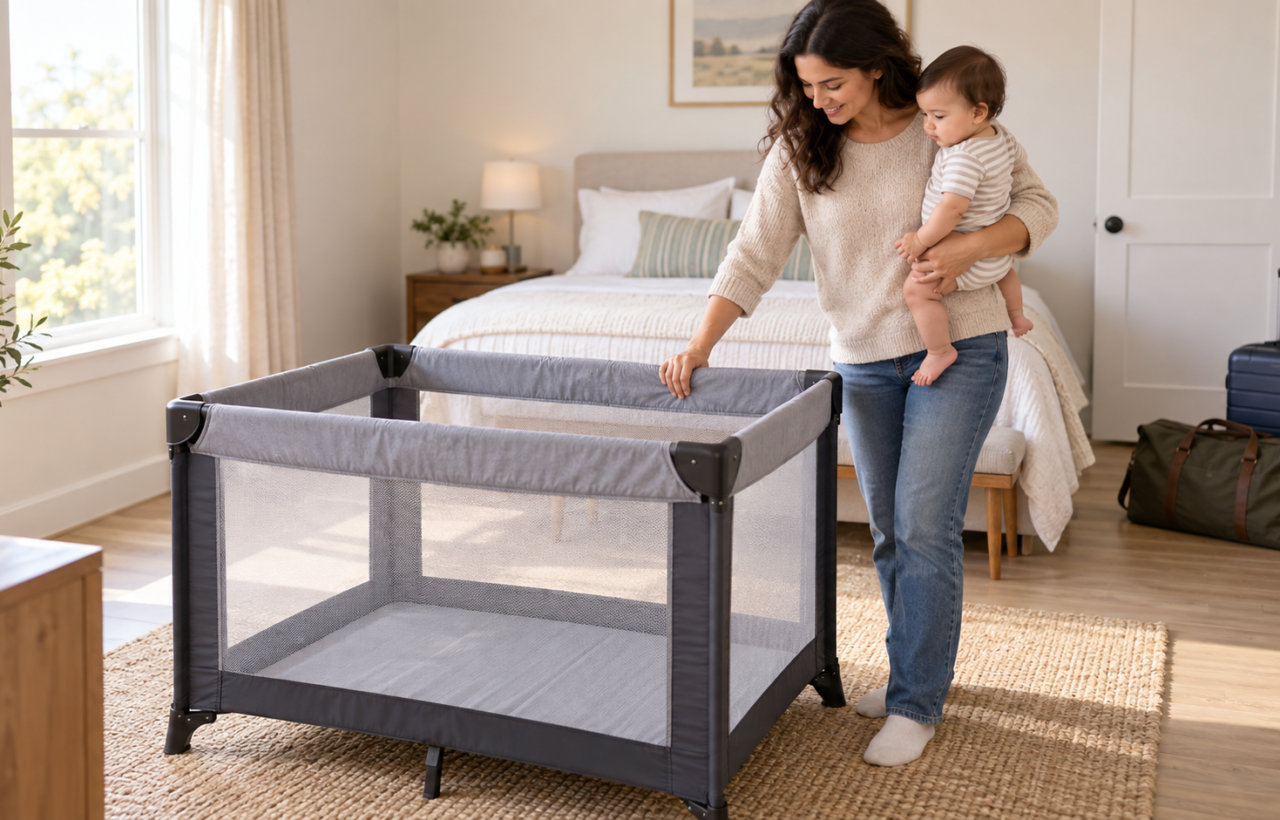
You need one contained place where your baby can sleep or play while you travel, visit family, or get through a busy part of the day. The safest choice is not automatically the lightest model or the one with the longest accessory list. It is the pack and play whose approved uses are clear, whose locks you can verify, and whose limits you will remember.
One distinction matters from the start: a play yard and an approved sleep space are not interchangeable labels. Use a model for sleep only in the configurations its manual expressly permits, and treat every bassinet, changing station, canopy, and organizer as a separate attachment with separate rules.
Put the safety test ahead of the feature list
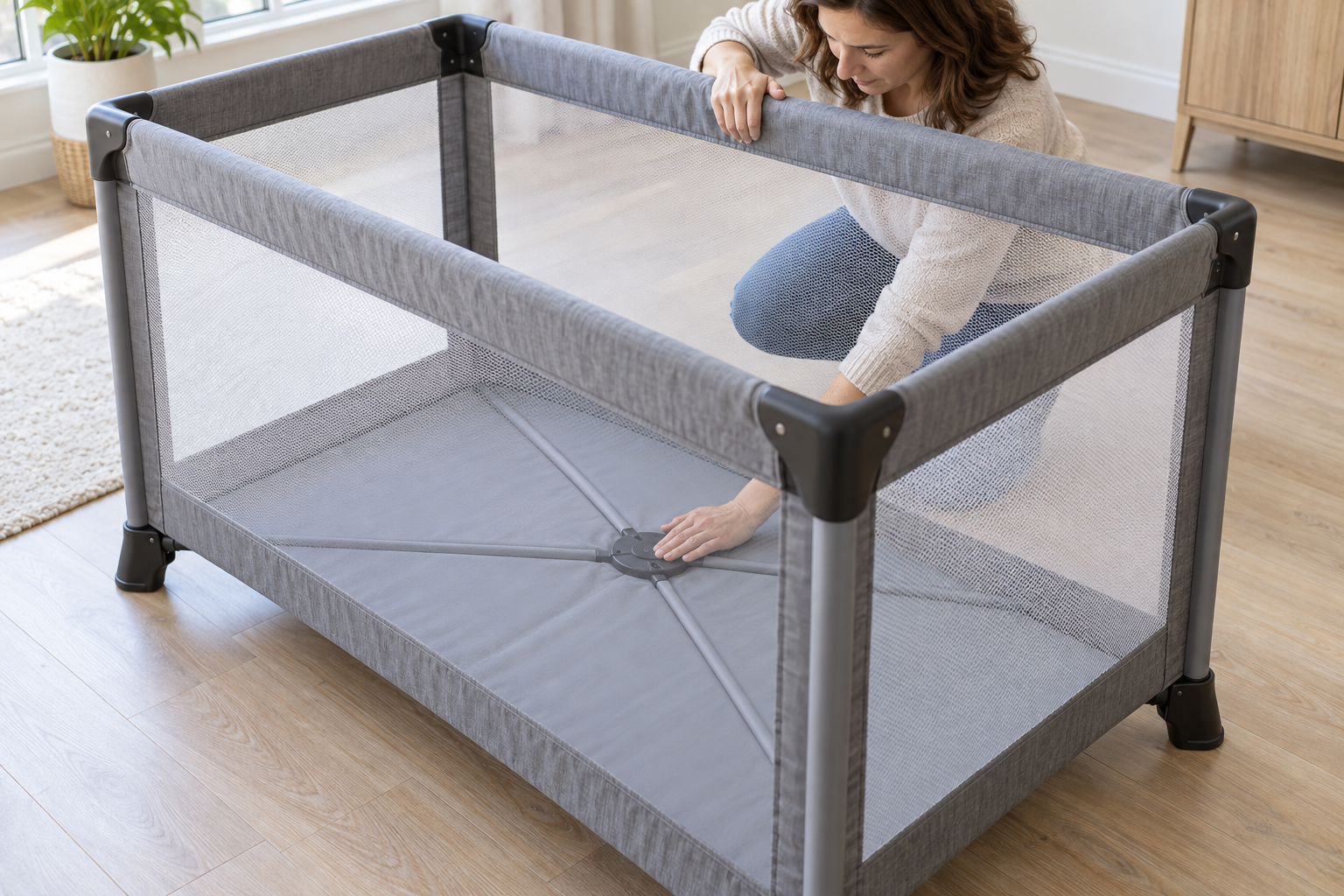
A useful buying decision weighs safe play, permitted sleep, and portability together. The manufacturer’s instructions then determine exactly what your particular model can do. Read those instructions before buying rather than assuming that a padded-looking attachment is suitable for sleep.
For any sleep configuration, look for a firm, flat surface made for that model. The fitted pad should sit level and snug, with no added cushioning and no gaps around its edges. Keep the space empty: no pillow, loose blanket, bumper, positioner, toy, nursing pillow, or aftermarket mattress. Adding a softer pad may feel helpful, but it can introduce gaps, entrapment points, or an uneven surface.
Place your baby on their back for sleep. A changing attachment is never a sleep surface, even if your baby dozes there. If another attachment is not explicitly identified in the manual as an approved sleep space, move your baby to one that is. If a medical condition may require different sleep positioning or equipment, ask your child’s clinician for individualized guidance instead of modifying the pack and play.
Key takeaways
- Confirm that the exact model and configuration are approved for the use you have in mind.
- Use only the original sleep surface or a manufacturer-approved replacement made for that model.
- Keep an occupied sleep space bare, firm, flat, and free of loose items.
- Follow the separate limit for every raised bassinet or accessory; the main play yard has its own limit.
- Do not use a unit with incomplete locking, torn mesh, exposed hardware, a warped floor, or missing identification.
Choose for the way you will actually use it

A travel-friendly pack and play that stays in your bedroom has a different job from one you will carry through airports. Decide where it will live most often, who will set it up, and whether it needs to support permitted sleep, supervised play, or both. That keeps a convenient accessory from distracting you from the features you will use every week.
- Read the manual online before checkout. Confirm the permitted sleep configurations, attachment limits, cleaning method, assembly sequence, and rules for fitted sheets. If the instructions are hard to locate or interpret, that difficulty will follow you when the product is in use.
- Measure both the open and packed spaces. Mark the open footprint on the floor with painter’s tape. Then compare the folded dimensions with your trunk, closet, doorway, luggage plan, or the spot where grandparents will store it.
- Test a solo setup. If you are shopping in person, fold and open the display unit without help. Check whether each lock gives you a clear visual, audible, or tactile confirmation. A mechanism that feels uncertain in a bright store will not become easier beside a sleeping baby.
- Judge portability as a complete task. Consider the folded weight, handle position, bag closure, number of loose components, and whether the unit stands securely while packed. A compact fold is less useful if several accessories need separate bags.
- Inspect visibility and construction. Mesh panels should let you see your child and should be securely joined to the frame, with no holes, loose seams, or places that can catch clothing or small fingers.
- Check the cleaning instructions. Spit-up and diaper leaks reach corners and seams. Removable, washable components can help, but only if you can reinstall them exactly as instructed. Never cover the sleep pad with an unapproved liner to make cleanup easier.
- Price accessories by their usable window. A raised bassinet may reduce bending during an early stage, but it has its own limit and will be retired before the main yard. Buy it because it solves a real near-term need, not because it makes the package look more complete.
- Look for durable identification. The model information, date code, warnings, and manufacturer contact details should remain legible. You will need them to find the correct manual, check a recall, or order an approved replacement part.
For frequent car trips, a quick fold and sensible packed shape may matter most. For air or train travel, carrying comfort and the number of separate pieces become more important. For a unit kept at a caregiver’s home, prioritize an uncomplicated setup and store the manual with the frame. If two models meet the same safety and use needs, choose the one the least-experienced caregiver can assemble and check confidently.
Use the same setup check every time
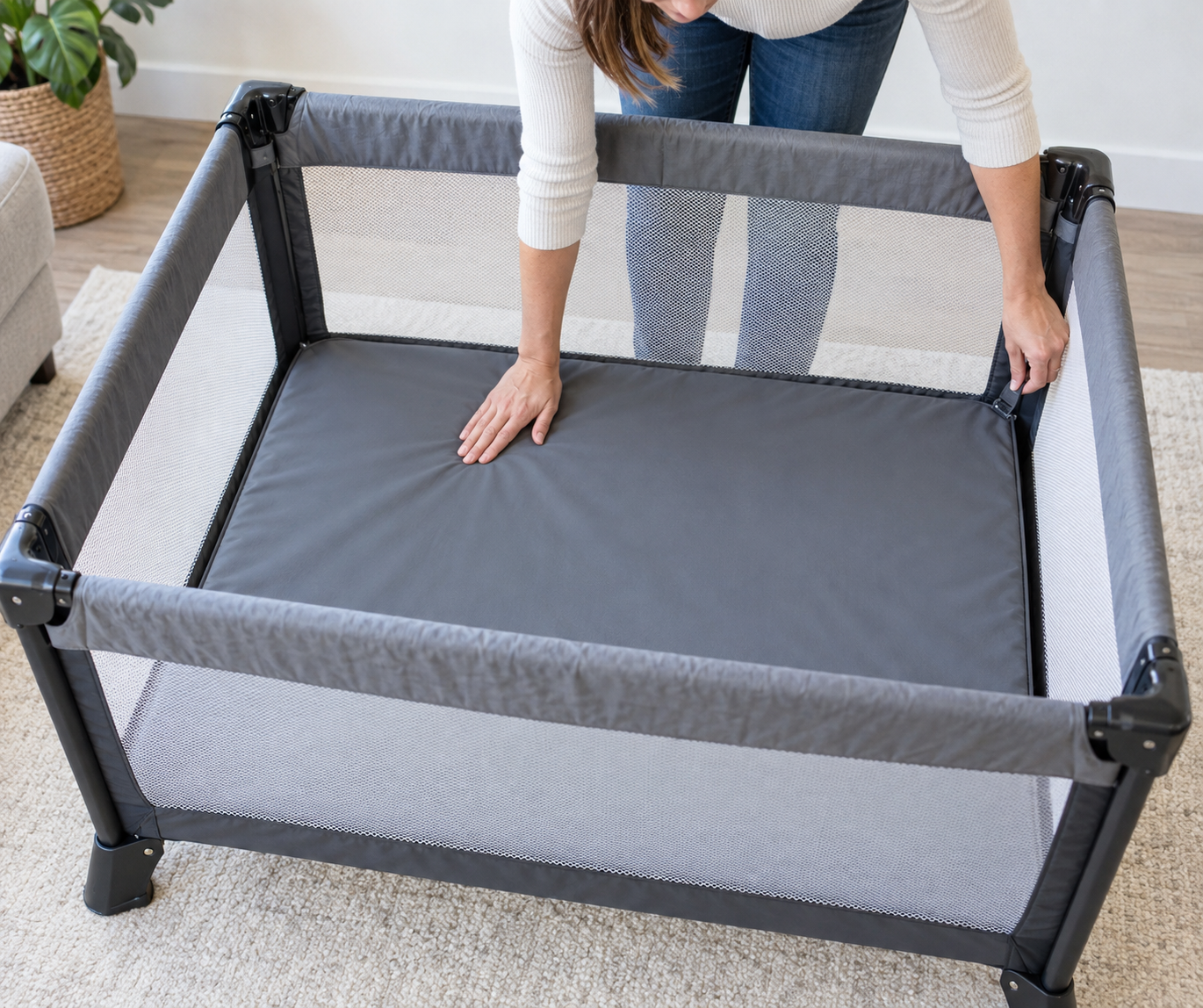
Most dangerous setup mistakes are ordinary ones: a rail that looks open but has not locked, a pad placed above an unsecured floor, or an accessory left attached in the wrong configuration. A short routine is more reliable than trusting that the unit feels familiar.
- Clear the location. Use a stable, level, dry floor. Keep the unit away from stairs, fireplaces, heaters, windows, blind cords, electrical cords, hanging decorations, and furniture your child could reach or use for climbing.
- Follow the model’s assembly order. Pack-and-play locking systems differ. Do not force a rail or improvise a sequence from memory when the instructions specify one.
- Verify the frame and floor. Check every rail, hinge, hub, wheel lock, and floor mechanism named in the manual. Push and pull gently at several points; nothing should fold, bow, or release.
- Install the correct pad. Lay the original pad in the required orientation, secure every provided fastener, and make sure it remains flat. Do not stack another mattress, foam layer, folded blanket, or spare pad underneath or on top.
- Check the enclosure. Run your eyes and hands over the mesh, seams, corners, and fasteners. Stop if you find a tear, loose thread, sharp point, broken plastic, protruding hardware, or an opening that was not part of the design.
- Remove unrelated items. Take out storage pieces, toys, changing supplies, packaging, and any attachment that is not approved for the current configuration. For sleep, leave only what the manual permits.
Repeat the lock-and-condition check after every move or reassembly, including at a hotel or relative’s home. Remove your child before folding, repositioning, or carrying the unit. If the pack and play becomes wet during cleaning or travel, let every component dry fully before storage and before your child uses it again.
Do not patch structural damage with tape, pins, improvised stitching, substitute screws, or a generic replacement pad. A repair can hide the defect without restoring the product’s tested construction. Stop using the unit until the manufacturer confirms an approved remedy or replacement.
Know when an attachment or the whole unit is finished
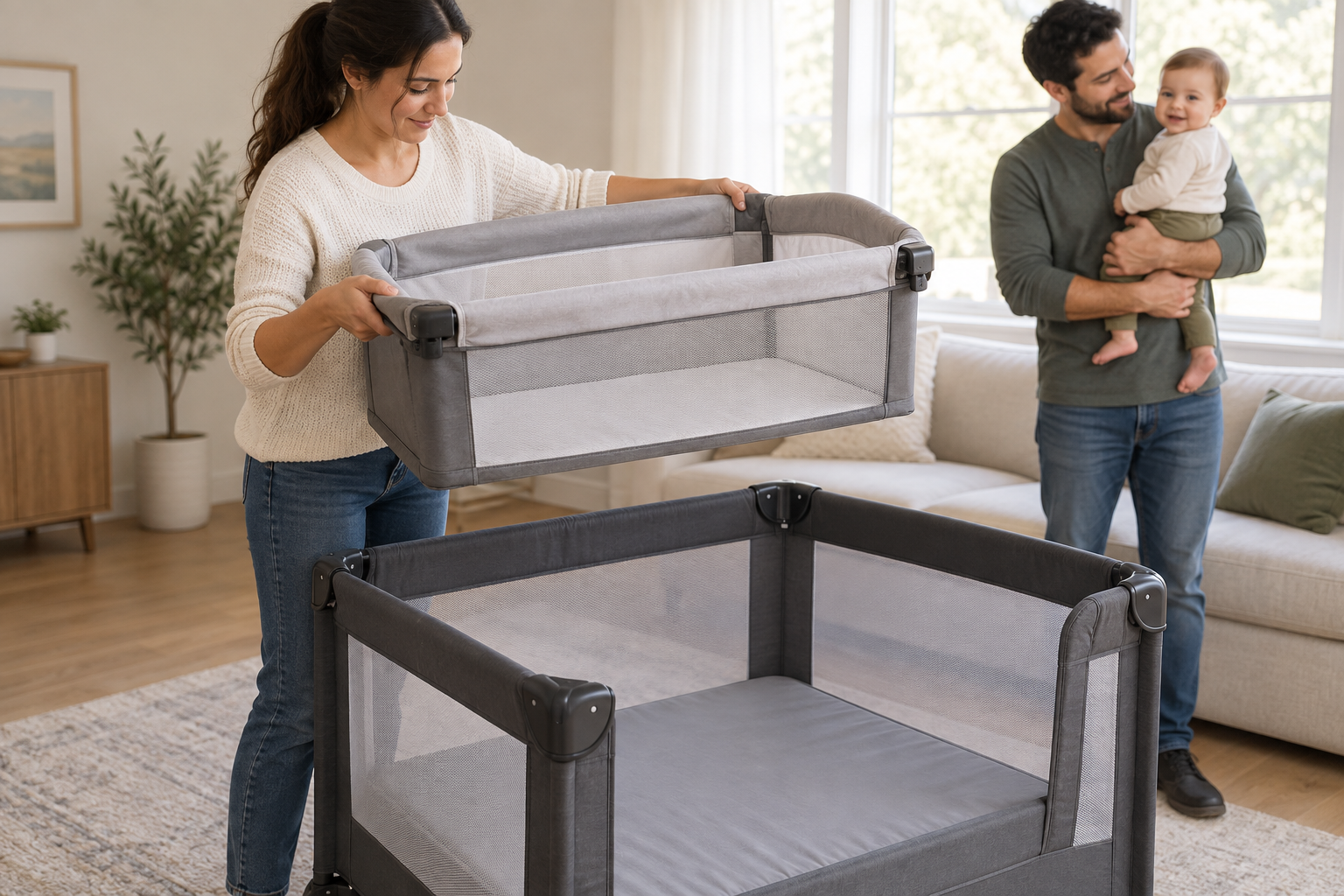
Your child can outgrow a raised bassinet or other attachment while still fitting comfortably in the main play yard. Check each component’s label and manual for its weight, height, and developmental limits. Stop at whichever limit comes first. Developmental milestones matter because a child who can change position, push up, sit, pull, or climb may defeat an attachment long before it looks physically small; follow the exact movement threshold named for your model.
Retire the main unit when your child reaches its stated limit, can climb out, or can access hazards beyond the sides. Stop sooner if the frame no longer locks reliably, the floor will not stay flat, the mesh or seams are damaged, parts are missing, or the model is subject to a recall that has not been remedied.
Be stricter with a secondhand or borrowed unit
- Find the model number, date code, manufacturer, and complete manual before accepting it.
- Check the model against the applicable national product-safety recall database.
- Confirm that the frame, pad, fasteners, travel bag, and any attachments are the original parts or approved replacements.
- Assemble it completely and inspect the locks, floor, mesh, seams, corners, and hardware before placing your child inside.
- Reject a unit whose identity, history, instructions, or required components cannot be established.
Do one full practice setup before your baby needs the pack and play. Save the manual on your phone, store any permitted accessories with their labels visible, and show every caregiver the same lock-and-surface check. That small rehearsal turns a late-night guess into a routine you can trust.
References




