

Your toddler spits at you, watches for your reaction, and may do it again. The useful goal in that heated moment is not to make them feel ashamed or force an apology. It is to stop the spit, protect the people nearby, and show your child what they can do instead.
Some toddlers spit at other people when they are angry. A short, repeatable response works better than turning the incident into a long confrontation. Your boundary can be firm without making the moment bigger.
What to do immediately after your toddler spits
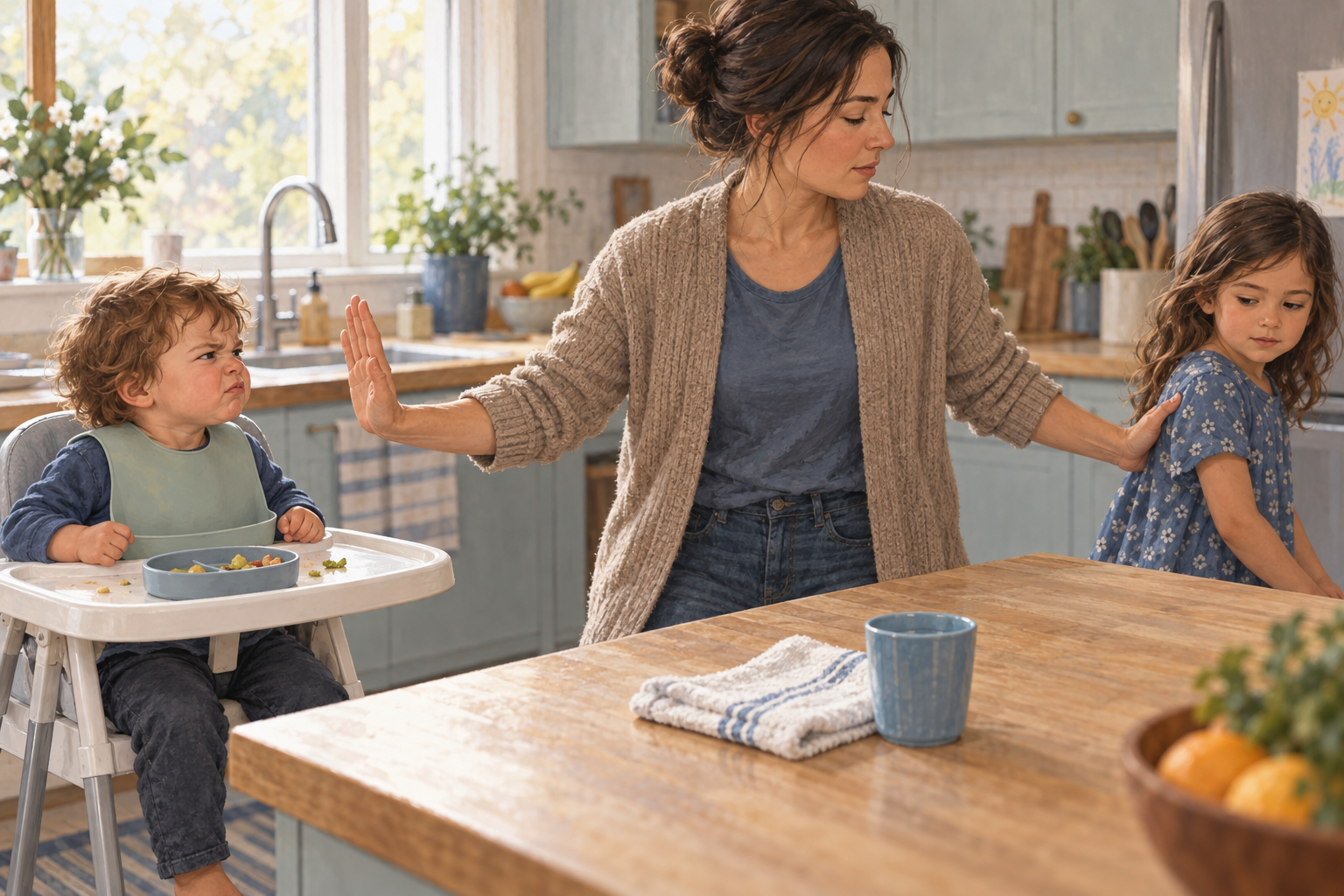
Decide on your response before the next incident. When every episode catches you by surprise, it is easy to alternate between laughing, scolding, pleading, and threatening. That variation can make the reaction itself interesting. A prepared sequence keeps your attention on the boundary.
- Create space. Turn your face away, step back, or move another child out of range. If your toddler is on your lap, place them somewhere safe beside you. You do not need to hold them down unless you are preventing immediate harm.
- State the boundary once. Use a plain sentence such as, “Spit is not for people. I will not let you spit at me.” Keep your voice steady. A lecture gives an overwhelmed toddler more language than they can use.
- Name the feeling without excusing the action. Try, “You are angry. You may say ‘mad’ or ‘stop.’” Anger is allowed; spitting at someone is not.
- Follow through. If the spitting continues, pause close play or move out of range: “I am sitting over here until your mouth is safe.” If it happens during a game, stop the game. The result should be immediate, related to the behaviour, and calm.
- Clean up without a performance. Deal with the saliva matter-of-factly. A calm toddler can help with a simple cleanup, but cleanup should not become humiliation or a prolonged punishment.
If another child was spat on, attend to that child first. You can say, “You did not deserve to be spat on. I am helping you.” Then address your toddler privately when possible. A public interrogation can add attention without teaching a usable alternative.
Do not spit back, call your toddler disgusting, or use physical punishment. Those responses model aggression and shift the conflict from “I will keep people safe” to “which of us can overpower the other?” If you feel yourself losing control, place your child somewhere safe, step back, and return to the script when you can deliver it calmly.
Look for the job the spitting is doing

“They know better” does not tell you why the behaviour keeps happening. After everyone is calm, look at the sequence around the incident. You are not trying to excuse it or assign a diagnosis. You are looking for the point where a different response can be taught.
- Before: What had just happened? A limit, a transition, a toy being taken, an adult turning away, or a difficult meal?
- During: Was the spit deliberately aimed at a person, released onto the floor, mixed with laughter, or connected to food and drink?
- After: Did your toddler gain intense attention, escape a demand, end an activity, obtain an item, or make other people laugh?
The pattern is more useful than a guess about intent. Spitting directly after a limit may be your toddler’s available expression of anger. Spitting that reliably produces a dramatic reaction may be partly about the reaction. Spitting during eating, drinking, or swallowing needs a different look from deliberate, person-directed spitting.
Pay particular attention to what happens after you say no. If spitting causes the limit to disappear, your toddler may learn that it changes the answer. Keep the original boundary when it is safe and reasonable: “You are angry that screen time is finished. Spitting will not turn it back on. You can say ‘mad.’”
If your toddler sometimes plays with saliva without aiming it at anyone, you can still set a hygiene boundary without treating it as an attack: “Saliva stays in your mouth. If you need to spit, use a tissue or the sink.” The same rule applies, but the emotional response does not need to be identical.
Teach a replacement your toddler can actually use

“Do not spit” removes a behaviour but leaves the original problem in place. Give your toddler a word, gesture, or safe action that can do the same job. The replacement must match their current communication ability. A child who cannot reliably say a sentence while calm will not produce one in the middle of a meltdown.
| What your toddler may need | Replacement to practise | How you can respond |
|---|---|---|
| To express anger | Say “mad,” point to an emotion picture, or make an agreed angry face | “You are mad. I hear you. The limit is still the same.” |
| To ask for space | Say “stop” or hold up an open hand | Give safe space when you can: “You said stop. I will move back.” |
| To request help | Say or sign “help” | Respond promptly and help with the part they cannot manage |
| To request a turn | Say “my turn” or point to a turn card | Acknowledge the request and explain what happens next |
| To remove saliva from their mouth | Ask for a tissue or go to the sink with an adult | Help them use the appropriate place without shaming them |
Practise outside the conflict. Use a toy or a tiny pretend scene: the toy becomes angry, starts to spit, and then tries “stop” instead. Keep the rehearsal brief and let your toddler copy the word or gesture. During a real incident, prompt only the replacement you have already practised.
Make the alternative worthwhile. When your toddler says “stop,” “mad,” or “help,” acknowledge it immediately even if you cannot grant the request: “You told me you are mad. I am listening.” If appropriate communication is ignored while spitting receives the biggest response of the day, the less useful behaviour may remain more effective.
Notice successful recovery, not just perfect prevention. You can say, “You were angry, and you used ‘stop.’ That kept everyone safe.” Specific feedback tells your toddler which action to repeat. General praise such as “good job” does not identify the skill.
Key takeaways for a consistent caregiver plan
Parents, grandparents, and child-care providers do not need identical personalities, but they do need the same basic boundary. Share a short plan that can be followed in the moment rather than a long explanation of everything that has happened.
- Use one boundary sentence: “Spit is not for people. I will not let you spit at me.”
- Respond by creating space or pausing the current activity, not by yelling or negotiating.
- Prompt one replacement your toddler can already manage, such as “mad,” “stop,” “help,” or an agreed gesture.
- Keep a simple note of what happened immediately before and after each incident until a pattern becomes visible.
- Do not let spitting reverse a reasonable limit, but reconnect once your child is calm and ready to try again.
- Give quick, specific attention when your toddler uses the safer replacement.
A useful message to child care might be: “Spitting usually follows a limit. Please step out of range, use our boundary sentence, prompt ‘mad’ or ‘help,’ and tell us what happened immediately before and after.” That gives everyone something observable to work with and avoids labelling your toddler as mean or defiant.
When spitting may need more than a behaviour plan

A behaviour plan is designed for deliberate spitting that is directed at people or linked to frustration. It should not be used to dismiss a possible health, feeding, swallowing, sensory, or communication concern.
Contact your child’s health-care provider if the spitting appears involuntary, is a sudden unexplained change, or occurs with pain, illness, difficulty eating or drinking, or trouble swallowing. Breathing difficulty needs urgent medical help. These situations require assessment, not stronger discipline.
It is also reasonable to seek help when the behaviour is frequent or intense enough to disrupt child care, relationships, meals, or ordinary family activities, or when a consistent plan is not producing progress. Start with your child’s primary health-care provider. They can help decide whether communication, feeding, developmental, or behavioural support is appropriate.
Choose your sentence and your toddler’s replacement now, then share both with every regular caregiver. At the next incident, create space, state the boundary, prompt the replacement, and follow through. That gives your toddler a predictable limit and a safe route back into connection.
References




