

Your baby is asleep against your chest. You lower them toward the bassinet, release one hand, and their eyes open. The frustrating part is how predictable it feels: the sleep happened, but the handoff did not.
A smoother transfer comes from changing fewer sensations at once. Prepare the sleep space, move slowly, maintain contact after the mattress takes your baby’s weight, and respond to stirring before it becomes a full wake-up. The goal is not a flawless performance. It is a calm, repeatable route from your arms to a safe sleep surface.
Why your baby wakes during the handoff
In your arms, your baby feels warmth, pressure, movement, and the shape of your body. A crib or bassinet feels still, open, and comparatively cool. The transfer can change all of those sensations within seconds.
Newborns are especially sensitive to changes in their surroundings. Being held also limits the sudden movements that can trigger their startle reflex. If the head or upper body drops slightly during the descent, that reflex may be enough to wake them.
This does not mean your baby has developed a bad habit. Many newborns need substantial help settling because independent sleep is still new to them. Treat the wake-up as information: notice whether it happens during the descent, at first contact with the mattress, when you remove your hands, or shortly afterward. Each pattern points to a different adjustment.
Prepare the timing and sleep space first
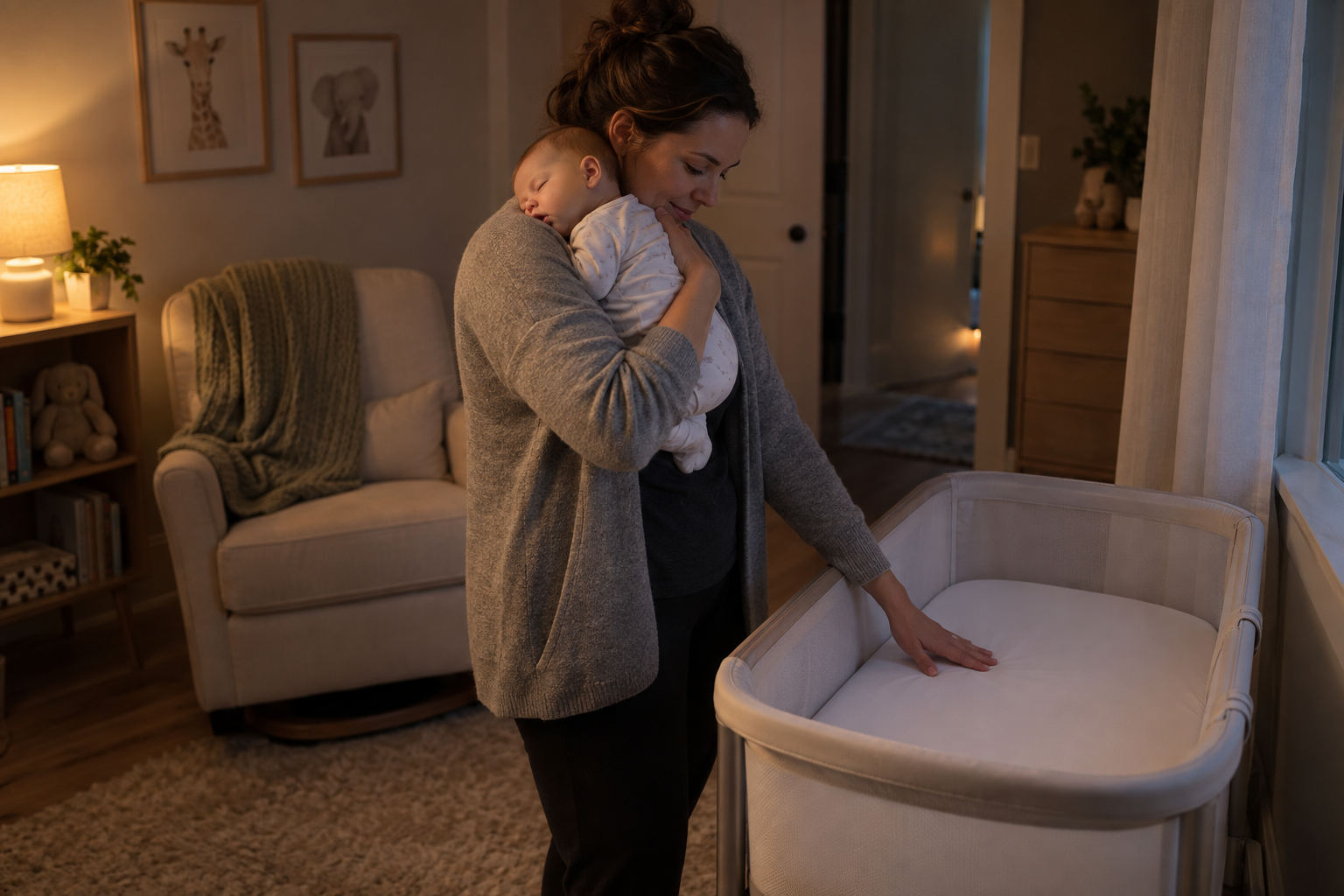
Do the practical checks before you begin soothing. If your baby is hungry, needs a diaper change, has trapped air, or seems uncomfortable, a perfect transfer technique will not keep them asleep. Address the likely need, then return to a quiet settling routine.
Watch for the earliest signs that your baby is ready for sleep. These may include staring into the distance, disengaging from interaction, or becoming mildly fussy. Waiting for intense crying in the hope that exhaustion will produce deeper sleep can backfire: an overtired baby may have more difficulty falling asleep and staying asleep.
Before picking your baby up to settle them, make sure the crib or bassinet is ready. Use a firm, flat mattress with a fitted sheet, place your baby on their back, and keep the sleep space empty. Do not add pillows, loose blankets, rolled towels, toys, sleep positioners, or a heated surface to make the mattress resemble your arms. A transfer is only successful if the destination remains safe.
Keep the room calm enough that you will not need to make sudden changes after the transfer. Dim the light before settling begins. Have anything you genuinely need within reach. If your baby stirs, avoid switching on bright lights or starting an animated conversation unless care or safety requires it.
You can try putting your baby down when they are drowsy rather than completely asleep, but do not turn that phrase into a test you both have to pass. Some young babies tolerate it and gradually practise settling in the bassinet. Others need to be fully soothed first. Either response can be normal in the newborn stage.
Use the same slow transfer sequence each time

A consistent sequence makes troubleshooting easier. Instead of changing the room, your hold, the timing, and the soothing method all at once, repeat these steps and adjust the point where your baby usually wakes.
- Settle beside the sleep space. Position yourself so you do not have to walk far, reach over clutter, or turn abruptly once your baby is asleep.
- Keep the head and neck supported. Place one hand under your baby’s head and shoulders and the other under their hips. Keep their body close to yours as you bend toward the mattress.
- Lower the hips first. Let your baby’s bottom meet the mattress before gradually lowering the back, shoulders, and head. This reduces the sensation of falling that can provoke a startle.
- Make the landing continuous. Do not let the last part of the descent become a small drop. Keep supporting the head and neck until they are resting fully on the mattress.
- Leave your hands in place. Once your baby is down, maintain gentle, still contact for a moment. A hand on the chest can help bridge the change from being held to lying independently. Keep their face and airway clear.
- Withdraw one hand at a time. Remove the hand from beneath the hips or torso slowly. Pause. Then ease away the hand supporting the upper body. If your baby twitches or startles, stop moving until they settle.
- Soothe in place before lifting. If your baby begins to stir, try a quiet voice, gentle patting, or a still hand on the chest. Give the response a chance to work while staying close. If the cry escalates or your baby needs something, pick them up, soothe them, and try again.
Move as if the transfer continues until you have stepped away. Parents often concentrate on the descent and then straighten quickly, pull both hands away together, or brush the side of the bassinet. Those final abrupt changes can undo an otherwise smooth landing.
If you are becoming drowsy while holding your baby, stop trying to achieve the perfect transfer. Put them on the safe sleep surface even if they wake, and get another alert adult involved if one is available. Contact sleep depends on the adult remaining awake and attentive.
Troubleshoot the exact moment the transfer fails

Your baby startles during the descent
Slow the downward movement and keep your baby’s body against your torso for longer. Check that the head is not tipping backward and that the upper body does not drop after the hips touch. A wake-up at this point usually calls for a steadier descent, not a softer mattress or extra bedding.
Your baby wakes when the mattress takes their weight
Abrupt loss of body contact may be the trigger. Keep your chest close as the hips and back settle, then maintain your hands on your baby after their full weight is down. Do not try to solve the contrast by warming the mattress with a heating device or adding soft items. Slow contact is the safer variable to change.
Your baby wakes when you remove your hands
Fade contact in stages. Hold still first, then lighten the pressure without removing your hand. Pause again before lifting it away. If your baby’s eyes open but they remain calm, resist the automatic urge to scoop them up. A quiet hand, soft voice, or gentle pat may be enough for them to settle where they are.
Your baby becomes fully alert or cries harder
At that point, stop treating the transfer as a movement problem. Check feeding, diapering, temperature, trapped air, and other signs of discomfort. If nothing appears wrong, pick your baby up, soothe them in the dim room, and try the sequence again when they are calm.
Repeated wake-ups do not necessarily mean you should keep extending the attempt. If both of you are becoming more activated, reset. Meet the immediate need and return to the transfer later. Changing methods frantically can add stimulation and makes it harder to identify what actually helps.
Age matters as well. A newborn who needs to fall asleep in your arms is not failing at sleep. Babies often become better able to soothe themselves at around 3 to 4 months, although this is a general developmental shift rather than a deadline. Sleep training, if your family chooses it, is a separate decision from learning a careful transfer technique.
Bring persistent concerns to your baby’s health-care provider, especially if lying flat repeatedly appears painful or wake-ups come with frequent choking, breathing difficulty, a colour change, poor feeding, or unusual difficulty waking. Transfer techniques should never be used to explain away signs that your baby may be unwell.
Key takeaways
- Prepare the safe sleep surface and check hunger, diapering, and discomfort before you begin settling.
- Start at early signs of tiredness; keeping a baby awake longer can make settling harder rather than easier.
- Lower the hips first, keep the head and neck supported, and avoid any small drop at the end of the descent.
- Maintain gentle contact after the landing, then remove one hand at a time.
- Notice exactly when your baby wakes and change one part of the sequence instead of changing everything at once.
- Needing help to fall asleep is common for newborns and is not evidence that you have spoiled your baby.
For the next few sleeps, use one transfer sequence and watch for the precise point where your baby reacts. That small observation will tell you more than another entirely new routine. Keep the sleep space safe, make one adjustment, and give your baby time to learn the handoff.
References




