
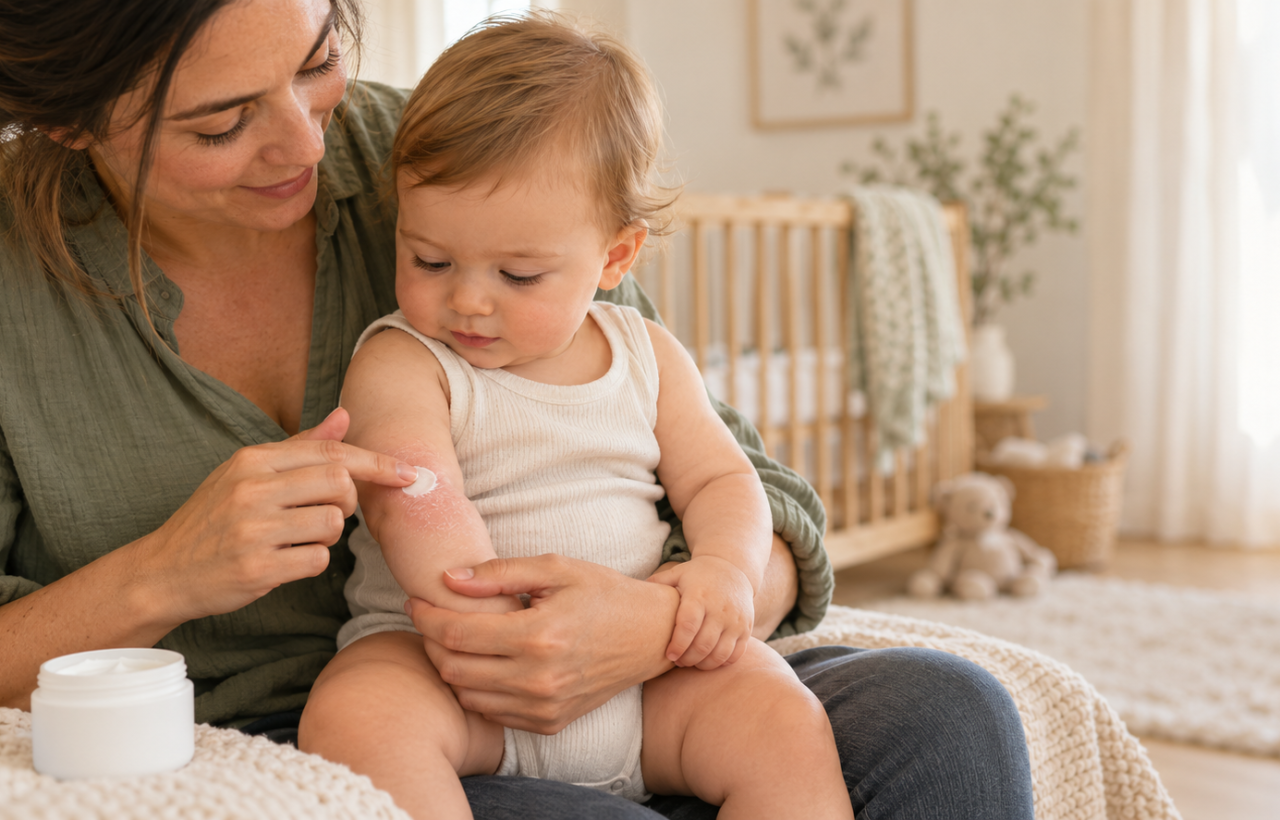
If your child’s eczema has moved to a new spot or changed from a red patch into tiny bumps, it is easy to wonder whether you are still looking at the same condition. With a baby or toddler who scratches, squirms, and cannot explain what feels wrong, the difficult part is not simply knowing that skin care matters. It is building a routine you can repeat and recognizing when the rash no longer belongs in the home-care category.
You do not have to identify every possible trigger at once. Learn your child’s usual pattern, keep bathing and moisturizing gentle and consistent, and involve a pediatrician or dermatologist when that pattern changes.
Key takeaways
- Atopic dermatitis can look different from one flare or body area to another, so learn your child’s usual locations and appearance without assuming every new rash is eczema.
- Keep baths brief and comfortably cool rather than hot. When cleanser is needed, focus it on the areas that actually need washing instead of routinely soaping the whole body.
- Use a fragrance-free moisturizer without lavender or other botanical extracts, and connect it to a predictable part of your child’s routine.
- Watch for triggers throughout the year. Cold, dry weather is not the only setting in which eczema can flare.
- Contact your child’s pediatrician or dermatologist when a rash looks different from their usual eczema or does not respond to the usual treatment as expected.
Learn your child’s pattern without diagnosing every rash

Atopic dermatitis does not have one fixed appearance. It may show up as flat red areas, scaly patches, small bumps, or thicker skin. It can also look different on the scalp, face, hands, and folds of the body. A familiar condition appearing in an unfamiliar form can therefore resemble another type of rash.
That variability is a reason to observe carefully, not a reason to label every mark as eczema. Create a simple record of your child’s normal flares. When the skin is active, note:
- Where the rash appears and whether it is flat, bumpy, scaly, or thickened.
- How much your child is scratching and whether the scratching is interrupting ordinary activities or sleep.
- What happened beforehand, such as a bath, pool visit, weather change, or newly introduced skin product.
- Which parts of the established care plan you used and whether the skin responded in its usual way.
- A dated photo in consistent lighting, especially if the rash may fade before an appointment.
This record is not a substitute for an examination. Its job is to help you compare today’s rash with your child’s baseline and give the clinician a clearer history. If you cannot confidently say, “This is how the usual eczema behaves,” that uncertainty is useful information to bring to the pediatrician or dermatologist.
Build one repeatable bathing and moisturizing routine
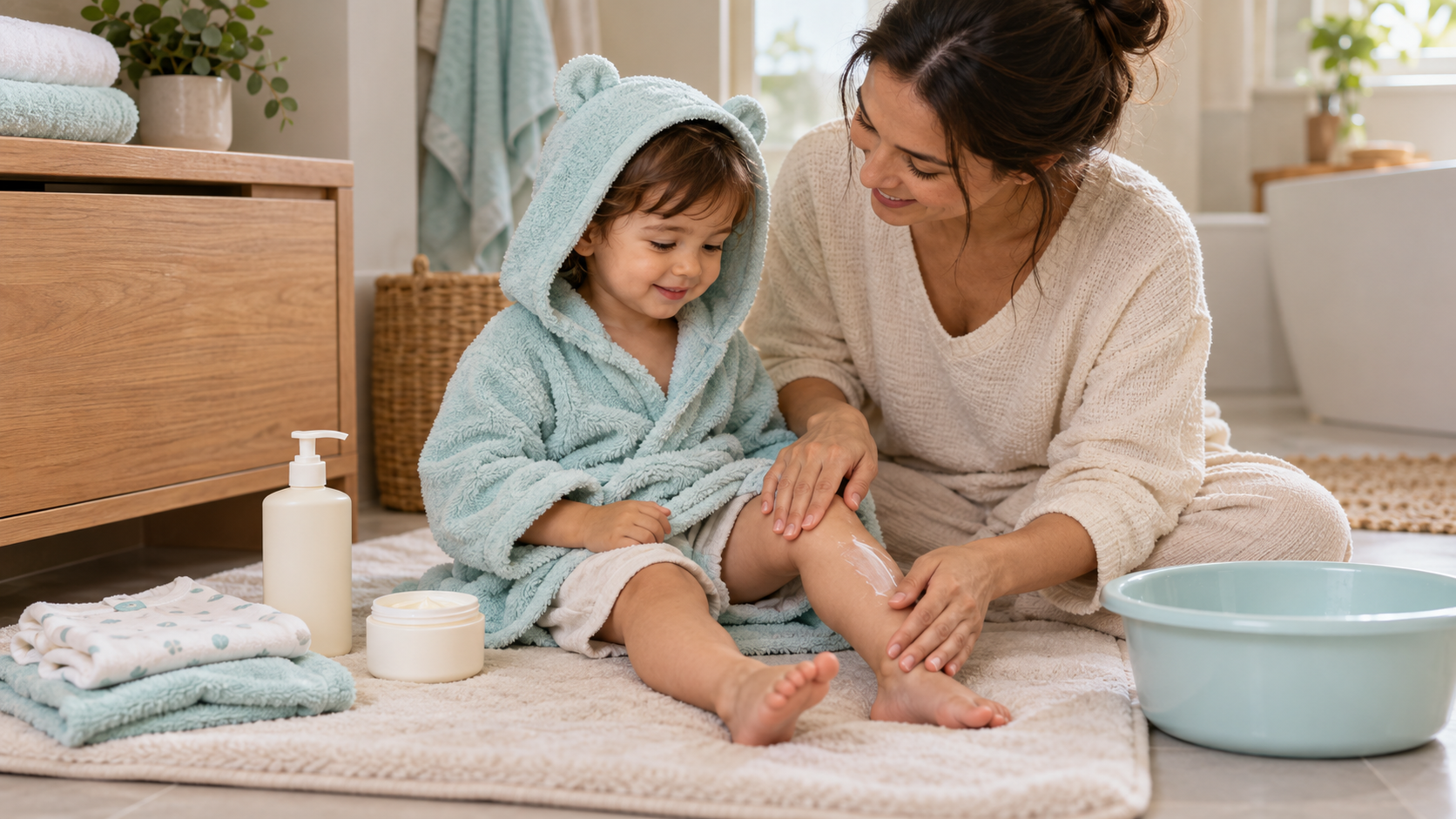
Hot water and long baths can disrupt an already vulnerable skin barrier. A gentler routine reduces that avoidable strain, but there is no need to turn bath time into a complicated treatment session.
- Set out the moisturizer and clean clothes before the bath so the next step does not disappear into toddler wrangling.
- Use comfortably cool or lukewarm water rather than very hot water, and keep the bath short.
- When soap or cleanser is needed, focus on the face, neck, armpits, and groin rather than automatically lathering the back, chest, arms, and legs.
- Follow the bath with the fragrance-free moisturizer that is part of your child’s care plan.
- Use any prescription eczema medicine exactly as your child’s clinician directed. Gentle bathing and moisturizer support treatment; they do not replace it.
Bath frequency deserves a similarly practical approach. Bathing less often helped the child described in the available material, but one family’s every-other-night schedule is not a universal medical rule. If your child’s skin regularly looks or feels worse after a nightly bath, ask their pediatrician or dermatologist whether a less frequent schedule would suit their skin and hygiene needs.
Moisturizer is the part most likely to be skipped when your child is rolling away, protesting, or ready for bed. Make it easier to do rather than relying on memory. Keep the product where your child gets dressed and attach its use to a dependable daily cue. Increased scratching after missed applications can be an early sign that the routine has slipped.
Product labels matter. Choose a fragrance-free formula without lavender or other plant extracts; botanical ingredients can irritate eczema-prone skin and may also provoke an allergy. “Natural” is not the same thing as gentle. Introduce one product at a time so that a reaction does not leave you guessing which new item caused it.
Track triggers through winter, summer, and pool days

Eczema is often treated as a cold-weather problem, but it can require attention all year. Cold, dry winter conditions may aggravate symptoms, while some children also flare in humid summer weather or around time spent in a pool. A clear spell in one season does not mean the condition has disappeared.
Use your notes to look for repetition across several flares. A useful trigger log connects an exposure with what happened next: “pool visit, then bumps on the belly” is more informative than “bad skin day.” Record weather conditions, bathing, swimming, skin products, and missed parts of the usual routine. You are looking for a pattern that repeats, not a single coincidence.
If you want to test a lifestyle change, change one manageable thing and keep the rest of the routine steady. Trying a new moisturizer, changing bath frequency, adding a humidifier, and switching sunscreen at the same time may leave you with no idea which change helped or irritated the skin. Gentle skin care and consistent moisturizing should remain the foundation while you discuss persistent triggers with your child’s clinician.
Know when the home routine is no longer enough

A new location does not automatically mean a new condition, but you should not have to guess indefinitely. Arrange an assessment with a pediatrician or dermatologist if the rash looks different from your child’s usual eczema or if the established treatment is not working in the way it normally does.
Eczema can sometimes become infected and look different for that reason. If you suspect infection, your child seems unwell, or the skin is worsening quickly, seek prompt medical advice rather than experimenting with an antifungal cream, a borrowed prescription, or another treatment chosen by appearance alone.
Repeated appointments are not a sign that you have failed to manage the condition. Atopic dermatitis can change as a child grows, and prescription treatment may be needed alongside lifestyle changes, gentle bathing, and moisturizer. Bring your photos, observations, product names, and notes about treatment response. That information helps the clinician decide whether this is the familiar condition in a new form or something that needs a different approach.
For tonight, make the routine easier by putting one suitable moisturizer where your child gets dressed and recording the current rash locations. At the next flare, you will have both a baseline and a plan. If the rash breaks that pattern, call the clinician instead of trying to outguess it.
References




