
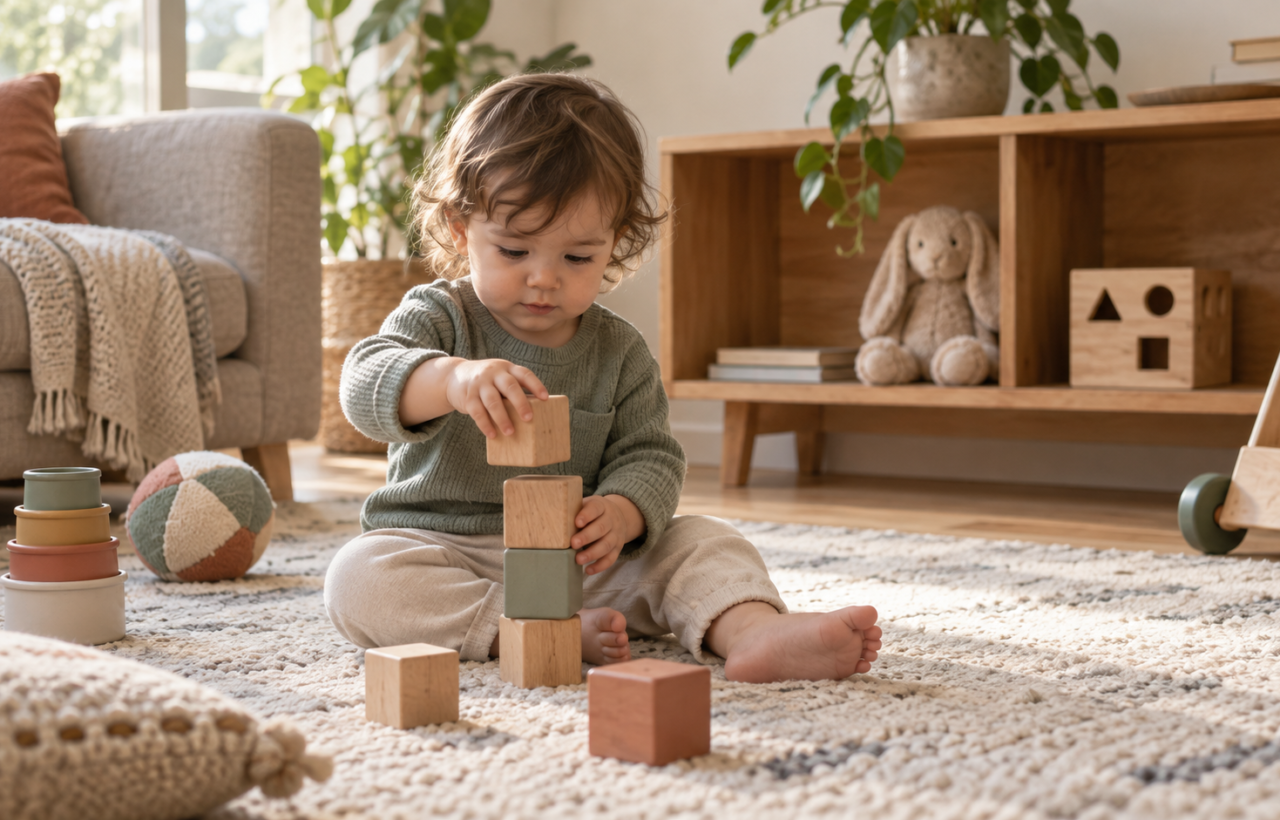
If your floor is covered, the toy basket will not close, and your child still seems unsure what to play with, you probably do not need another storage bin. You need a smaller, clearer selection.
There is no magic toy count that suits every baby or toddler. A useful answer is this: keep enough toys available to support different kinds of play, but few enough that your child can see them, choose between them, and use them without first emptying a crowded container.
Why there is no universal toy number
A total that works in one home may be impractical in another. The right amount changes with your child’s development, interests, available play space, and the kinds of toys involved. A collection of large activity toys creates a different environment from a similarly sized collection of stacking cups, figures, or blocks.
Ownership and access are also different questions. Your child can own toys that are stored away without having every item available at the same time. That is why the better question is how many toys your child can use well at once, not how many are somewhere in the home.
Use the play area as your practical limit. Toys should fit within their assigned shelves, baskets, or floor space without being packed into a jumble. Your child should be able to find a wanted item without digging through everything else. If the collection no longer passes that test, reduce what is available before buying more storage.
Let your child’s play show you when there are too many
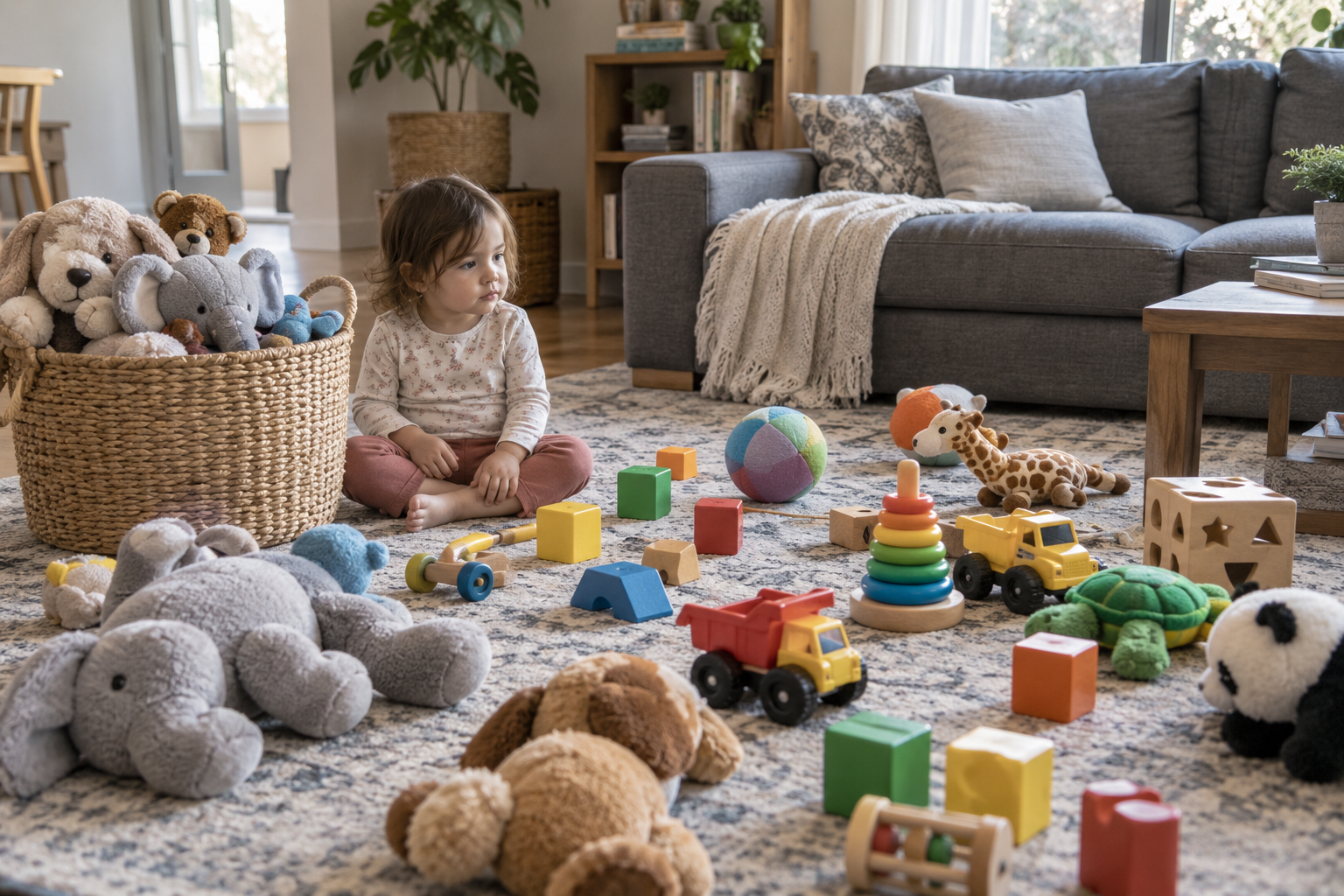
Mess alone does not prove that a child has too many toys. Babies and toddlers explore by moving, carrying, filling, emptying, and combining objects. A busy play session can look chaotic while still being focused and productive.
Look for repeated patterns instead. The accessible selection may be too large or poorly arranged when:
- Your child regularly dumps out an entire container but settles with almost none of its contents.
- They move rapidly from toy to toy without returning to an idea or action.
- Favourite toys are often buried, hidden, or difficult to reach.
- Pieces from unrelated sets are so mixed together that the toys no longer work as intended.
- Your child cannot take out a toy without dislodging several others.
- Cleanup depends entirely on an adult because the storage system is too full or complicated for the child to understand.
Any of these can happen on an unsettled day, so do not treat an isolated play session as a verdict. Pay attention to what happens repeatedly. If your child plays longer and more purposefully after you clear the area, that response is more useful than an arbitrary target count.
The opposite matters too. A small selection is not automatically a good selection. If every available item asks your child to do essentially the same thing, reducing the collection further will not improve it. Replace duplication with variety rather than simply chasing minimalism.
Build a useful mix instead of a bigger pile
Start with what your child currently does, not what a package promises they will learn. Babies may be interested in grasping, shaking, mouthing, rolling, or watching an action repeat. Mobile babies and young toddlers often explore by carrying, filling, emptying, pushing, stacking, and knocking down. Older toddlers may add building, matching, pretend play, and simple problem-solving.
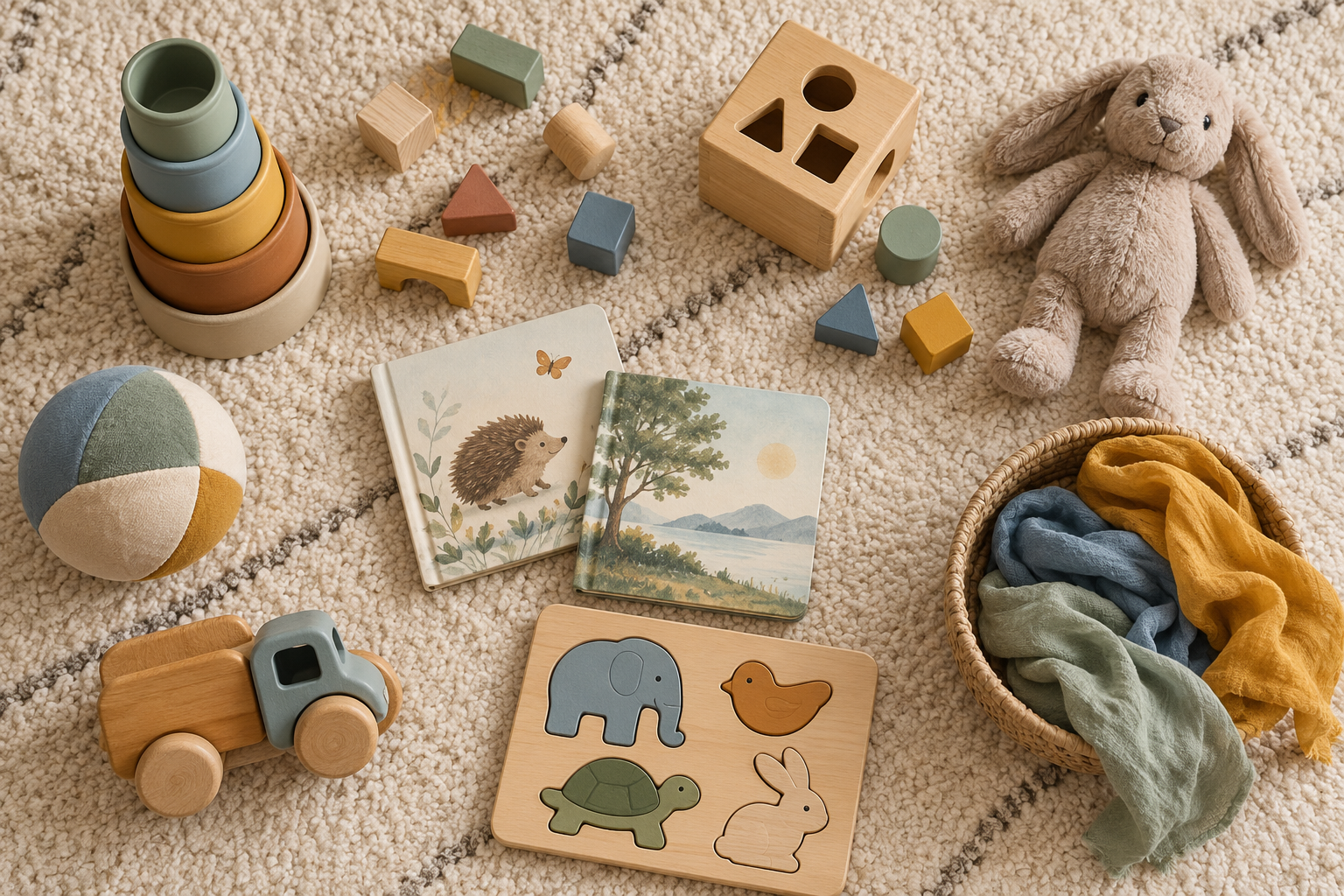
Choose a small active mix that supports several of those actions. Depending on your child’s stage, that mix might include:
- Something to hold and move: such as an easy-to-grasp rattle, ball, vehicle, or push-and-pull toy.
- Something to put together or take apart: such as stacking cups, blocks, nesting objects, or a simple sorter.
- Something for open-ended play: an item that can be used in different ways rather than producing only a fixed response.
- Something for social or pretend play: such as a doll, toy animal, pretend household object, or another prop that invites interaction.
- Something quiet to examine: such as a sturdy book, puzzle suited to the child’s abilities, or an object with interesting shapes and textures.
This is a menu, not a shopping list. You may already have several items that serve more than one purpose. A set of cups can be stacked, nested, filled, carried, hidden, or used in pretend play. A toy that supports many actions may deserve space more than several toys that each perform a single trick.
Keep current favourites even when they look developmentally simple. Repetition is part of play, and a familiar object can become more interesting as your child finds new uses for it. The goal is not constant novelty. It is an accessible selection that leaves room for attention and imagination.
Safety still sets the boundary. Follow the manufacturer’s age and safety guidance, especially while your child mouths objects. Keep choking hazards and unsuitable loose parts out of reach, and remove toys that are broken, sharp, or damaged rather than placing them back into rotation. A toy that is unsafe for your child’s current stage does not belong in the active set, even if it is a favourite.
Rotate toys without creating another household chore
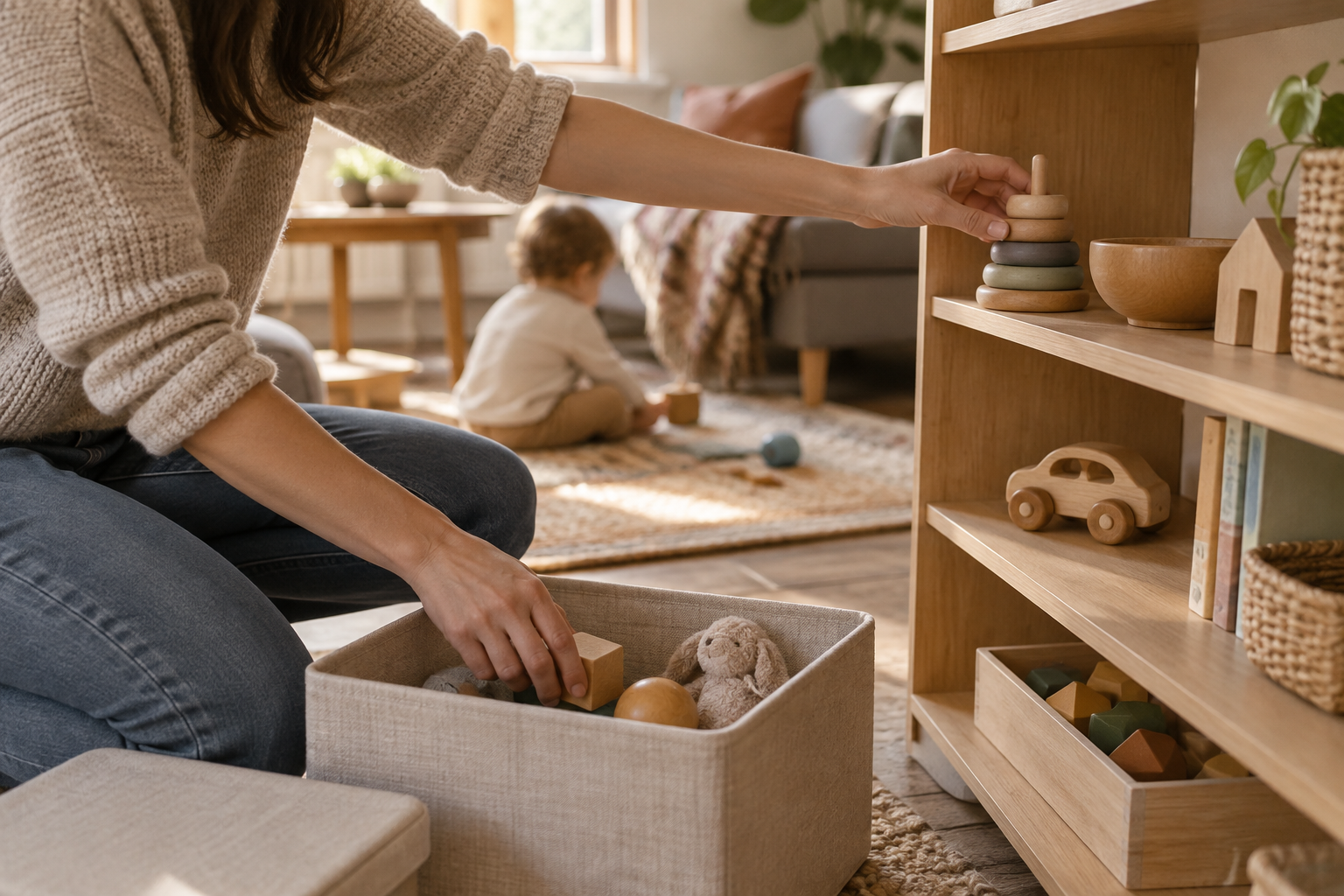
Toy rotation simply separates what is available now from what is safely stored for later. It does not require a strict calendar, matching containers, or a carefully themed playroom.
Use this practical reset:
- Protect the favourites. Set aside the toys your child seeks out and uses regularly. Do not remove a comfort item merely to make the collection look balanced.
- Sort by what the toys let your child do. Group items used for movement, building, pretend play, problem-solving, sensory exploration, and shared play. This makes unnecessary duplication easier to see.
- Fill the active space loosely. Put back a varied selection that fits without stacking toys in deep, crowded layers. Empty space is part of the system because it makes choosing and returning toys easier.
- Store the remainder out of sight. Clearly separate stored toys from the active set. If your child can see an overflowing backup container, it still competes for attention.
- Observe before changing anything. Notice what your child repeatedly chooses, ignores, combines, or searches for during ordinary play.
- Swap with a reason. Bring something back when interest has faded across the active selection, when your child is ready for a different kind of play, or when a stored item answers a clear current interest.
You do not need to replace the entire selection at once. Changing a few items preserves familiar anchors while creating enough difference to invite another look. If a toy returns from storage and is still ignored, it may be the wrong fit for your child’s current stage or simply something they do not enjoy.
Before donating anything you are uncertain about, place it in a temporary holding area. If nobody looks for it and it adds nothing useful when reintroduced, letting it go becomes an easier decision. Keep sentimental toys outside the everyday play system if you are saving them for emotional rather than practical reasons.
New gifts should not automatically expand the active collection. Decide where a new toy will live before adding it to the play area. When the assigned space is already comfortably full, store or remove something else instead of compressing more into it.
Key takeaways
- There is no universally correct toy count for every baby, toddler, home, and developmental stage.
- Count what is accessible separately from what your child owns; stored toys do not need to compete with the active selection.
- The active set is manageable when your child can see, choose, use, and help return its contents.
- Repeated unfocused dumping, buried favourites, and inaccessible storage are better signals than a raw total.
- A varied mix of play possibilities is more useful than many toys that perform the same function.
- Rotate in response to your child’s play, not because a calendar says the display must change.
Start with the area your child uses most. Keep the favourites, remove unsafe or damaged items, and store enough of the remaining toys that every available choice is easy to see. Then watch what your child actually does. Their play will give you a better limit than a universal number ever could.
References




