
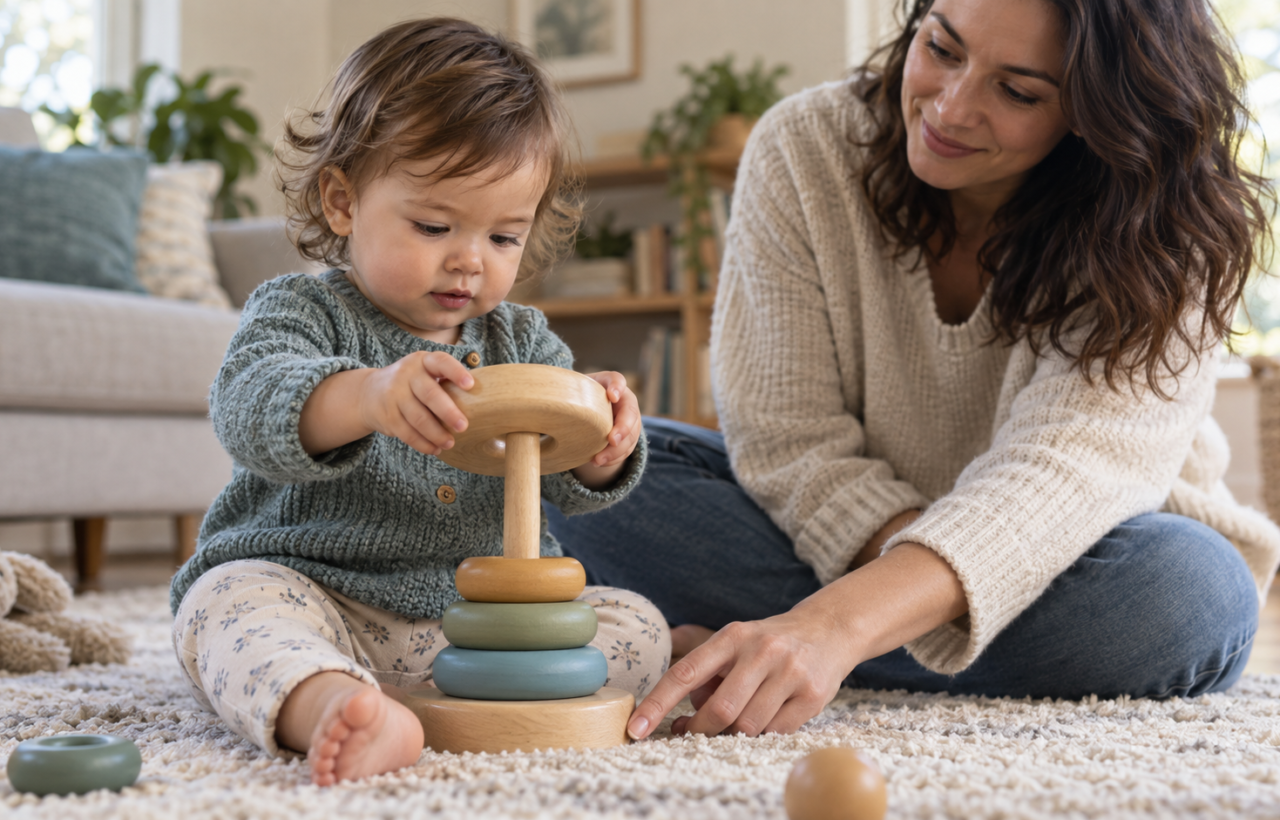
Your baby reaches for a toy but cannot quite grasp it. Your toddler wants to put on a shirt, gets one arm stuck, and immediately asks you to finish. In moments like these, it can be hard to tell whether you should step in or wait.
Scaffolding gives you a practical middle path. You make the next part possible without taking ownership of the whole task. Your child still reaches, chooses, communicates, experiments, and solves; you supply only the support that is missing.
Key takeaways
- Choose one small part of the task that your child can genuinely do.
- Start with the lightest useful support: a pause, a better setup, a gesture, a short cue, or a quick demonstration.
- Give one clue at a time, then leave space for your child’s response.
- Judge the attempt by your child’s participation, not by how neat or complete the result looks.
- Reduce your help as soon as it is no longer needed, but add it back when the situation or your child’s capacity changes.
What help without taking over actually looks like
In early learning, educational scaffolding is temporary, adjustable help that allows a child to practise a skill that is not yet fully manageable alone. The support changes with the child. It might make the goal clearer, reduce the number of choices, steady an object, model one action, or divide a large task into a reachable next step.
The important word is temporary. A scaffold helps your child carry more of the task and then gets lighter as that becomes possible. That does not mean every helpful support must eventually disappear. Accessibility tools, communication supports, and other accommodations may be useful over the long term and serve a different purpose.
Before you step in, ask three questions:
- What can my child already do? Look for the part that is independent, even if it is small.
- Where does the attempt break down? Identify the exact obstacle instead of labelling the entire task as too hard.
- What is the least help that would make another attempt possible? Choose support you can remove without changing the goal.
Suppose your child can pick up a shape-sorter piece but cannot find the matching opening. You might rotate the sorter so the correct opening is visible. If your child can find the opening but the box slides away, you might steady the box. If your child is already trying different openings, the best scaffold may be no prompt at all. The activity is the same, but the useful support is different.
Finishing the puzzle, dressing your child, or placing every toy in the bin may solve the immediate problem, but it does not scaffold the part your child was trying to learn. At the other extreme, withholding all help can leave a child with no useful information. The aim is not maximum independence in every moment. It is meaningful participation with enough support to move forward.
Use this five-step loop in ordinary routines
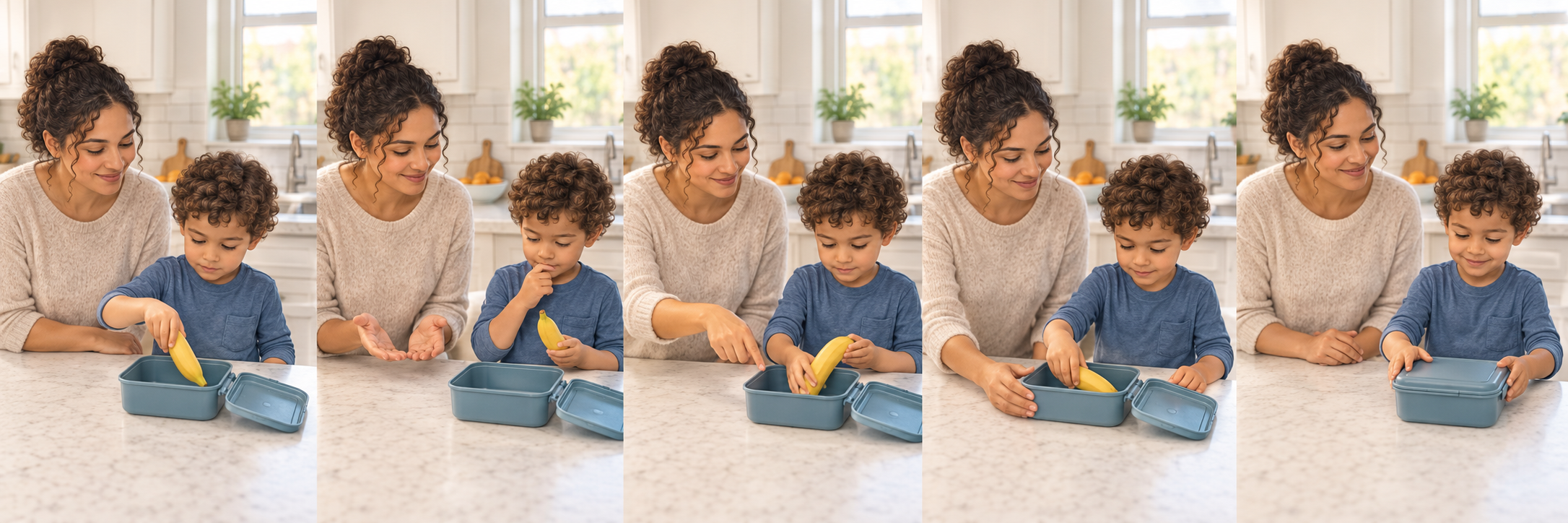
- Pick a small, low-pressure goal. Replace “get dressed” with “push one arm through the sleeve.” Replace “clean up” with “put this block in the bin.” A child-sized goal makes it easier for both of you to see what help is actually needed.
- Watch one complete attempt. Give your child a chance to show you the current strategy. You may discover that the problem is not understanding the goal but finding the opening, holding two things at once, choosing among too many objects, or knowing how to begin.
- Offer the lightest promising support. Change one thing rather than adding several instructions. Move the bin closer, point to the sleeve, hold the container still, or model the first motion.
- Pause and let your child take a turn. Avoid stacking a verbal direction, a demonstration, and physical assistance into the same moment. One clue followed by a real pause tells you whether that clue was enough.
- Hand control back and fade the help. Once your child re-engages, stop directing. On the next attempt, begin with slightly less support. If that is not enough, you can restore the previous level without treating it as a failure.
You do not need to repeat the task until it is mastered. Babies and toddlers learn through recurring moments across the day. Continue while your child is interested, and let the routine end when the practical need has been met or the interaction has stopped being productive.
A prompt ladder from least to most help
When you are unsure how much help to give, move through this ladder until your child can participate:
- Wait. Stay available and give your child a chance to notice the problem or begin again.
- Adjust the setup. Reduce clutter, bring the needed object within reach, turn an opening toward your child, or steady something that keeps moving.
- Use a gesture. Look toward, point to, or tap the relevant object without completing the action.
- Give one short cue. Try “Arm in,” “Turn it,” or “Block in the bin” instead of explaining the entire sequence.
- Model one action. Demonstrate with another piece or start the motion once, then return the materials.
- Share the action. Hold one part while your child moves another, or guide only the portion that is blocking progress.
This is not a rigid test. You can skip to more direct help when your child is already upset, when the task must be completed, or when safety is involved. If a prompt does not work, repeating it more loudly usually adds pressure without adding information. Change the setup, show the action, simplify the goal, or finish calmly and try another time.
Examples for play, communication, dressing, and cleanup
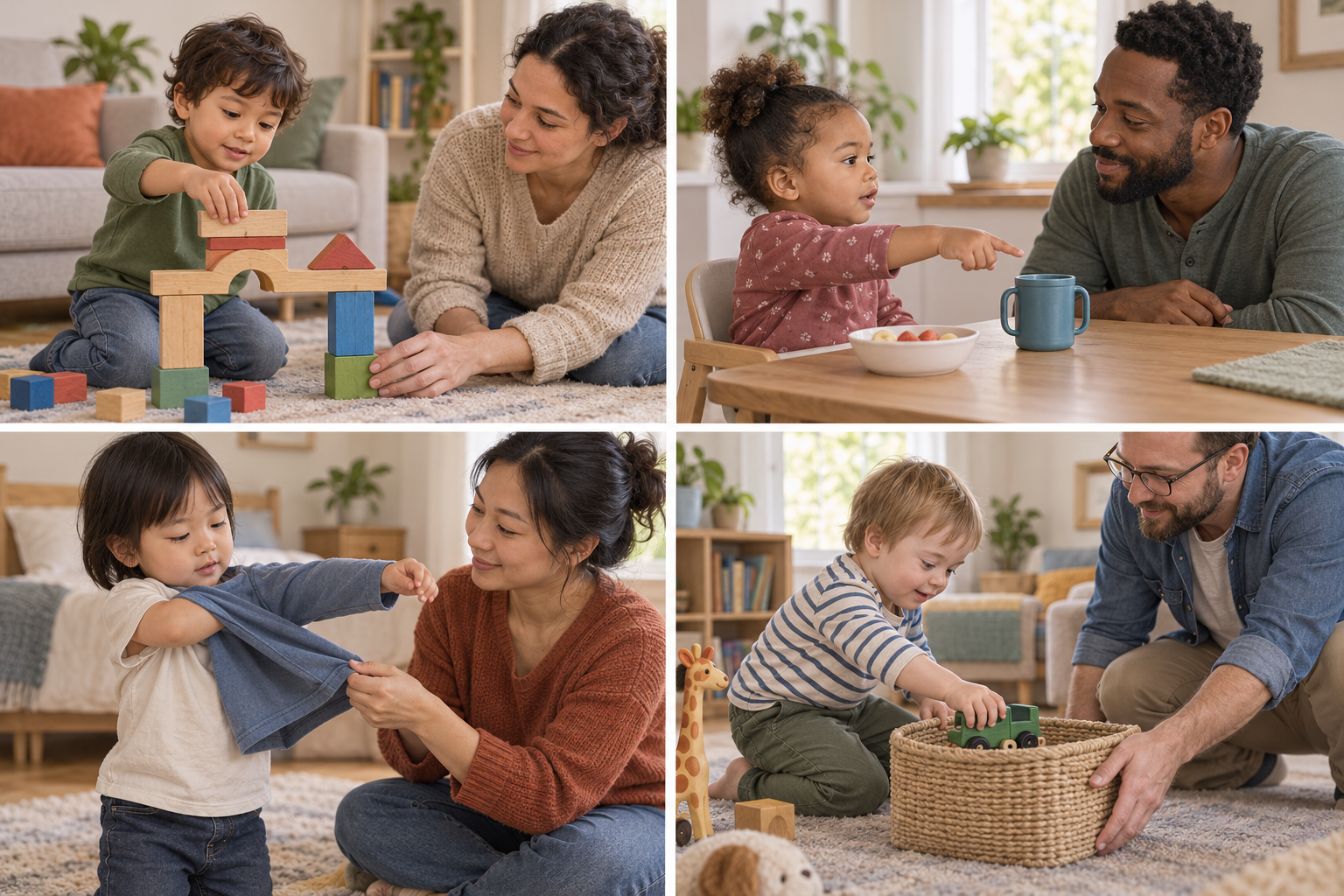
These examples are not milestone checklists. Choose an example according to what your child is doing now, not what you think a baby or toddler of a particular age should be doing.
| Everyday moment | Your child’s part | Temporary support | How to fade it |
|---|---|---|---|
| Supervised play with a safe object | Reach toward the object and close the hand around it | Place it within a manageable reach and steady it if it rolls or shifts | Stop steadying it, then return it to an ordinary reachable position |
| Communicating a want | Look, reach, point, make a sound, sign, or use a word | Model one simple word that matches the likely meaning and respond to the communication without requiring imitation | Pause before supplying the word next time and accept any clear way of communicating |
| Putting an object in a container | Carry or release the object over the opening | Use a wide container, bring it closer, and gesture toward the opening | Remove the gesture first, then place the container in its usual location |
| Stacking or nesting toys | Choose and place the next piece | Remove distracting pieces and align the base so it stays stable | Stop aligning the base, then add another possible piece |
| Getting dressed | Push an arm through a sleeve | Bunch the sleeve and hold its opening where your child can find it | Hold only the shirt, then lay it ready and wait before helping |
| Cleaning up | Put one toy into the correct bin | Bring the bin close, point to one toy, and use a brief cue such as “In the bin” | Stop pointing after your child starts, then use one cue for the whole group of toys |
Communication deserves special care. Do not turn food, water, comfort, or a wanted object into a prize your child receives only after producing a particular sound or word. You can model useful language while still responding to a look, gesture, sign, sound, or other clear attempt to communicate. The learning opportunity comes from the back-and-forth exchange, not from making your child prove the skill.
Know when to fade, simplify, or stop
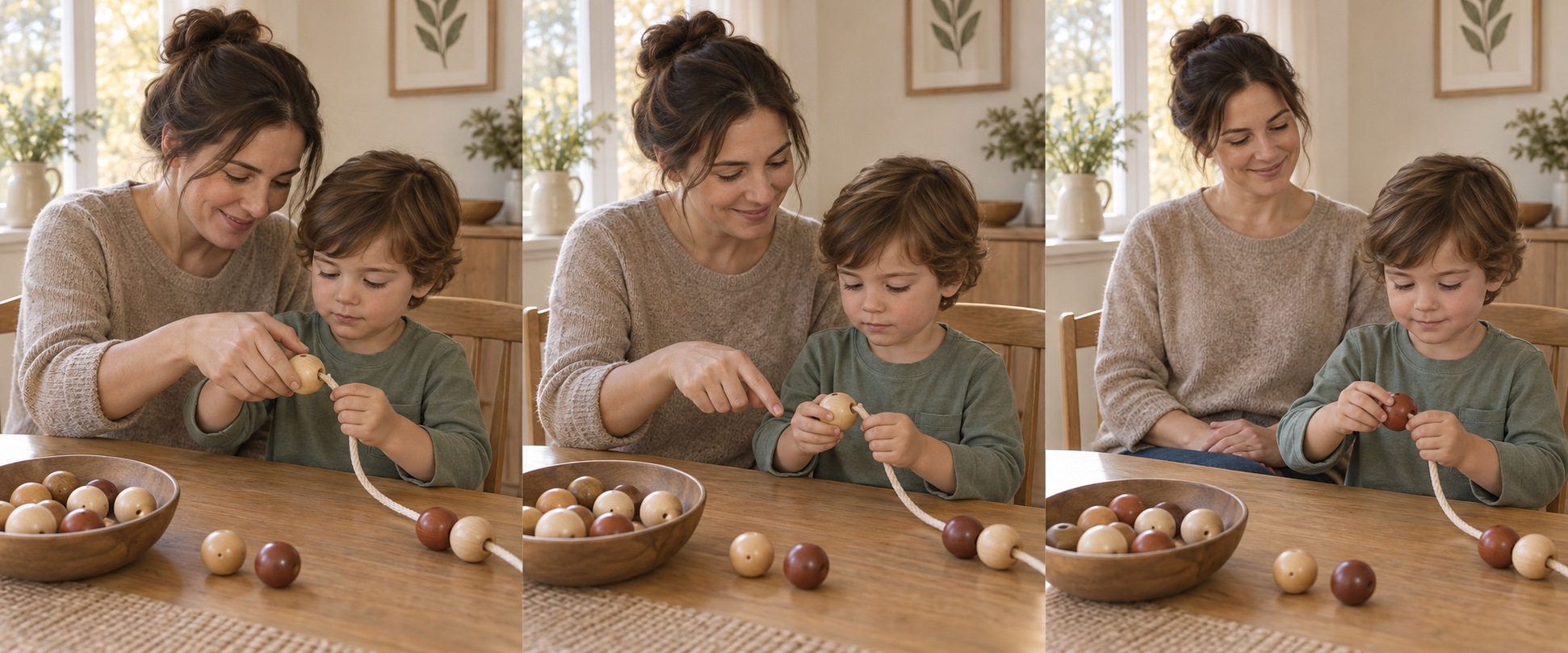
A well-matched scaffold often looks modest: one brief clue, followed by your child’s work. Watch the participation rather than the finished product.
Use less help when your child is taking over
- Your child starts before you give the usual prompt.
- The attempt changes in a useful way after a small clue.
- Your child completes the important part while you only steady or position something.
- Your child repeats the action independently in a later moment.
Fade one element at a time. If you have been holding the container and pointing to it, stop pointing but continue holding. Removing every support at once can make it difficult to tell which part was helping.
Use more help when the next step is still hidden
- Your child remains interested but cannot work out how to begin.
- The same unsuccessful motion continues without providing new information and frustration is rising.
- The materials demand several actions at once, such as holding, aligning, and pushing.
- Your instruction contains more than one step and your child loses track partway through.
Instead of taking over, shrink the task. Stabilize one object, remove extra choices, complete an unrelated part, or model the missing action once. If your child succeeds only while you direct every movement, your support is probably doing too much of the learning. Hand back one meaningful decision or action.
Stop treating the moment as practice when it is no longer one
A child who is tired, hungry, overstimulated, uncomfortable, or deeply upset may need more help than on another day. That is responsiveness, not lost progress. Complete necessary care, offer comfort, or leave the activity for later.
Safety also changes the goal. Near traffic, hot objects, water, stairs, or an elevated changing surface, take control rather than waiting for an independent attempt. Save experimentation for a low-risk setting where a missed step will not cause harm.
Scaffolding is a teaching approach, not a way to determine whether development is on track. If you are concerned about how your child moves, communicates, hears, sees, or engages across different situations, note the specific behaviours you observe and discuss them with your child’s health-care professional or a qualified early-childhood professional.
Choose one recurring moment to try this in: one sleeve, one toy going into a bin, one reach during play, or one turn in a simple back-and-forth exchange. Decide which small part belongs to your child, offer the lightest clue that makes it reachable, and remove a little help as soon as you can. That small handoff is where the practice happens.
References




