
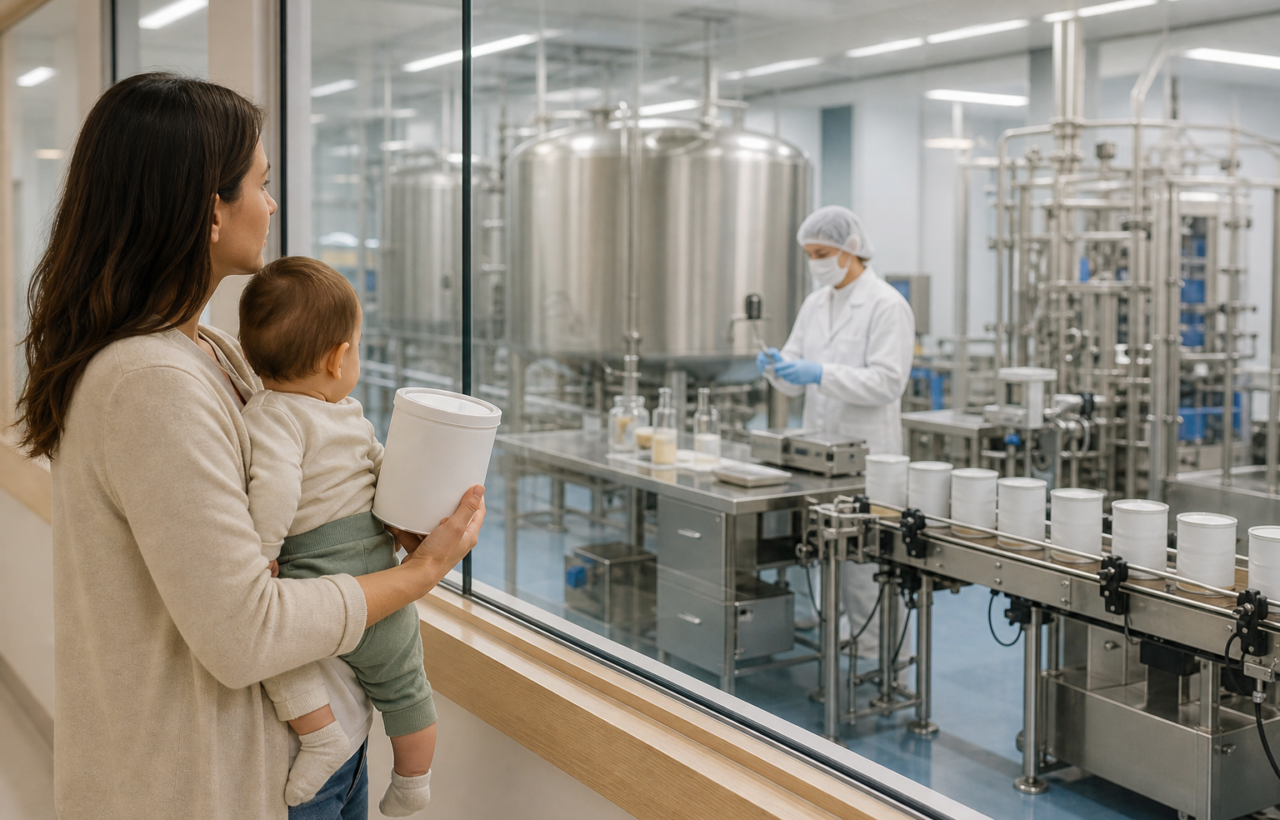
Choosing infant formula is often framed as an ingredient decision. The hibobbie Blog source article makes a broader point: parents may also want to understand how formula is manufactured, tested, packaged and moved before it reaches a home.
This matters because formula is used during a sensitive stage of feeding and development, and many families rely on it either fully or alongside breast milk. The source focuses on Bobbie’s U.S. manufacturing model, while also describing wider pressures in the American infant formula supply chain.
Why Manufacturing Has Become Part Of The Formula Conversation
According to the source, more than 80% of infants in the United States receive formula at some point during their first year. That includes babies who are exclusively formula-fed, babies who receive both breast milk and formula, and babies whose feeding routine changes over time.
The same article reports that the U.S. powdered formula market has historically been concentrated among brands tied to Abbott Laboratories, Perrigo and Mead Johnson Nutrition, which it says have supplied 80% to 90% of powdered formula nationwide. Concentration can make large-scale production efficient, but the source argues it can also make the system vulnerable when a problem affects a major facility.
The 2022 Abbott recall and related formula shortage is presented in the source as an example of how facility-level disruption can affect families far beyond one local market. For parents, the practical takeaway is not that one format or brand is automatically best, but that manufacturing oversight, supply chain design and traceability are worth understanding.
What Parents Can Ask About A Formula Supply Chain
Infant formula manufacturing is not just a single blending step. In general terms, a product may involve ingredient sourcing, quality checks, mixing, processing, packaging, storage and distribution. The more places a product moves through, the more coordination is required to maintain consistency and documentation.
The source contrasts traditional multi-location production with Bobbie’s stated approach, in which ingredient storage, formula manufacturing, canning and packaging happen at one Ohio facility. Hibobbie Blog describes this as a way to reduce handoffs and keep more of the process under direct oversight.
For a parent comparing formulas, useful questions may include:
- Where is the formula manufactured?
- Are major production steps handled in one facility or across multiple locations?
- How are ingredients checked before production begins?
- What testing happens during production and after a batch is complete?
- Can families access batch-level or product-level transparency information?
What The Source Reports About Bobbie’s Model
Hibobbie Blog says Bobbie manufactures its infant formula in a fully integrated facility in Ohio. The article describes the site as built for infant nutrition and says the company keeps ingredient storage, blending, canning, packaging and storage readiness within the same operation.
The source also says Bobbie performs more than 2,000 safety and quality checks on every batch. It reports that testing covers nutrient accuracy, contaminants and microbiological safety, and that quality checks occur throughout production rather than only at the end.
On ingredients, the article says Bobbie uses organic lactose as the primary carbohydrate, added whey protein, and DHA at 20 mg per 100 kcal, a level the source says is aligned with European nutritional guidelines. It also says organic ingredients, including grass-fed milk, are sourced and tested before production.
Regulation Sets The Floor, Process Choices Still Matter
All infant formula sold in the United States is regulated by the Food and Drug Administration, according to the source. The article says these rules cover nutrient requirements, safety, sanitation, testing and labeling. It also states that Bobbie’s manufacturing facility is FDA-registered and operates according to Current Good Manufacturing Practices, or cGMPs.
That regulatory baseline is important, but it does not mean every company organizes manufacturing in the same way. Facility design, monitoring systems, documentation practices and the number of production handoffs can differ. Those choices may affect how easily a company can trace a batch, investigate an issue or explain its process to families.
The source also notes the common formula formats families may encounter: powdered formula mixed with water, liquid concentrate diluted before feeding, and ready-to-feed liquid formula. Some babies may need specialty formulas based on medical guidance, so parents should involve a pediatric provider when feeding needs are complex.
Key Takeaways
- Formula choice can involve more than ingredients; manufacturing, testing and traceability also matter.
- According to hibobbie Blog, Bobbie makes formula in an Ohio facility where major production steps happen under one roof.
- The source reports more than 2,000 safety and quality checks per Bobbie batch.
- FDA regulation applies to infant formula sold in the United States, but companies can still differ in how they manage oversight and transparency.
Reading Formula Claims With A Practical Eye
The most useful formula information is specific enough to be evaluated. A broad claim about quality is less helpful than a clear explanation of where production happens, what is tested, when testing occurs and how results are documented.
The hibobbie Blog article presents Bobbie’s integrated Ohio facility as a transparency and control advantage. Parents do not need to become manufacturing experts, but asking better questions about the process behind the can can make formula decisions clearer, especially when reliability and safety are central concerns.
Inspired by this post on hibobbie Blog.