
If the toys are everywhere, the diaper basket is empty, and getting out the door requires a string of negotiations, a tighter schedule probably won’t fix the problem. You need fewer things to remember and fewer moments when your baby or toddler has to cooperate perfectly.
The useful distinction is simple: organize the adult work, not the child. Keep safety, supplies, and handoffs predictable. Let play, clothing, activity choices, and the appearance of the room carry much less pressure.
Give structure only to the things that carry consequences
Not every preference deserves to become a rule. When everything is treated as equally important, you spend the day correcting small things and have less patience for the limits that really matter.
Sort your expectations into three practical groups:
- Hold the boundary: supervision, safe sleep, allergies, medication instructions, food safety, car-seat use, gates, locked hazards, and any care directions specific to your child.
- Create a predictable path: diaper changes, meals or milk, naps, leaving the house, bath time, and caregiver handoffs. The sequence can be familiar even when the clock changes.
- Leave room for choice: which suitable outfit to wear, which book to read, how to play, whether an optional activity gets finished, and whether the play area looks polished in the middle of the day.
This separation matters if you naturally like an orderly home. An adult can care deeply about tidy counters and still leave a child’s clothes, room, and interests relatively uncurated. Your preference for visual order can be handled through storage and resets rather than constant correction.
If another person provides care, put the consequential information on a short handoff card. Include the child’s current eating and sleep pattern, recognizable hunger and tiredness cues, allergies, comfort strategies, emergency contacts, and any firm household boundaries. Record medication authorization, dose, and time exactly when relevant; a caregiver should never have to reconstruct that information from memory.
Keep the card limited to what changes care. A long document full of preferences makes the critical details harder to find. Matching socks and the ideal order of toys do not belong beside allergy information.
Make the room carry more of the mental load
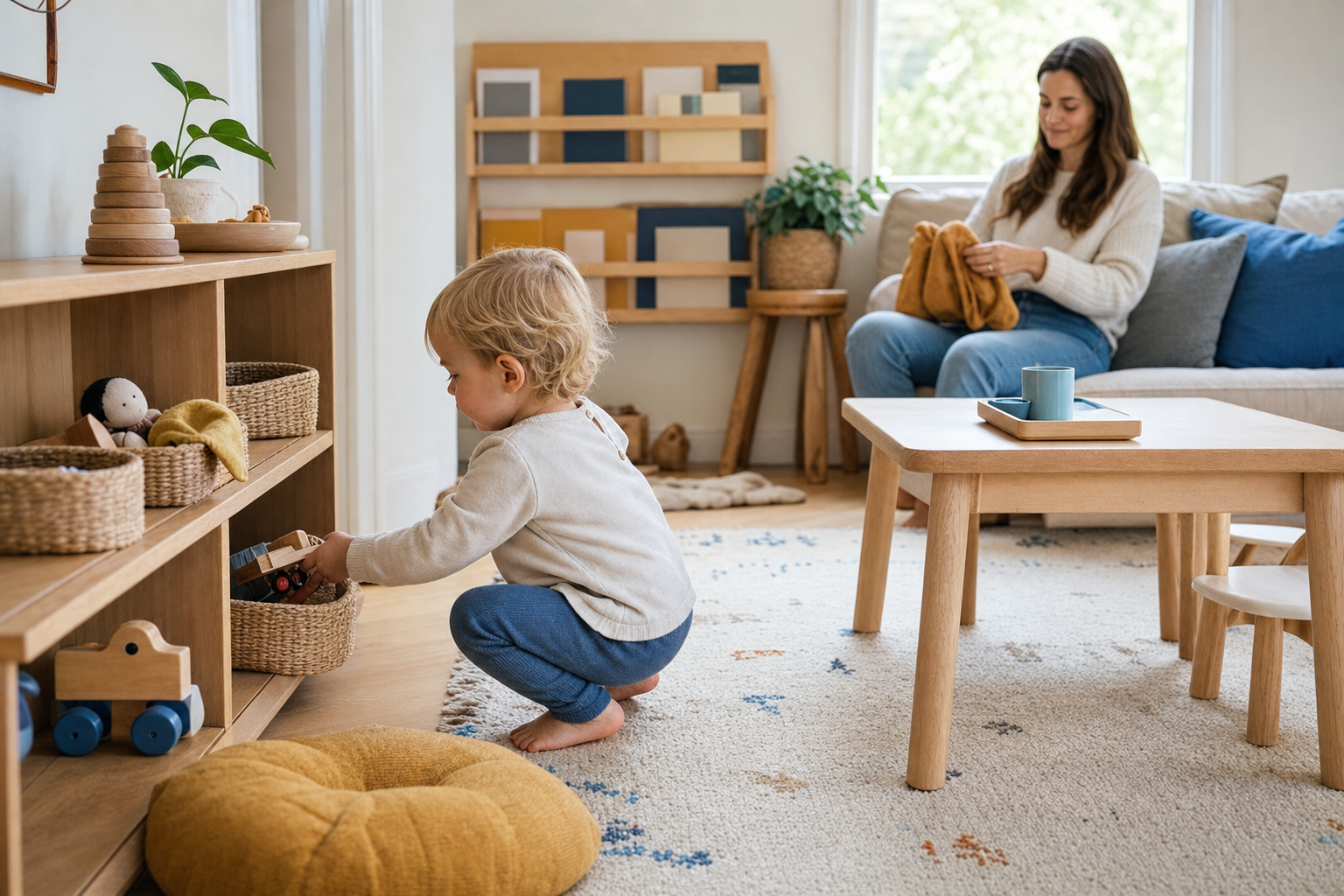
A useful childcare setup lets you complete ordinary care without searching, remembering, or crossing the room repeatedly. You do not need matching containers. You need clear homes for the objects used at predictable moments.
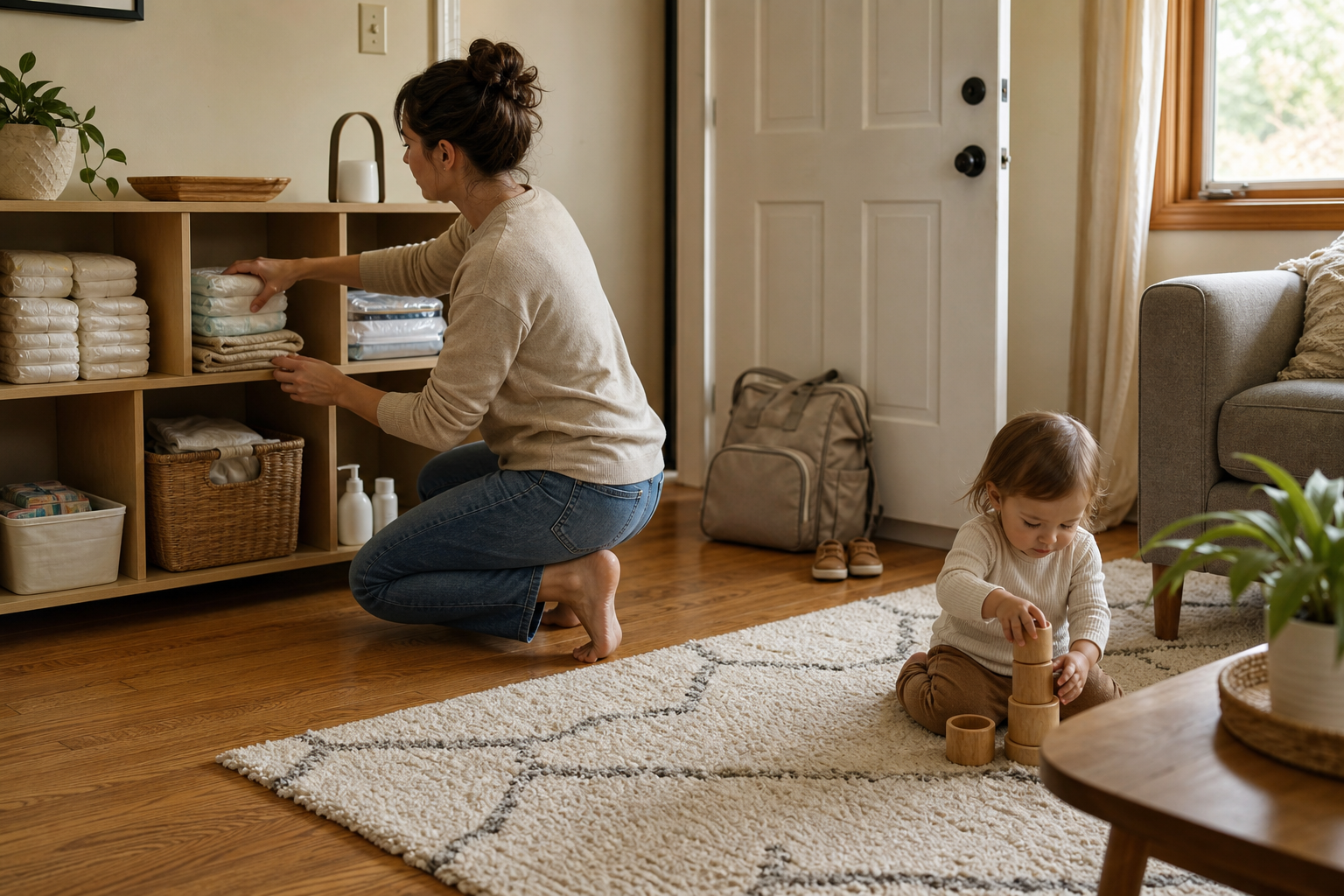
- Care station: Keep the supplies for routine care together and within the caregiver’s reach, while keeping medicines, creams, cords, plastic bags, and other hazards inaccessible to the child. Prepare changing supplies before placing a baby on the changing surface.
- Exit station: Give the diaper bag, weather gear, carrier, and other regular outing items a fixed landing place near the door. Return them there after each outing, even if the rest of the room remains messy.
- Reset basket: Put misplaced objects into a single basket instead of leaving the child repeatedly to return every item. Empty it at a natural handoff, such as after bedtime or before the next caregiver takes over.
- Usable play area: Keep a small selection of developmentally appropriate objects accessible and store the rest. The goal is not a display; it is a floor area where the child can see what is available and begin.
Reset in order of consequence. Remove food, cups, and hazards first. Restock care supplies next. Prepare the clothing or outing items needed for the next transition. Clear enough floor for safe movement. Then stop. Folding every piece of laundry and arranging every toy is a separate household project, not a condition of adequate childcare.
An older toddler can help drop large toys into a basket or carry clothes to a hamper. Treat that as participation, not a test. If the child loses interest, finish the necessary part without turning cleanup into the day’s final battle.
Use tiny choices and play to soften necessary transitions

Young children cannot choose whether every care task happens, but they can sometimes choose how they move through it. Offer control inside the boundary: the blue pajamas or the striped pajamas, the animal book or the vehicle book, walking to the bathroom or being carried.
The choice must be real and manageable. Do not offer an option you cannot accept, and do not keep adding alternatives after the child rejects the available ones. Calmly name what is happening next and help when help is needed.
A small imaginary frame can also change the tone. A pajama fashion show can carry brushing, combing, and getting dressed toward bedtime without adding a prize. A stuffed bear can hop toward the bath. A toddler can stomp like a dinosaur to the door. The story is a bridge into the task, not a reward for obedience.
- For a baby: Use a consistent short phrase, show the next familiar object, and provide the physical help the child needs. Predictability is more useful than a verbal choice the baby cannot yet understand.
- For a child beginning to choose: Hold up two acceptable items and pause. If choosing becomes frustrating, choose gently and continue.
- For an imaginative toddler: Add a character, sound, or pretend mission to a transition that commonly stalls.
You do not need to turn every diaper change or departure into a performance. Save playful prompts for the transitions where they genuinely reduce friction. If the game makes the child more excited, distracted, or distressed, drop it and return to a short, clear sequence.
Play should not be used to push past pain, fear, illness, or an unmet physical need. When resistance is unusual or intense, first check the practical causes: discomfort, hunger, fatigue, temperature, an unfamiliar caregiver, or a task that is moving too quickly. At meals, keep imagination separate from pressure to take another bite.
Set up an invitation to play, not a planned performance
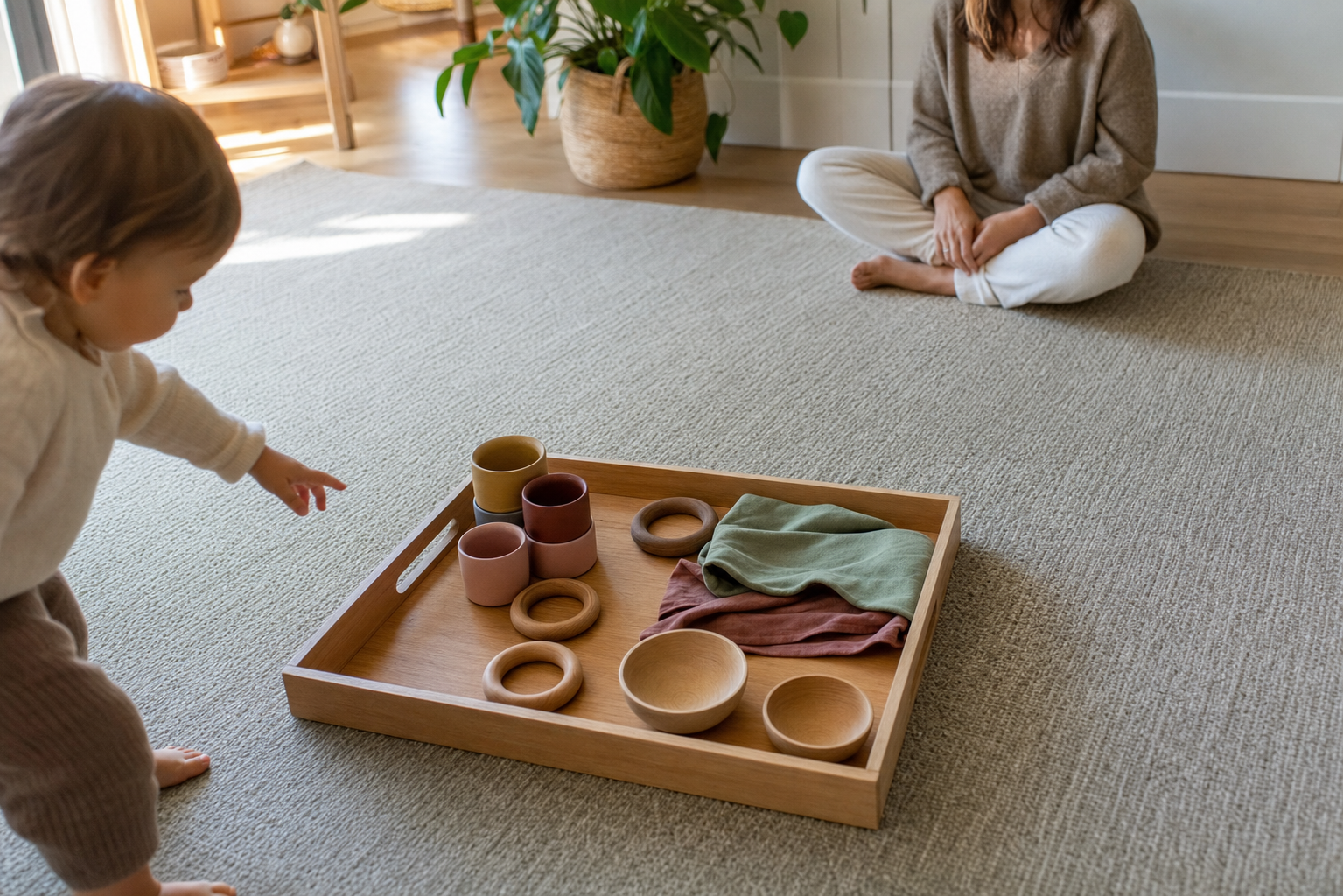
You do not have to entertain a child continuously or prepare a polished activity. Often, a few open-ended objects and a starting action are enough. Materials such as blocks can remain interesting because the child decides what they become instead of following a single built-in purpose.
Build a low-lift play invitation like this:
- Clear a safe patch of floor or a low surface.
- Place a few age-appropriate, open-ended objects where the child can see them.
- Demonstrate one simple action, such as putting a cup inside another or moving a block into a container.
- Add a brief prompt if the child understands it: make a home, fill the truck, or help the toy get to bed.
- Stay close enough to supervise, but leave room for the child to change the idea.
For a baby, this might mean age-rated stacking cups or large blocks and a container. For a younger toddler, it could be large blocks, toy animals, or cups to fill and empty. An older toddler might turn a large clean cardboard box, with staples and loose tape removed, into a bed for a stuffed animal.
Household and recycling materials require extra judgment with children under three. Skip anything small enough to enter the mouth, anything sharp or breakable, containers with residue, loose caps, plastic film, long cords, magnets, batteries, or materials that shed pieces. If your child mouths objects, use age-rated play materials intended for that stage instead. Open-ended does not mean unsupervised or improvised without a safety check.
Do not measure success by how long the child plays alone. A baby may explore while you sit beside them, and a toddler may invite you into the story. The useful win is that you supplied a manageable beginning without scripting the entire experience or judging the result.
Key takeaways
- Organize supplies, safety information, and caregiver handoffs before trying to organize your child’s behaviour.
- Keep firm boundaries for safety and essential care; use flexible sequences for routines and genuine choices for low-stakes details.
- Reset the room by consequence: hazards first, care supplies second, the next transition third, and cosmetic tidying only if you still have capacity.
- Use a small choice or playful character to begin a difficult transition, then calmly help if the prompt does not work.
- Offer a few age-safe, open-ended materials instead of planning elaborate entertainment or expecting a finished product.
Start with the transition that drains you most. Put its supplies in one place, decide which part is non-negotiable, prepare one acceptable choice, and choose a short cue you can repeat. Leave the rest of the system alone until that small routine feels ordinary. Low-pressure organization works when it gives you less to police and gives your child more room to be a child.
References
- Scary Mommy – I’m A Type C Mom And Proud Of It
- Scary Mommy – Chelsea Anderson Is The Michael Jordan Of Babysitting For A Reason