

If you are deciding whether to bring a baby or toddler to Denver’s Molly Brown House Museum, the shortest useful answer is this: it can work as an adult or older-sibling outing with a very young child along, but it is not designed as a toddler-first attraction.
The house offers hands-on family materials, self-guided exploration and useful accessibility features. It is also a delicate historic home that is not recommended for children under six. Before adding it to your day, look honestly at your child’s current stage and decide what would make the visit worthwhile for your family.
Make the under-six recommendation your first filter
The museum is not recommended for children under six because of the home’s delicate nature, although parents are allowed to use their discretion. That is not the same as an age ban, but it should shape your expectations. You will be supervising your child inside a preserved Victorian home, not entering a children’s museum where every surface is meant for play.
For families with children from birth to age three, it helps to think about the visit by stage:
- Birth to roughly 12 months: The exhibits will be for you, not the baby. A visit may be manageable if you confirm your equipment options in advance and are comfortable stepping out whenever your baby needs a break.
- Roughly 12 to 24 months: This is often the hardest stage for a delicate-house visit. A newly mobile toddler who wants to walk, grab and investigate may find the museum’s boundaries frustrating. Waiting is likely to be the easier choice unless another adult can help and leaving early would not spoil the day.
- Roughly 24 to 36 months: Consider whether your child can stay beside you, respond to a simple hands-off instruction and move through indoor rooms without running. The family activities may hold their attention briefly, but the under-six recommendation still applies.
Age is only a rough filter. Readiness matters more. If your toddler cannot yet distinguish between an object offered for touching and an artifact that must be left alone, this probably is not the right museum for them yet. In a family with an older Titanic enthusiast, another workable option is to divide temporarily: one adult explores with the older child while the other takes the toddler outside.
Know what children can touch before you enter
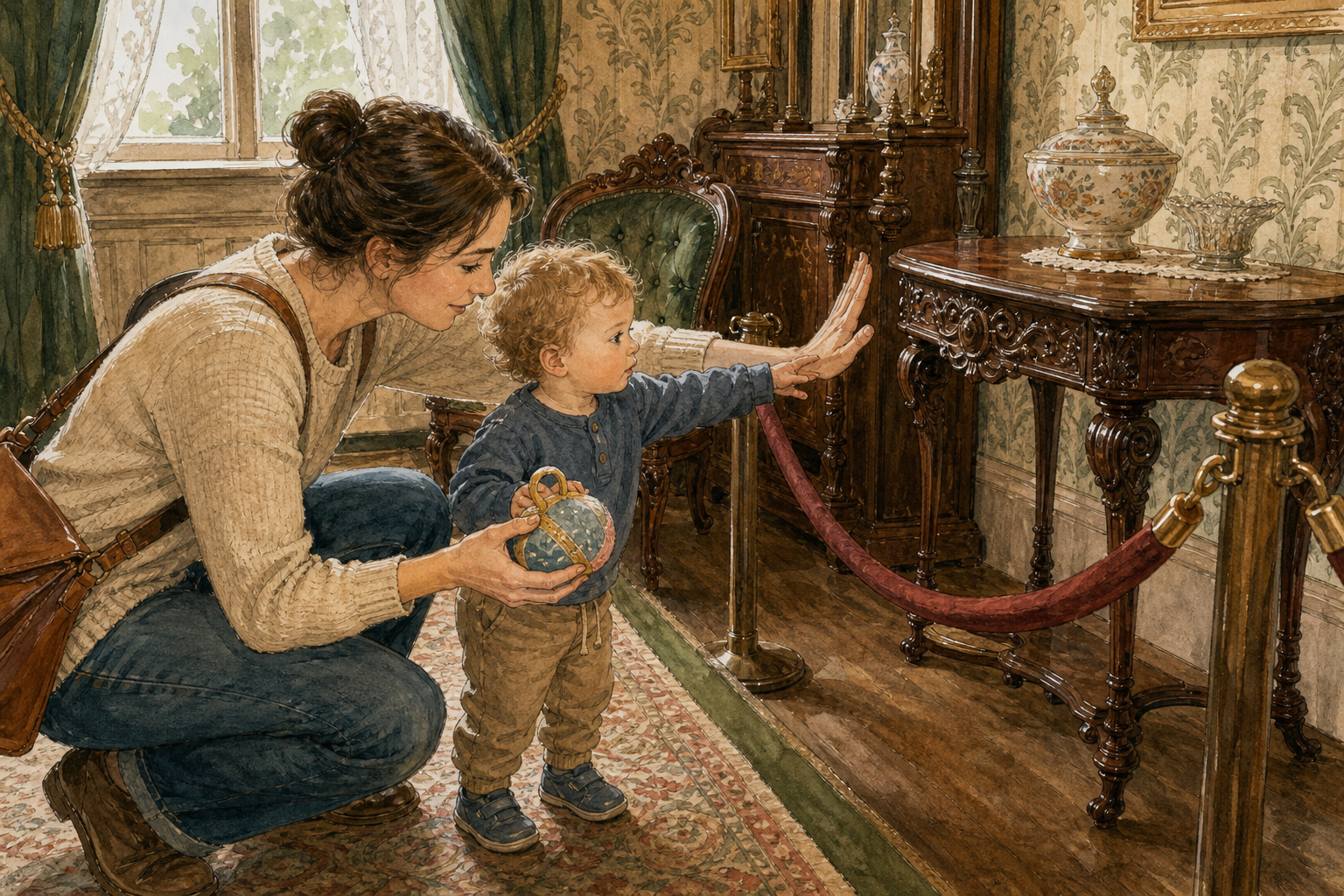
Some areas and objects are off-limits, but the museum provides family baskets with bilingual activity sheets and tactile materials, including textiles, family photographs and stuffed toys. Treat those materials as the clear invitation to touch. Do not assume that an interactive element in one room makes nearby furnishings available for little hands.
The self-guided family format is the strongest option for a child under three because it lets you move at your child’s pace. A guided tour may offer more depth for an older child, but it also asks everyone to follow someone else’s timing. With a toddler, the freedom to shorten a room, pause at a basket or head for the exit is more valuable than completing every part of the interpretation.
If an older sibling is fascinated by the Titanic, the dedicated room is likely to be the main reason to visit. It contains one of fewer than 10 surviving letters written on Titanic letterhead, along with a dice-based survival activity using passenger-class cards. Those features can open a thoughtful conversation with a school-age child about privilege and human behaviour during a disaster. A baby or toddler, however, will need something immediate and tactile, so use the family basket rather than expecting the historical story to carry their attention.
The free Bloomberg Connects app can provide additional material. If an adult in your group wants to use it, download it before the outing so arrival time is not spent setting up a phone while someone else manages the children.
Confirm the practical details the access description does not answer

The property is a 7,500-square-foot Victorian house rather than a purpose-built modern museum. Its documented access features are specific: the main floor accommodates mobility devices, a lift reaches the lower level, and a video tour with information cards covers the upstairs for visitors who cannot access it. Family-friendly restrooms and water fountains are also available.
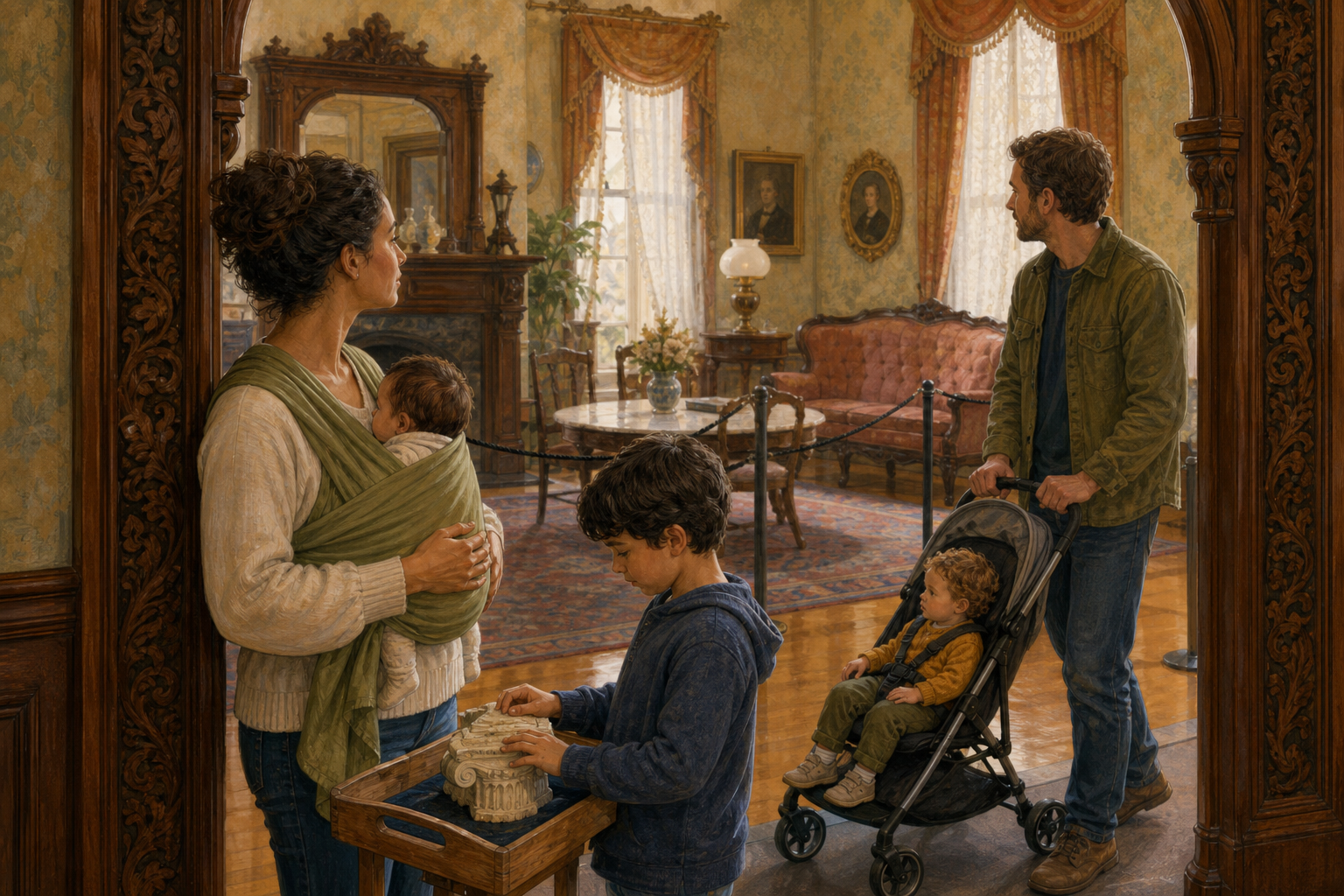
Those details do not confirm that a stroller or child carrier may be used throughout the house. They also do not establish whether there is a changing table, a feeding space or somewhere to store bulky baby gear. Ask the museum directly about the facilities and equipment your family needs before travelling there. Mobility access and stroller permission are separate questions at many historic properties.
A simple plan will reduce the amount of negotiation you have to do inside:
- Confirm current opening hours, admission arrangements and the policy for your stroller or child carrier.
- Choose the self-guided family option if you need control over pace and departure time.
- Explain the touching rule immediately before entering, not earlier in the day when it is still abstract.
- Ask for the family materials and make those the objects your child is encouraged to investigate.
- Let one adult concentrate on the child while another reads or uses the app, then switch roles if needed.
- Leave when supervision becomes a struggle. Finishing the house is not worth turning the last rooms into a contest with an overtired toddler.
Decide whether the history is enough to justify the logistics
The visit offers much more than a connection to the Titanic. Margaret Brown used her family’s wealth to support causes that included women’s suffrage, miners’ rights, a local animal rescue and the construction of Denver’s Cathedral Basilica of the Immaculate Conception. Inside the home, gold details, original light fixtures, restored crystal windows, an ornate oak staircase and creaking hardwood floors help make her period tangible.
That combination can make the museum a rewarding stop for adults and older children. It does not turn the house into an activity centre for a two-year-old. If your main goal is to give your toddler a place to move and play, choose a different destination. If your goal is to see the house or give an older sibling meaningful Titanic history, a short self-guided visit with an easy exit can still make sense.
Build an outdoor reset into the plan instead of following the museum with another structured indoor stop. The house is about two and a half blocks from the Colorado State Capitol, and the surrounding neighbourhood can become a short walk after the visit. If you have a car and want a larger second outing, Red Rocks Amphitheatre is roughly 15 miles southwest of Denver; it is free to visit, has restrooms and is surrounded by trails. Check its event schedule before making the drive.
Quick answers for parents of young children
Are babies and toddlers allowed in the Molly Brown House Museum?
Parents may use their discretion, but the museum is not recommended for children under six because the historic home is delicate. Treat that as a meaningful suitability warning rather than a routine disclaimer.
Can a toddler touch anything inside?
Yes, but only where interaction is invited. Family baskets contain touchable materials such as textiles, photographs and stuffed toys. Other areas and artifacts remain off-limits.
Is the entire house accessible without using stairs?
No. The main floor accommodates mobility devices, and a lift serves the lower level. Visitors who cannot reach the upstairs can use a video tour and information cards instead.
Is it worth visiting with a toddler and an older Titanic fan?
It can be, especially if two adults can divide responsibilities. Use the self-guided format, prioritize the older child’s interests and accept that the toddler may need to leave before everyone else is finished.
Before putting the museum on your itinerary, decide who the visit is mainly for. If an adult or older child is excited about the house and you can give your toddler a flexible, quick exit, confirm the practical policies and go self-guided. If the whole outing depends on your child under three being entertained by the museum itself, save it for a later Denver trip.