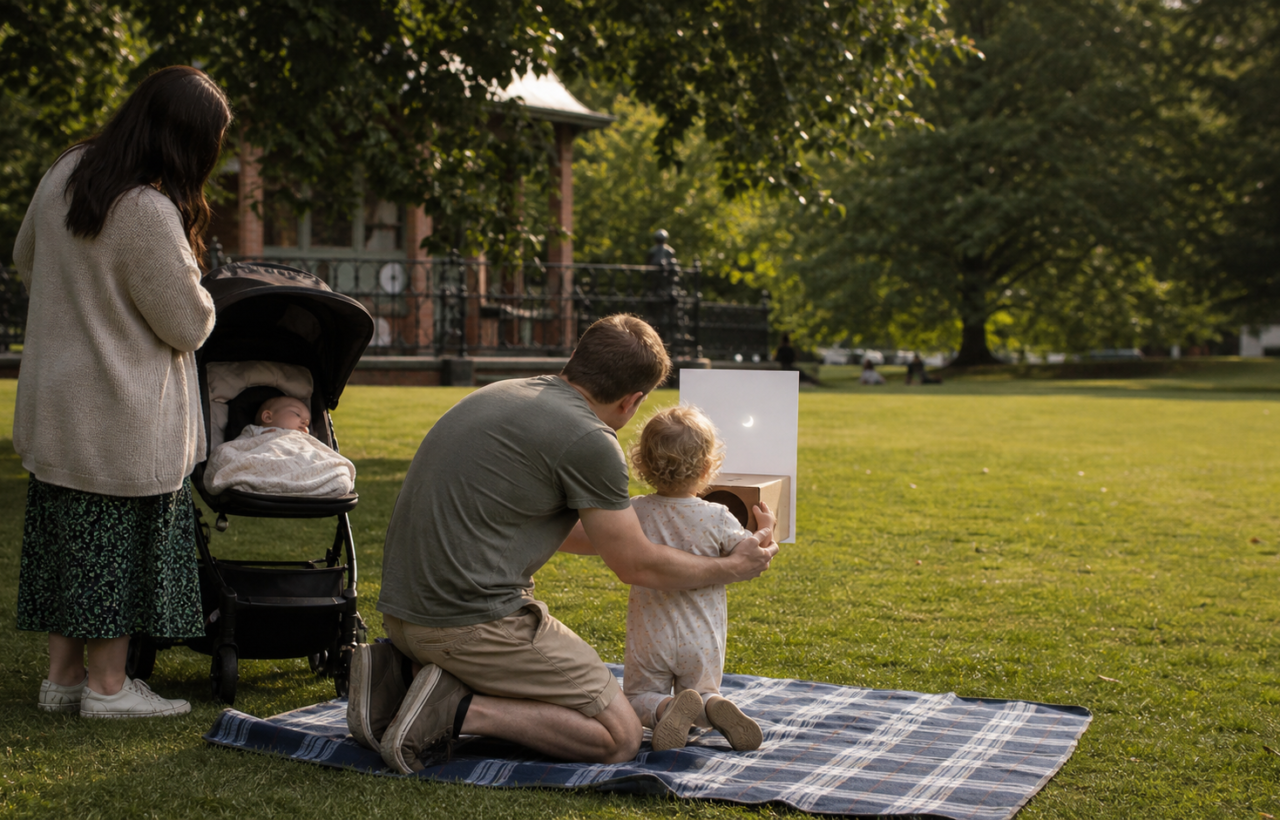
On 12 August 2026, families across the UK will have a chance to see a partial solar eclipse. If you will have a baby or toddler with you, the safest plan is not simply to buy small eclipse glasses and hope they stay on.
Choose a viewing method your child cannot accidentally defeat. For most under-threes, that means watching a projected image instead of looking towards the Sun. You can still make the eclipse feel special without asking a young child to manage equipment beyond their developmental stage.
Choose the method by ability, not just age
“Partial” describes how much of the Sun is covered. It does not mean that a quick unprotected look is safe. The uncovered part remains intensely bright, so every direct glance needs proper solar viewing protection.
A child’s ability to follow the viewing routine matters more than whether they are one, two or nearly three. Use these practical distinctions:
- For a baby: plan indirect viewing for the family. Keep the baby comfortably shaded and positioned away from the Sun while adults take turns looking. A pram hood can provide ordinary shade, but it is not a solar filter.
- For a mobile toddler who grabs or removes things: make projection the default. They can watch the eclipse appear on a card while keeping their eyes down.
- For an older toddler who follows instructions reliably: direct viewing may be possible with genuine eclipse viewers made for looking at the Sun, but only with an adult beside them and fully focused on correct use.
- For a child who lifts, loosens or peers around the viewer: stop direct viewing immediately and return to projection. This is not a skill to practise while facing the Sun.
If you are the only adult with an active toddler, projection is the more manageable choice. It lets you supervise the child without trying to protect their eyes, control their hands and take your own look at the same moment.
Use a method that keeps unfiltered sunlight out of their eyes
If your child will use an eclipse viewer
Buy purpose-made solar eclipse viewers from a reputable supplier and retain their instructions. Inspect them before the event. Do not use a viewer that is torn, scratched, punctured, coming apart or too loose to stay in the correct position.
Rehearse the sequence indoors: viewer securely in place before the child turns towards the Sun; eyes turned away or down before the viewer comes off. Use the same short words on the day: “Glasses on, then look up. Eyes down, then glasses off.”
- Do not substitute ordinary sunglasses, even very dark ones.
- Do not improvise with smoked glass, coloured plastic, sweet wrappers or homemade filters.
- Do not let a child look at the Sun through binoculars, a telescope or a camera. Optical devices concentrate sunlight and require correctly fitted specialist solar equipment.
- Do not place eclipse glasses between an eye and binoculars or a telescope. The glasses are not designed to handle concentrated light from an optical instrument.
- Do not assume thin cloud makes direct viewing safe. If the Sun is visible through the cloud, continue using the safe method you planned.
If specialist optical equipment is not already familiar to you, leave it at home. A first eclipse with a toddler is not the right setting in which to learn solar telescope setup while also supervising small hands.
Make a simple pinhole projector
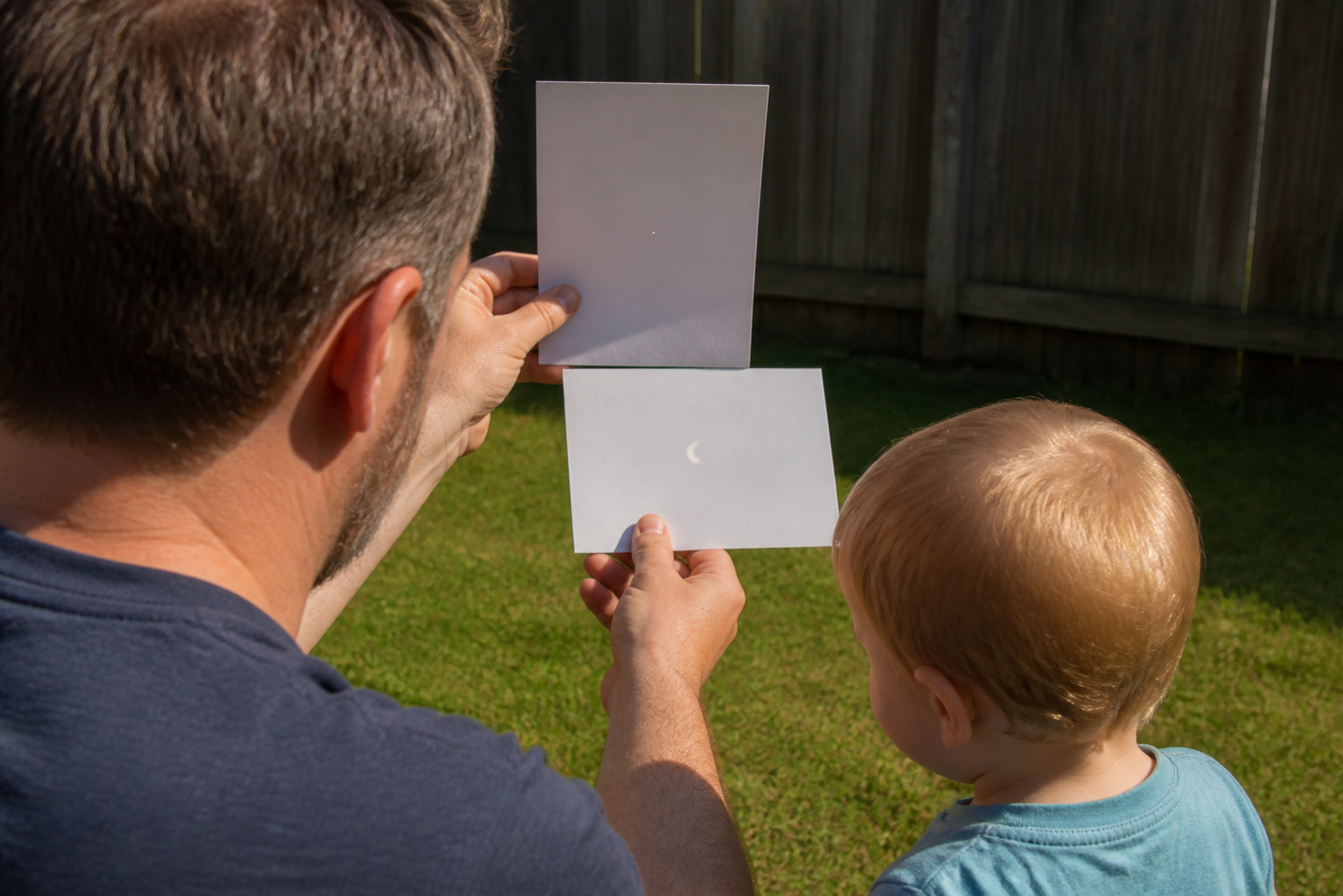
Projection is useful because nobody needs to face the Sun. You need two pieces of light-coloured card and something that can make a small, clean hole.
- Make a small pinhole in the centre of one card.
- Stand with your back to the Sun. Hold the card with the hole above your shoulder so sunlight passes through it.
- Hold or place the second card in the patch of light behind the first. Move the cards nearer or farther apart until the projected image is clear.
- Watch the image on the second card as its shape changes. Never look through the pinhole towards the Sun.
Test the setup before your child joins you so you are not troubleshooting while they wait. An adult should control the card with the hole; a toddler can point to the projected shape, describe it or help draw what they see on a separate sheet of paper.
Plan the outing around your child’s routine
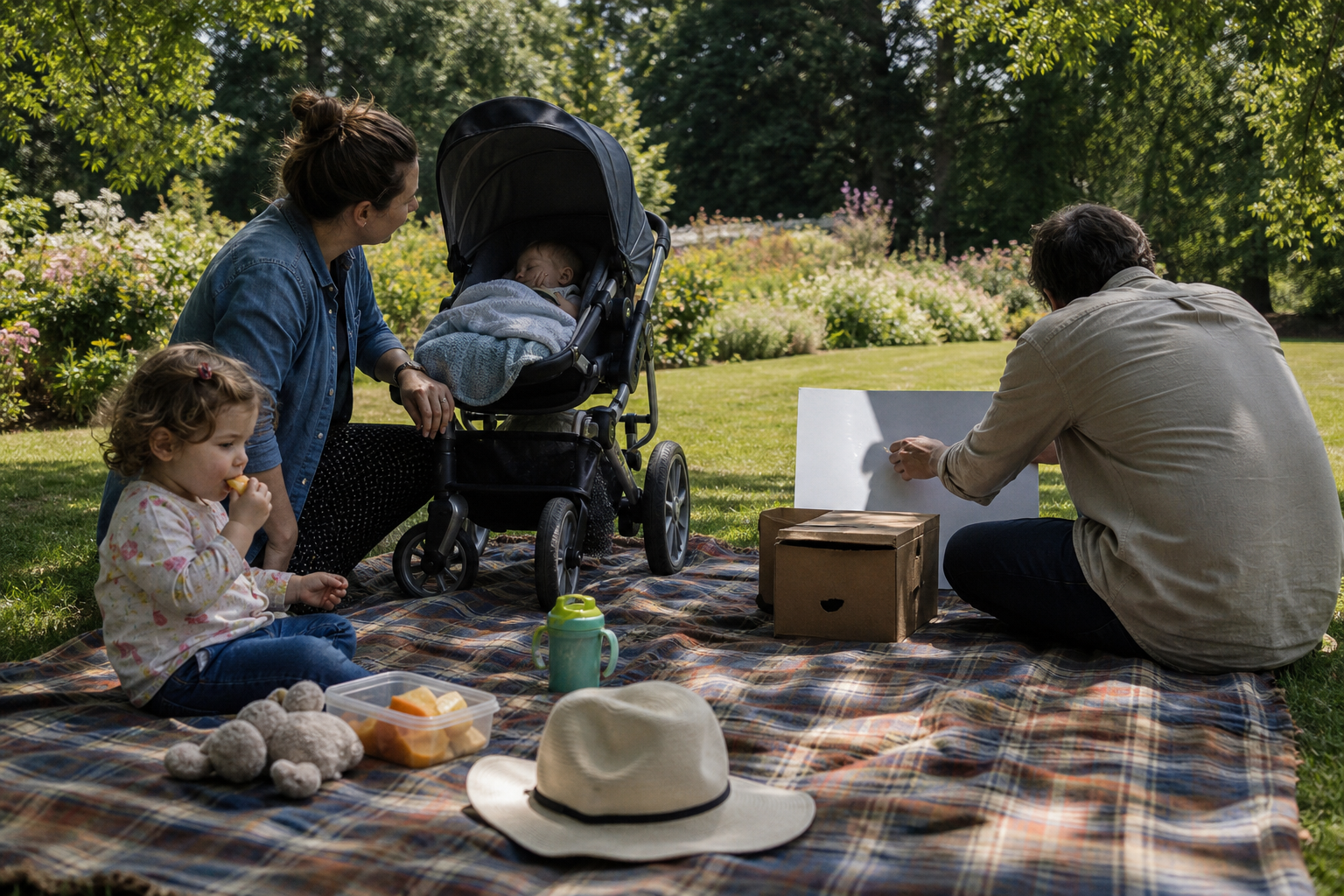
The exact viewing time and appearance will depend on where you are in the UK. Check the local start and end times from a trustworthy astronomy service closer to the date, then fit your plan around naps, feeds and the journey home. There is no benefit in keeping an overtired child outside for every stage.
Give each adult one job before anyone looks up. One person controls the viewers or projector. One person stays within reach of the child. If you have a baby as well as a toddler, decide who remains responsible for the baby while another adult views the eclipse. Taking turns is safer than everyone trying to watch at once.
- Choose a place where you can see the sky without standing beside traffic, open water or another hazard that requires competing supervision.
- Keep eclipse viewers put away until an adult is ready to control them. Inspect them again before use.
- Bring the same shade, drinks, food, nappies and spare clothing you would take on an ordinary outdoor family trip.
- Keep the plan brief enough that leaving early does not feel like failure.
- Have an indoor livestream ready as the backup for cloud, a disrupted nap or a child who wants to go home.
A partial eclipse may not turn the day dramatically dark where you are. Avoid promising a particular visual effect. Tell a toddler something concrete instead: the Moon will move between Earth and the Sun, and you are going to watch the Sun’s projected shape change on the card.
Make the experience work even if your child will not look
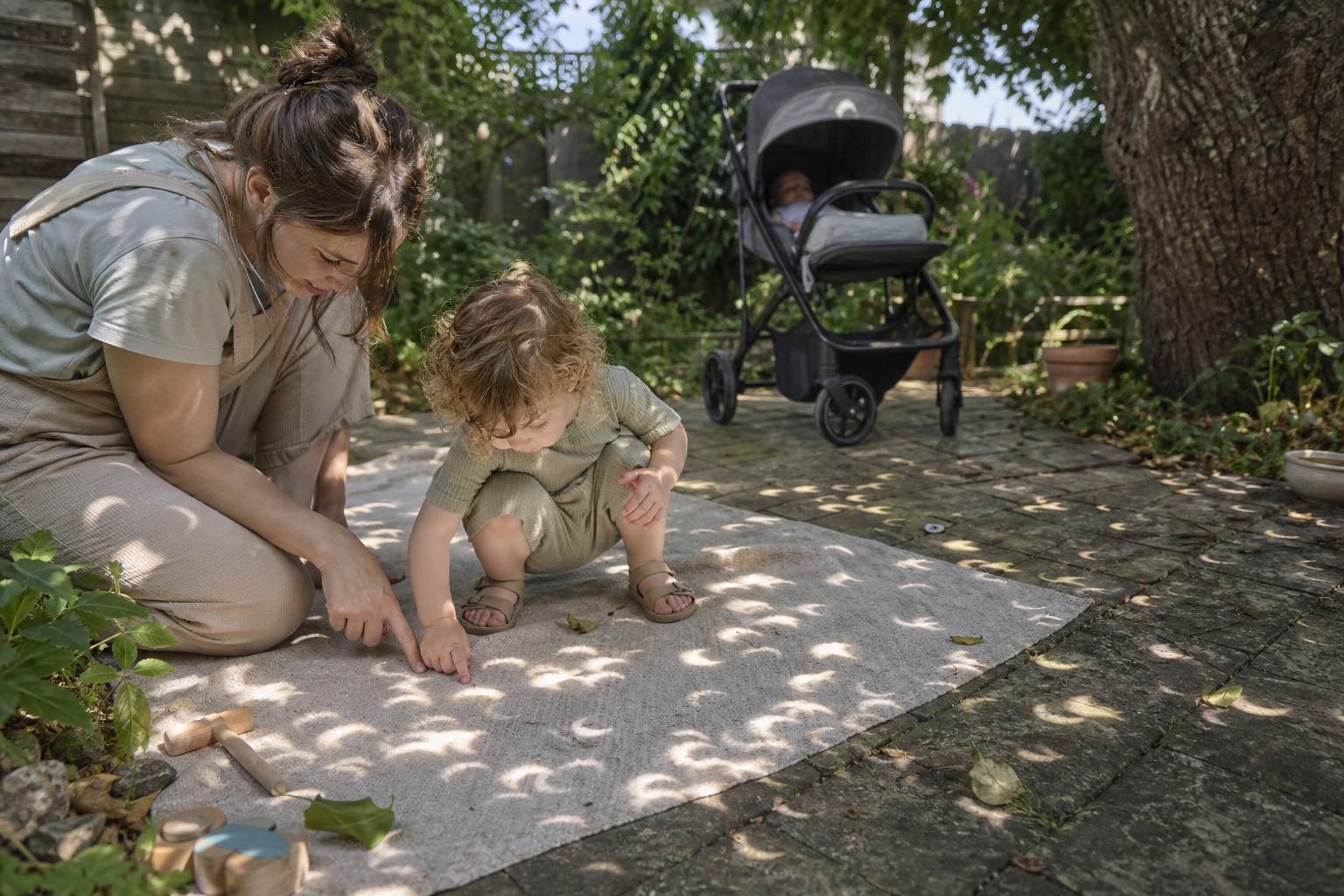
A baby does not need to see the eclipse directly to be part of the occasion. They can stay shaded while you narrate what is happening, take a family photograph facing away from the Sun, or look at the projected image with you. The memory belongs to the family even if the baby sleeps through it.
With a toddler, keep the activity physical and simple. Ask them to find the bright shape on the projection card, trace its outline on another page, or notice how several small holes can create several projected images. Repeat one safety rule consistently: “We look at the card, not at the Sun.”
If your child refuses the viewer, will not stay beside you or keeps trying to look around the equipment, end their outdoor viewing. Move indoors, use a livestream or let another adult watch while you take the child elsewhere. Missing part of an eclipse is a small consequence; gambling with eyesight is not.
Key takeaways for eclipse day
- The UK event is on 12 August 2026, with exact local circumstances to be checked nearer the date.
- Projection is the simplest default for babies and toddlers who cannot reliably keep a viewer in place.
- Direct viewing requires undamaged, purpose-made eclipse viewers and uninterrupted adult supervision.
- Ordinary sunglasses, improvised filters and cloud are not eye protection.
- Binoculars, telescopes and cameras need their own correctly fitted specialist solar equipment; eclipse glasses alone do not make those devices safe.
- If your child or the weather changes the plan, watch indoors rather than improvising outside.
Put 12 August in your calendar now. Beside it, write down your viewing method and which adult will supervise the child. Add the exact local timing and forecast closer to the day. If either the safe equipment or the dedicated supervision is missing, use a projected image or watch on a screen.
References