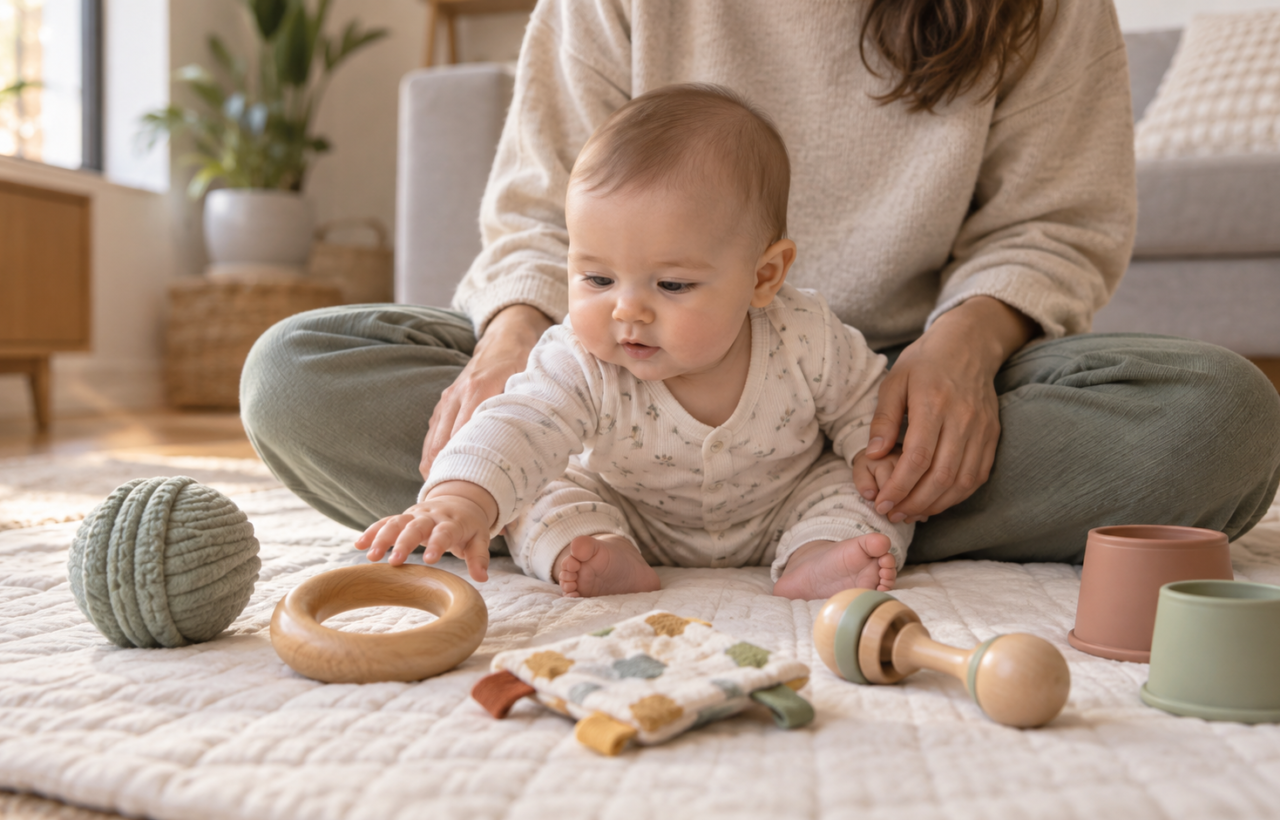
When every toy promises sensory learning, motor development, or early discovery, it is hard to tell which features will actually matter to your six-month-old. The useful question is not how much a toy can do. It is what your baby can do with it.
Look for toys that invite a clear action: reaching, grasping, mouthing, shaking, squeezing, tracking, passing, banging, or knocking something over. A simple toy that your baby can act on repeatedly is usually more useful than an elaborate toy that performs for them.
Start with your baby, not the feature list
At six months, babies do not all have the same skills. Your baby may be reaching accurately but still working on holding an object. They may enjoy tummy time, roll to reach something interesting, sit with support, pass an object between their hands, or explore almost everything with their mouth. Another baby of the same age may engage differently.
That variation matters when you shop. The goal is to meet your baby at the edge of what they can already do, then give them room to practise. Toys can encourage age-appropriate learning through play, but they do not need to push a baby toward the next milestone before they are ready.
Before choosing a toy, use this fit test:
- Your baby can notice it. The toy has a shape, texture, movement, or sound that attracts attention without depending on a complicated display.
- Your baby can act on it. It is manageable enough to touch, hold, mouth, kick, or move using the abilities they have now.
- The action produces a clear result. A shake creates a sound, a squeeze creates a crinkle, a push makes something roll, or a touch reveals a different texture.
- The action can be repeated. Repetition lets your baby explore what happens when they try the same movement again.
- You can adjust the challenge. You can change the toy’s position or orientation without replacing it or turning on another mode.
- Your baby controls the pace. The toy responds to your baby instead of running through a long sequence by itself.
Treat the manufacturer’s age range as a safety screen, not a promise that every baby in that range will enjoy the toy. Do not buy a toy labelled for an older child just because it looks more educational. That label may reflect small parts, greater strength or coordination requirements, or a type of play your baby cannot yet manage safely.
Match each toy to an action your baby can practise
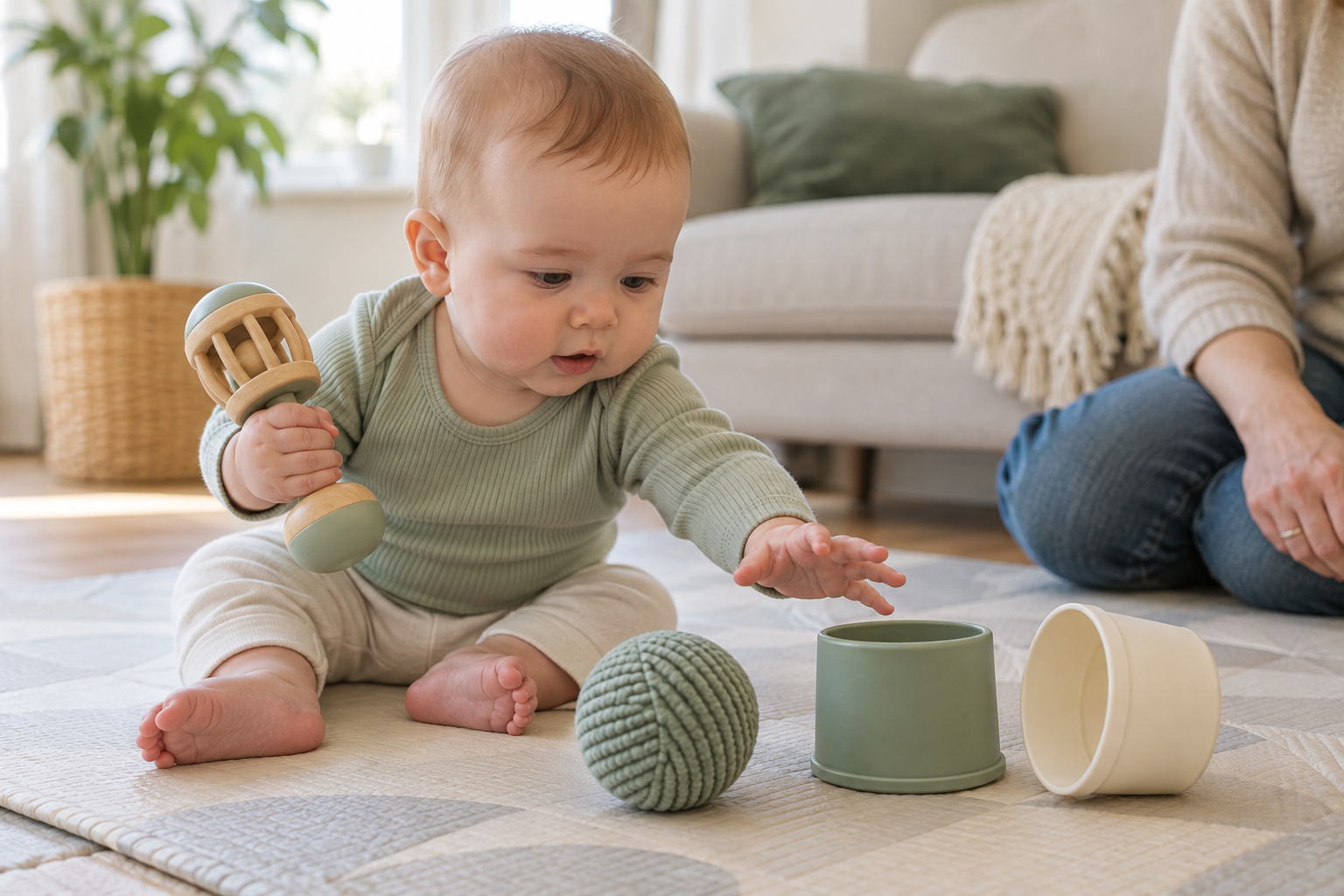
Shopping by developmental claim is vague. Shopping by action is much easier. Think about what your baby is trying to do during floor play, then choose a toy that makes that action possible.
- For reaching, grasping, and mouthing: Choose a baby-safe textured ring, easy-to-hold rattle, or teether designed for this age. It should offer an obvious place to grip and should not feel too heavy or awkward when your baby’s movements are still imprecise. Offer it near the centre of the body first, where both hands can find it.
- For shaking, squeezing, and cause and effect: Try a soft rattle, crinkle toy, or fabric toy that responds immediately to movement. The developmental value is in the understandable connection between the action and the result. Demonstrate briefly, then give the toy back so your baby can create the effect.
- For looking, tracking, and shifting weight: A baby-safe floor mirror, securely attached play-gym toy, or slow-moving ball can invite your baby to follow movement and reach. During tummy time, keep the object low and initially close enough that an attempt can succeed. Moving it too far away may turn practice into frustration.
- For holding, transferring, and banging: Soft blocks, linked rings, and lightweight cups give both hands something to do. Let your baby hold an object, bring the other hand in, pass it, drop it, or bang it on the floor. These ordinary actions are the play; you do not need to turn them into a lesson.
- For early problem-solving: Nesting cups, soft blocks, and simple containers can be useful well before a baby can stack or sort them independently. You can build a small arrangement for your baby to knock down, place an object where it is partly visible, or offer an empty cup to inspect. The task should be easy to affect even when it cannot yet be completed in the conventional way.
- For shared attention and language: A sturdy cloth book, textured book, mirror, or simple picture toy gives you something to examine together. Name what your baby touches, notices, or does. Describing the moment is more useful than asking questions that have a correct answer.
You do not need a separate purchase for every action. A textured ball might be grasped, mouthed, passed, rolled, and tracked. Cups might be banged together, knocked over, held with both hands, and later nested. A toy with several safe uses usually has more staying power than one built around a single automated performance.
Lights and music are not automatically developmental, and they are not automatically bad. Ask who controls the interesting part. If a brief touch starts a clear response, your baby can begin to explore cause and effect. If the toy continues performing while your baby watches, use its quieter physical features too, or choose something that demands more action from the child.
Make play easier before you make it harder
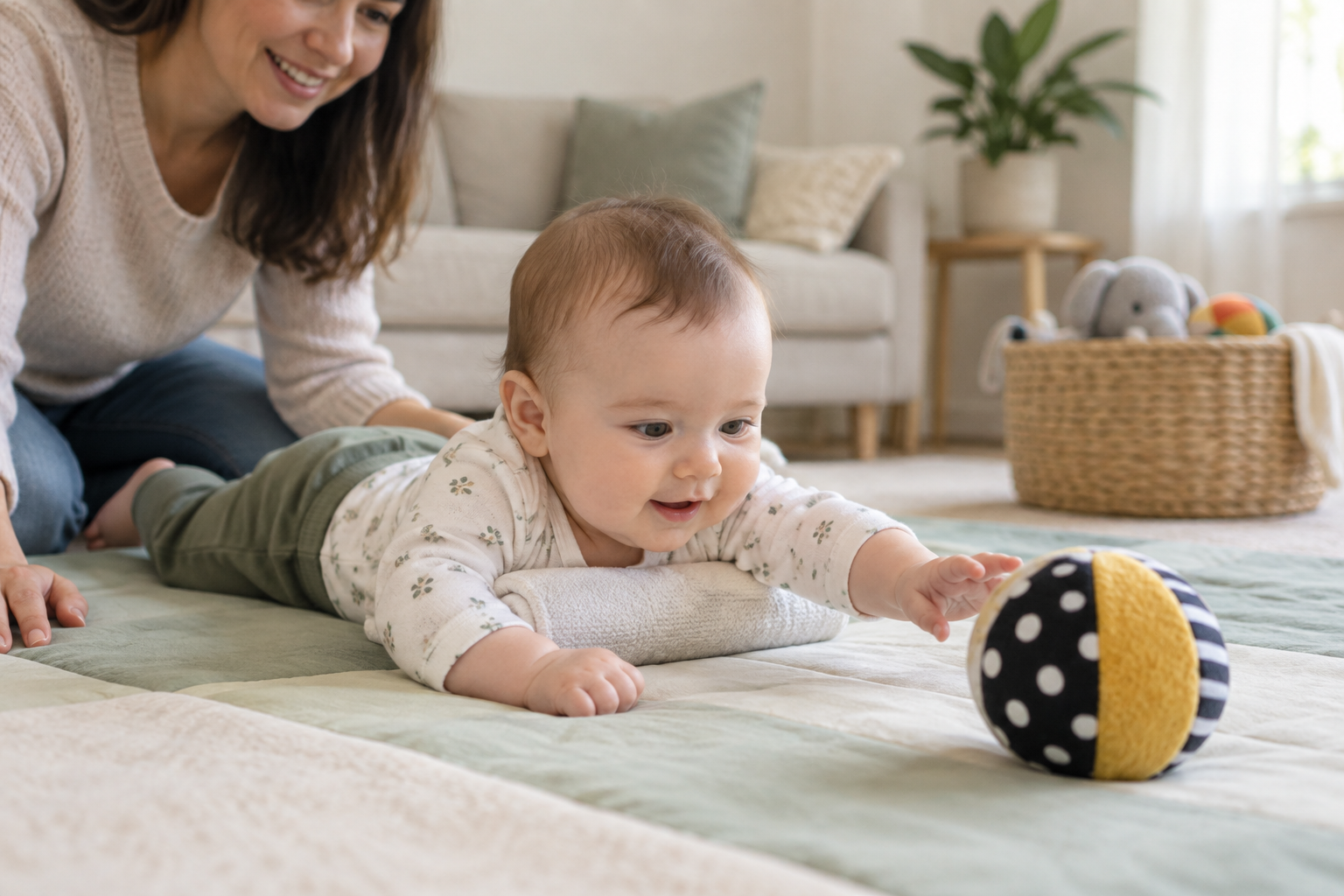
A well-chosen toy can still miss the mark if it is presented out of reach, surrounded by distractions, or demonstrated so often that the adult takes over. Use a simple rhythm that leaves room for your baby’s response.
- Begin when your baby is comfortable and alert. Use a clear floor space and a position your baby can already maintain safely. Do not prop them into a posture they cannot control.
- Offer a single toy within comfortable reach. Let your baby look before moving it, shaking it, or placing it in their hand.
- Demonstrate briefly. Make the toy crinkle, roll, or rattle, then pause. The pause is what gives your baby an opportunity to respond.
- Follow the attempt. If your baby reaches, bring the toy just close enough to keep the attempt productive. If they shake it, let the sound repeat. If they drop it, allow time to look for where it went.
- Describe rather than direct. Simple language such as ‘you shook it’ or ‘that side feels bumpy’ connects words to an experience already holding your baby’s attention.
- Change the challenge gradually. Turn the toy so a different grip is available, place it slightly to the side, or use it in another familiar floor-play position. Change the setup only after your baby has had time to explore the easier version.
- Stop when engagement drops. Looking away, repeatedly pushing the toy aside, fussing, stiffening, or becoming drowsy can mean your baby needs a break or a different activity.
Do not measure a play session by how long your baby stays with the toy. A brief stretch of active reaching, shaking, or examining may be more useful than prolonged exposure to a toy that is doing all the work. Your role is to create the opportunity, keep it safe, and respond to what your baby actually tries.
Placement can also change what a familiar toy invites. A mirror in front of your baby during tummy time encourages a different movement from a ring offered near the chest while your baby lies on their back. During supported floor sitting, an easy-to-grasp toy can give the hands a purpose, but stay close and keep the surrounding area clear. Never use an elevated surface as a substitute for floor play.
Make safety part of the developmental fit
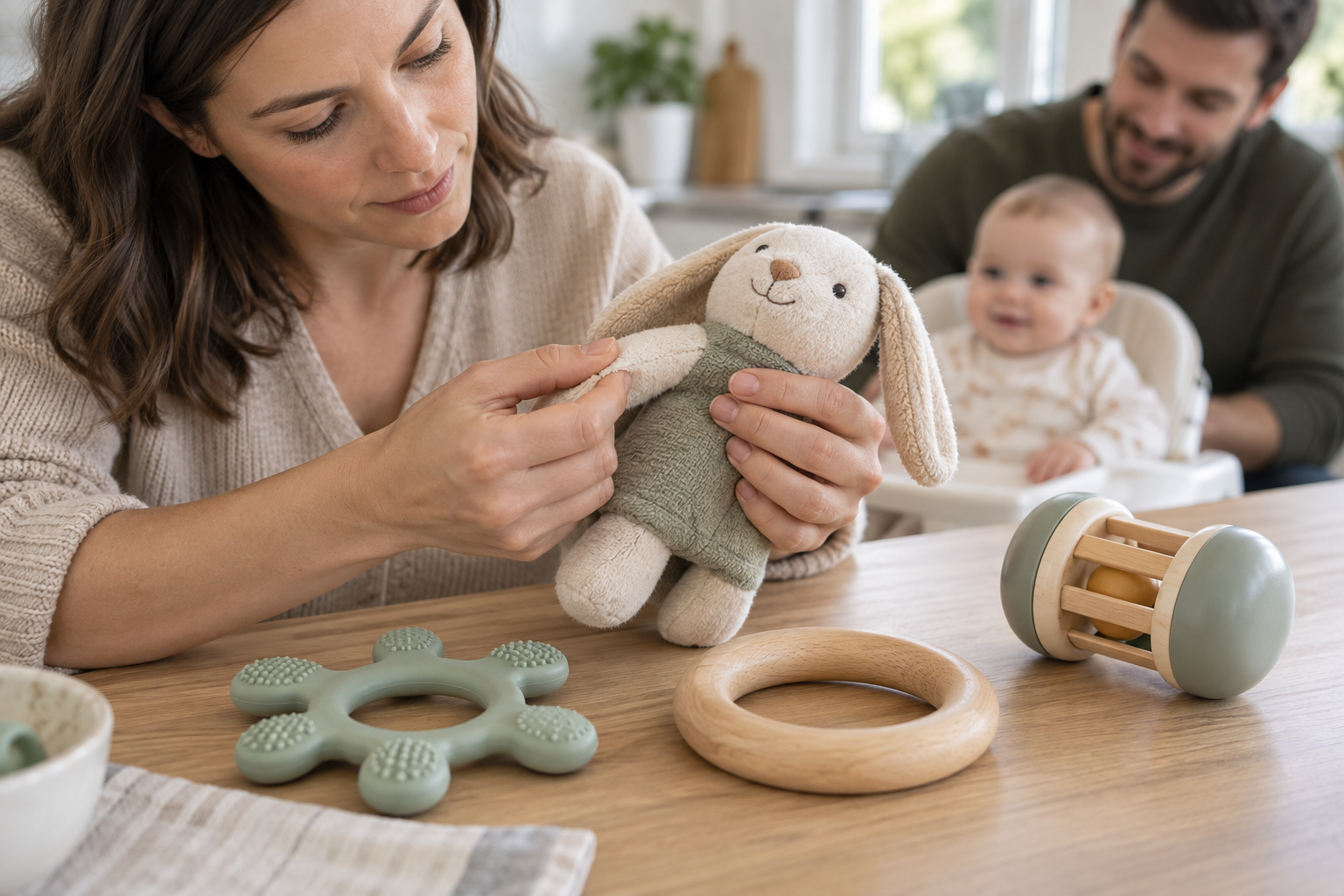
Six-month-olds commonly explore toys with their mouths and may pull, twist, drop, or strike them in ways the packaging photo does not show. Inspect the actual toy your baby will use, even when it came from a trusted brand or an older sibling.
- Read the current age label and warnings. Follow the manufacturer’s instructions for assembly, use, cleaning, and any required adult supervision.
- Pull gently on attached pieces. Stop using the toy if a part is loose, a seam has opened, stuffing is accessible, or anything can detach.
- Check hard surfaces. Remove toys with cracks, sharp edges, peeling material, or damage caused by chewing or dropping.
- Secure batteries completely. Button batteries, accessible battery compartments, and loose high-powered magnets can cause severe injury if swallowed. If a compartment does not close securely, keep the toy away from your baby.
- Avoid cords, loops, and improvised attachments. Do not tie a toy around your baby’s neck or attach it to a crib, car seat, or stroller unless that exact use is permitted by the manufacturer.
- Keep loose toys out of the sleep space. A crib or other infant sleep space is not a play area. Put toys away when play ends.
- Clean for the way the toy is used. If it goes into your baby’s mouth, choose something you can clean as directed and dry fully. Replace items that trap moisture, leak, or cannot be cleaned after damage.
- Supervise the whole interaction. An age label cannot account for wear, damage, the surrounding environment, or the particular way your baby uses an object.
Reassess hand-me-down toys as if you were seeing them for the first time. Confirm that every original part is present, closures still work, and the item has not become brittle or damaged in storage. Sentimental value does not make a worn toy safe.
Toys provide opportunities to practise; they do not diagnose, prevent, or correct a developmental problem. If you are concerned about how your baby sees, hears, moves, uses their body, or interacts with you, record what you are noticing and bring it to your child’s healthcare professional rather than looking for a more advanced toy.
Build a useful toy rotation without filling the room

Too many visible toys can make it harder for you to see what is holding your baby’s attention. Keep a limited selection in the play area and store the rest. Rotate an item when your baby repeatedly ignores it, when its challenge has become too easy, or when another toy would invite a different action.
Before buying anything new, audit what you already own by verbs: What can your baby grasp? What can they shake? What can they safely mouth? What can they watch move? What can they knock down? What can you look at together? The missing action, if there is one, gives you a much clearer shopping brief than a broad promise about brain development.
Do not retire a toy merely because your baby has discovered its most obvious use. A baby may first watch a cup, then hold it with both hands, mouth its rim, bang it, drop it, and later explore how objects fit inside it. Reintroducing a familiar toy after your baby’s abilities change can reveal an entirely different kind of play.
When a toy no longer fits, set it aside promptly. Signs include pieces becoming unsafe under your baby’s stronger pulling, frustration because the required action is still far beyond reach, or a design intended for a younger stage no longer being used as directed. Rotation should follow your baby’s behaviour and the toy’s condition, not pressure to move through products on a schedule.
Key takeaways
- Choose toys by the action they invite: grasping, shaking, mouthing, tracking, passing, banging, knocking down, or looking together.
- Prefer a clear, repeatable result that your baby can cause over a long automated performance.
- Match the challenge to the abilities your baby has now, not the milestone or age claim you hope the toy will produce.
- Demonstrate briefly, pause, and let your baby’s attempt determine what happens next.
- Inspect every toy for loose parts, damage, exposed batteries, magnets, cords, and cleaning problems before use.
- Buy a new toy only when it safely adds an action or play experience your current selection does not offer.
For your next play session, choose the simplest suitable toy you already have, place it within comfortable reach, and wait. What your baby tries to do with it will tell you more about the right next toy than any long feature list.
References