
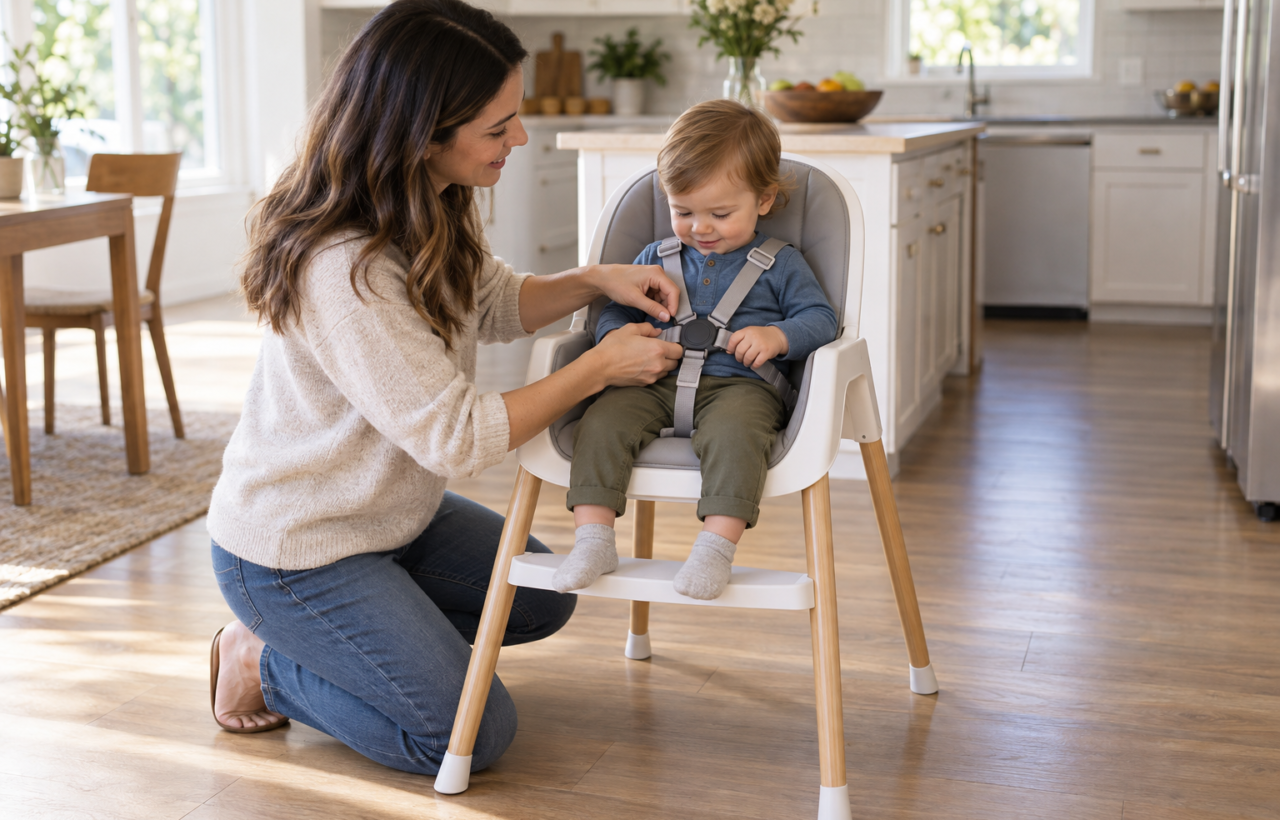
A high chair can look sturdy, wipe clean in the store and still become frustrating once you are fastening a wriggling child three times a day. The useful question is not how many features it has. It is whether you can secure your child correctly, keep the chair stable and clean every food-catching crevice without skipping steps.
Use the checks below when choosing a chair, assessing a hand-me-down or resetting the one already in your kitchen. The safest option is usually the one whose locks, restraints and cleaning routine are easy to use correctly at every meal.
Fit the chair to your child before judging its features

High-chair readiness is developmental, not simply a date on the calendar. Your child must meet the chair manufacturer’s requirements and be able to maintain the position the seat is designed to support. If your baby repeatedly slumps, tips sideways or cannot keep their head steady in the recommended position, pause high-chair use and ask a pediatric health professional about feeding readiness.
Once your child is ready, check the fit with the restraint fastened. Their back and pelvis should be supported, the tray should not press into their body, and the straps should lie in the positions shown in the manual. A correctly adjusted footrest can make the seat more comfortable by giving dangling feet somewhere stable to rest, but it does not replace the restraint.
- Check the model’s stated size, weight and developmental limits. These are specific to the chair, so do not borrow a limit from a different model.
- Use only the seating positions approved for feeding. A reclined position, if the chair has one, may be intended for a different use or stage.
- Remove bulky clothing if it prevents the harness from lying correctly.
- Use only cushions and inserts approved for that model. An improvised pillow can change the fit or obstruct the restraint.
- Readjust straps as your child grows. A setting that worked last month may now be too loose or sit in the wrong place.
Upright positioning does not make every food appropriate for every child, and no high chair prevents choking. Keep your child seated and continuously supervised while eating. Ask a pediatric health professional for individualized feeding guidance, and learn age-appropriate choking first aid from a qualified provider rather than waiting for an emergency.
Make this safety check before every meal
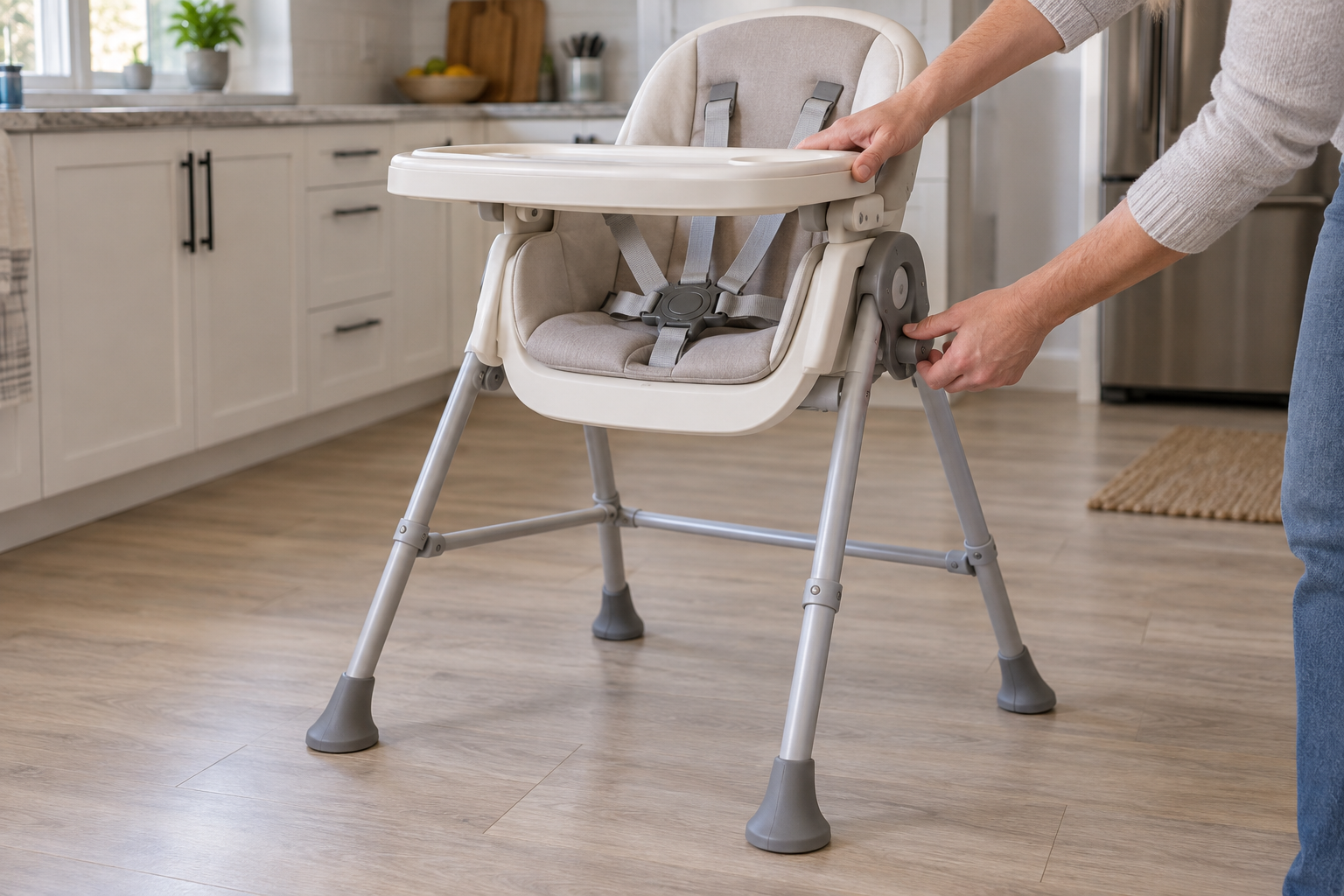
Most high-chair safety depends on repeatable setup rather than a feature you buy once. A short routine catches the unlocked wheel, half-open frame or loosened strap before your child is in the seat.
- Place the chair directly on a flat, stable floor. Never raise it on a counter, table or other piece of furniture.
- Clear the reach zone. Move hot drinks, appliance cords, knives, tablecloths and other objects your child could pull down. Leave enough distance from tables, counters and walls that your child cannot push against them and destabilize the chair.
- Open the frame completely, if it folds, and confirm that every required lock has engaged. Lock the wheels or casters whenever the chair is parked.
- Seat your child and fasten every strap and buckle supplied for that seating mode. Adjust the restraint according to the manufacturer’s instructions so it is secure without overtightening.
- Attach the tray and pull gently to confirm that both sides are latched. The tray is a work surface, not a substitute for the harness.
- Stay close enough to respond immediately. Do not leave your child alone in the chair, even when the tray and restraint appear secure.
Do not allow a child to climb into or out of the chair without help. Do not move an occupied high chair unless its instructions expressly describe that use. If a wheel lock, folding latch, tray catch or buckle does not engage consistently, stop using the chair until the manufacturer confirms an approved repair or replacement.
Performance shows up during the mess, not in the showroom
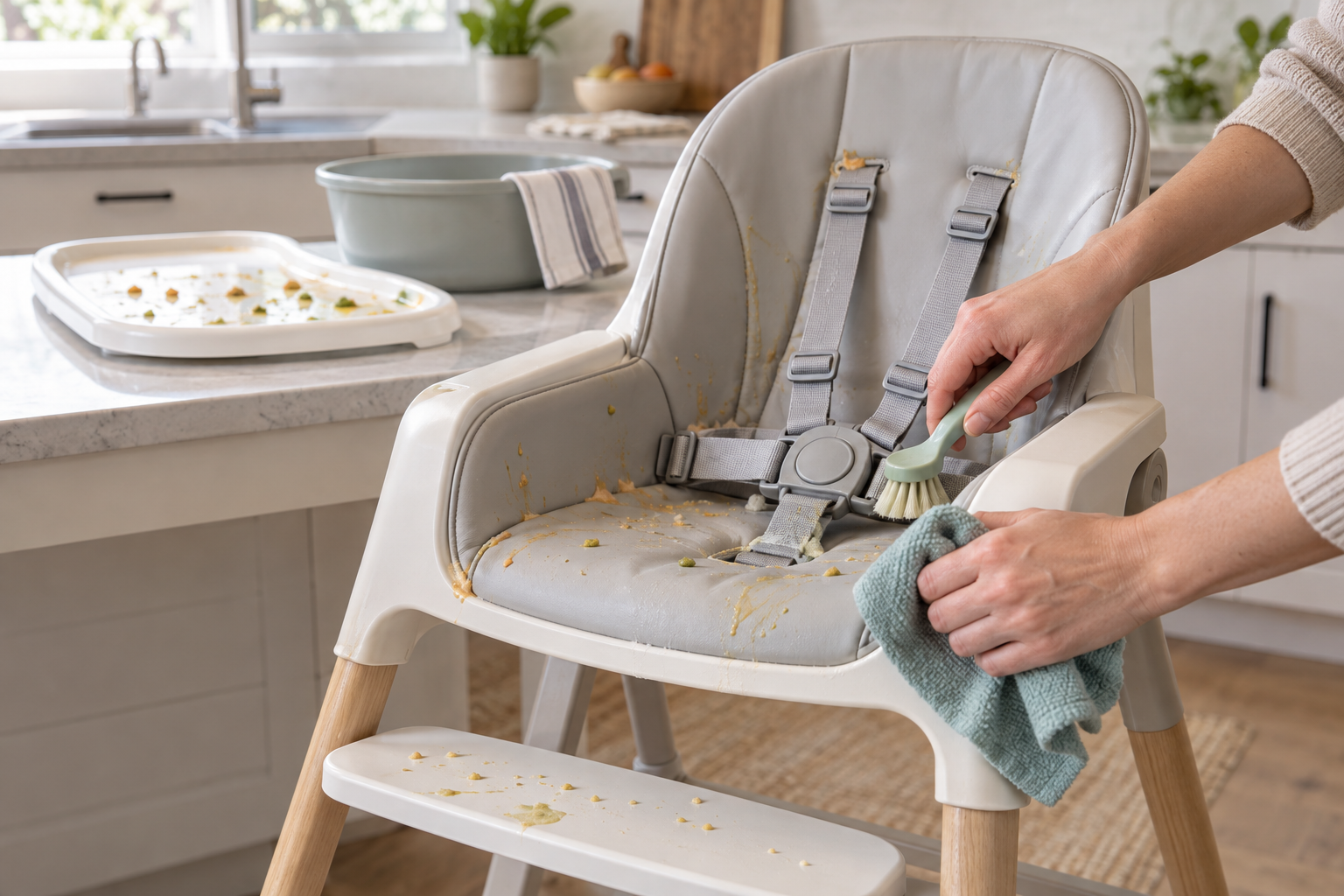
A chair performs well when the correct setup remains practical during a busy meal. Secure and comfortable seating, paired with manageable cleanup, matters more in daily use than an accessory you rarely touch. If buckling the harness is awkward or cleaning requires a long disassembly, the design creates friction exactly where parents are most likely to be rushed.
Inspect the food traps before you buy
Run your fingers around the seat edges, under the tray, beside the buckle and where the seat joins the frame. Deep seams, exposed hardware and narrow channels can hold puree, crumbs and spilled milk. That is not merely cosmetic: debris can make a buckle sticky or hide damage in a moving joint.
- Remove and reinstall the tray. The mechanism should be obvious to an adult but difficult for the seated child to release.
- Check whether the harness can be removed for cleaning without being easy to misroute during reassembly.
- Confirm which parts are actually washable or dishwasher-safe. Do not immerse the frame, buckle or padded components unless the care instructions permit it.
- Look under any fabric cover. A washable cover saves little time if food regularly reaches a difficult-to-clean shell beneath it.
- Ask where wet parts will dry. A cover that must air-dry may require a second seating plan before the next meal.
Choose for your real kitchen routine
A wide base may feel reassuring but block a busy walkway. A folding frame may save space but add a lock you must check whenever it is reopened. Wheels may make an empty chair easier to reposition but add brakes that must be engaged. None of these features is automatically better; each creates a task that has to fit your room and routine.
Before deciding, imagine the least convenient meal of the week. Can you position the chair without creating a trip hazard? Can you buckle the restraint correctly while your child moves? Can you clean the tray, harness and seat before they are needed again? If another caregiver will use the chair, can that person identify every lock without a demonstration?
After each meal, remove visible food from the seat, restraint and tray using the approved cleaning method. Inspect moving parts regularly and let washed components dry fully before reassembly. Strong cleaners, abrasive tools and unapproved lubricants can damage finishes or mechanisms, so follow the model’s care instructions instead of improvising.
Be stricter with second-hand and inherited chairs
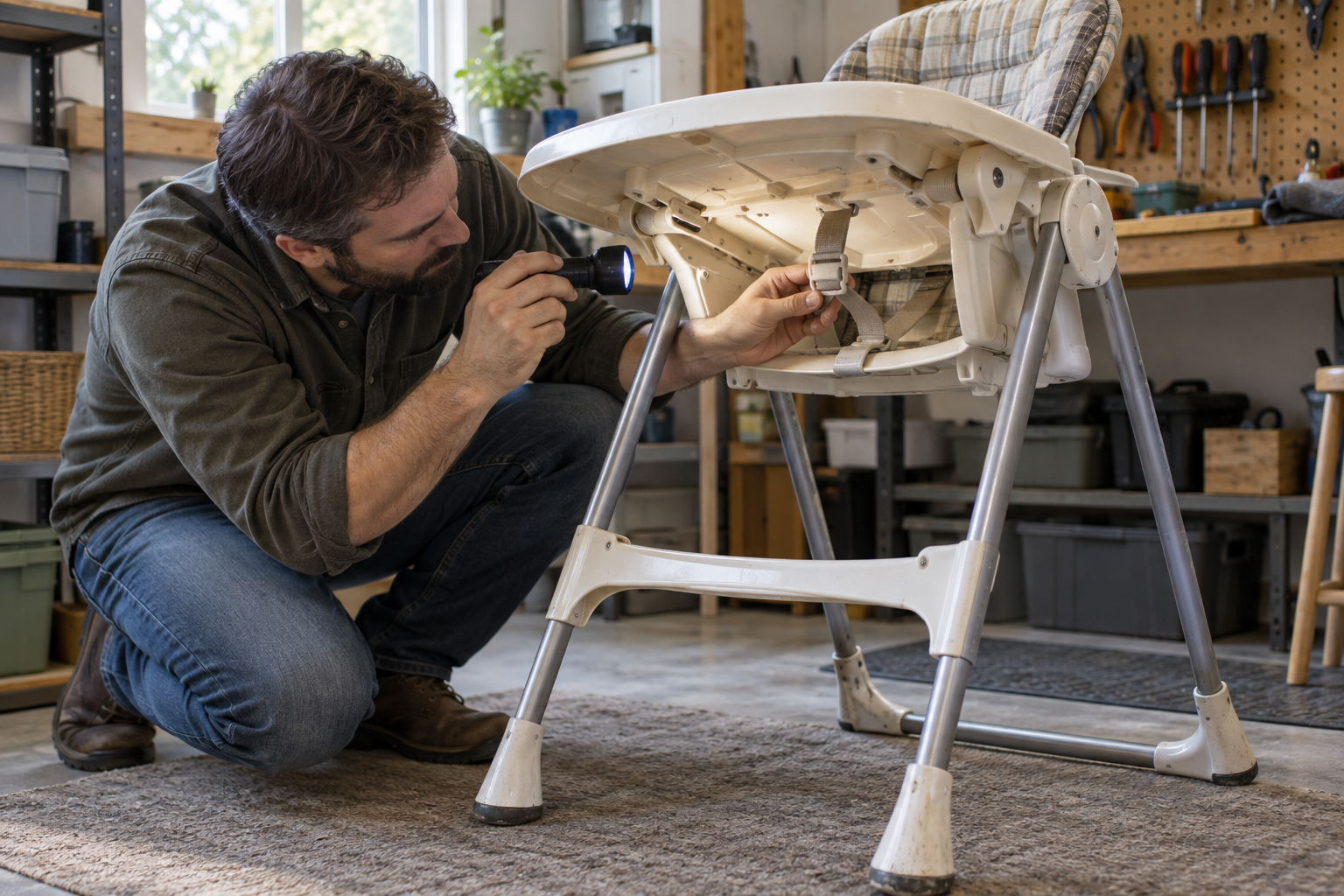
A used chair can be practical, but familiarity is not proof that it is complete or safe. You need to identify the exact model, verify its status and inspect the parts that carry or restrain your child. If the label is missing and the model cannot be confirmed, you cannot reliably check the correct limits, instructions, replacement parts or safety notices.
- Find the manufacturer, model identification and any serial or date information still attached to the chair.
- Locate the correct manual and compare the chair with its parts list. All required straps, buckles, fasteners, feet, locks and tray components should be present.
- Check the official product-recall database for the country where you will use the chair. Follow the stated remedy for the exact model rather than assuming a similar-looking version is affected or unaffected.
- Inspect the frame for cracks, bent legs, corrosion, loose connections, damaged welds and missing non-slip feet.
- Operate every adjustment, folding lock, wheel brake and tray latch several times. A mechanism that works intermittently is not dependable enough for use.
- Fasten and release the buckle repeatedly after cleaning it as directed. Replace only with a part approved for that model; a generic strap may fit through the slot without providing the intended restraint.
Pass on a chair with unresolved recall instructions, structural damage, missing restraint parts or a lock that will not stay engaged. Do not donate or resell a chair you have stopped using because it is unsafe; that only transfers the risk to another family.
Key takeaways
- Confirm developmental readiness and the manufacturer’s model-specific limits before using the chair.
- Use every supplied restraint point at every meal. The tray does not hold a child safely by itself.
- Place the chair on a flat floor, engage all locks and clear anything your child could pull down or push against.
- Judge performance by setup, fit and cleanup during a rushed, messy meal, not by the length of the feature list.
- Stop using the chair when a structural part, buckle or lock is damaged or unreliable.
- For a second-hand chair, verify its identity, instructions, parts and recall status before seating your child.
Before the next meal, find the model label, adjust the harness, clear the chair’s reach zone and test every lock. If a required part is missing or a latch will not engage, use a safe alternative while you contact the manufacturer. A good high chair is not the one that promises the most; it is the one that makes a safe routine straightforward enough to repeat.
References




