
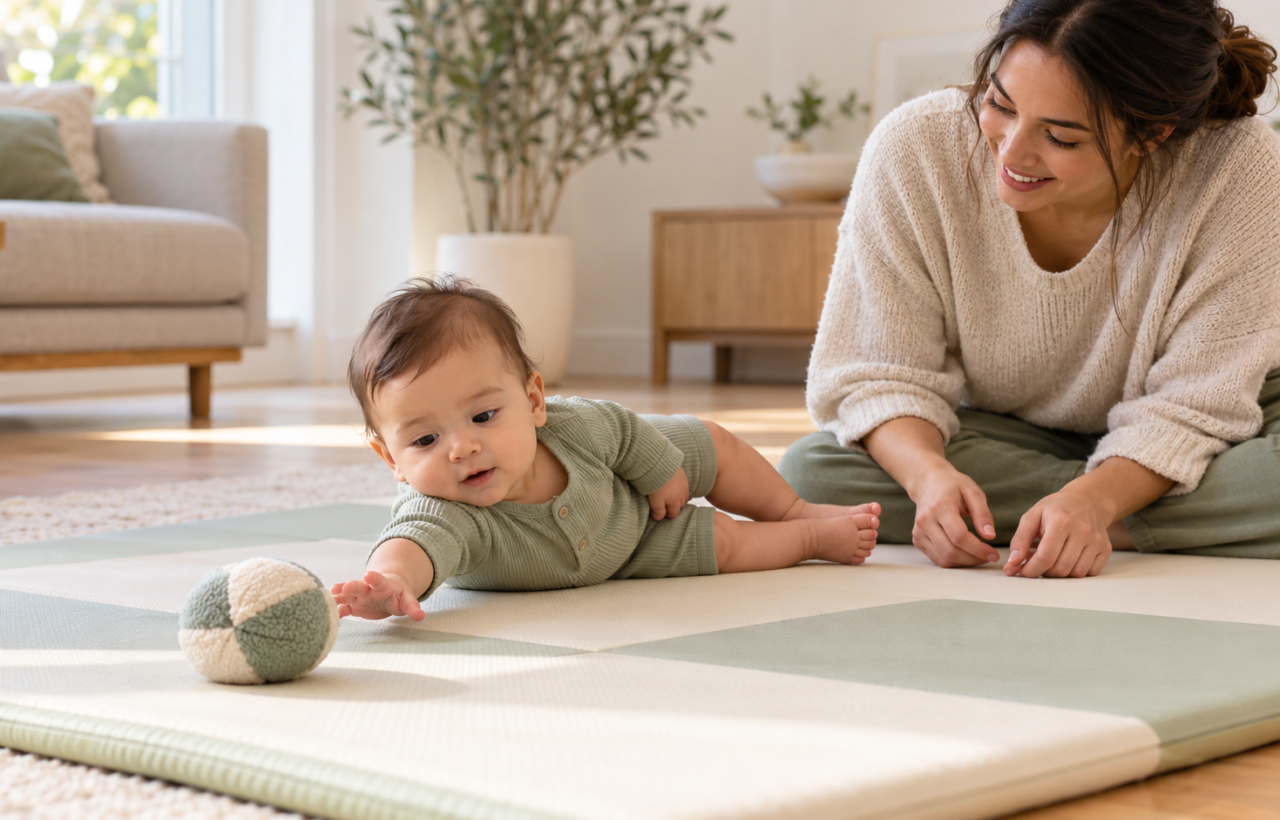
If you are wondering whether your baby needs exercise – or whether you should be doing more to help them roll, sit, crawl, or stand – the useful answer is simpler than a milestone chart can make it seem. Your baby needs safe, repeated chances to move. They do not need to be coached toward a deadline.
The aim is to create an inviting setup, let your baby do the active work, and notice how that work changes. The four play ideas below give you a practical starting point. Just as importantly, they help you distinguish an emerging skill from one your baby can use independently.
Exercise means creating an opportunity, not moving your baby through it
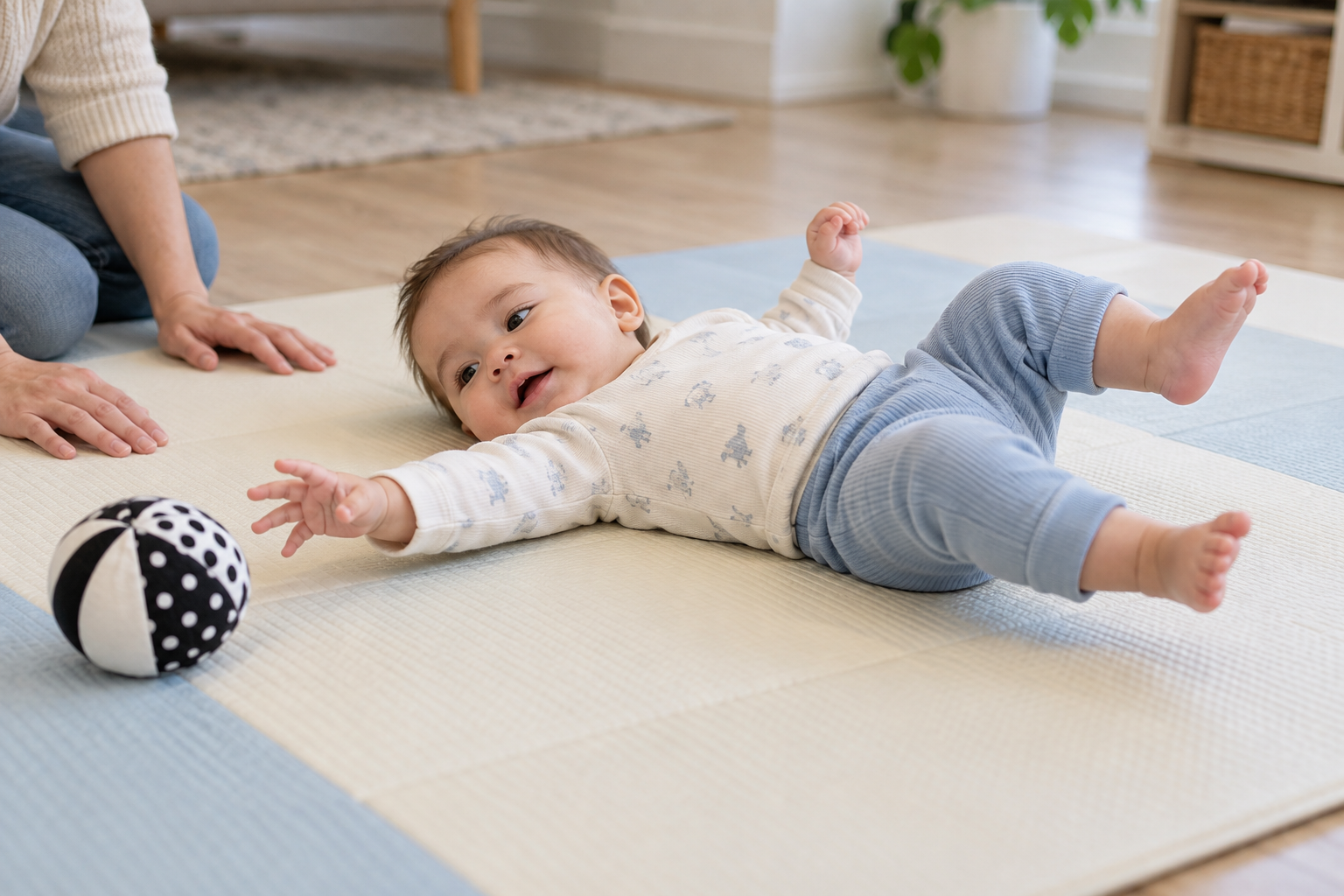
Infant exercise does not look like an adult workout. A baby’s ordinary movements are already muscle work, and simple games can turn that work into enjoyable practice. Your role is to provide the space, position, and reason to move. Your baby’s role is to decide whether and how to respond.
That distinction matters. If you roll your baby over, you have shown them a position. If they turn their head, shift their weight, reach across their body, and complete the roll, they have practised the skill. Both experiences can be part of play, but only the second tells you what your baby can initiate.
The same applies to sitting and standing. A baby held upright by your hands, a seat, or cushions is experiencing an upright position; they are not yet sitting independently. Treat supported positions as brief practice, not proof that the milestone has arrived.
Use the same simple loop during any movement game:
- Choose a time when your baby is awake, calm, and interested in looking around.
- Place them on a firm, clear floor surface where you can stay within reach.
- Offer one reason to move, such as your face, voice, or a safe toy just within sight.
- Pause long enough for your baby to attempt a response before helping.
- End or change the activity when their movements lose control, they turn away, or they become upset.
You do not need to count repetitions. Watch the quality of the attempt instead: Is your baby contributing to the movement? Can they breathe comfortably? Do they look engaged? Does one side move differently from the other? Those observations are more useful than finishing a set.
Four play setups that let your baby do the work
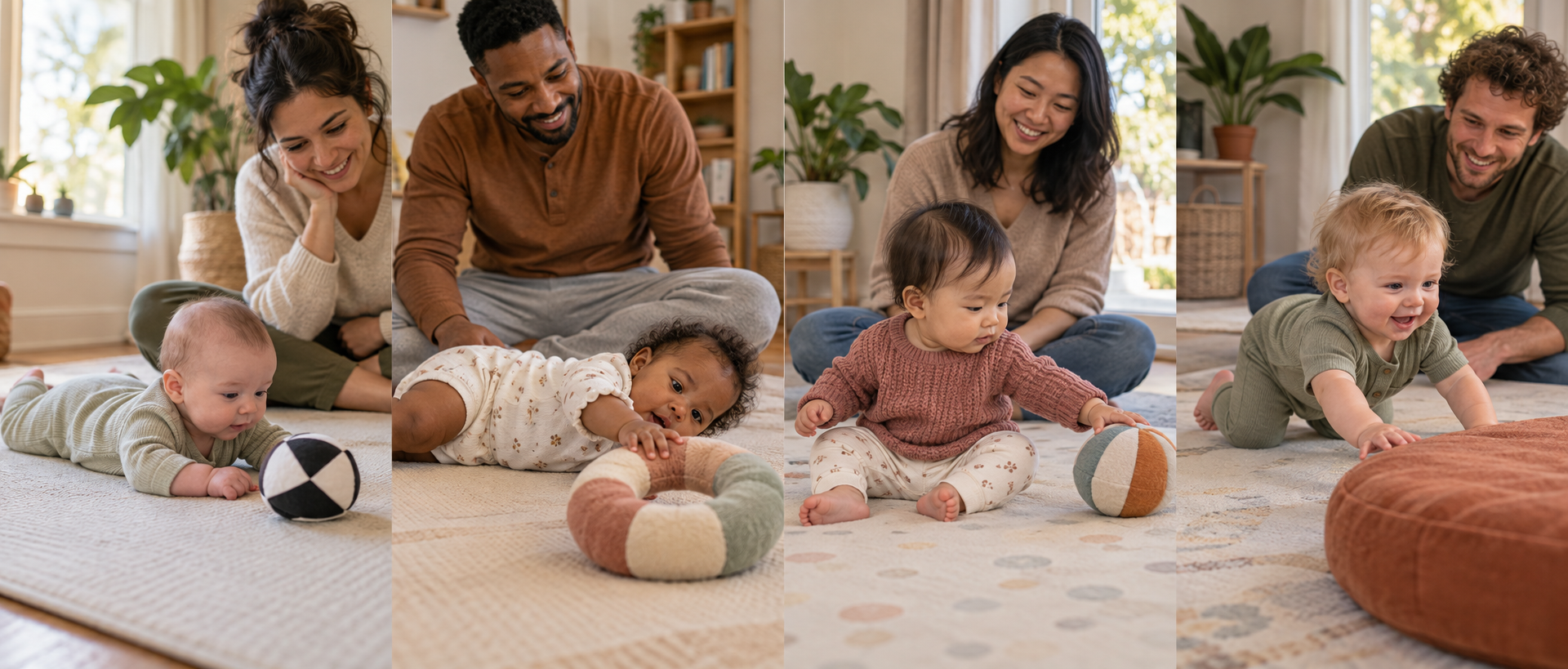
You do not need special equipment. A clear patch of floor, your attention, and one suitable toy are enough. These activities can be shortened, simplified, or skipped according to your baby’s current control.
- Face-to-face tummy play. Place your awake baby on their tummy on a firm floor mat and supervise continuously. Get down at floor level so your face is easy to find. You can slowly move your face or a toy from the centre toward either side, then wait for your baby to look, turn, or lift. The attempt matters even if the movement is small. If your baby cannot keep their airway clear, presses their face into the surface, or becomes distressed, reposition them immediately. A sofa, adult bed, or other soft raised surface is not a safe substitute.
- Reach-and-follow play. With your baby on their back, place a safe, lightweight toy where they can see it without handing it directly to them. Wait for a look, arm movement, body turn, or reach. Move the toy to the other side on the next attempt so both directions get an invitation. Keep the toy close enough that success is possible; this is practice, not a test of how far your baby can stretch. The object must be too large to become a choking hazard and must not have loose parts.
- Kick-and-pedal play. While your baby lies on their back, give their legs room to kick freely. You can gently cup their lower legs and guide a small, easy pedalling motion, then let go and see what they do. Stay within the range that moves without resistance. Do not push a knee toward the chest, force the legs apart, or continue if one leg resists, your baby appears uncomfortable, or the movement causes pain.
- Supported balance and reach. When your baby can keep their head aligned during supported upright play, sit on the floor and support their trunk with your hands or body. Offer a toy in front rather than holding your baby up by the hands. Give only as much trunk support as they need to remain controlled. If their head drops, their body folds forward, or they cannot recover their balance, provide more support or return to an easier floor position. Do not pull on the wrists or hands to teach sitting or standing.
A short, interested attempt is useful. A longer session after your baby has stopped participating is not. Fussing, looking away, stiffening, or losing smooth control can simply mean that your baby needs a different position, a break, food, sleep, or your quiet attention.
Repeat familiar setups rather than constantly adding harder ones. Repetition lets your baby solve the same movement with gradually less help. It also makes changes easier for you to notice.
Read first-year milestones as a changing pattern
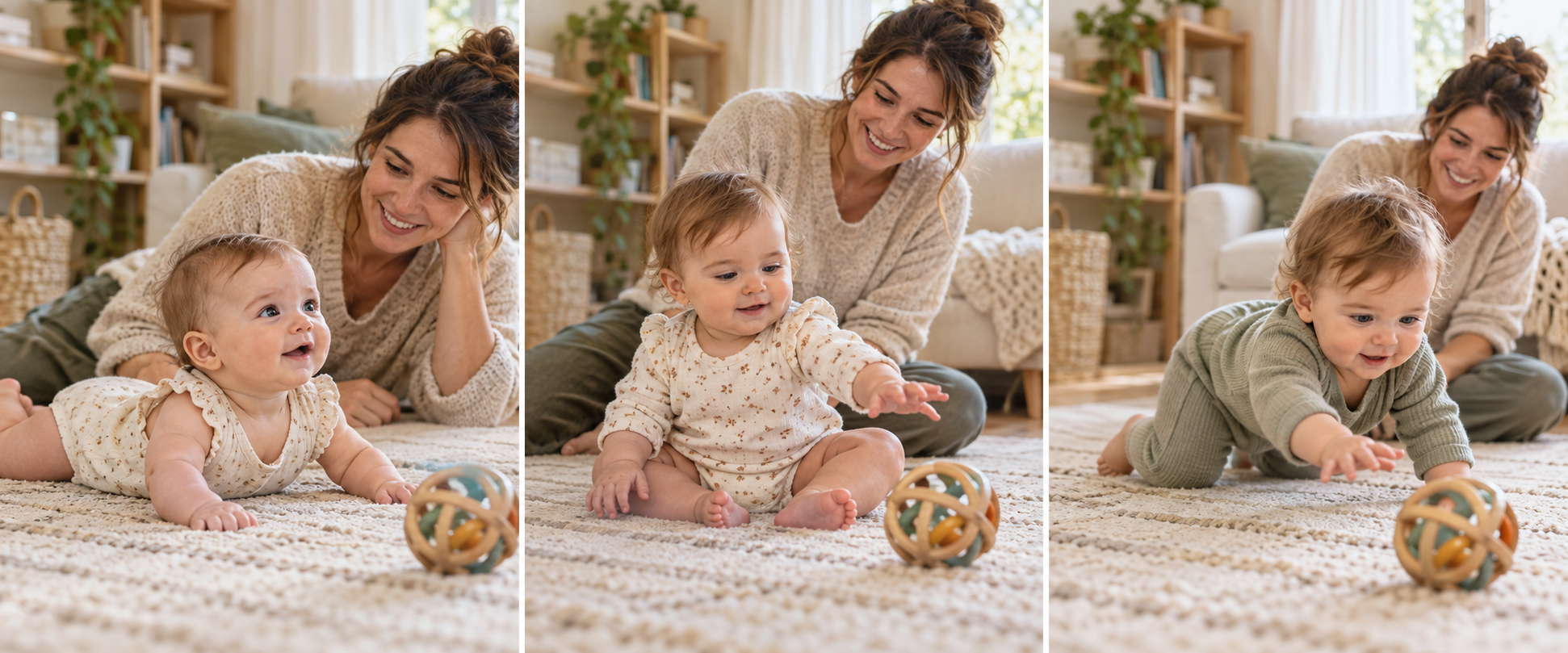
The memorable moments are not limited to crawling or walking. A smile, discovering the feet, and taking first steps all reflect a baby becoming more able to engage with their body and the people around them.
Milestones do not arrive as a neat weekly checklist. Skills overlap, and babies can use different movement strategies. Look for a developing pattern: more control, more intentional movement, less support, and a wider range of things your baby can initiate.
| What may be emerging | What you might notice | What you can do |
|---|---|---|
| Head and upper-body control | Your baby’s head becomes steadier during supported positions, or they lift and turn it during tummy play. | Continue supervised floor play and offer something interesting at eye level. |
| Hands, feet, and reaching | Your baby watches their hands or feet, brings the hands toward the middle, or reaches for a nearby object. | Leave the arms and legs free, and place one safe object within a realistic reaching distance. |
| Turning and rolling | Your baby twists, reaches across the body, shifts onto a side, or completes a roll. | Clear enough floor space for the movement and offer reasons to turn in both directions. |
| Sitting balance | Your baby uses their arms for support or stays upright with progressively less help at the trunk. | Practise on the floor with hands ready. Do not leave a baby propped in a position they cannot exit or recover from. |
| Floor mobility | Your baby pivots, shuffles, scoots, crawls, or finds another way to reach something interesting. | Babyproof the reachable area and allow room to explore instead of placing the desired object into their hands. |
| Upright movement | Your baby rises at stable furniture, moves sideways while holding on, or experiments with unsupported steps. | Use stable surroundings, stay close enough to guard a fall, and let your baby initiate the rise rather than pulling them up by the arms. |
Read the rows as possibilities, not a mandatory sequence. Your baby may work on several at once, and not every baby uses the same form of floor mobility. Independent steps also do not have to appear before the first birthday for movement practice to be valuable.
When you want a clearer view of progress, note three things: what your baby initiated, how much support they needed, and whether the movement looked similar on both sides. A skill is becoming established when it appears intentionally and repeatably, not when an adult can place the baby in the finished position.
An occasional short video can help you remember what a movement looked like and show a clinician exactly what concerned you. Record ordinary play rather than repeatedly trying to provoke a difficult movement.
Know when to pause and when to ask for a developmental check

A milestone range is not a reason to dismiss a concern. These play ideas cannot diagnose or treat a developmental problem, and more exercise is not a substitute for an assessment.
- Pause the activity if your baby turns away, cries, repeatedly arches, loses head control, becomes exhausted, or appears uncomfortable. Settle them and return to an easier position only if they are calm and interested.
- Arrange a medical or developmental check if your baby consistently moves one side differently, strongly favours one direction, seems unusually stiff or floppy, appears to have pain with movement, or is not gaining skills in the way you expected. A pediatrician or family doctor can assess the whole pattern and decide whether a physiotherapy or other developmental referral is appropriate.
- Contact a clinician promptly if your baby loses a skill they previously used. Do not wait for a harder milestone to appear or try to correct the loss with extra exercise.
- Seek urgent medical help if movement is accompanied by trouble breathing, a blue or grey colour, unresponsiveness, or a significant injury. Stop the activity and use local emergency services rather than continuing to observe at home.
You do not need to identify the cause before asking for help. Bring your notes or video and describe what happens, which side is involved, whether it is repeatable, and what support your baby needs. That is more informative than saying only that a milestone is early or late.
Key takeaways
- Your baby gets useful exercise through active floor play; you provide the opportunity rather than completing the movement for them.
- Tummy play, reaching, free kicking, and supported balance can all be adjusted to the control your baby has now.
- Look for changes in intention, control, symmetry, and the amount of support needed instead of treating one date as a pass-or-fail deadline.
- Never force a joint, push through resistance, or pull your baby into sitting or standing by the hands.
- Persistent asymmetry, pain, unusual stiffness or floppiness, or loss of a skill deserves professional attention.
At your baby’s next calm, awake play window, clear one safe patch of floor and choose a single setup. Offer the invitation, pause, and watch what your baby initiates. That small observation gives you a more useful next step than trying to hurry the next milestone.
References
- Parents – Help Your Baby Grow Stronger with These 4 Fun Exercises
- Parents – Uncover Sweet Baby Milestones: From Smiles to Steps and More




