
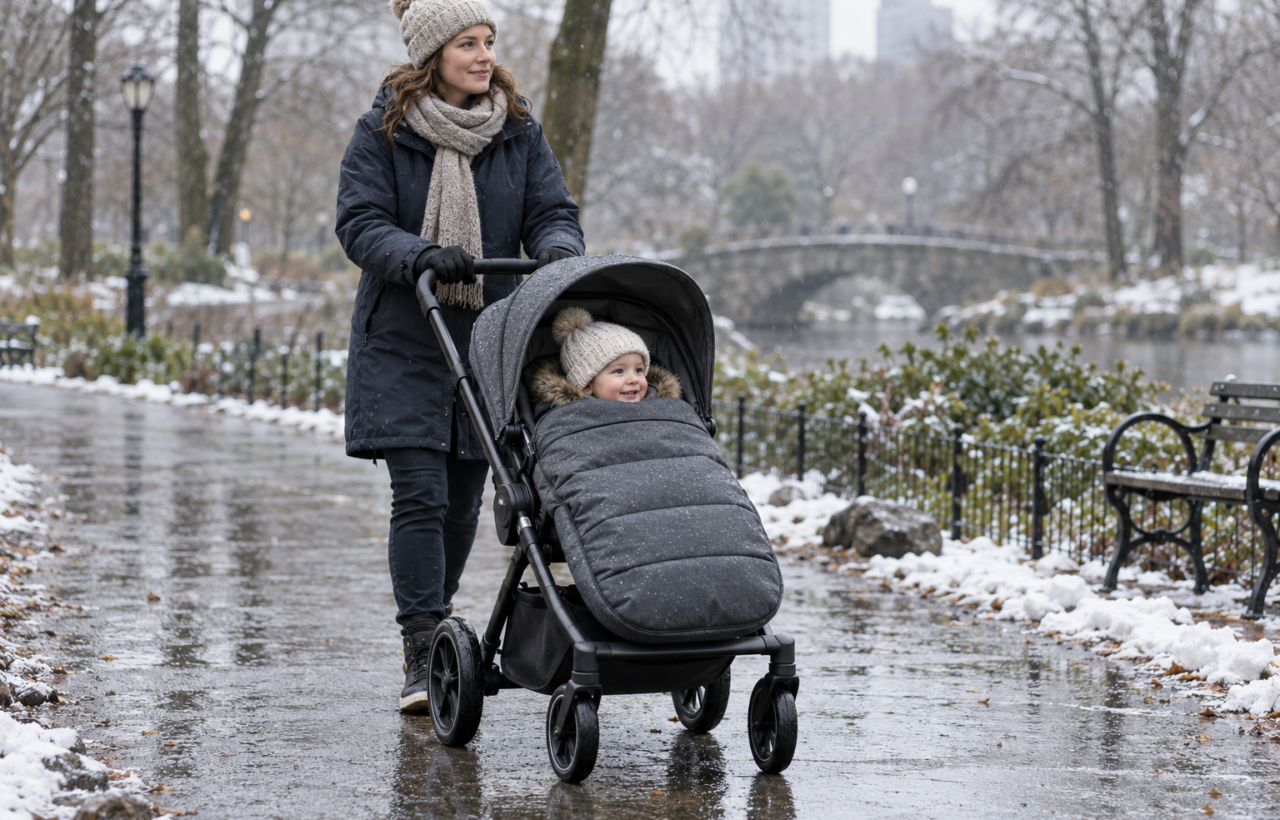
The thickest stroller footmuff is not automatically the best one. You need a footmuff that fits your stroller’s harness, stays out of the wheels, handles the weather you actually walk in, and opens quickly when your child gets warm.
Full-length footmuffs and covers can help shield a child from rain, snow, and wind. Coverage is only part of the decision, though. Fit, adjustability, cleaning, and safe harness use will determine whether the footmuff becomes an everyday winter essential or an awkward extra you leave at home.
Choose protection for the winter walks you actually take
Start with your routine rather than the product’s puffiness. A family taking short walks between a warm car, daycare, and the grocery store needs easy temperature control. A family spending longer stretches outside needs better coverage against wind and wet weather. A toddler climbing in with slushy boots creates a different cleaning problem from a young baby riding fully reclined.
Use these common situations to narrow the features that matter:
- Frequent indoor stops: Look for a front panel you can unzip widely or remove without taking your child out. You should be able to release heat as soon as you enter a store, cafe, or transit vehicle.
- Exposed or windy walks: Prioritize a close-fitting upper section, good side coverage, and attachment points that prevent the footmuff from sliding down. The face must remain completely uncovered.
- Wet snow or rain: Read the shell description carefully. Water-resistant and waterproof are not interchangeable claims. If the manufacturer does not make a clear moisture-protection claim, do not assume a soft or insulated fabric will keep water out.
- Slushy toddler outings: A wipe-clean or reinforced foot area can matter more than extra lining. A removable front panel also makes mud and snack spills easier to manage.
- Limited stroller storage: Check how bulky the footmuff is when removed. You may need to carry it after the day warms up.
A footmuff does not generate heat. It holds warm air around your child and reduces exposure, so the useful question is not simply how warm it feels in your hands. Ask how easily you can reduce that insulation when the wind drops, the sun appears, or you move indoors. A two-way zipper, an opening at the feet, or a detachable front can make one footmuff useful across more conditions.
Confirm the stroller fit before comparing fabrics
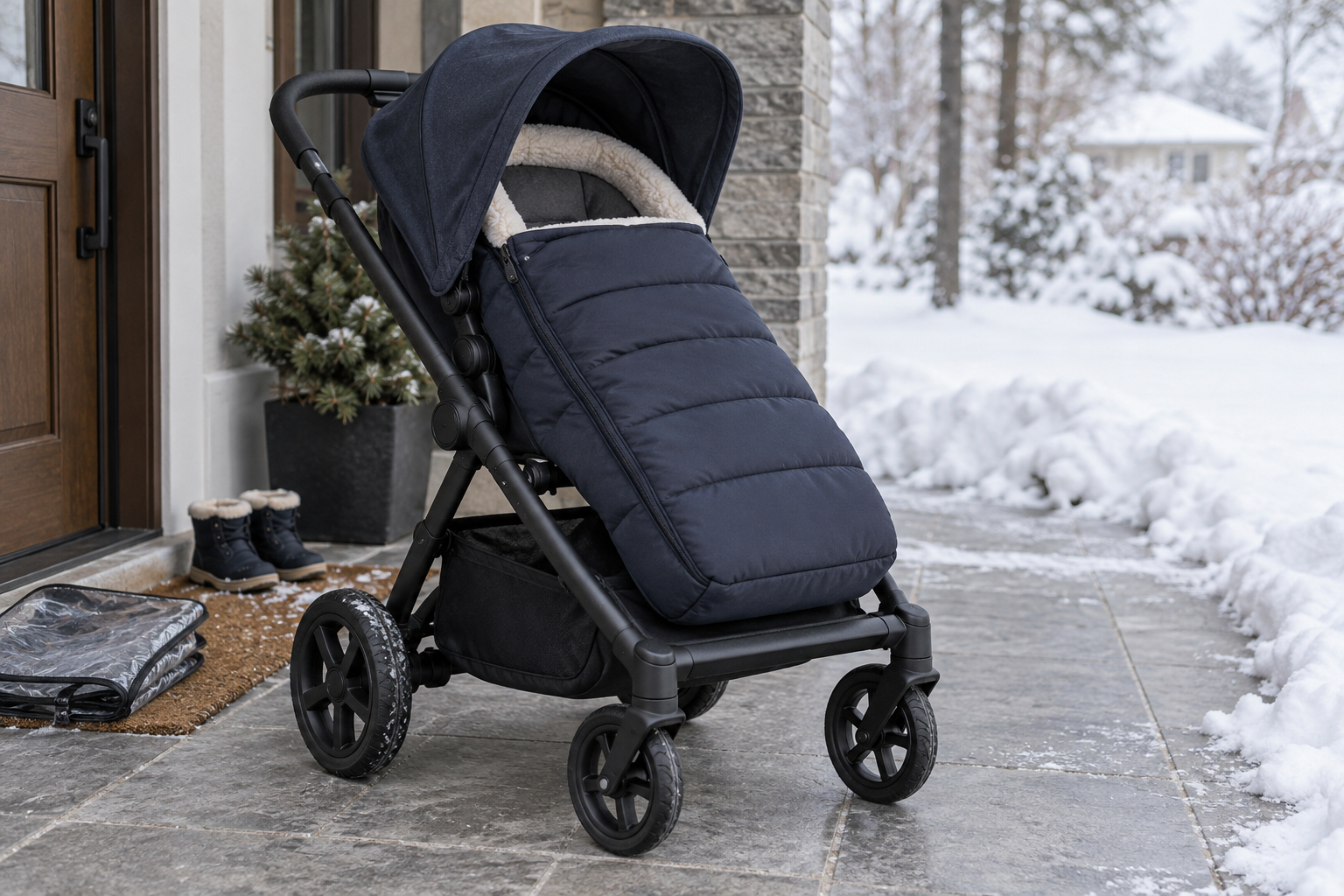
A compatibility label is a starting point, not proof that the footmuff will work neatly in every stroller configuration. Even a product described as universal still has to match the location of your harness slots, the shape of the seat, and the way your stroller reclines and folds.
Check these points against your exact stroller model:
- Harness openings: The shoulder, waist, and crotch straps must pass through the intended openings without twisting, stretching, or being rerouted. Never cut new slots into the footmuff.
- Seat contact: The back panel should lie flat. Thick folds behind your child’s back or bottom can change the seating position and make the harness harder to fit correctly.
- Attachment points: The footmuff should stay in place when your child moves. Its straps, tabs, or elastic loops must attach only where the instructions permit and must not interfere with moving stroller parts.
- Recline and canopy: Test every recline position you use. Make sure the canopy, bumper bar, and any reversible seat mechanism still operate normally.
- Length and wheel clearance: The foot end must remain clear of the wheels, ground, brake, and folding joints. At the other end, the top should sit below your child’s face and should not bunch around the mouth or nose.
- Folding: Find out whether the manufacturer allows the stroller to be folded with the footmuff attached. If the fold becomes stiff or incomplete, remove the footmuff instead of forcing the mechanism.
Your child’s stage changes the fit test. For a baby riding reclined, pay particular attention to bunching behind the body and alignment with the harness. If your child is still using a bassinet, use only accessories approved for that bassinet; a seated-stroller footmuff should not be improvised into a mattress or sleep surface. For a walking toddler, check that the foot end has enough room and will tolerate wet footwear without pulling the whole liner downward.
Keep the harness secure and the warmth adjustable
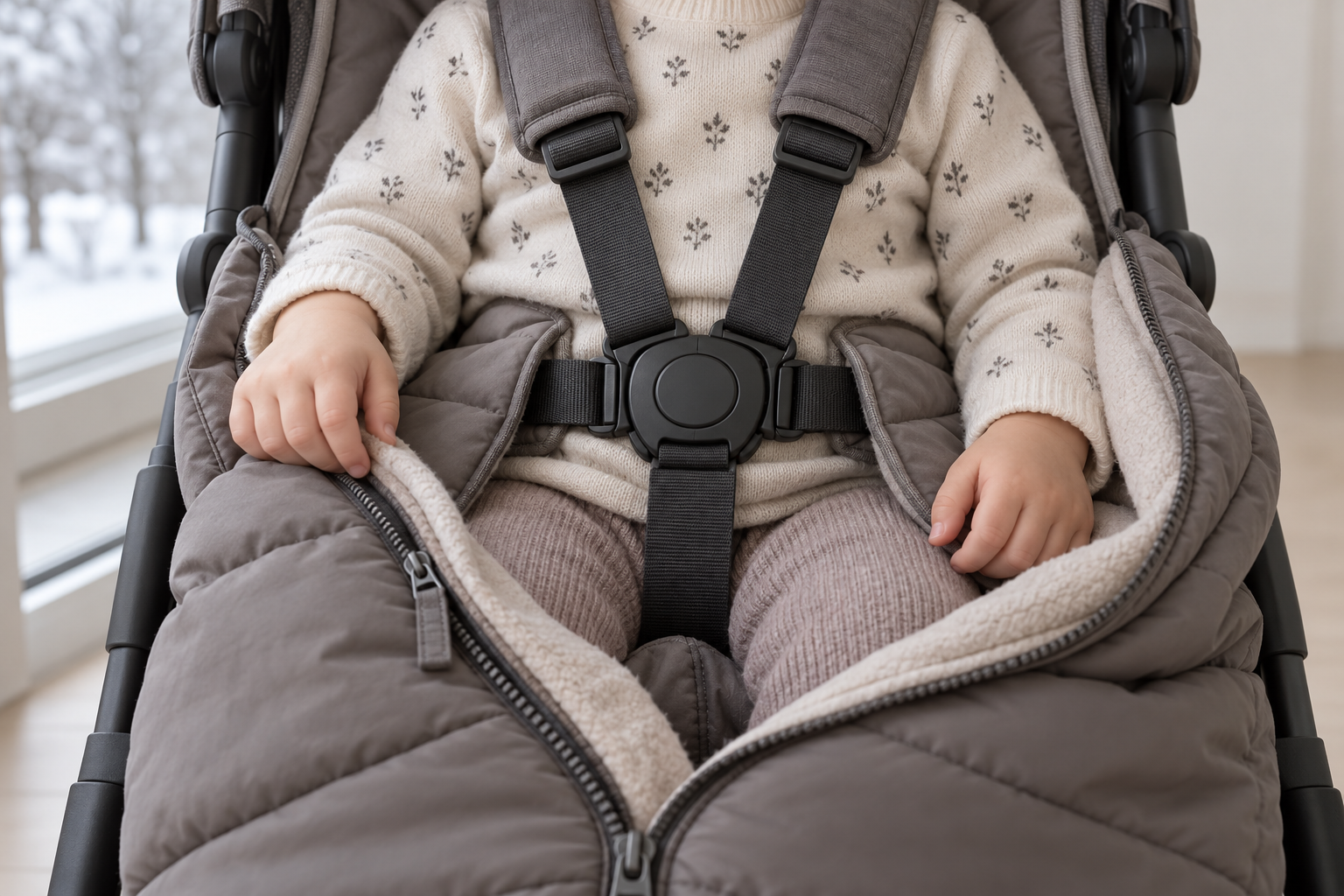
The footmuff should work around the stroller’s restraint system, not replace or bypass it. Route every strap through the prescribed opening, keep the webbing flat, and buckle and tighten the harness as directed in the stroller manual. If the footmuff prevents that, it is not compatible with your setup.
Do not assume that a stroller footmuff is suitable for an infant car seat. Vehicle restraints are tested as complete systems, and extra padding behind or beneath a child can affect the harness fit. Use a product in a car seat only when the car-seat manufacturer explicitly permits that type of accessory, and follow both sets of instructions. A stroller-compatible label alone is not enough.
Warmth also needs active adjustment. Dress your child for the conditions, secure the harness, and use the footmuff as the adjustable outer layer. There is no single correct number of clothing layers for every child, footmuff, or day. Wind, sun, precipitation, time outdoors, and transitions into heated spaces all change the result.
Check your child during the outing rather than waiting for complaints. If the torso feels unusually hot or damp, open the footmuff or remove a layer. Unzip it promptly when you enter a warm building or vehicle. Keep the face uncovered at all times, and do not pull the top higher than its intended position or drape another cover over the opening.
Inspect the details that make daily use easier
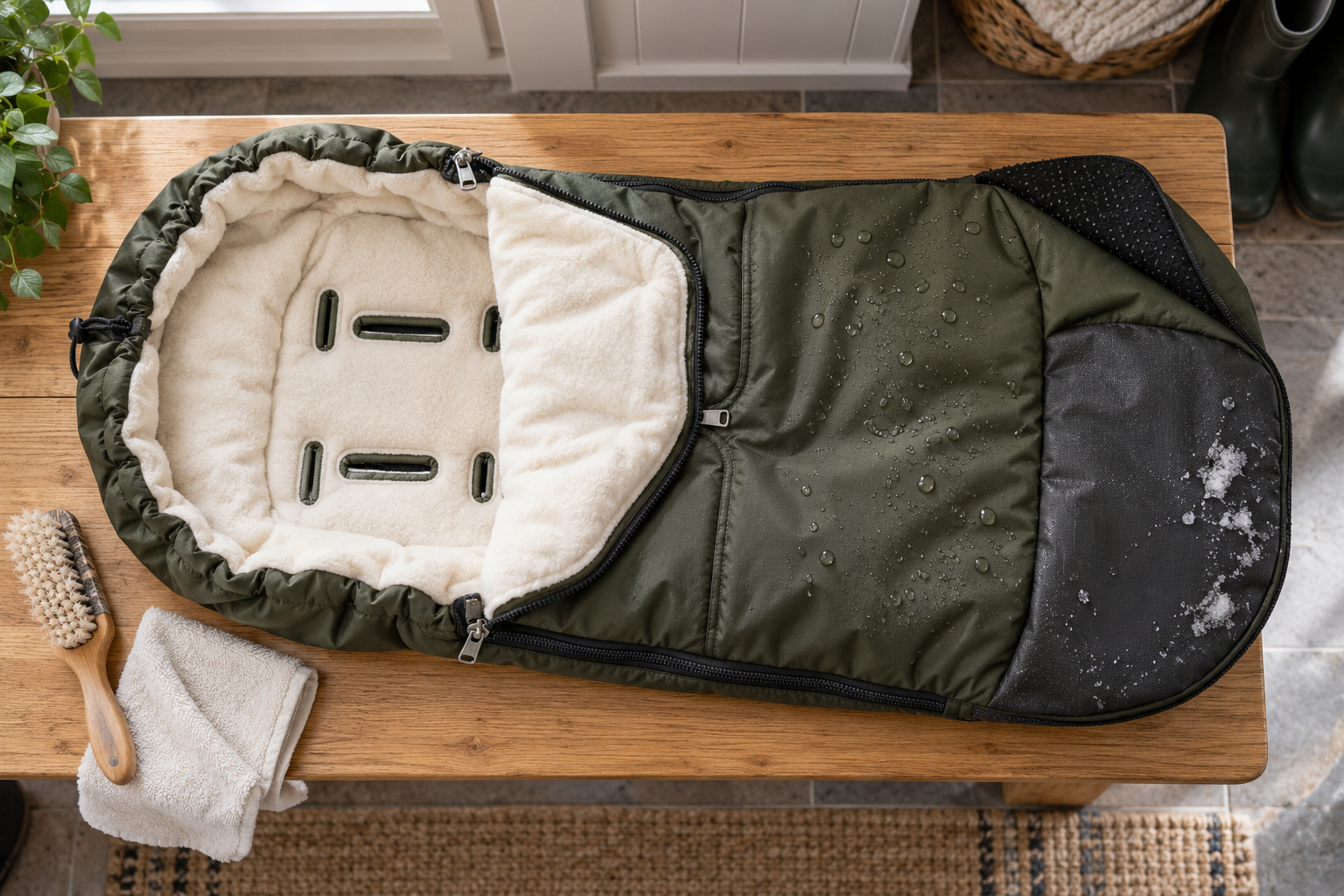
A footmuff can look excellent on a product page and still be frustrating during a rushed departure. Small design choices determine whether you can buckle a wriggling child, handle muddy boots, and regulate warmth without dismantling the stroller.
- Zipper access: Make sure the opening gives you enough room to buckle the harness. A zipper that can open from more than one direction may also let you vent the feet or torso without removing the front.
- Removable front: This can turn the back panel into a stroller liner on milder days and simplify cleaning after a spill.
- Secure upper edge: The top should remain in position without creeping toward the face when your child moves.
- Boot-friendly lower section: For a walking child, look for a surface you can wipe or wash and enough space to avoid compressing the feet.
- Clear care instructions: Check whether the whole footmuff is machine washable, whether parts must be washed separately, and how it should be dried. Follow the care label so the insulation, shell, and coatings are not damaged.
- Practical storage: Consider where a wet or muddy footmuff will go when removed. A product that occupies the entire stroller basket may be inconvenient on changeable days.
Run a complete fit check before the first cold outing
- Read the stroller and footmuff instructions, then install the footmuff using only the specified openings and attachment points.
- Seat your child in the clothing normally worn for a winter walk. Route, buckle, and tighten the harness exactly as the stroller manual directs.
- Check that the back panel remains flat and that no thick ridge sits behind the neck, back, bottom, or harness buckle.
- Move the seat through the positions you use. Operate the canopy, bumper bar, brake, and reversible-seat mechanism, if present.
- Zip and unzip the footmuff while your child is seated. Confirm that you can reach the buckle quickly and that the upper edge and zipper stay away from the face.
- Push the stroller around indoors and turn the front wheels fully. Recheck that the footmuff has not slipped and that its lower edge cannot reach the wheels or ground.
- Test the stroller fold only if the instructions allow the footmuff to remain attached. Stop if the fold catches or requires extra force.
If the footmuff fails any part of this check, exchange it rather than modifying the accessory or the stroller. Cutting openings, improvising ties, or forcing the fold can create a new problem while hiding the original incompatibility.
Key takeaways before you buy
- Choose for your real routine: wet sidewalks, exposed walks, frequent indoor stops, or muddy toddler boots.
- Verify harness alignment, seat fit, wheel clearance, recline, canopy movement, and folding on your exact stroller.
- Prioritize adjustable coverage over maximum bulk. You need to release heat quickly when conditions change.
- Treat stroller and car-seat compatibility as separate questions. Never add padding to a car-seat harness system without explicit manufacturer approval.
- Look for cleaning instructions you can realistically follow throughout winter.
- Do a full indoor fit check while a return or exchange is still possible.
Install the footmuff before the first snowy morning, when you have time to correct the harness routing and test every stroller function. Once it fits cleanly, keep the zipper within reach and adjust it as conditions change. The best winter setup is the one you can use safely without slowing down every departure.
References




