
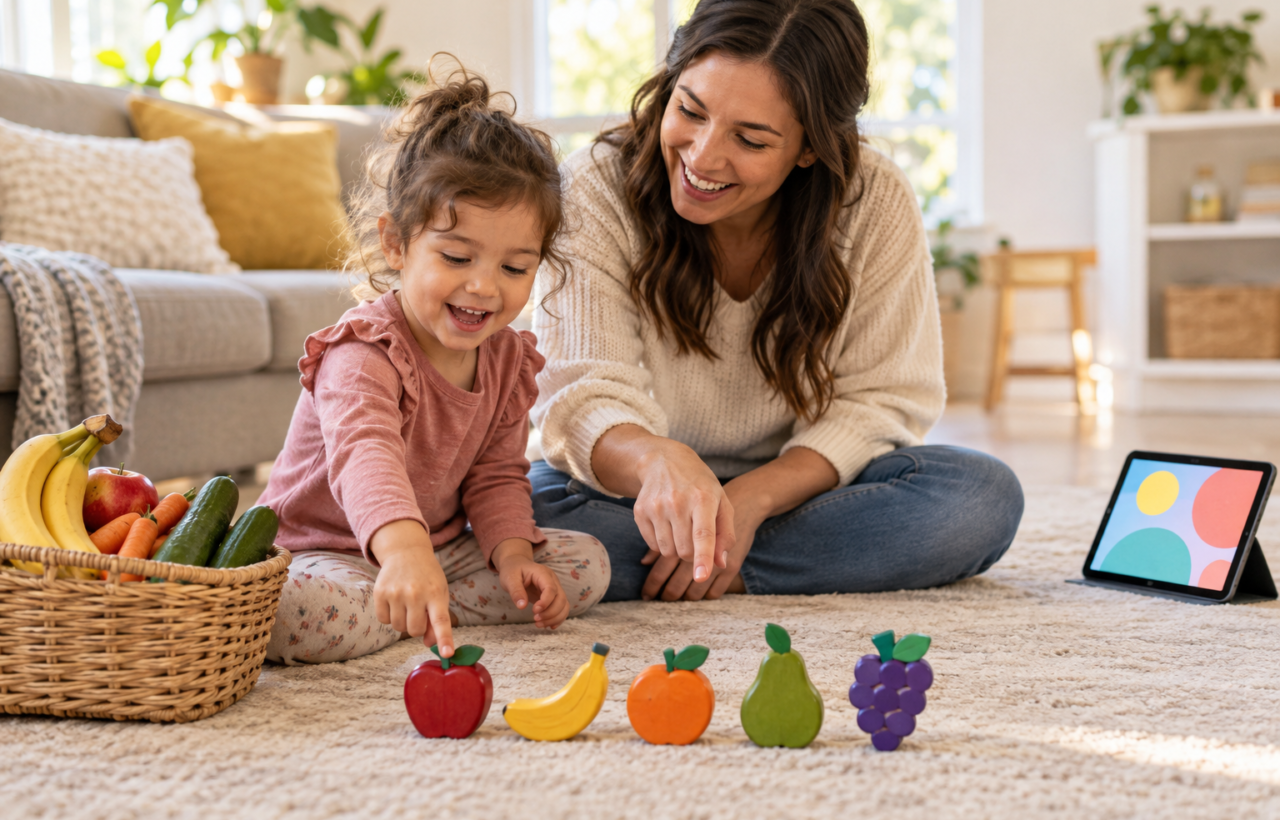
Your child can sing a CoComelon chorus from memory. But can they use the idea when the screen is off? That is the more useful question if you are choosing learning songs rather than simply looking for something familiar to watch.
A song can introduce and repeat a concept, but you give that concept somewhere to land. Pick one small learning target, join in without turning the song into a test, and bring the same idea into play or a family routine later. This works whether your child sings every word, contributes one sound, points, or copies a movement.
Choose one learning target before you press play
CoComelon has enough educational material that it is easy to ask one song to do too much. Counting alone can involve saying number words in order, matching each number to one object, counting backward, and recognizing what a total represents. A child may be ready for one of those tasks without being ready for all of them.
The available counting material ranges from forward and backward counting to counting as high as 100. Treat that range as a menu, not a developmental checklist. Hearing a song that reaches 100 does not mean your child needs to count to 100 or understand a group of that size.
- If your child is beginning to join in, focus on the order of a short number sequence.
- If they can recite numbers but skip objects, place or touch one object for each number word.
- If forward counting is familiar, use a countdown during a real action, such as putting toys into a basket.
- If your child is not speaking yet, invite them to show numbers with fingers, point, clap, or move an object.
Food songs need the same focus. CoComelon uses songs to introduce nutritious foods and early healthy-eating habits, but your immediate target might simply be recognizing a food, helping with a meal routine, or using a descriptive word. It does not have to be taking a bite.
Use the same three-step learning loop
You do not need a lesson plan. Use a short before-during-after loop that keeps the song enjoyable and gives your child a chance to use its idea.
- Before: Name one thing to notice. You might say, “Let’s listen for the numbers,” or, “Let’s see which foods we recognize.” One sentence is enough.
- During: Model the action instead of repeatedly questioning your child. Raise a finger for each count, move one toy at a time, or point to a relevant food image. Pause at a familiar gap only when your child enjoys supplying what comes next.
- After: Repeat the concept in an ordinary moment. Count blocks, shoes, steps, or toys. At a meal, name a food and describe something your child can observe about it.
The middle step is where well-meant learning often becomes a quiz. Asking, “What number is this?” after every line measures performance more than it supports participation. If your child turns away, becomes frustrated, or asks you to stop, let the song return to being a song. You can offer the idea again another day.
Make counting visible, not only singable
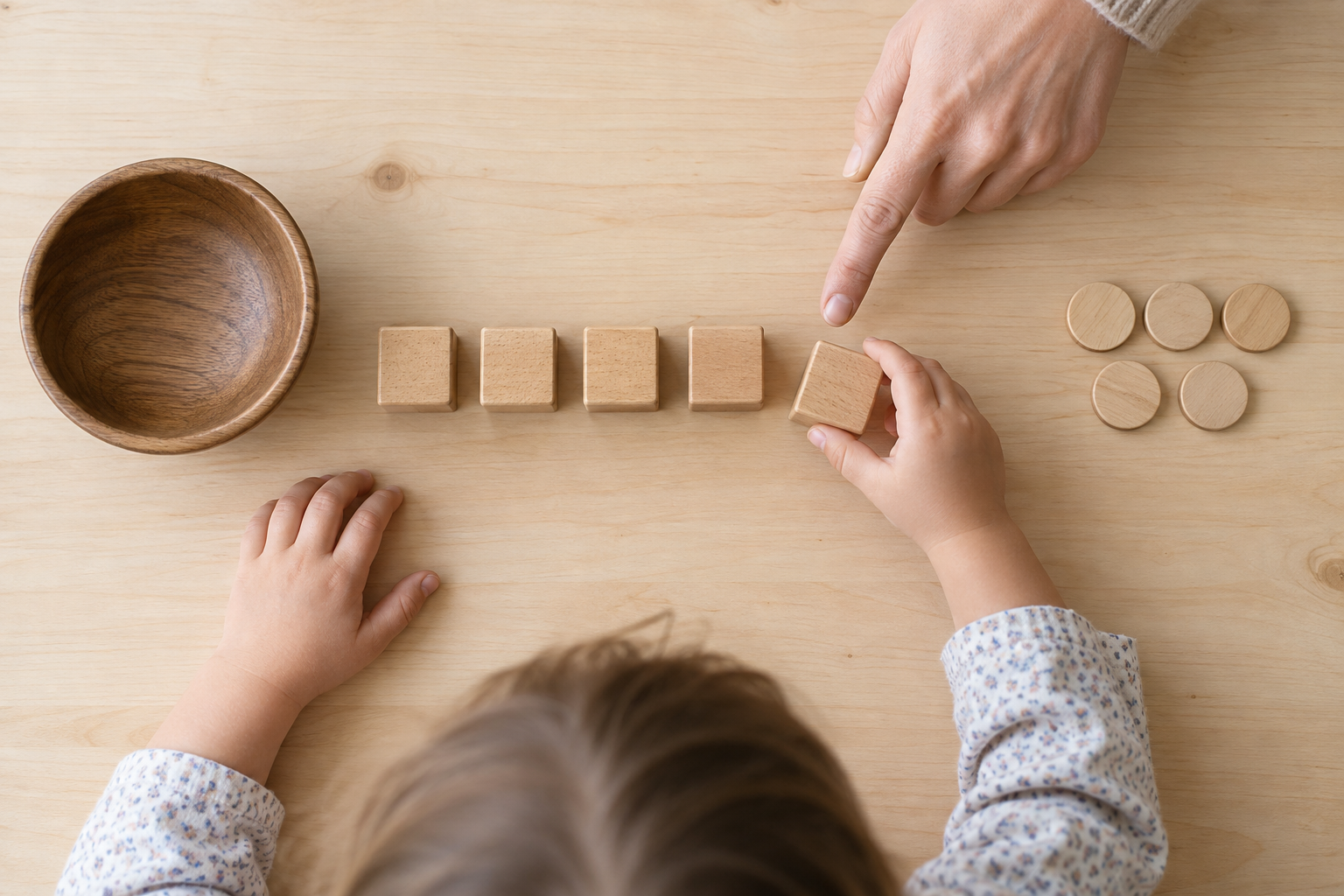
A child can memorize a number sequence without yet connecting each word to a quantity. You can make that connection visible by pairing every number with one movement or one object. The pairing matters more than creating an elaborate activity.
- Build and count: Add one block for each number. When the tower comes down, use a backward-counting song or rhythm to turn the reset into another practice opportunity.
- Park the toys: Move one car, animal, or figure into a space as you say each number. Slow down if the words get ahead of the objects.
- Count through cleanup: Put away one item per number. Stop when the available objects are gone rather than continuing the sequence without them.
- Leave a gap: Pause before a familiar number and give your child room to respond with a word, gesture, or object. Supply the answer casually if they do not respond.
- Change the objects: Once a sequence is familiar with blocks, try it with socks, spoons, or bath toys. Using the same idea with different objects is more informative than singing the same lyric perfectly.
Watch whether the count stays matched to the objects. If your child says several numbers while moving one toy, shorten the sequence and model one word for one movement. That gives you a precise next step without correcting every mistake.
Use food songs to build familiarity, not pressure
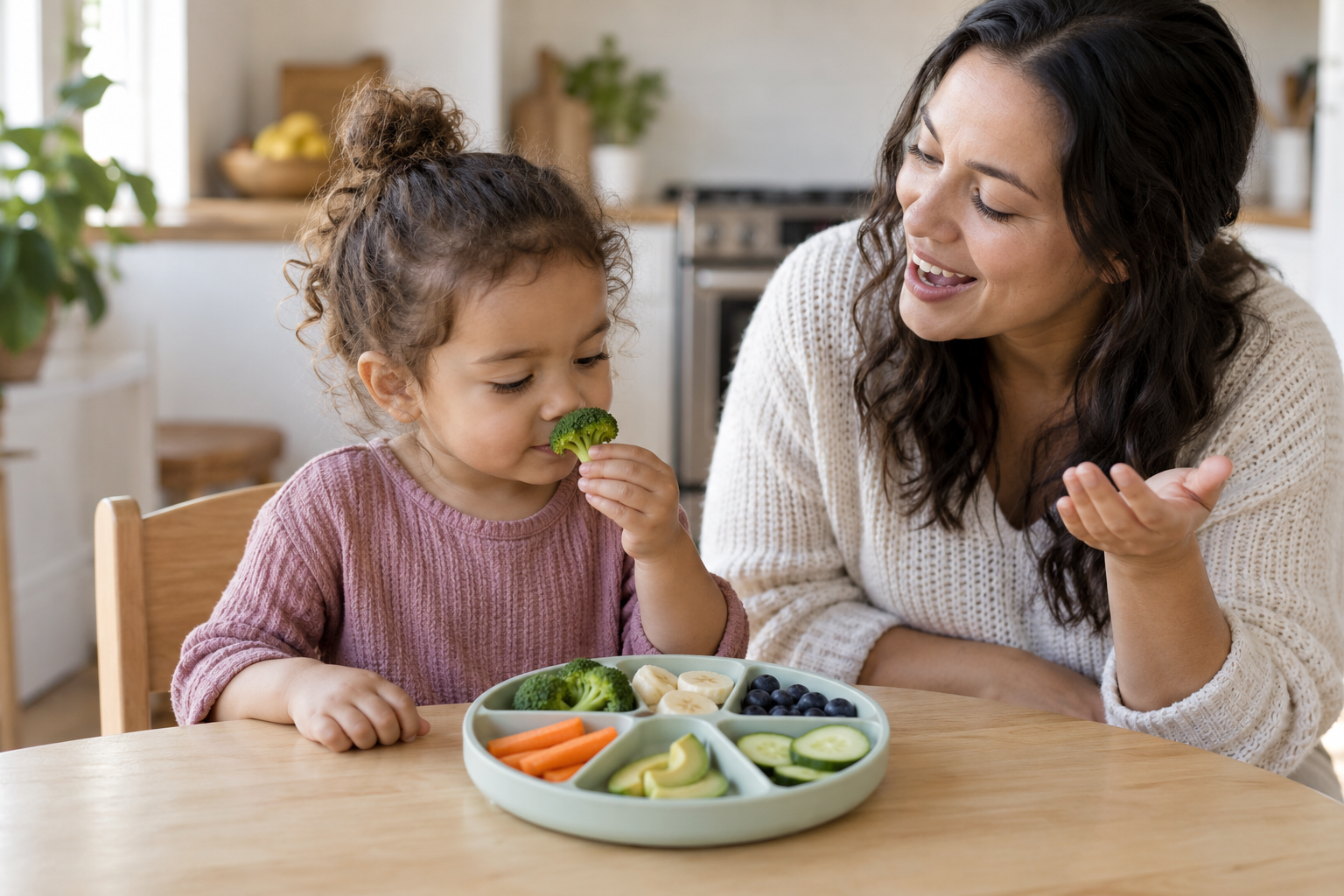
A food song can make names and routines familiar. It cannot decide whether your child is hungry, make an unfamiliar texture comfortable, or guarantee that a food will be eaten. Keep the learning goal separate from the number of bites taken.
- Name what is present: Point out a food that is actually on the table rather than testing your child on a long list.
- Describe what can be noticed: Talk about colour, shape, smell, temperature, or texture. Your child can participate by looking or pointing; tasting does not need to be the price of joining in.
- Connect the song to a routine: Reuse part of its rhythm while washing produce, carrying a plate, or helping set the table.
- Offer a manageable role: Let your child choose between two available utensils, point to a food, or place something on the table. The choice is about participation, not whether the meal itself is optional.
- End without a score: Avoid turning the song into a bargain in which singing requires a bite. Recognition, conversation, and calm participation are useful outcomes too.
If feeding involves suspected allergies, trouble chewing or swallowing, concerns about growth, or an extremely limited range of foods, a learning song is not the right tool for that problem. Bring the concern to your child’s health-care professional.
Look for learning away from the video
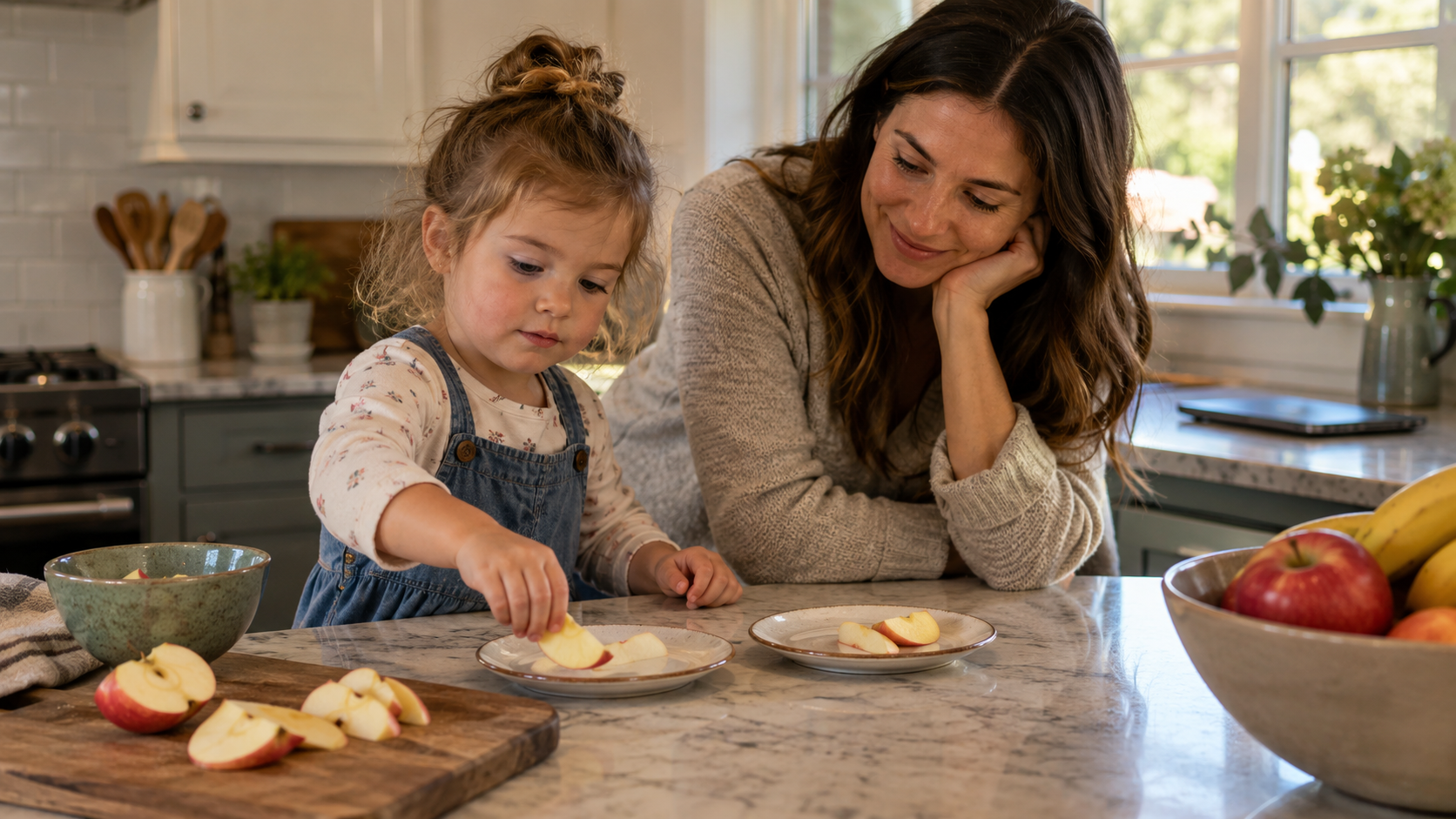
Perfectly repeating a lyric shows that the lyric is familiar. The stronger sign of useful learning is transfer: your child brings part of the idea into a different setting without needing the original scene on screen.
- Your child anticipates the next number in a sequence.
- They move or touch one object for each number word.
- They use a countdown while playing or tidying.
- They count a new kind of object, not only the objects shown in the song.
- They recognize or name a food during a meal or grocery routine.
- They copy a meal-preparation action or repeat relevant language when food is present.
You do not need to see all of these signs, and quiet watching does not prove that nothing was learned. Pick one behaviour that matches your target and notice whether it begins appearing elsewhere. If it does, keep using the idea in daily life. If it does not, make the task smaller: fewer objects, a shorter sequence, one food name, or one simple action.
Key takeaways
- Choose one goal for a song: number order, one-to-one counting, a countdown, food recognition, or participation in a routine.
- Tell your child what to notice before the song, model it during the song, and reuse it later with real objects or food.
- Treat counting to 100 as possible exposure, not as a required preschool milestone.
- Use food songs to support familiarity and conversation, not to pressure your child to eat.
- Judge progress by what your child uses away from the screen, not by how accurately they perform the entire song.
For the next CoComelon session, choose just one song and one follow-up action. Put a few toys nearby for counting, or save one food word for the next meal. A small connection your child can repeat in real life is more useful than trying to extract every possible lesson from one viewing.
References
- Parents – 13 ‘CoComelon’ Songs That Make Learning to Count Feel Like Play
- Parents – 15 ‘CoComelon’ Songs That Make Healthy Eating More Fun for Kids




