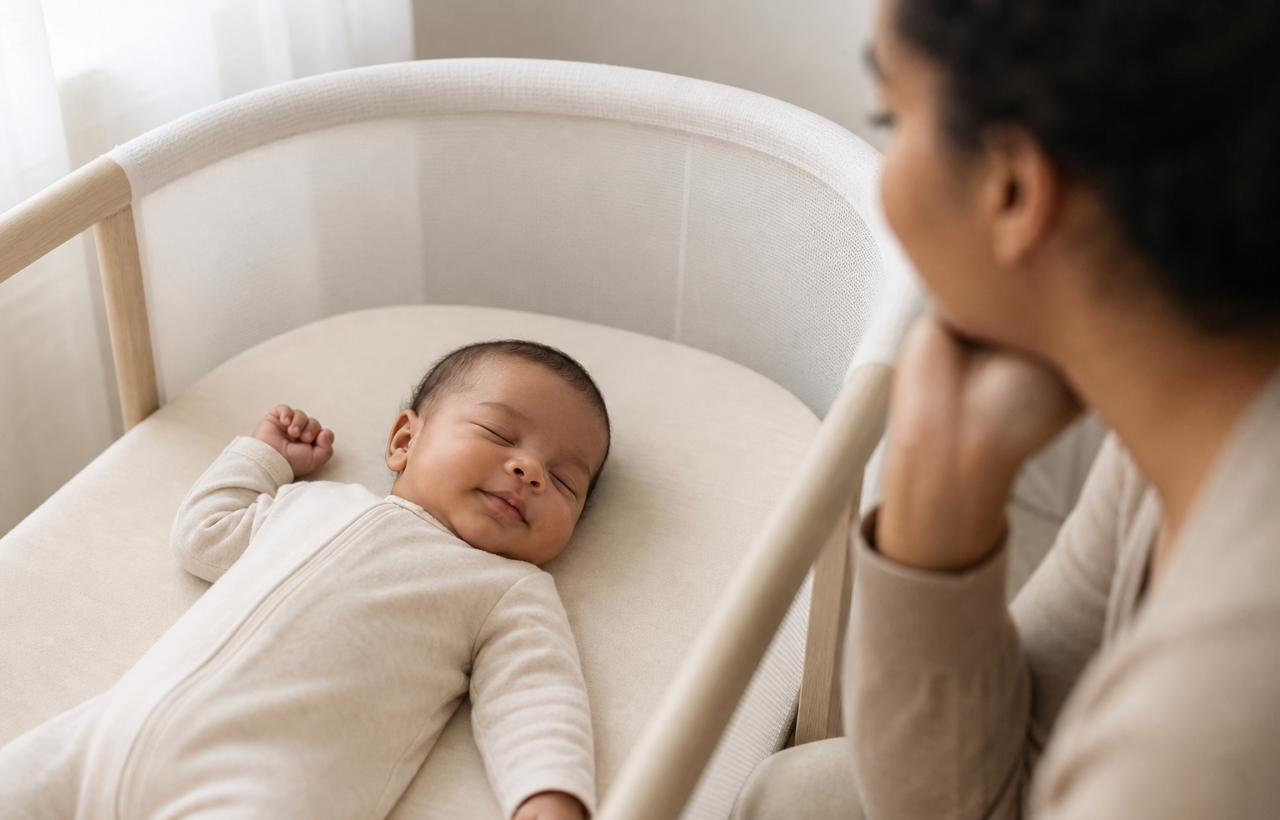
You catch a tiny grin while your baby is asleep. It looks deliberate, but it disappears before you can decide whether your baby was smiling at you, dreaming, or reacting to something in their body.
In the first weeks, a sleepy smile is usually an automatic facial movement rather than a message. Knowing what surrounds the smile – sleep, wakefulness, eye contact, laughter, or repeated movements – helps you distinguish normal active-sleep behaviour from an emerging social milestone and from the rare pattern that needs medical attention.
The smile usually starts inside the sleep cycle
Newborn sleep is surprisingly active. Newborns spend about half of their sleep in rapid eye movement sleep, often called REM or active sleep. That compares with roughly one-third for older babies and about one-fifth for adults. With so much time in this active stage, parents have many chances to see facial expressions and small movements.
During active sleep, your baby’s eyes may move behind closed lids. You may also notice twitching, arm or leg movements, sucking motions, and brief smiles alongside the other activity. A quick grin that appears in this setting and fades on its own fits the usual active-sleep pattern.
The expression is still part of development even when it is not intentional communication. A young nervous system is coordinating signals, sensations, and facial muscles. Smiling may also give those muscles early practice, although you cannot tell from one grin exactly what your baby is processing.
Sleep smiles and social smiles give you different clues
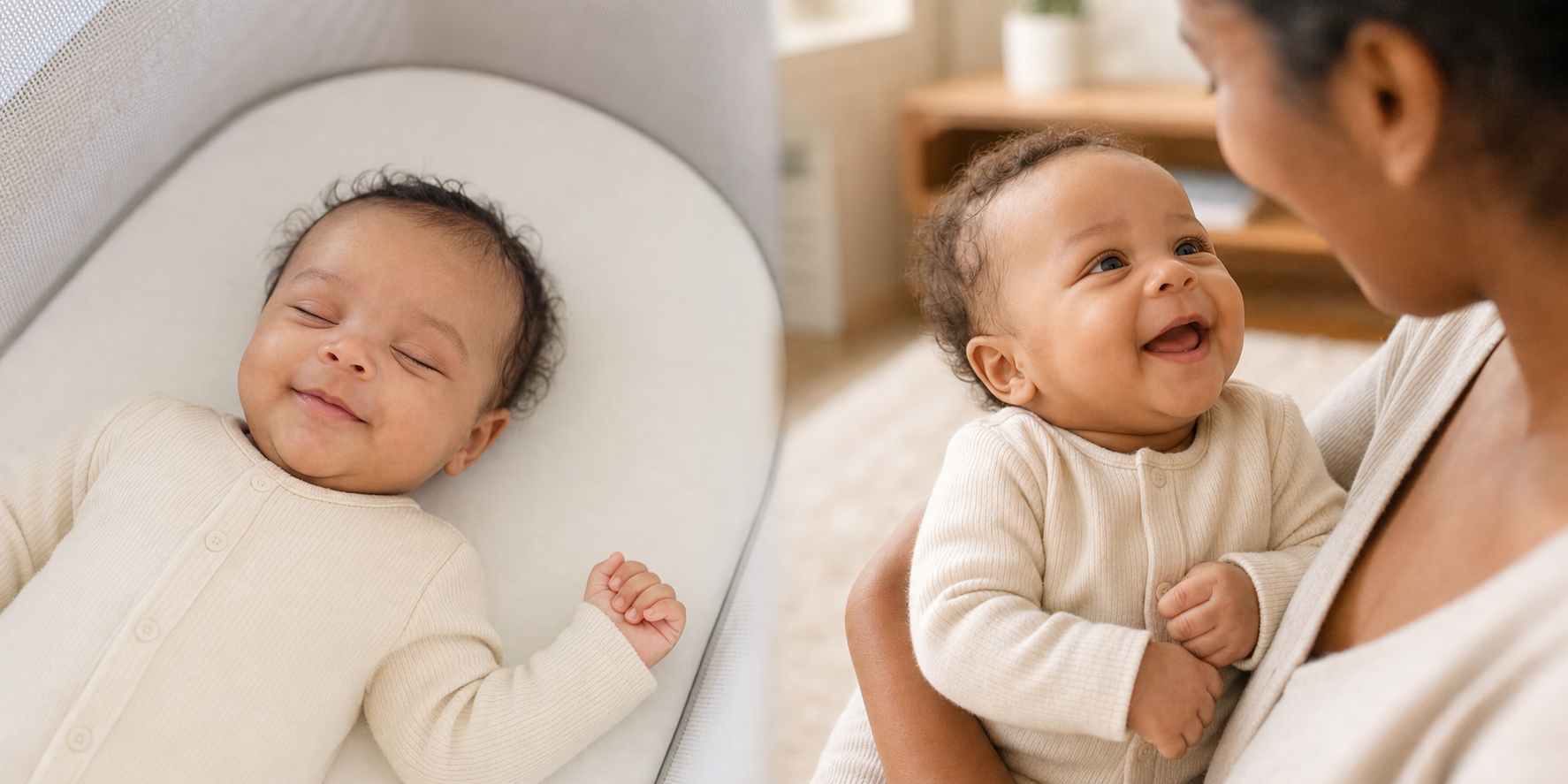
The most useful distinction is not how cute or convincing the smile looks. It is whether the expression happens as part of an awake, back-and-forth exchange.
| Clue | Sleep smile | Emerging social smile |
|---|---|---|
| Baby’s state | Asleep, often during active sleep | Awake and engaged |
| Likely trigger | Internal nervous-system activity or body sensations | A face, familiar voice, eye contact, or playful interaction |
| Usual timing | Common in the earliest weeks | Often begins around 6 to 8 weeks |
| Appearance | Brief and often closed-mouth | Often more open-mouthed and engaged |
| What it tells you | An automatic expression occurred during sleep | Your baby may be responding to another person |
No mouth shape proves what kind of smile you saw. Context is the better test. When your baby is awake and settled, bring your face into view, speak or smile, and then pause. A smile that follows your voice, expression, or eye contact is a stronger sign of social engagement than one that appears without an external prompt.
Social smiling commonly begins between 6 and 8 weeks. Treat that as a useful developmental window, not a diagnosis based on a date. If you are concerned about your baby’s responsiveness or development, discuss the pattern with your child’s health-care professional.
A grin cannot confirm a happy dream or trapped gas
It is tempting to give a sleep smile a story, especially when the expression looks peaceful. But it has not been established that young babies dream in the same way older children and adults do. A grin is therefore not proof that your baby is having a happy dream.
Body sensations may contribute to facial movements. Digestion, warmth, touch, and other internal signals are all new experiences for an infant. Still, there is no medical evidence proving that babies smile because of gas. The expression cannot tell you that gas passed, discomfort ended, or a digestive problem is present.
The practical rule is simple: do not use the grin alone to draw conclusions about dreams, mood, comfort, or digestion. Look at the whole situation. Sleep state, responsiveness, accompanying movements, and whether the pattern repeats tell you more than the smile’s shape.
Repeated, uncontrollable laughter is a different pattern

A fleeting sleep smile is usually ordinary. Rarely, however, unusual laughter around sleep can be associated with a gelastic seizure. This does not look like a single quiet grin. The concerning pattern is an episode of laughter that seems involuntary or uncontrollable and may recur in a similar way.
Features worth reporting to your child’s doctor include:
- Laughter rather than a brief smile, especially when it appears uncontrollable.
- An episode lasting about 20 to 30 seconds.
- Squirming, grunting, or lip smacking during the episode.
- The same cluster of laughter and movements happening repeatedly.
These signs do not let you diagnose a seizure at home. They do give a clinician a reason to assess what happened. About one-third of people diagnosed with gelastic seizures had their first episode during infancy, so a baby’s young age is not a reason to dismiss a repeated, unusual pattern.
If you see an episode like this, keep your baby calm and safe, then contact your child’s doctor to decide what should happen next. Be ready to describe how long it lasted, whether your baby responded to you, which movements occurred, and whether you have seen the same sequence before. A normal brief sleep smile by itself does not match this description.
Key takeaways for the next smile you see
- In the earliest weeks, most smiles during sleep are automatic rather than socially directed.
- Active sleep can include eye movements behind closed lids, twitching, sucking motions, limb movements, and brief smiles.
- An emerging social smile happens while your baby is awake and responds to a face, voice, play, or eye contact, often beginning around 6 to 8 weeks.
- A sleep grin cannot confirm a happy dream, positive emotion, or relief from gas.
- Repeated, uncontrollable laughter lasting about 20 to 30 seconds, especially with squirming, grunting, or lip smacking, should be discussed with your child’s doctor.
Over the coming weeks, watch for the shift from an isolated sleeping grin to an awake smile that answers you. In the moment, check three things: whether your baby is asleep or awake, whether you saw a brief smile or sustained laughter, and whether unusual movements repeat with it. Those details let you enjoy an ordinary sleep smile while still noticing when the pattern deserves a closer look.