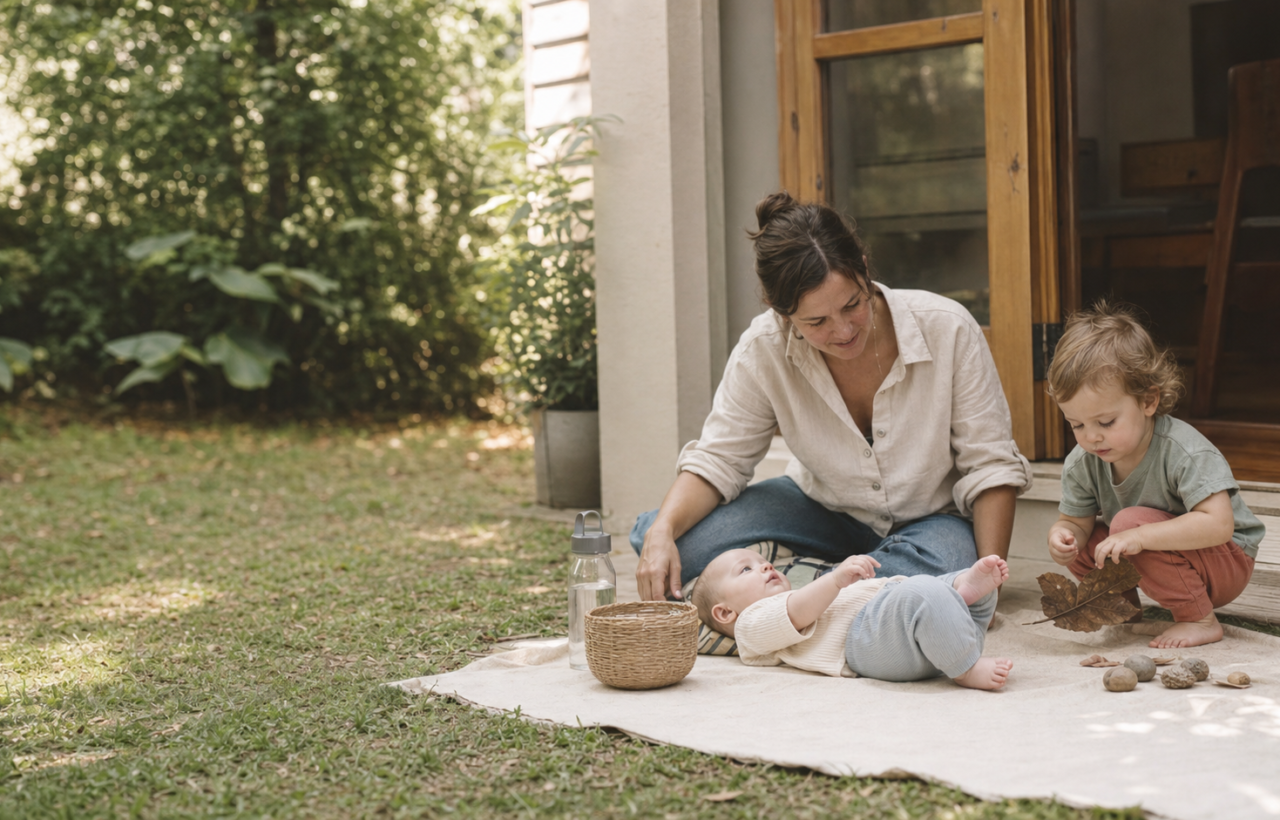
You get everyone dressed, carry half the house to the door, and finally make it outside. Then your baby fusses on the blanket or your toddler asks to go back in. If outdoor play feels like more work than play, you probably do not need a better activity. You need an easier transition and a simpler starting point.
For children from birth to age three, success does not mean hours of independent play. It can mean a calm look at the trees, several rounds of filling and dumping a container, or a short walk during which your toddler stops to inspect every rock. The aim is to make going outside familiar enough that neither of you needs a special plan.
Fix the transition before you fix the activity
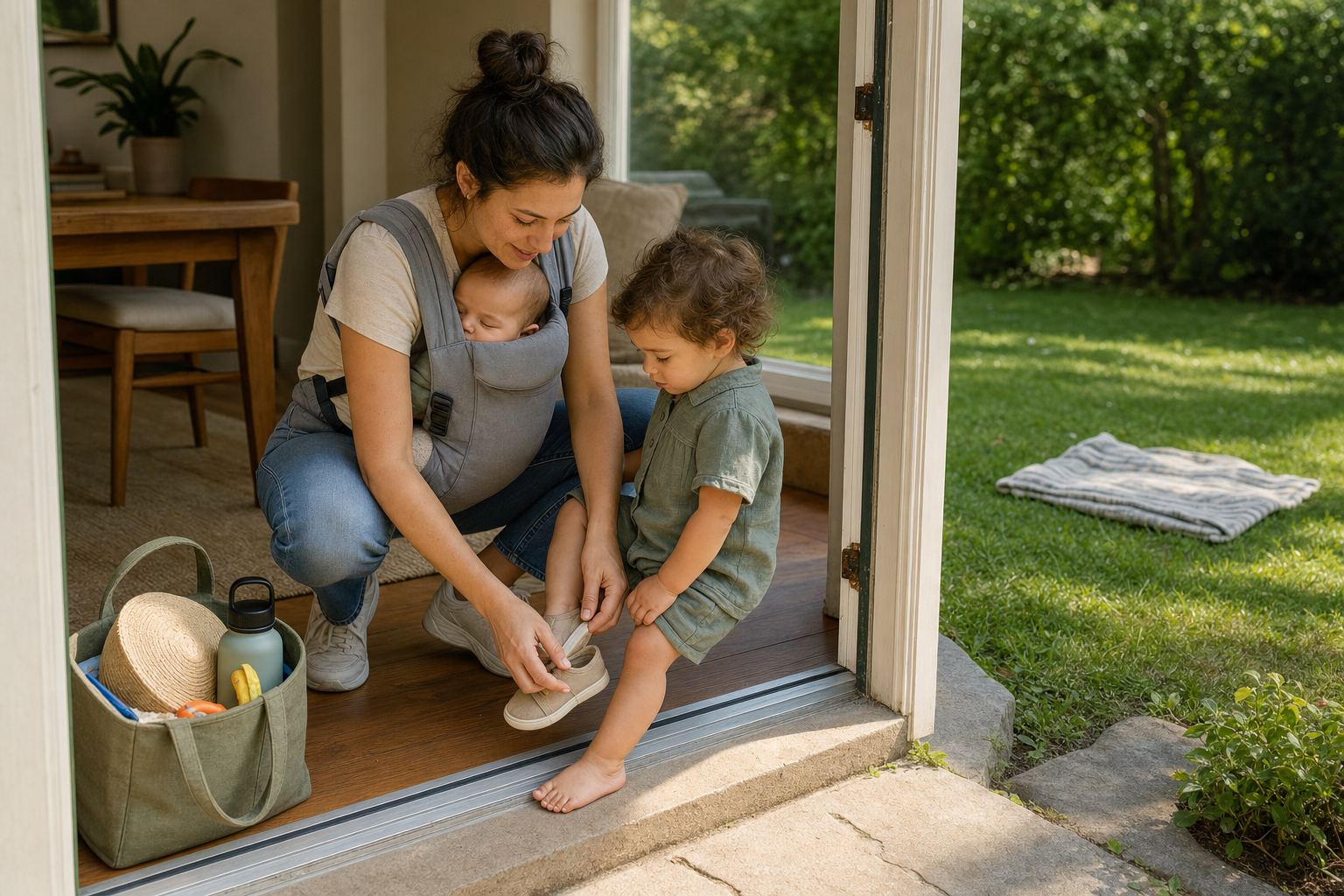
Resistance often peaks before a child gets outside: a screen or toy has to be put down, shoes have to go on, and the day suddenly changes direction. Once you recognize the transition as the hard part, you can stop treating every refusal as proof that your child dislikes outdoor play.
Give outside time a predictable place in the day. You might go out after breakfast, after a nap, or while waiting for dinner. The particular moment matters less than using a cue your child can learn. Say, “Snack is finished; now we put on shoes and go outside,” instead of repeatedly asking whether they want to go.
A toddler can still have a useful choice without deciding whether the outing happens: “Boots or sneakers?” “Ball or chalk?” “Stroller first or walking first?” Two concrete options preserve some control while keeping the routine moving.
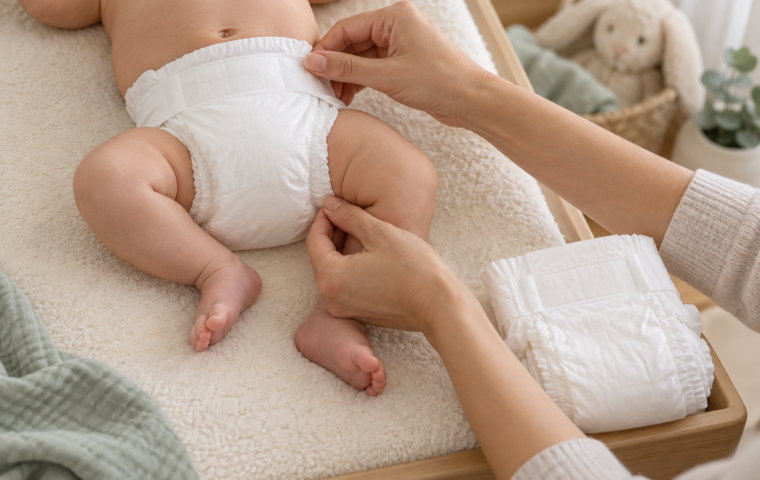
Remove as many practical delays as you can. Keep outdoor shoes, weather-appropriate layers and a small play bin near the exit. Restock diapers and wipes after an outing rather than when everyone is waiting at the door. If getting outside requires searching several rooms for supplies, the routine will feel unusually difficult on an already tiring day.
Choose outdoor play that fits your child’s stage
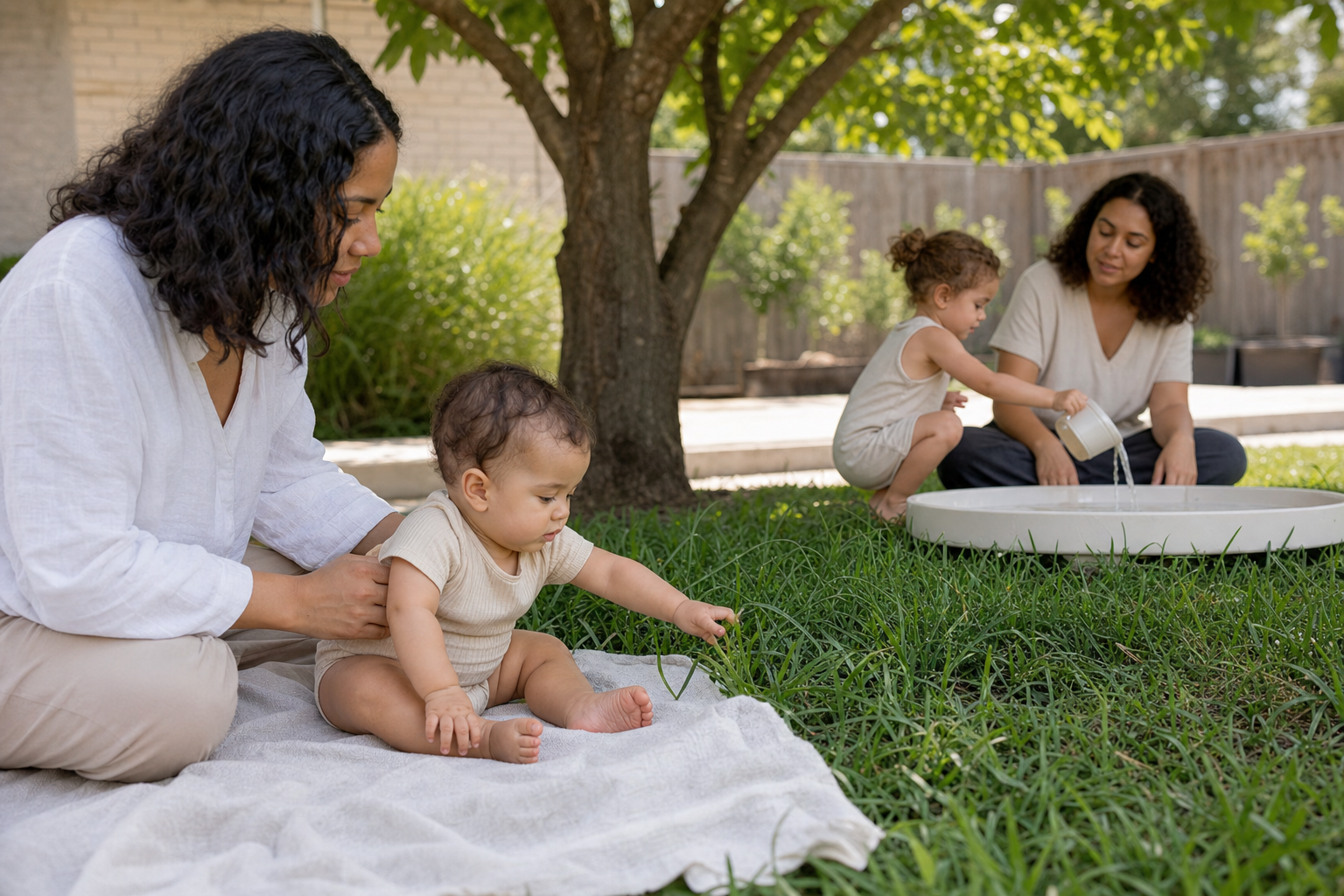
“Go play” is a workable instruction for some older children. It is not a realistic starting point for a baby or a young toddler. Children under three need supervision, an accessible place to move and materials suited to what they can currently do. Your role changes as their mobility and attention change.
For babies who are not yet mobile
Think of outside time as shared observation rather than independent entertainment. Sit together on a blanket or hold your baby where they can watch leaves move, follow shadows, listen to birds and feel a breeze. Name what has caught their attention without trying to produce a constant stream of stimulation: “The branch is moving,” or “You hear a truck.”
Bring one familiar floor toy if it helps your baby settle, but let the surroundings do some of the work. Outdoor play at this stage can be quiet. Looking, listening, reaching and turning toward a sound are all ways of participating.
For crawling babies and young toddlers
Build around actions your child already repeats: carrying, pushing, dropping, filling, emptying and climbing onto low, stable surfaces. Offer a ball to chase, large containers to nest, a bucket to carry or a push toy on a clear surface. A small amount of water with cups can support repeated filling and pouring while you remain close and attentive.
Children in this stage explore with their mouths as well as their hands. Skip small stones, short sticks, chalk pieces and other objects that could be swallowed or cause an injury. Check the area before play, use large age-appropriate materials, and stay close enough to intervene. Water play also requires continuous adult supervision, even when the container is shallow.
For older toddlers approaching age three
Offer a simple purpose and leave room for your child to change it. A paintbrush and water can become sidewalk painting, toy washing or puddle making. Chalk can become roads, parking spaces, shapes or marks with no recognizable subject. A ride-on toy can become a delivery vehicle once you add a chalk destination or a safe obstacle to travel around.
You can also turn a walk into a spoken scavenger hunt: find something red, something rough, something that moves, or two leaves that look different. There is no need to print a checklist. The point is to help your toddler notice the space, not to complete every prompt.
Start the play, then stop directing it
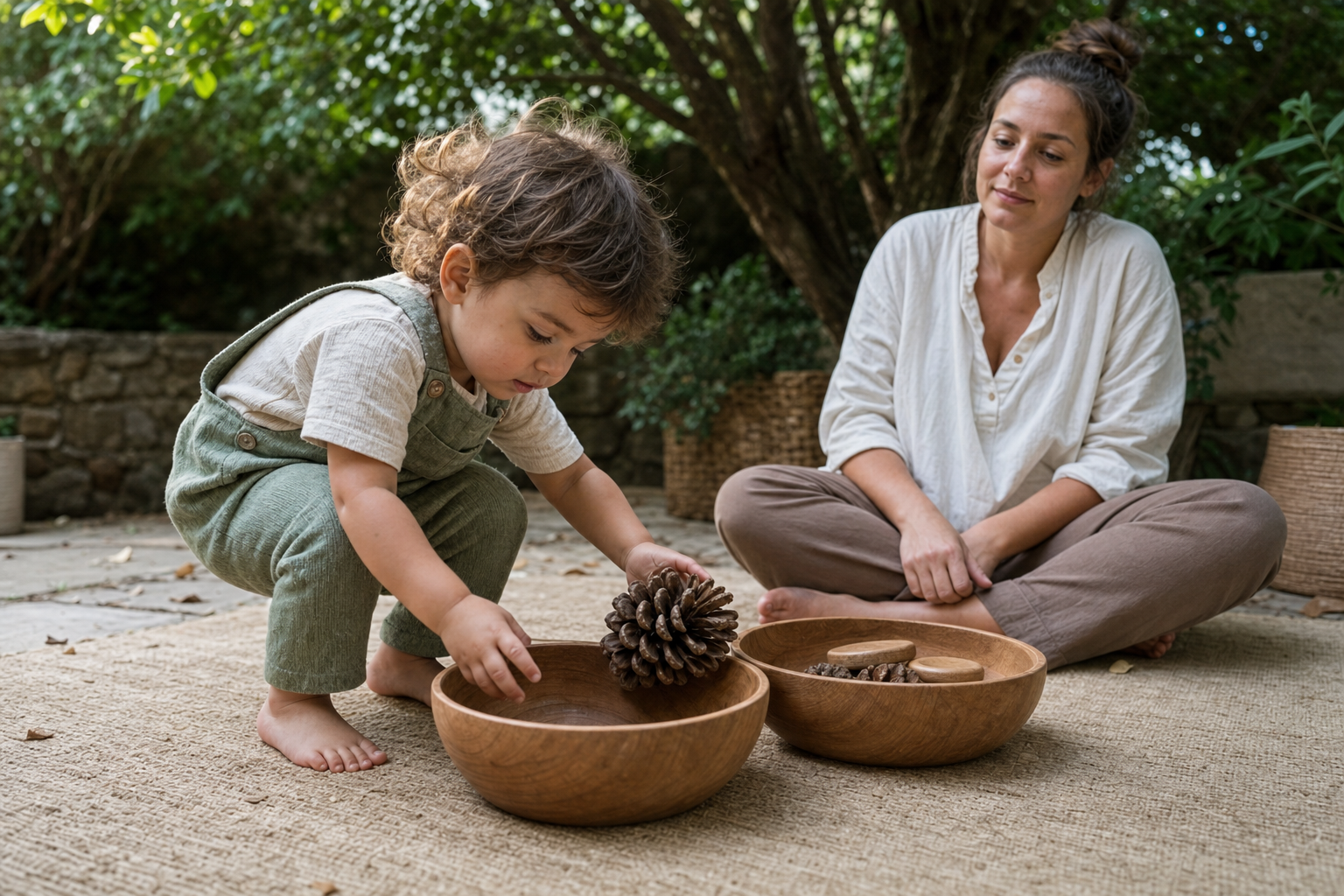
Some toddlers begin playing as soon as the door opens. Others stand beside you and say there is nothing to do. In that moment, give one small invitation rather than presenting a menu of activities.
- “Can you make this dry pavement darker with the wet brush?”
- “Where should we park this truck?”
- “Can this cup hold all of the water?”
- “Let’s find a smooth thing and a bumpy thing.”
- “These animals need a place to sleep. What could we build?”
Join just long enough to make the action clear. Wet one patch, draw the beginning of a road, place one toy animal in a bucket or roll the ball once. Then pause. If your child changes the plan, follow their version instead of correcting it.
This is the difference between an invitation and a performance. An invitation gives your child an entry point. A performance makes you responsible for keeping the activity interesting. Outdoor environments can help children move from waiting for entertainment to creating play from what is already present, especially when they have simple, open-ended materials.
Do not rush to fill every pause. A toddler may watch, wander or repeat one apparently pointless action before a game takes shape. Moving rocks from one place to another may look like preparation for play to an adult, but for the child, that repeated action may be the play.
Build a small outdoor setup that can change
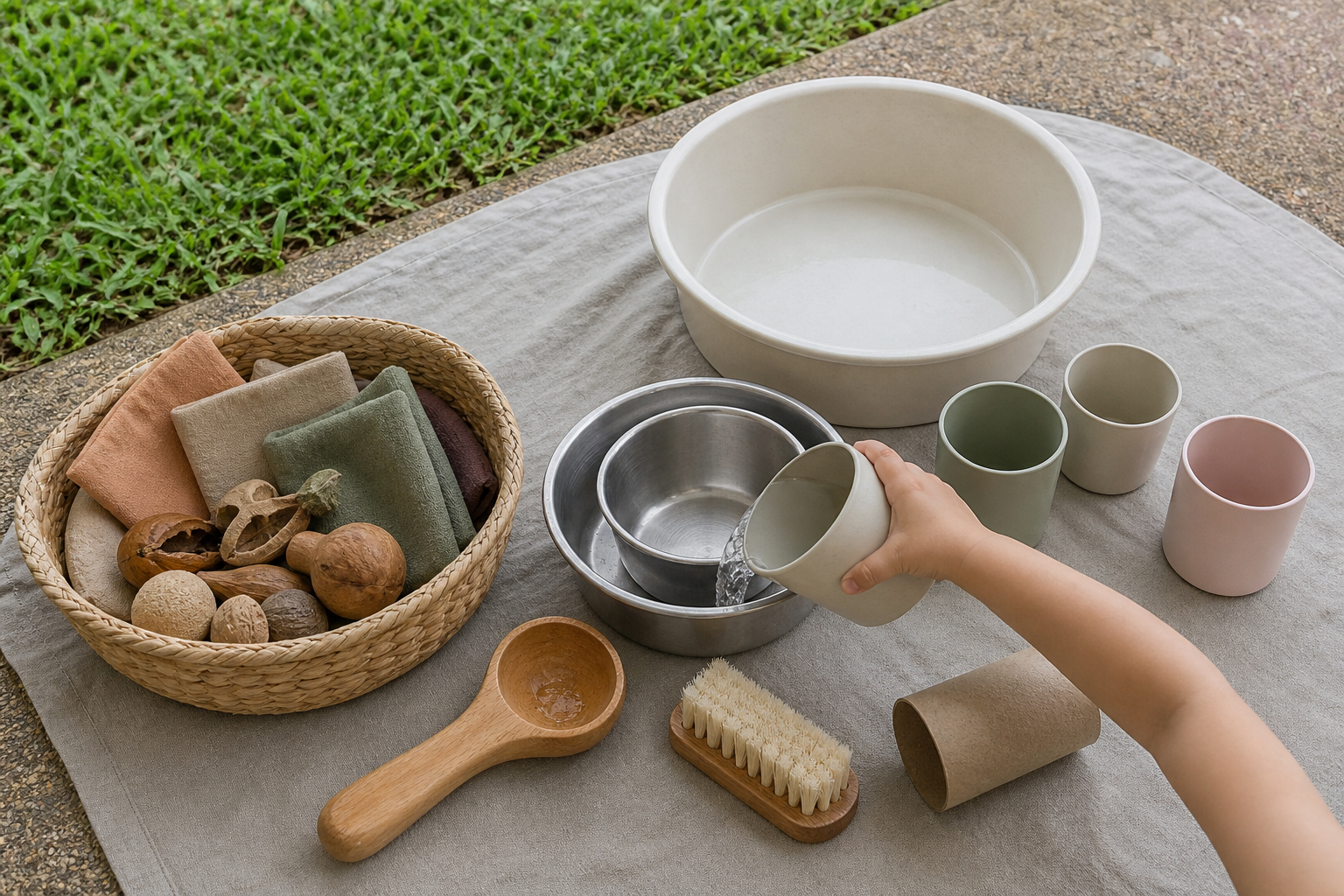
A crowded yard or a large collection of outdoor toys is not necessary. In fact, too many visible choices can make it harder for a young child to settle. Start with a small bin and bring out only a few items at a time.
- A ball that is easy to roll, carry and kick
- Bubbles for an adult to blow and a child to chase
- Large cups, a bucket, a sponge and a paintbrush for water play
- Washable sidewalk chalk for a toddler who no longer mouths play materials
- Toy animals, vehicles or other familiar figures
- Large containers that can be filled, emptied, stacked or used as pretend furniture
Rotate what is available every week or two instead of buying something whenever interest fades. A bucket that disappeared for a while can feel newly useful when it returns beside a sponge or a toy truck.
Open-ended materials are valuable because they do not dictate one finished result. A large cardboard box can be a tunnel, shop counter or garage. A flower pot can hold water, become a drum or serve as a bed for a toy animal. For a child under three, however, “loose parts” must still be selected with close supervision and safety in mind. Avoid sharp, splintered, breakable or mouth-sized objects, and remove loops or cords that could become hazardous.
No yard is required. A balcony that has been made safe, a front step, a shared courtyard, a patch of grass or a nearby path can support the same kinds of play. Match the materials to the space: water and brushes on a paved surface, a ball in an open area, or a noticing walk where there is no room to spread out.
Help outdoor play last without forcing it
When a child wants to go back inside quickly, first check the ordinary causes. They may be hungry, tired, too hot or cold, wet, uncomfortable in their clothing, overwhelmed by noise, or frustrated because the available play is beyond their current ability. Solving that problem will do more than introducing a more elaborate activity.
Keep early outings easy to end. Play close to home or the stroller, and carry a compact kit with the diapering supplies, drink and spare layer you normally need. A short, manageable outing that ends calmly is more useful for building the routine than staying outside until everyone is miserable.
If your toddler loses interest, change one element rather than replacing the entire setup. Add water to the cups. Put a toy animal in the chalk road. Move the bucket to a different surface. Ask whether the ball can roll down a small slope. One change can open a new direction while allowing your child to remain inside the play they have already built.
Also notice what repeatedly holds your child’s attention. One toddler may return to water every time. Another may want to carry objects along a path. Another may spend the whole outing watching vehicles. Use that pattern when choosing tomorrow’s invitation. You do not need novelty when repetition is still working.
Key takeaways for your next trip outside
- Attach outdoor time to a familiar part of the day so leaving the house is not a fresh negotiation.
- Offer a toddler two practical choices, such as shoes or one item to bring, rather than asking an open-ended question about going out.
- Match play to the child’s current actions: watching and reaching for babies; filling, carrying and pushing for mobile children; simple pretend prompts for older toddlers.
- Begin with one invitation and step back when your child takes over.
- Keep a small outdoor bin and rotate a few items instead of presenting everything at once.
- Treat short outings as worthwhile. Familiarity comes from going outside regularly, not from forcing each session to last.
On the next suitable day, choose the easiest possible version: shoes on, one ball or bucket, and a nearby place where your child can move safely. Give one starting idea, then watch what they do with it. That response will tell you more about the next outing than a long list of activities ever could.