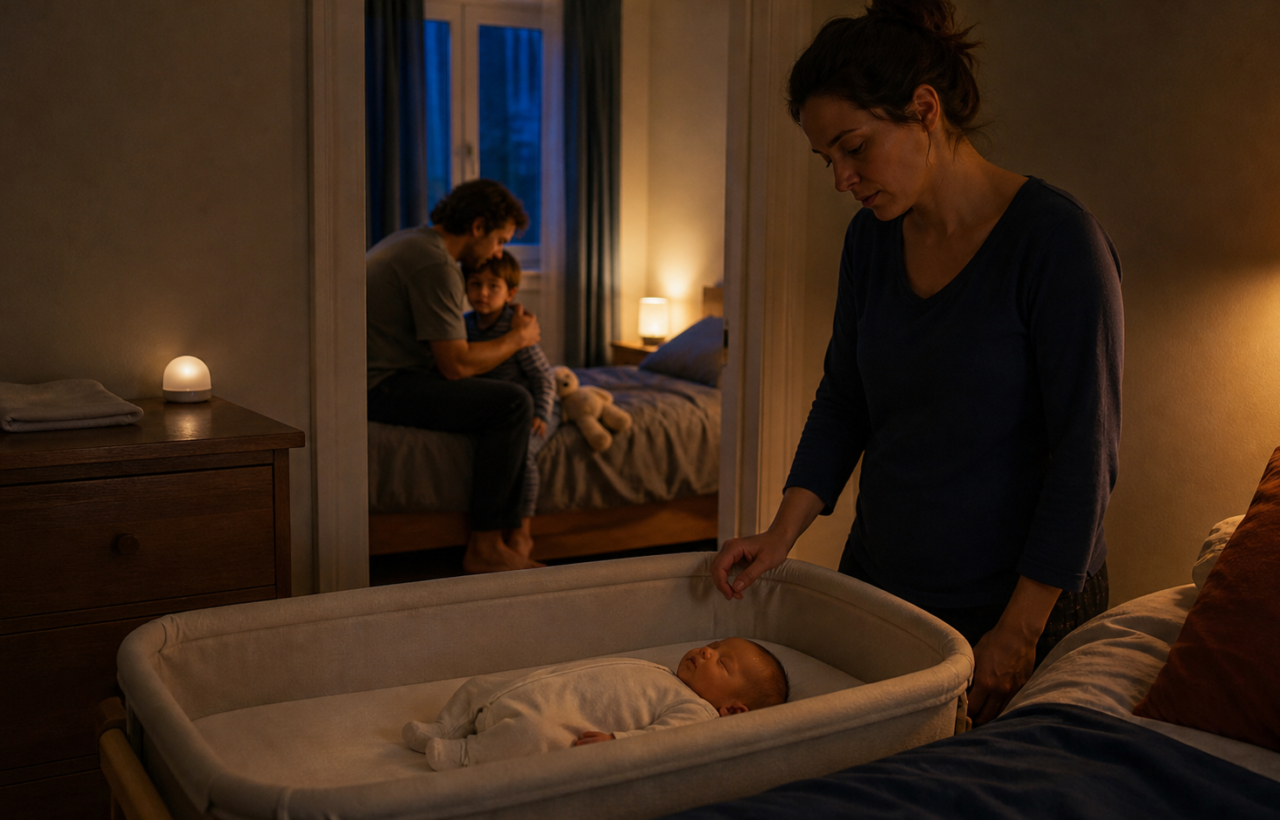
Your newborn has finally settled when your older child calls for water, another hug, or help finding the one stuffed animal that matters tonight. Then morning arrives on the older child’s schedule, no matter how often the baby woke.
That overlap is the real difficulty of newborn sleep in a multi-child family. You may feel more confident caring for a baby this time, but confidence doesn’t make two children’s needs happen one at a time. The workable goal is not to make everyone sleep on the same schedule. It is to protect a few dependable parts of the night so the whole household can function.
Stop trying to make every child’s sleep line up

A newborn’s feeding and waking patterns will not reliably coordinate with an older child’s bedtime. If you treat synchronization as the goal, every interruption feels like proof that the plan has failed. Build a minimum standard for the night instead.
That standard should include a safe place for the baby to sleep, a recognizable bedtime sequence for the older child, a default division of overnight work, and a plan for the morning. Those anchors can remain in place even when the timing of feeds changes or one child has a difficult night.
Key takeaways
- Judge the first weeks by whether everyone is safe and getting chances to recover, not by whether the newborn follows a schedule.
- Keep the older child’s bedtime sequence as familiar as possible, even when you need to shorten it.
- Decide before bedtime who responds to the baby, who responds to older children, and who covers the early morning.
- When nursing makes an equal split impossible, move the diapering, burping, settling, and environmental checks to the other adult where possible.
- Treat every night setup as if it will be used by a very tired caregiver. Clear, simple, safe arrangements beat elaborate systems.
Match your expectations to the first 100 nights

The first 100 nights are better treated as a planning window than a deadline. Your baby may move through it differently, and a longer stretch on one night does not establish a permanent pattern. Still, the rough phases can help you decide what kind of effort is useful at each point.
| Period | What may be happening | What to do differently |
|---|---|---|
| Weeks 1-4 | Newborn feeds commonly occur every two to three hours around the clock. | Focus on recovering between feeds. Do not spend scarce energy trying to force a sleep schedule. |
| Weeks 5-8 | Some babies begin to sleep for a slightly longer stretch overnight, but the change may not arrive predictably. | Keep the sleep environment consistent. Avoid rebuilding the family’s routine around one unusually good night. |
| Weeks 9-12 | A longer first stretch, clearer sleepy cues, and a more readable daily pattern may begin to appear. | Add light structure around the pattern you can actually observe rather than the schedule you hoped to have. |
| Approaching night 100 | The baby may be consolidating more sleep while older children become accustomed to the household’s new rhythm. | Keep the few routines and handoffs that reduce friction. Let the rest remain flexible. |
In the earliest phase, the useful question is not, “How do we get the baby sleeping through?” It is, “Where can each adult recover before the next unavoidable task?” That might mean going to bed soon after the older child, handing the post-feed settling to someone else, or asking visiting family to cover breakfast and the older child’s morning routine rather than holding the baby while you remain on duty.
As patterns emerge, watch the baby’s first stretch of the night. It may become the best opportunity for the adult handling feeds to sleep. Protecting that opportunity can matter more than completing evening chores that can wait.
Use the older child’s bedtime as the household anchor

Your older child’s familiar bedtime does two jobs. It reassures them that an important part of family life still belongs to them, and it gives the adults a known point around which to arrange the evening. It does not need to be elaborate. It needs to be recognizable.
Keep the sequence more consistent than the clock: wash, pajamas, book, cuddle, bed, for example. On a difficult evening, shorten individual steps instead of abandoning the sequence. One book instead of several still feels more familiar than a completely improvised bedtime.
<!– wp:list {