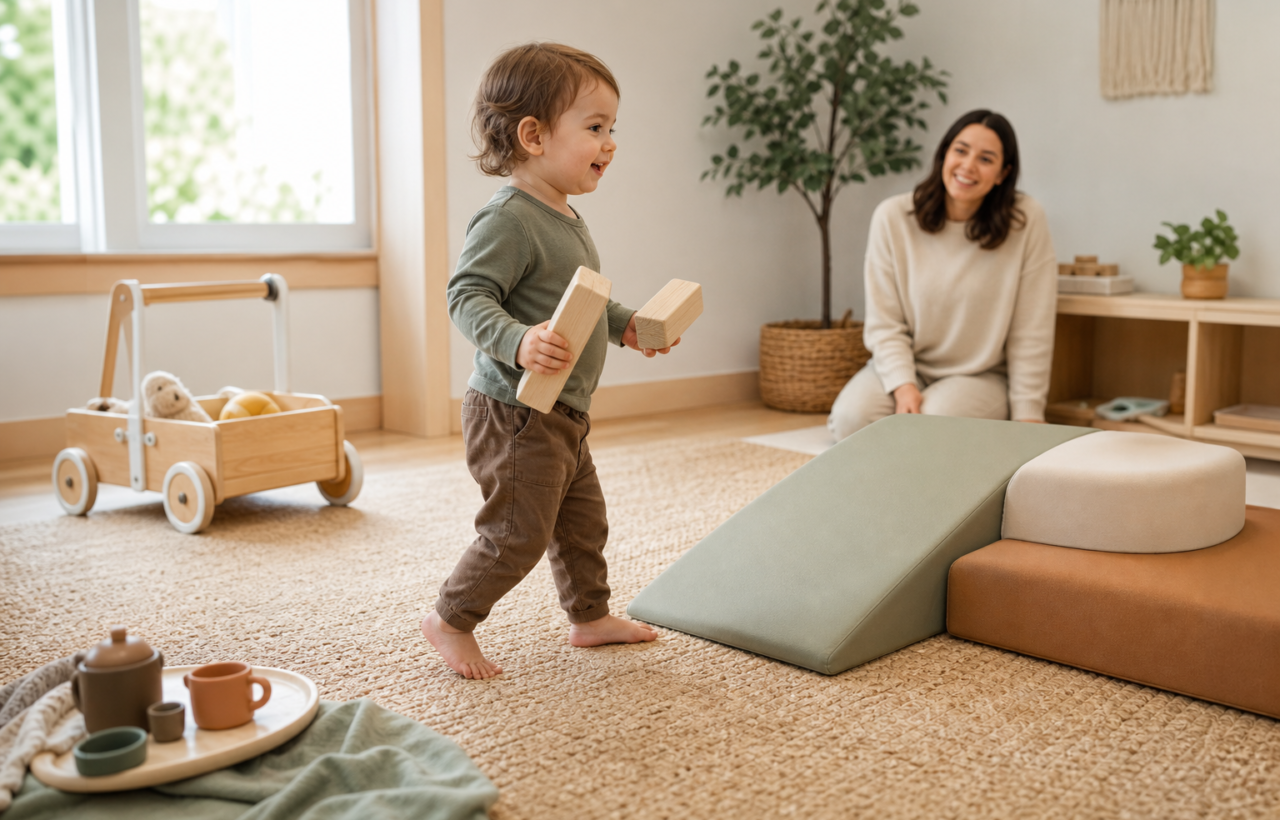
Your toddler is halfway onto the sofa, pushing a laundry basket across the room, or carrying every block they own from one corner to another. The right developmental toy does not try to make that child sit still. It gives all that movement a safer purpose.
Around 18 months, useful toys encourage independent exploration and pretend play. For an active toddler, the best choices combine those opportunities with climbing, pushing, carrying, steering, reaching, or squatting. The goal is not to buy the busiest toy. It is to match the toy to the action your child already wants to repeat.
Key takeaways
- Watch what your toddler repeatedly tries to do before choosing a toy: climb, push, carry, dump, reach, chase, or act out familiar routines.
- Choose a toy that adds a manageable next step to a movement your child can already begin and finish safely.
- Evaluate the play area along with the product. A good climbing toy in the wrong room is still the wrong choice.
- Look for repeatable play rather than electronic features. A ramp that becomes a slide, tunnel, ball run, and pretend road offers several kinds of play without changing the equipment.
- Follow the product’s age range, assembly instructions, intended configuration, and supervision guidance. Do not make a toy more challenging by stacking or raising it unless it was designed for that use.
Start with the action your toddler keeps choosing
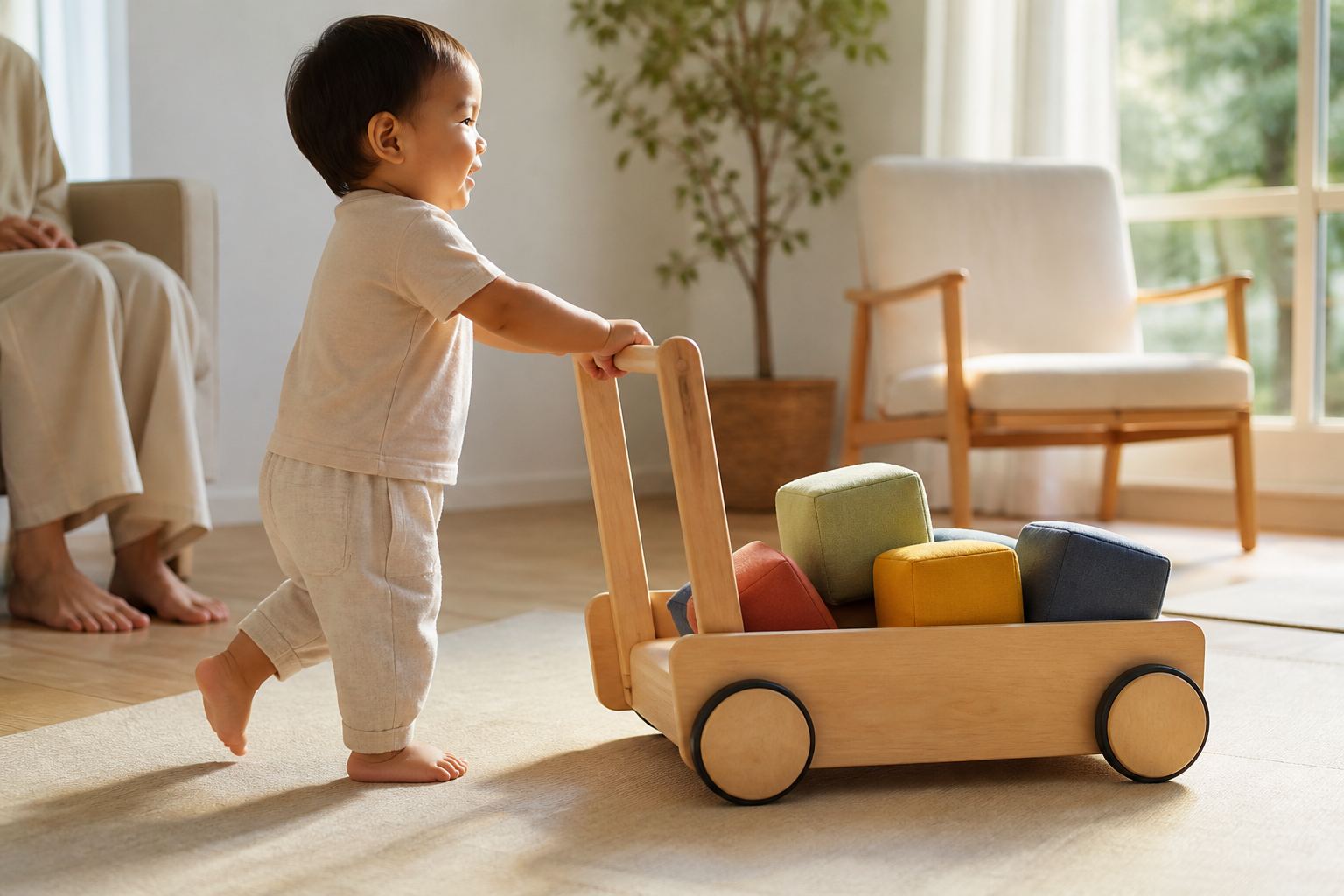
Before shopping, watch a few ordinary play periods. Ignore which objects your child is using and notice the action instead. A toddler who pushes a dining chair may be asking for pushing and steering, not for another vehicle with buttons. A child who empties every drawer may be interested in carrying, sorting, and dumping. The behaviour tells you more than the packaging does.
| What you keep seeing | Useful play action | Toy formats to consider | What the play can practise |
|---|---|---|---|
| Climbing onto furniture | Going up, over, under, and down | A low climbing structure, climbing-grade foam shapes, or an age-appropriate ramp and slide | Balance, whole-body coordination, and planning a route |
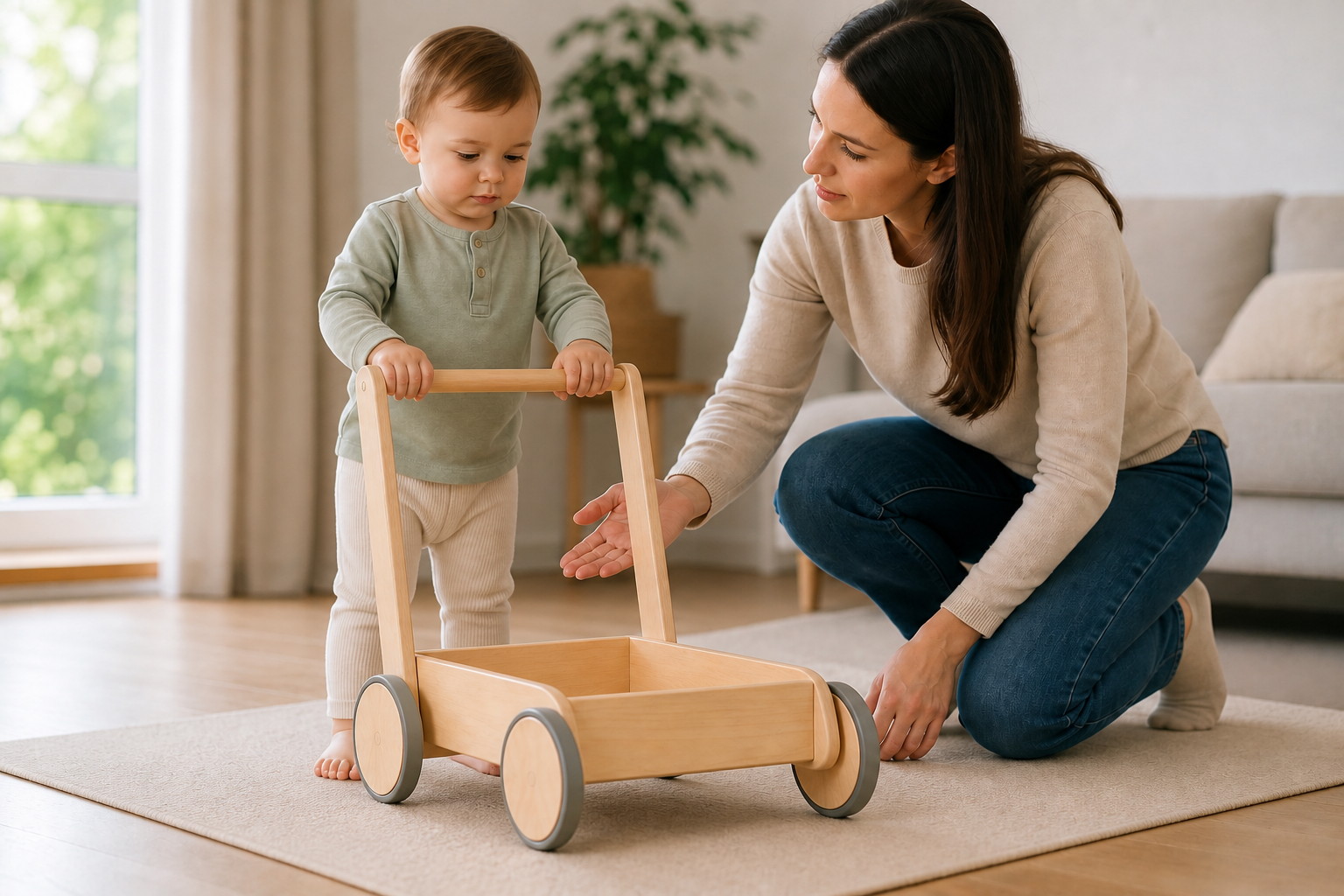
| Pushing chairs, boxes, or baskets | Starting, stopping, and steering | A stable push toy, cart, or wagon intended for your child’s stage | Walking control, direction changes, and purposeful movement |
| Carrying and dropping household objects | Filling, transporting, unloading, and repeating | Large age-appropriate blocks, soft balls, open containers, or a sturdy play cart | Squatting, carrying, hand-eye coordination, and cause and effect |
| Standing up and abandoning seated toys | Reaching, turning, placing, and posting while upright | A freestanding activity panel, a raised posting toy, or a ball run designed for standing play | Hand control without requiring prolonged sitting |
| Copying cooking, caregiving, driving, or cleaning | Moving through a familiar pretend routine | A doll and accessories, play food, vehicles and figures, or child-sized pretend tools | Sequencing, language, imagination, and social play |
Start with something your toddler can already approach confidently, then add a small challenge. For a new climber, that might mean a low step with an obvious handhold and a clear way down. For a confident carrier, it might mean moving blocks in a wagon and unloading them at a pretend building site. If your child cannot work out how to start or stop without being placed into position, the toy may be ahead of their current skill.
Do not treat pretend play as the quiet alternative to physical play. A doll can be carried up a ramp, a toy animal can be rescued from a tunnel, and pretend groceries can be delivered across the room. Those combinations give movement a goal, which often makes a simple toy worth repeating.
Build an active-play zone, not just an active toy
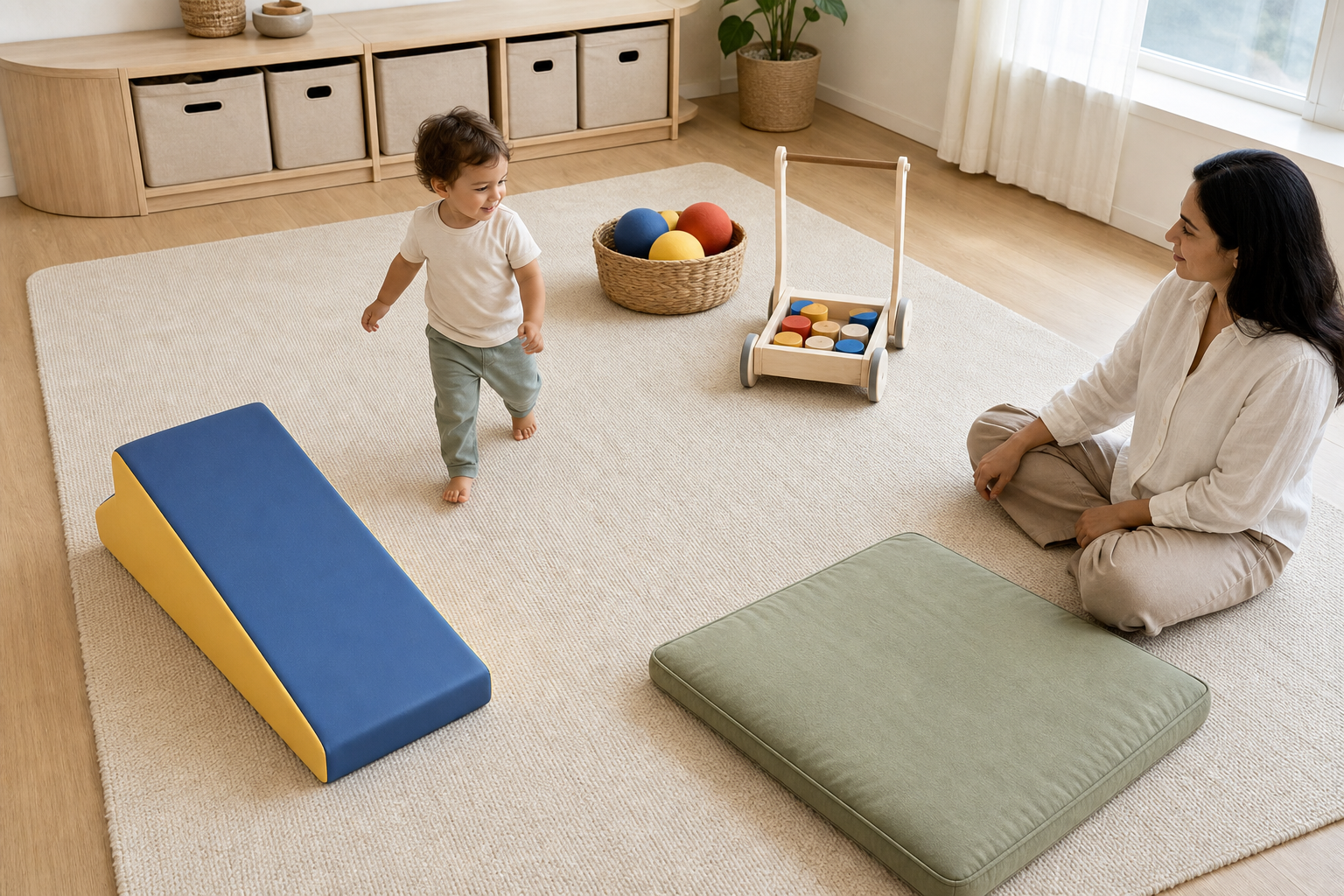
The room determines whether active equipment is practical. Before buying a climber, ramp, slide, or ride-on, mark out where it would actually sit and where your child would enter, move, and get off. Include the full path of play, not only the product’s footprint.
- Use the toy only on a surface permitted by its instructions. A stable product can still shift or tip on an unsuitable floor.
- Keep the movement path away from stairs, doorways, glass, sharp furniture edges, cords, and objects a child could strike or pull down.
- Leave the entry and exit unobstructed. A child needs room to turn around, step off, or abandon an attempt without landing on another toy.
- Remove loose balls and other rolling objects when they are not part of the activity. A carefully arranged climber is less useful if the approach is covered with things that move underfoot.
- Assemble every component as directed, check connections regularly, and stop using the equipment if a fastener, seam, grip, or structural part is loose or damaged.
- Use only the configurations shown by the manufacturer. Do not place a climber on furniture, add improvised height, or stack pieces that were not designed to lock together.
- Stay close enough to respond to the movement your child is attempting. A toddler who used a toy predictably yesterday may try a completely different route today.
- Account for siblings and pets. A safe turn can become unsafe if another child jumps onto the structure, pushes a moving toy, or blocks the landing area.
Climbing toys can help active toddlers move and develop gross motor skills, and active play may even make bedtime easier for some families. Treat that as a possible side effect, not a promise. A climbing structure is a play tool, not a sleep intervention, and making it taller or more difficult will not create a better bedtime routine.
If you cannot create a clear, stable play zone or provide the supervision the equipment requires, skip the large climber for now. A push-and-carry circuit using an age-appropriate cart, soft objects, and open containers can still offer substantial movement without turning the room into an obstacle course.
Extend the play without making the toy more dangerous
Toddlers learn a great deal by repeating an action and changing a small part of it. You do not need to keep buying new equipment. Change the purpose of the movement while leaving the physical challenge familiar.
- Add a destination: Put a basket at the end of a pushing route so your toddler can deliver blocks, pretend food, or stuffed animals.
- Add a simple problem: Roll a soft ball down a ramp and place the collection container where your child needs to squat, retrieve it, and start again.
- Use every safe side of the equipment: A structure designed for it might support climbing over the top, crawling underneath, parking vehicles below, or using the ramp as a road.
- Connect movement to pretend play: Turn the climber into a hill, the wagon into a delivery cart, or the tunnel into an animal’s home.
- Change the route, not the height: Move an activity’s starting point or destination while keeping the equipment in its approved configuration.
- Demonstrate the first move, then pause: Show how a ball enters a track or how a block reaches the basket. Give your toddler room to repeat, alter, or reject the idea.
This is where open-ended toys earn their space. Large blocks can be cargo, seats for dolls, building materials, or markers along a path. A wagon can support pushing, collecting, transporting, and pretend errands. The developmental value comes from what your child does with the object, not from how many features appear on its box.
Repetition is useful, but forced repetition is not. If your toddler walks away, let the activity end. A toy that fits will usually invite a return without constant adult prompting. If it only works when you arrange every piece, narrate every action, and physically guide the child, it may be too complicated or simply mismatched to the interest you observed.
Check the fit before you buy
A product can be well designed and still be wrong for your child, room, or daily routine. Run through this checklist before ordering or accepting a large hand-me-down:
- Current interest: Does it support an action your toddler already chooses, or are you hoping the purchase will create an entirely new style of play?
- Developmental readiness: Can your child begin the main action, understand where it ends, and get out of the activity safely?
- Product guidance: Does the stated age range, intended use, assembly method, and any user limit fit your child and household?
- Stable setup: Can you place it on the required surface without improvising, bracing it with furniture, or removing a safety component?
- Clearance: Is there enough unobstructed room for the approach, movement, exit, and an adult who needs to stay nearby?
- Repeatable uses: Can your child climb, carry, steer, build, or pretend in several safe ways without altering the structure?
- Realistic supervision: Can you provide the attention this particular kind of play requires at the times your toddler is likely to use it?
- Maintenance: Can you inspect, clean, move, and store it without skipping steps because the process is too difficult?
Be wary of choosing by maximum challenge. Higher, faster, and more complicated do not automatically mean more developmental. A lower toy that your toddler can use purposefully and revisit is more useful than an impressive structure that requires constant lifting, rescuing, or correction.
The same rule applies to feature-heavy activity toys. Lights and sounds may attract attention, but attraction is not the same as active play. Ask what your child can initiate: push it, fit something into it, carry it, steer it, climb it, or turn it into a story. If the most interesting action is pressing a button and waiting, it may not meet the movement need that brought you shopping.
Choose the smallest setup that matches the movement you see most often, prepare its play zone, and offer one clear invitation. Then watch what your toddler repeats. If they can start the play, vary it, and finish safely, the toy is doing useful work. Let the next purchase fill a different movement need rather than duplicating the same one in a new colour.
References
- Parents – The Best Toys for 18-Month-Olds: 60 Recommendations From Parents & Experts
- Parents – The 20 Best Climbing Toys That Can Tire Out the Most Energetic Toddlers