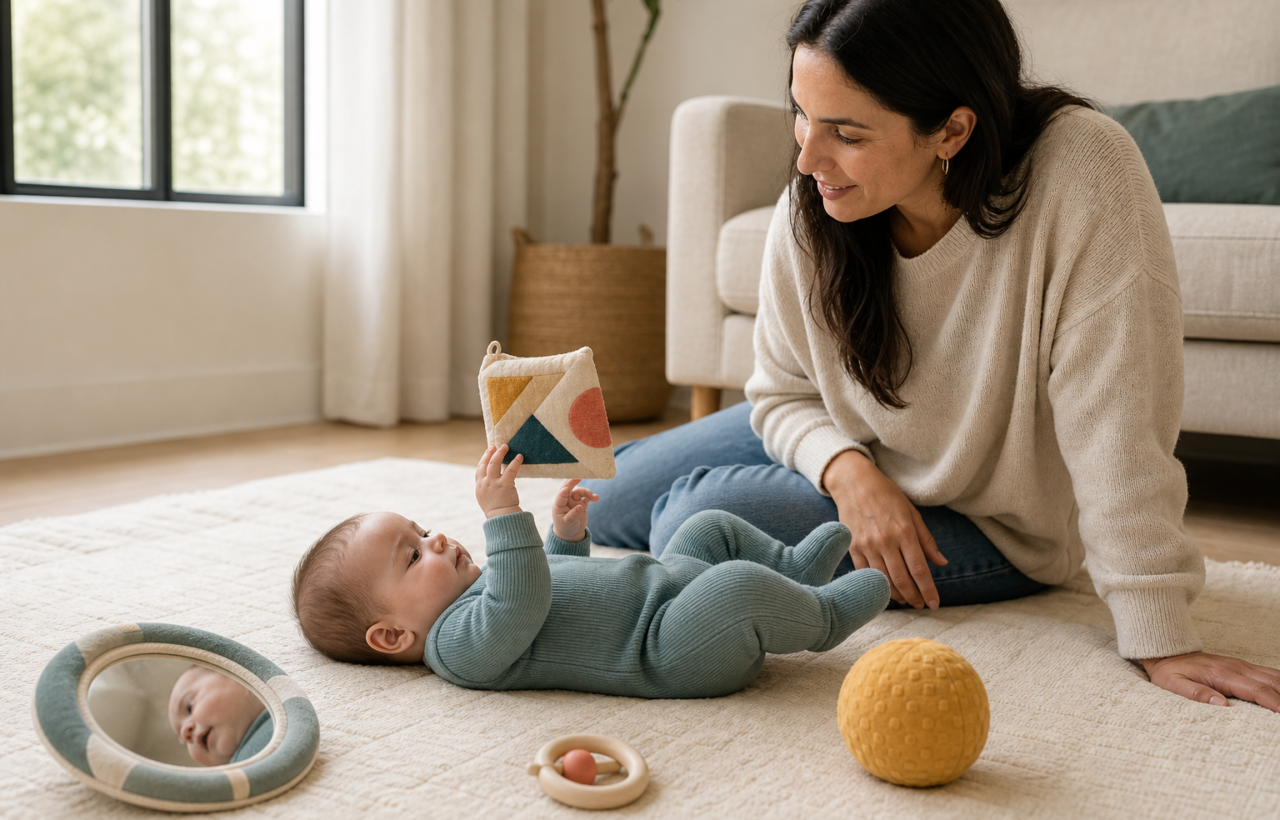
You are standing in front of toys that crinkle, flash, wobble, sing, spin and promise to develop everything at once. For a five-month-old, more stimulation is not automatically more useful. The better question is simple: what can your baby notice and do with this toy?
A good sensory toy gives your baby an accessible action and a clear response. A hand brushes fabric and it crinkles. A foot kicks and something moves. A rattle turns an arm motion into sound. These small feedback loops can invite movement, language and discovery without asking your baby to master a complicated toy.
Start with the play your baby is already attempting
Five months is an age, not a fixed skill checklist. Babies of the same age may differ in how steadily they hold an object, how long they tolerate floor play, whether they reach with either hand, and which sounds or textures keep their attention. Choose for the baby in front of you, not for the milestone printed in an advertisement.
Watch an ordinary play period before buying anything. You are looking for the action your baby keeps trying to repeat:
- Do they swipe at hanging objects but struggle to close a hand around them?
- Do they hold a toy briefly, then bring it toward their mouth?
- Do they turn toward a soft rattle or your voice?
- Do they study faces, reflections, strong shapes or moving objects?
- Do their arms or legs become more active when an object responds?
That repeated action tells you what to look for. A baby who swipes may benefit from a light hanging toy positioned within reach. A baby working on holding may get more from a narrow grasping ring than a large activity console. A baby fascinated by sound needs a rattle they can activate through movement, not necessarily a toy that plays a long recording after an adult presses a button.
The most useful toy is usually easy enough to activate by accident and interesting enough to invite another attempt. That is how passive entertainment becomes active discovery.
Match the toy type to a clear play purpose
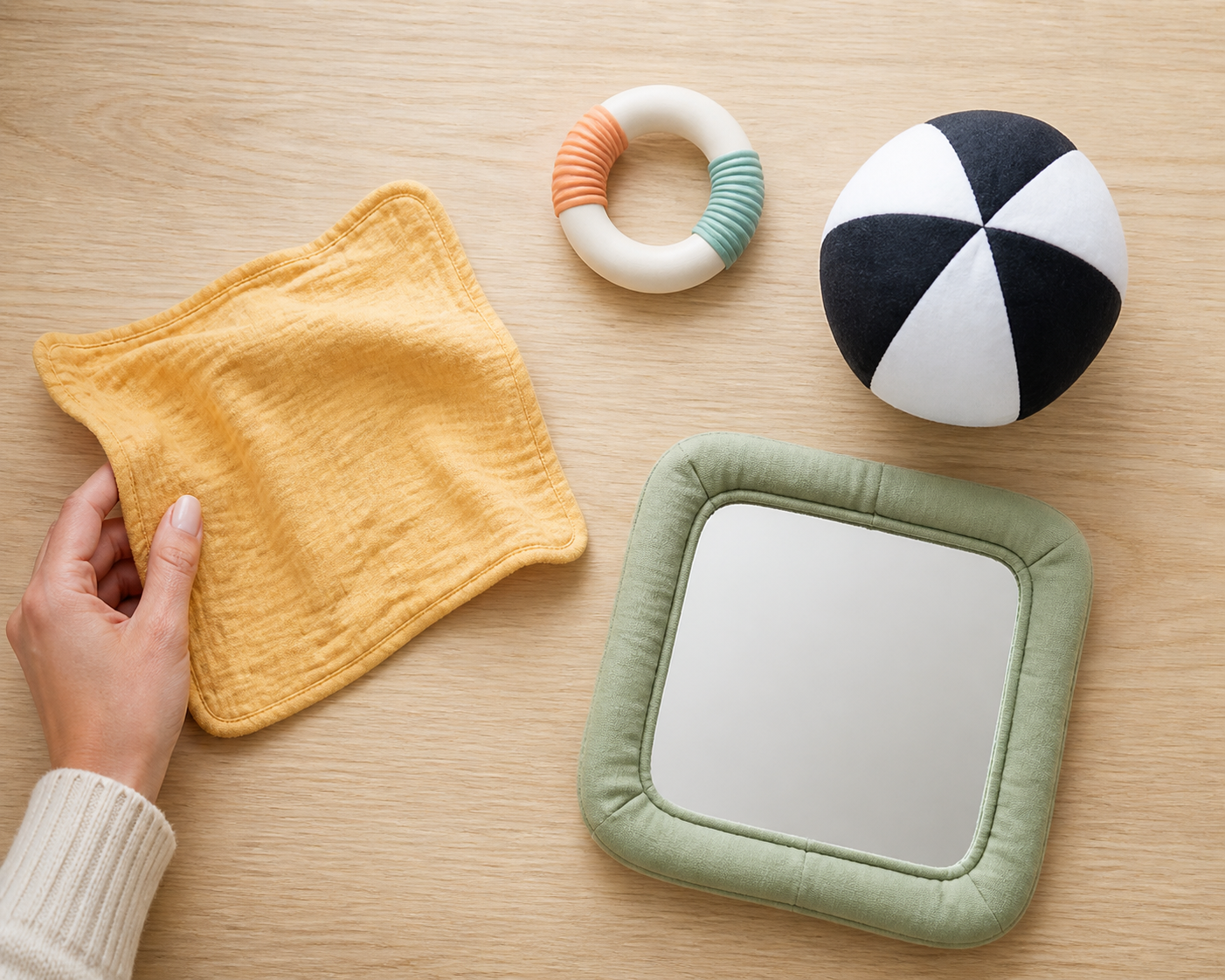
You do not need a separate toy for every sense. Many simple toys combine touch, sight, sound and movement. What matters is that each feature supports something your baby can do rather than surrounding them with effects they cannot control.
| Play purpose | What to look for | How to offer it |
|---|---|---|
| Reaching and grasping | A light rattle, easy-grip ring, soft ball with graspable sections or hanging toy | Place it near the middle of your baby’s reach, then shift it slightly to one side once the first position is manageable. |
| Cause and effect | A crinkle toy, gentle rattle, wobbling toy or object that moves when touched | Let your baby trigger the response. Pause instead of immediately making the toy perform again for them. |
| Touch and mouthing | A washable teether, textured fabric toy, soft book or textured ball designed for babies | Offer it clean and within easy reach. Let your baby explore without directing them toward a particular texture. |
| Looking and tracking | Clear shapes, visible contrast, a baby-safe mirror or an object that moves predictably | Move it slowly across your baby’s view, then stop and allow time for their eyes and head to respond. |
| Floor movement | A play mat, activity gym or soft toy that is easy to notice during supervised floor play | Position the toy close enough to make an attempt realistic. Move it farther only when reaching has become easy. |
| Early conversation | A soft book, puppet used by an adult, animal figure or sound-making toy | Name what your baby touches, imitate their sounds and leave pauses for a look, movement or vocal response. |
When choosing among similar toys, favour the one with the clearest relationship between action and result. A rattle that sounds when your baby moves it teaches more about their own effect on the world than a toy that cycles through unrelated lights and songs on its own.
Also consider physical effort. A beautiful wooden rattle may be too heavy for your baby to hold comfortably right now. A large plush toy may be pleasant to touch but difficult to grasp or move. Save toys that currently require adult operation and give everyday play space to objects your baby can influence.
Turn the toy into active play
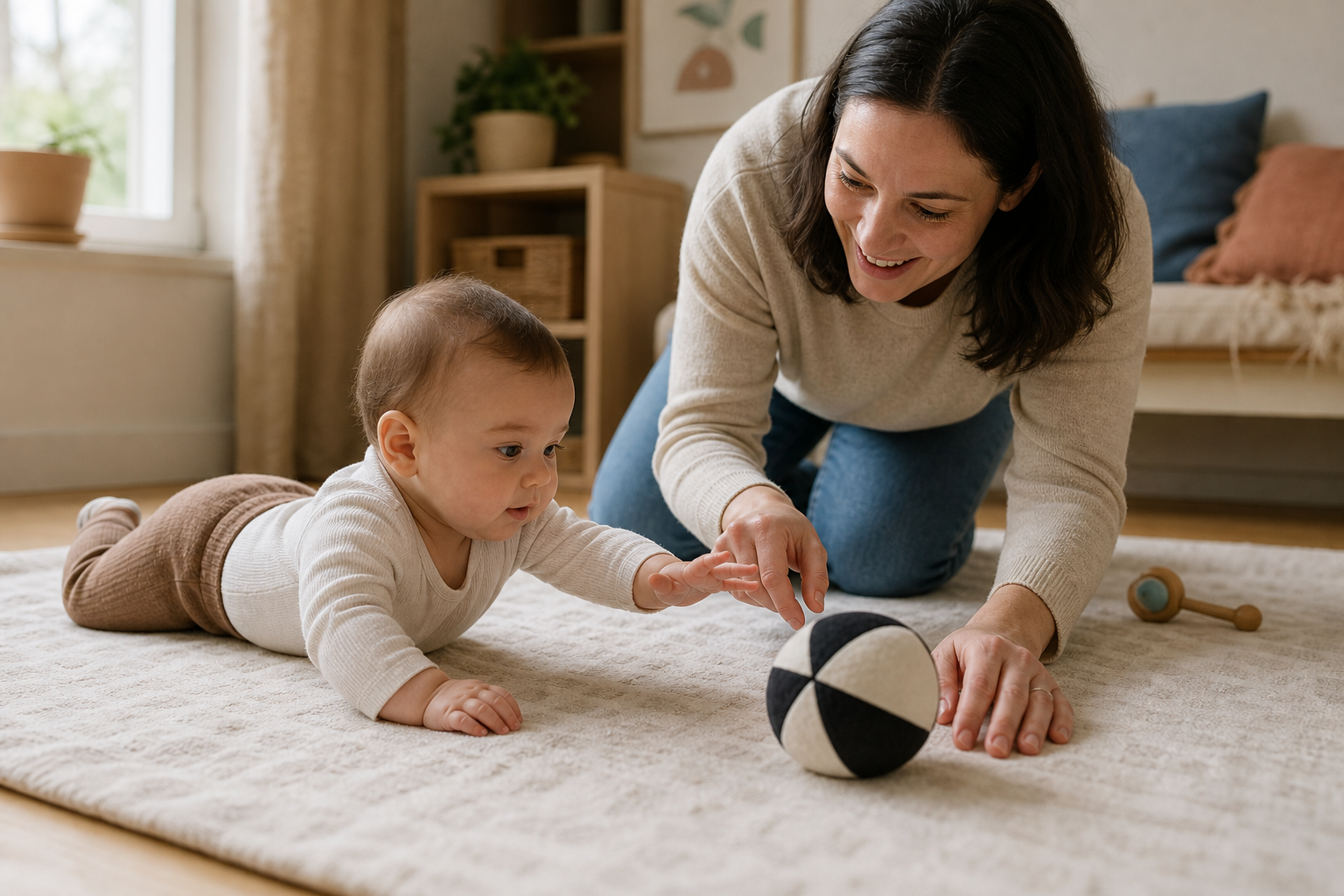
Sensory development does not come from placing a toy nearby and waiting for it to deliver stimulation. It comes from your baby’s attempt, the toy’s response and the chance to try again. You can support that cycle without taking over.
- Begin when your baby is awake and available for play. Hunger, fatigue or discomfort can make even a well-chosen toy unappealing.
- Offer one main toy in a relatively calm space. If several toys are competing for attention, it becomes harder to see what your baby is actually trying to do.
- Place the toy where an attempt is possible. Do not press it into your baby’s hand or repeatedly move their arm for them.
- Wait after a look, reach, kick or sound. Babies often need more processing time than an adult expects.
- Describe the immediate experience in plain language: the ring feels bumpy, the page crinkles, the ball rolled, or the rattle made a sound.
- Change one part of the challenge when interest fades. Turn the toy, place it on the other side, use it during supervised tummy time or pair it with your voice.
- End or switch activities when your baby repeatedly turns away, becomes fussy, stiffens, closes their eyes or stops engaging.
Repetition is not a sign that play has become unproductive. Your baby may need many chances to connect an arm movement with a sound or a kick with a swinging object. You can keep the action familiar while changing the position or the words you use around it.
Rotation can also make a small collection work harder. Keep some toys out of sight, then bring them back later. This lets you notice whether your baby uses a familiar object in a new way rather than relying on constant novelty.
Run a safety check before every play session
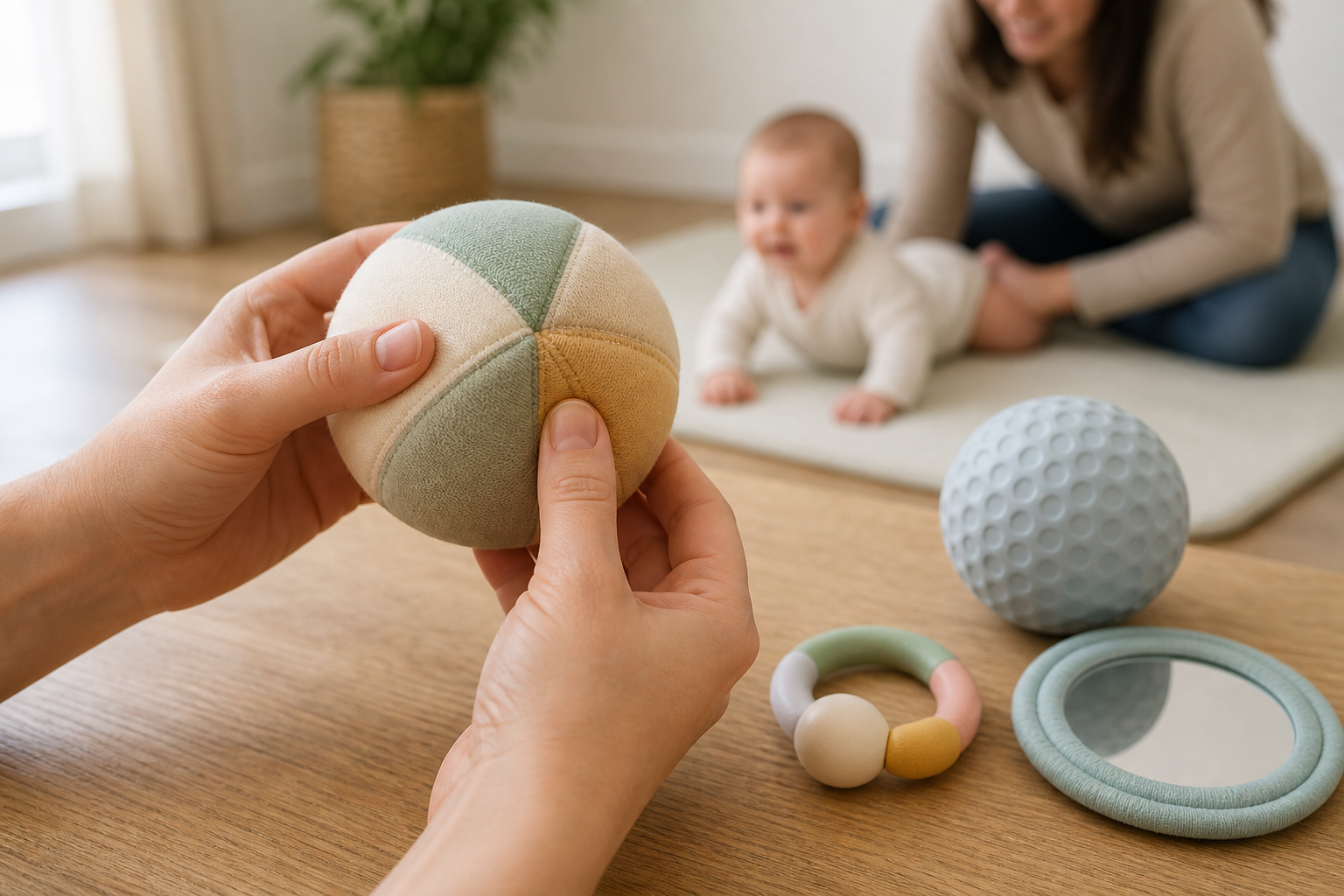
An age label is a starting point, not a substitute for inspection. Babies explore with their mouths, and a toy that was safe when new can become unsafe after a seam opens, a piece loosens or a battery cover breaks.
- Confirm that the manufacturer identifies the toy as suitable for your baby’s age and intended type of play.
- Check for loose pieces, open seams, exposed stuffing, peeling surfaces, cracks, sharp edges or attachments that could detach.
- Reject toys with small parts or loose beads that could become choking hazards.
- Make sure battery compartments are fully closed and secured. Stop using an electronic toy if its casing or battery cover is damaged.
- Do not add your own ribbon, cord or elastic loop to attach a toy. Use only the attachment supplied by the manufacturer and follow its instructions.
- Test sound where your baby’s head will be. If it is uncomfortable for you at that distance, choose a quieter toy or use it farther away.
- Follow the cleaning directions for surfaces your baby mouths. Let washed toys dry fully before returning them to play.
- Use floor-play toys on a clear floor surface, not on a sofa, bed, changing table or other raised area.
- Keep play toys out of the sleep space. A toy that is appropriate during awake, supervised play does not automatically belong in a crib.
Supervision should match the toy and the activity. Stay close enough to intervene if your baby gets tangled, rolls into an awkward position, pushes the toy against their face or damages it during play. Never prop your baby in a position they cannot maintain just to use a toy.
A sensory toy is not a treatment or a test of development. If you are worried about how your baby sees, hears, moves or responds, or you notice a loss of a skill they previously used, bring the concern to your baby’s health-care provider. Buying a more stimulating toy is not a substitute for that conversation.
Key takeaways
- Choose for your baby’s current actions, not for the largest number of features on the box.
- Look for a clear feedback loop: your baby reaches, kicks, grasps or shakes, and the toy responds.
- Lightweight, graspable and washable often matter more than electronic effects.
- Offer one main toy, wait for your baby’s response and adjust the position before replacing the activity.
- Inspect every toy for damage, loose parts, unsafe attachments and exposed mechanisms before play.
- Treat turning away, fussing or disengaging as information. A quieter toy or a break may be more useful than extra stimulation.
Start with a toy you already own. Inspect it, place it within realistic reach and watch what your baby tries to repeat. If the toy lets them make something happen, it has a useful role. If it mostly asks them to watch, set it aside and offer something simpler.
References